Motion of a charge in a magnetic field
NCERT Class 12 Physics Chapter 4 Section 4.3
Quick answer
The magnetic force on a moving charge is at right angles to its velocity, so it does no work and the speed stays constant. For nonrelativistic motion with q the charge magnitude and v at right angles to a uniform field B, the charge moves in a circle of radius r = mv/(qB) with angular frequency ω = qB/m, which does not depend on its speed. A velocity part along B is unaffected, so the path becomes a helix whose pitch is the distance moved along B in one turn.
With your textbook
NCERT Physics Part I (Class 12), Chapter 4 “Moving Charges and Magnetism”, Section 4.3 “Motion in a Magnetic Field”, pages 112–113.
Open the official NCERT chapter (PDF, 3.7 MB, ncert.nic.in) (opens in a new tab)
Checked against the 2026-27 reprint on .
How does a charge move in a magnetic field?
Motion in a uniform magnetic field
The magnetic force on a moving charge is always at right angles to its velocity, so it does no work and the speed stays the same; only the direction of motion changes (NCERT Section 4.3, page 112). In a uniform field:
The particle will describe a circle if v and B are perpendicular to each other
NCERT Physics Part I (Class 12), Section 4.3, page 112
If the velocity also has a part along B, that part is unaffected, and the circle is stretched into a helix (page 112).
In plain words: the field keeps turning the particle sideways without ever pushing it forwards, like a stone whirled on a string. If the particle is also drifting along the field, it corkscrews along the field lines.
Circular motion perpendicular to the field
The formulas below use q as the positive magnitude of the charge, with q > 0 and B > 0; the sign decides the sense of rotation. They assume nonrelativistic motion (v ≪ c), a uniform static field, and no other appreciable force or radiation loss. At relativistic speeds the period grows with energy, so the speed-independent frequency is an approximation.
- A force does work only if it has a part along (or against) the motion. The magnetic force is at right angles to the velocity, so it does no work and does not change the speed; it can change the direction of the momentum (NCERT page 112).
- An electric force qE is different: it can have a part along the motion, so it can transfer energy as well as momentum (page 112).
- In a uniform field with v at right angles to B, the force qv × B acts as a centripetal force and the particle moves in a circle in the plane at right angles to B (NCERT page 112, Figure 4.5).
- This is uniform circular motion: a force of constant size qvB, always pointing to the centre (reasoned from NCERT page 112).
- In a field going into the page, a positive charge goes round anticlockwise, as in NCERT Figure 4.5, and an electron goes round clockwise, since its force is reversed (reasoned from the direction of v × B).
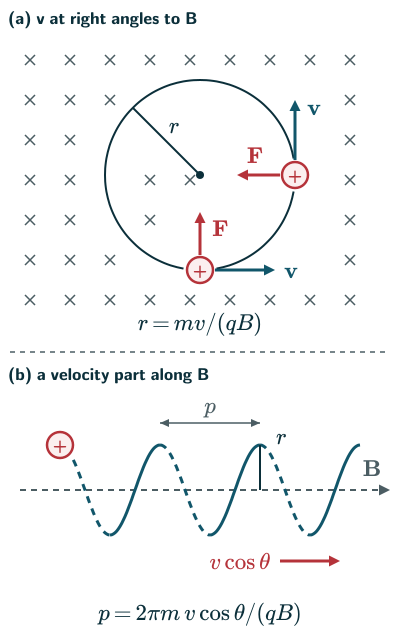
Radius and angular frequency of the path
- The centripetal force mv2/r is provided by the magnetic force qvB. Equating them, mv2/r = qvB, which gives (NCERT Eq. (4.5), page 112):
Radius of the circle (NCERT Eq. 4.5)
- The larger the momentum, the larger the radius (page 112). In terms of the kinetic energy K, mv = √(2mK), so r = √(2mK)/(qB) (reasoned).
- With v = ωr, the angular frequency is (NCERT Eq. [4.6(a)], page 112):
Angular frequency (NCERT Eq. 4.6(a))
- ω and the frequency ν do not depend on the speed or the energy: a faster particle moves in a bigger circle and takes the same time to go round (page 112).
- The time for one revolution is T = 2π/ω = 1/ν = 2πm/(qB) (NCERT page 112).
- NCERT’s Summary calls ν = qB/(2πm) the cyclotron frequency: its independence of speed is used in the cyclotron, a machine that accelerates charged particles (NCERT Summary point 3, page 132).
- NCERT slip: the chapter’s introduction says “We shall see how particles can be accelerated to very high energies in a cyclotron” (page 108), but the 2026–27 book has no section on the cyclotron; it is mentioned only in passing (pages 112 and 132).
Helical motion
- If the velocity has a part v|| along B, that part is not affected by the field. The part at right angles to B still gives a circle, so the path is a helix wound round the field lines (NCERT pages 112–113, Figure 4.6).
- The signed displacement along the field in one rotation is p; the geometrical pitch length is |p|. Thus p can be negative for motion against B. Using T from NCERT Eq. [4.6(a)], it is (NCERT Eq. [4.6(b)], page 113):
Pitch of the helix (NCERT Eq. 4.6(b))
- The radius of the circular part is the radius of the helix (page 113). It uses only the velocity at right angles to B, v⊥: r = mv⊥/(qB) (reasoned from NCERT Eq. (4.5)).
- If v makes an angle θ with B, then v|| = v cos θ and v⊥ = v sin θ. For θ = 90° the helix becomes a circle; for θ = 0 or 180° it moves in a straight line along or against the field (reasoned).
Solved examples
Example 1: An electron in a field (NCERT Example 4.3)
An electron (mass 9 × 10⁻³¹ kg, charge magnitude 1.6 × 10⁻¹⁹ C) moves at 3 × 10⁷ m/s at right angles to a field of 6 × 10⁻⁴ T. Find the radius of its path, its frequency and its energy in keV.
Answer: r = mv/(qB) = 9 × 10−31 × 3 × 107/
Example 2: Proton and alpha particle
A proton and an alpha particle (twice the charge, about four times the mass) enter the same field at right angles to it. Compare the radii of their paths if they have (a) the same speed, (b) the same kinetic energy.
Answer: (a) r = mv/(qB) ∝ m/q, so rα/rp = 4/2 = 2. (b) r = √(2mK)/(qB) ∝ √m/q, so rα/rp = √4/2 = 1: the same radius (reasoned from NCERT Eq. (4.5)).
Example 3: A helix
A proton (mass 1.67 × 10⁻²⁷ kg) moves at 2.0 × 10⁶ m/s at 60° to a field of 0.10 T. Find the radius and the pitch of its helix.
Answer: v⊥ = v sin 60° ≈ 1.73 × 10⁶ m/s and v|| = v cos 60° = 1.0 × 10⁶ m/s. Radius: r = mv⊥/(qB) = 1.67 × 10−27 × 1.73 × 106/(1.6 × 10−19 × 0.10) ≈ 0.18 m. Period: T = 2πm/(qB) ≈ 6.56 × 10⁻⁷ s, so the pitch is p = v||T ≈ 0.66 m (NCERT Eqs. (4.5) and [4.6(b)], pages 112–113).
Example 4: Does a faster particle go round faster?
Two electrons move at right angles to the same field, one at 1 × 10⁶ m/s and one at 3 × 10⁶ m/s. Compare their radii and their times for one revolution.
Answer: r ∝ v, so the faster electron moves in a circle 3 times as large. But T = 2πm/(qB) does not depend on v, so both take the same time to go round (NCERT Eqs. (4.5) and [4.6(a)], page 112).
Common mistakes to avoid
Common mistake
Thinking the magnetic field speeds the particle up
The magnetic force is at right angles to the velocity, so it does no work; the speed and the kinetic energy stay the same (NCERT page 112).
Common mistake
Using the whole speed for the radius of a helix
Only the part of the velocity at right angles to B goes into r = mv/(qB); the part along B sets the pitch instead.
Common mistake
Thinking the period depends on the speed
T = 2πm/(qB): a faster particle moves in a bigger circle but takes the same time to go round (NCERT page 112).
Quick revision summary
- The magnetic force does no work: the speed is constant and only the direction changes.
- v at right angles to a uniform B: a circle of radius r = mv/(qB), larger for larger momentum.
- ω = qB/m (so ν = qB/(2πm), the cyclotron frequency) and T = 2πm/(qB), all independent of the speed.
- A velocity at an angle θ to B gives a helix: radius mv sin θ/(qB), pitch p = 2πm v cos θ/(qB).
- Same speed: r ∝ m/q; same kinetic energy: r ∝ √m/q.
Formula sheet
- r = mv/(qB)
- ω = 2πν = qB/m
- T = 2πm/(qB)
- pitch: p = 2πm v cos θ/(qB)
- r = √(2mK)/(qB)
Questions students ask
Which quantities stay constant for a charge moving in a uniform magnetic field?
For a charge moving in a uniform magnetic field, the speed, the kinetic energy and the size of the momentum stay constant, while the velocity and momentum change direction when the transverse velocity is nonzero, because the magnetic force is always at right angles to the motion (NCERT page 112). With v at right angles to B, the radius mv/(qB), the angular frequency qB/m and the period are constant too, and so is the size of the acceleration, qvB/m, which always points to the centre and so keeps changing direction (reasoned from NCERT Eqs. (4.5) and [4.6(a)], page 112). On a helix the part of the velocity along B stays constant as well (NCERT page 112).
What path does a charged particle follow when the electric and magnetic fields are parallel?
When uniform electric and magnetic fields point the same way, a charge with some velocity across them moves on a helix of fixed radius whose pitch changes from turn to turn, growing while the electric force speeds it along the field (beyond the NCERT text, reasoned from NCERT Eq. (4.3)). The electric force qE lies along B, so it changes only the velocity along the field; the part across it, and with it the radius mv⊥/(qB) and the period 2πm/(qB), stay the same. So, once it moves the way the electric force pushes, each turn takes it farther than the last: for a proton in E = 6.0 × 10 V m and B = 0.60 T, each pitch is about 6.9 mm longer, within the nonrelativistic approximation.
Do an electron and a proton with the same momentum move on the same circle in a magnetic field?
An electron and a proton with the same momentum, moving at right angles to the same uniform field, go round circles of the same radius, because r = mv/(qB) depends only on the momentum mv and the size of the charge, which is e for both (reasoned from NCERT Eq. (4.5), page 112). They go round in opposite senses, since their charges have opposite signs, and at very different rates: the period 2πm/(qB) is proportional to the mass, so the electron goes round about 1.8 × 10 times as often (1.67 × 10 kg against 9.1 × 10 kg). That ratio holds only while the electron, which moves that many times faster than the proton, is still much slower than light.
Is the cyclotron in the NCERT Class 12 book and in the JEE Main and NEET syllabus?
The cyclotron is named in the 2026–27 NCERT Class 12 Physics book only in passing (pages 108 and 112, Summary point 3, page 132), with no section on how it works, and neither the JEE Main nor the NEET (UG) 2026 syllabus names it. Its physics is in both, under “Force on a moving charge in uniform magnetic and electric fields” (Unit 13), and NCERT gives its key fact: the frequency ν = qB/(2πm), the cyclotron frequency, is independent of speed in the nonrelativistic approximation. Beyond the NCERT text, Ernest Lawrence won the 1939 Nobel Prize in Physics for the cyclotron (NobelPrize.org); a voltage alternating at that frequency kicks a circling particle twice each turn, so it speeds up and spirals outwards (reasoned).
Practice questions
Try each question first, then open the answer to check your working.
-
Q1. A proton moves at 4.0 × 10⁶ m/s at right angles to a field of 0.50 T. Find the radius of its path (proton mass 1.67 × 10⁻²⁷ kg).
Show answerHide answer
r = mv/(qB) = 1.67 × 10−27 × 4.0 × 106/(1.6 × 10−19 × 0.50) ≈ 8.4 × 10⁻² m (NCERT Eq. (4.5), page 112).
-
Q2. If the field is doubled, what happens to the radius and to the frequency of a charged particle moving at right angles to it?
Show answerHide answer
The radius halves, since r = mv/(qB), and the frequency doubles, since ν = qB/(2πm) (NCERT Eqs. (4.5) and [4.6(a)], page 112).
-
Q3. A charged particle enters a uniform magnetic field moving exactly along the field. What path does it follow?
Show answerHide answer
A straight line at constant speed: with v parallel to B the magnetic force is zero (NCERT page 110).