Biot–Savart law: the field of a current element
NCERT Class 12 Physics Chapter 4 Section 4.4
Quick answer
The Biot–Savart law gives the magnetic field of a short element dl of a wire carrying a steady current I in vacuum: dB = μ I dl sin θ/(4πr), where r is the distance to the point and θ the angle between dl and r. The field is at right angles to the plane of dl and r, given by the cross product dl × r, and is zero along the line of the element. The constant is μ/4π ≈ 10 T m/A.
With your textbook
NCERT Physics Part I (Class 12), Chapter 4 “Moving Charges and Magnetism”, Section 4.4 “Magnetic Field due to a Current Element, Biot-Savart Law”, pages 113–115.
Open the official NCERT chapter (PDF, 3.7 MB, ncert.nic.in) (opens in a new tab)
Checked against the 2026-27 reprint on .
What is the Biot–Savart law?
The Biot–Savart law
NCERT opens Section 4.4 with where magnetic fields come from:
All magnetic fields that we know are due to currents (or moving charges) and due to intrinsic magnetic moments of particles.
NCERT Physics Part I (Class 12), Section 4.4, page 113
The Biot–Savart law gives the field dB that a short piece dl of a wire carrying a current I produces at a point a distance r away: it is proportional to I and to the length of the piece, inversely proportional to r2, and at right angles to the plane containing dl and r (NCERT page 113).
In plain words: chop a current-carrying wire into tiny pieces. Each piece makes a small magnetic field that wraps round it, strongest side-on and zero straight ahead along the wire. Add up the pieces and you get the field of the whole wire.
Field of a current element
This is the magnetostatic law for steady currents in vacuum, evaluated away from the source (r > 0). A finite short piece Δl may replace dl only approximately when its length is small compared with its distance from the observation point.
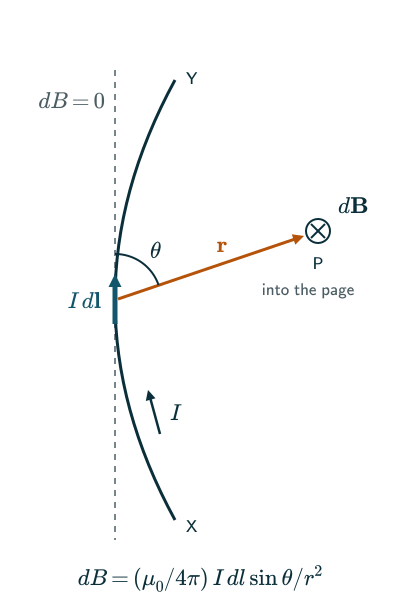
- Take a conductor XY carrying a current I, and an element dl of it. Let r be the displacement from the element to the point P, and θ the angle between dl and r (NCERT page 113, Figure 4.7).
- The field dB at P is proportional to I and to |dl|, inversely proportional to r2, and its direction is perpendicular to the plane containing dl and r. In vector form, for a vacuum (NCERT Eq. [4.7(a)], page 113):
Biot–Savart law (NCERT Eq. 4.7(a))
- Its size follows from the cross product, |dl × r| = r dl sin θ (NCERT Eq. [4.7(b)], page 114):
Size of the field of an element (NCERT Eq. 4.7(b))
- Direction: the sense of dl × r follows the right-hand screw rule. Look at the plane of dl and r and turn from dl towards r: if the turn is anticlockwise, the field points towards you; if clockwise, away from you (NCERT footnote, page 113). See the vector product.
- On the line of the element itself, θ = 0 and sin θ = 0, so the field there is zero (NCERT page 114).
- To find the field of a whole conductor, add the vector fields of all its elements: integrate NCERT Eq. [4.7(a)] along the conductor (Summary point 4, page 132).
- A straight wire (standard result beyond NCERT, from integrating Eq. [4.7(b)]): at a perpendicular distance d, the field is μ0I/(4πd) times (sin α + sin β). Here α and β are measured from the perpendicular to the lines joining the two ends. Both enter positively when the perpendicular foot lies between the ends; otherwise use signed angles, giving a difference of the endpoint terms. For a very long wire, α = β = 90°, giving μ0I/(2πd), as NCERT finds from Ampere’s law (NCERT Eq. (4.14), page 118).
- A moving charge (reasoned, beyond NCERT): a charge q moving with velocity v, much less than c, has the same quasistatic field form for uniform motion, neglecting retardation and acceleration/radiation terms. Its field is given by NCERT Eq. [4.7(a)] with I dl replaced by qv.
Biot–Savart law and Coulomb’s law (NCERT page 114):
- Alike: both are long range, falling off as the inverse square of the distance, and both obey superposition. The magnetic field is linear in its source I dl, just as the electric field is linear in the charge.
- Source: the electric field comes from a scalar source, the charge; the magnetic field from a vector source, I dl.
- Direction: the electric field lies along the line joining the source and the point; the magnetic field is perpendicular to the plane of r and I dl.
- Angle: the magnetic field depends on the angle θ, which has no counterpart in the electrostatic case.
Permeability of free space
- The constant in the law is (NCERT Eq. [4.7(c)], page 114):
Permeability of free space (NCERT Eq. 4.7(c))
- μ0 is called the permeability of free space (or vacuum). Its unit is T m A−1, with dimensions [M L T−2 A−2] (NCERT page 114 and table, page 134).
- With the permittivity ε0 it is linked to the speed of light c: ε0μ0 = 1/c2 (NCERT page 114; NCERT returns to this in Chapter 8). So fixing one of ε0 and μ0 fixes the other.
- NCERT slip: NCERT calls 10−7 T m/A an “exact value” and says μ0 “is fixed to be equal to 4π × 10−7” (page 114). That was true under the old definition of the ampere. Since the revised SI adopted in November 2018 took effect on 20 May 2019 (NCERT Physics Part I (Class 11), page 1), the ampere is fixed through the exact value of the elementary charge e (Class 11 Table 1.1, page 2), and μ0 is a measured constant: 1.256 637 061 27 × 10−6 N A−2 (CODATA 2022, NIST). This equals 4π × 10−7 to about 1 part in 1010, so μ0/4π = 10−7 T m/A remains the value to use.
Solved examples
Example 1: Field of a short element (NCERT Example 4.4)
An element Δl = Δx î, with Δx = 1 cm, is at the origin and carries a current of 10 A. Find the field on the y-axis 0.5 m away.
Answer: here θ = 90°, so dB = (μ0/4π)I dl/r2 = 10−7 × 10 × 10−2/0.25 = 4 × 10⁻⁸ T. The direction is that of î × ĵ = k̂, the +z direction (NCERT pages 114–115). The field is small.
Example 2: At an angle to the element
An element 1.0 cm long carries 5.0 A. Find the field it produces at a point 0.20 m away, on a line at 30° to the element.
Answer: dB = 10−7 × 5.0 × 0.010 × sin 30°/0.202 = 10−7 × 0.025/0.040 ≈ 6.3 × 10⁻⁸ T, perpendicular to the plane of the element and the line (NCERT Eq. [4.7(b)], page 114).
Example 3: Straight ahead of the element
In Example 1, what is the field at the point 0.5 m along the x-axis?
Answer: zero. The point lies on the line of the element, so θ = 0 and sin θ = 0 (NCERT page 114).
Example 4: The speed of light from ε and μ
Taking ε0 = 8.854 × 10⁻¹² C2 N−1 m−2 and μ0 = 4π × 10−7 T m/A, find 1/√(ε0μ0).
Answer: ε0μ0 = 8.854 × 10−12 × 1.257 × 10−6 ≈ 1.113 × 10⁻¹⁷ s2 m−2, so 1/√(ε0μ0) ≈ 3.00 × 10⁸ m/s, the speed of light (NCERT page 114).
Common mistakes to avoid
Common mistake
Drawing dB along r
Unlike the electric field, dB is at right angles to the plane containing dl and r, never along r (NCERT page 114).
Common mistake
Forgetting the sin θ
Points on the line of the element get no field from it, and points off to the side get the most; the size has a factor sin θ (NCERT Eq. [4.7(b)], page 114).
Common mistake
Taking r from P to the element
r runs from the element to the point P. Taking it the other way reverses the direction of dB (NCERT page 113).
Common mistake
Mixing r and r
In the size, dB has r underneath. In the vector form, r is underneath because the vector r is on top; the two forms agree (NCERT Eqs. [4.7(a)]–[4.7(b)]).
Quick revision summary
- Magnetic fields come from currents (moving charges) and from intrinsic magnetic moments of particles.
- Biot–Savart law: dB = (μ/4π) I dl × r/r, at right angles to the plane of dl and r.
- Size dB = μ I dl sin θ/(4πr): zero along the line of the element, largest side-on.
- Like Coulomb’s law it is inverse square and obeys superposition; unlike it, the source is a vector and there is an angle factor.
- μ/4π ≈ 10 T m/A and εμ = 1/c; since the 2018 SI revision μ is measured, equal to 4π × 10 to about 1 part in 10.
Formula sheet
- vector form: dB = (μ/4π) I dl × r/r
- dB = μ I dl sin θ/(4πr)
- μ/4π ≈ 10 T m/A
- εμ = 1/c
- dB = 0 along the line of the element
Questions students ask
What are the applications of the Biot–Savart law in Class 12, JEE and NEET?
In NCERT Class 12 the Biot–Savart law is applied to the circular current loop: adding the fields of its elements gives the field on the axis and μ0I/(2R) at the centre, and handles arcs such as a semicircle (NCERT Section 4.5, pages 115–117). That is the application both exams name: Unit 13 of the JEE Main syllabus lists “Biot - Savart law and its application to the current carrying circular loop”, and NEET (UG) 2026 has almost the same line. In NCERT, the long straight wire and the solenoid are done with Ampere’s circuital law instead.
Why is there a 4π in the Biot–Savart law?
The 4π in the Biot–Savart law, dB = (μ0/4π)I dl sin θ/r, is put there by choice, as in Coulomb’s law, so that Ampere’s circuital law, which sums the field round a whole closed path, comes out without it (reasoned from NCERT pages 114 and 118). Adding the elements of a long straight wire gives B = μ0I/(2πr), and going round a circle of length 2πr then gives ∮ B·dl = μ0I, with no π left. The choice does not change any field: μ0/4π ≈ 10 T m A, so μ0 ≈ 4π × 10 T m A (NCERT page 114; compare Coulomb’s law).
What is the difference between permittivity and permeability of free space?
The permittivity of free space, ε0 ≈ 8.854 × 10 C N m, sets the strength of electric forces through Coulomb’s k = 1/4πε0 (NCERT Chapter 1, page 8), while the permeability, μ0 ≈ 4π × 10 T m A, sets the strength of a current’s magnetic field (NCERT page 114). A larger ε0 would weaken electric forces, a larger μ0 strengthen magnetic fields; ε0μ0 = 1/c ties them. In matter μ0 is multiplied by the relative permeability, the analogue of a dielectric constant (NCERT Chapter 5, page 146).
Is the Biot–Savart law derived from theory or found by experiment?
The Biot–Savart law is an experimental law: NCERT simply states it (page 113), and nothing more basic in Class 12 gives it. Beyond the NCERT text, on 30 October 1820, the year of Oersted’s discovery (NCERT page 107), Biot and Savart told the Paris Academy of Sciences that a long straight wire’s field, measured by how fast a magnetised needle swung near it, varies as 1/d, as μ0I/(2πd) does (Biot and Savart, Annales de chimie et de physique 15, 222–223, 1820). The law for one element is the rule that, added over a whole circuit, reproduces such measurements; it cannot be tested on one element alone, since a steady current needs a closed circuit (reasoned).
Practice questions
Try each question first, then open the answer to check your working.
-
Q1. An element 2.0 mm long carries 8.0 A. Find the field it produces 0.10 m away, at right angles to the element.
Show answerHide answer
dB = 10−7 × 8.0 × 2.0 × 10−3/0.102 = 1.6 × 10⁻⁷ T (NCERT Eq. [4.7(b)], page 114).
-
Q2. An element along +y carries a current. Which way does its field point at a point on the +x axis?
Show answerHide answer
Along ĵ × î = −k̂, the −z direction (NCERT Eq. [4.7(a)], page 113).
-
Q3. Name the two sources of all known magnetic fields.
Show answerHide answer
Currents (or moving charges) and the intrinsic magnetic moments of particles (NCERT page 113).