Magnetisation and magnetic intensity
NCERT Class 12 Physics Chapter 5 Section 5.4
Quick answer
Magnetisation M is the net magnetic moment per unit volume, and magnetic intensity is H = B/μ0 − M, so B = μ0(H + M). In an ideal uniformly filled long solenoid with negligible end effects H = nI; finite samples can also have a demagnetising field. For a linear isotropic material M = χH, μr = 1 + χ and B = μH, with susceptibility positive for paramagnets and negative for diamagnets.
With your textbook
NCERT Physics Part I (Class 12), Chapter 5 “Magnetism and Matter”, Section 5.4 “Magnetisation and Magnetic Intensity”, pages 145–147.
Open the official NCERT chapter (PDF, 1.9 MB, ncert.nic.in) (opens in a new tab)
Checked against the 2026-27 reprint on .
What are magnetisation and magnetic intensity?
Magnetisation and magnetic intensity
Electron orbital motion and intrinsic spin give atoms magnetic moments, and in a bulk material these add up as vectors (NCERT Section 5.4, page 145). NCERT defines:
We define magnetisation M of a sample to be equal to its net magnetic moment per unit volume
NCERT Physics Part I (Class 12), Section 5.4, page 145
The field inside a material is then split into two parts: the magnetic intensity H, related to free currents and the geometry of the magnetised sample, and the magnetisation M of the material itself, with B = μ0(H + M) (NCERT Eq. (5.12), page 146).
In plain words: put an iron rod inside a coil and the field gets much stronger. Part of the field is made by the coil’s current, which you control; the rest is made by the material itself, as its atoms line up. For an ideal uniformly filled long solenoid, H = nI describes the current’s contribution and M the material’s response. In a finite sample, the material also produces a demagnetising field that affects H; the general definition is H = B/μ0 − M.
Magnetisation M
- An electron has orbital and intrinsic spin contributions to its magnetic moment. In a bulk material these moments add up vectorially and can give a non-zero net moment (NCERT page 145).
- The volume-averaged magnetisation is the net magnetic moment per unit volume (NCERT Eq. (5.7), page 145):
Magnetisation (NCERT Eq. 5.7)
- For uniform magnetisation this average is also the local value; otherwise local M can vary within the sample. M is a vector with dimensions [L−1 A], measured in A m−1 (page 145).
- Inside an ideal long, uniformly filled solenoid, neglecting end effects. A long solenoid with n turns per unit length and current I has field B0 = μ0nI in its empty interior (NCERT Eq. (5.8), from Chapter 4). Fill it with a magnetised material and the field becomes B = B0 + Bm, where the material adds Bm = μ0M (NCERT Eqs. (5.9)–(5.10), pages 145–146).
Magnetic intensity H
- NCERT introduces another vector field, the magnetic intensity H (NCERT Eq. (5.11), page 146):
Magnetic intensity (NCERT Eq. 5.11)
- H has the same dimensions as M and the same unit, A m−1 (page 146). So the total field is (NCERT Eq. (5.12), page 146):
Total field in a material (NCERT Eq. 5.12)
- The split: NCERT’s solenoid model separates the applied-current contribution from the material’s magnetisation (page 146). In a finite magnet, however, H includes a demagnetising field produced by the sample itself: it is not universally independent of the material or shape.
- In the ideal long-solenoid model with a uniform filling and negligible end effects, H = nI: the core changes M and B but not H (NCERT Example 5.5(a), page 147, where NCERT’s text says “dependent of the material”; it means independent).
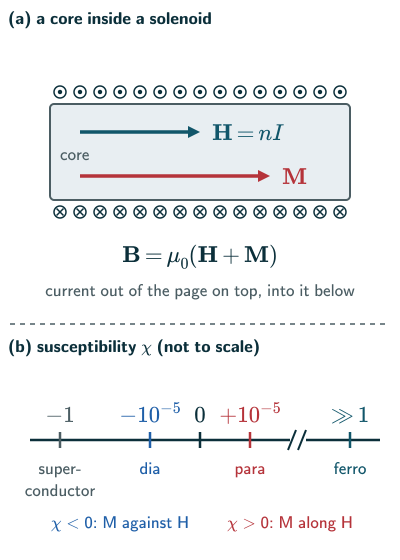
Susceptibility and relative permeability
- In the linear isotropic model, the response to the internal H is measured by the magnetic susceptibility χ (NCERT Eq. (5.13), page 146):
Magnetic susceptibility (NCERT Eq. 5.13)
- χ is dimensionless. It is small and positive for paramagnetic materials and small and negative for diamagnetic ones, where M points opposite to H (page 146).
- NCERT calls a material with M = χH a linear material (NCERT Summary point 6, page 150). A ferromagnet is not linear: its χ is large but changes with H and with the sample’s past, so the ratio M/H found at one non-zero field holds only at that state; it is undefined at H = 0 if remanent M remains (reasoning beyond NCERT).
- Putting NCERT Eq. (5.13) into Eq. (5.12) gives B = μ0(1 + χ)H = μ0μrH = μH (NCERT Eqs. (5.14)–(5.15), page 146), with:
Relative permeability (NCERT page 146)
- μr is the relative magnetic permeability, the magnetic analogue of the dielectric constant. The analogy is in the formula, μ = μ0μr as ε = Kε0. But a dielectric completely filling fixed-charge parallel plates weakens E to E0/K, while a core with μr > 1 strengthens B in an ideal long solenoid at fixed current to μrB0 (reasoning). At fixed plate voltage and separation, however, the electric field remains V/d. The magnetic permeability is μ = μ0μr = μ0(1 + χ), with the same dimensions and unit as μ0 (page 146).
- χ, μr and μ are linked: given one, the other two follow (page 146).
- NCERT slips in the Chapter 5 table (page 151): the magnetic moment is given dimensions [L−2 A], but they are [L2 A], as the unit A m2 and NCERT’s own Chapter 4 table show; and the unit of magnetic flux is written W (weber), but the weber’s symbol is Wb (W is the watt).
Solved examples
Example 1: A solenoid with a core (NCERT Example 5.5)
An ideal long, uniformly filled solenoid with 1000 turns per metre carries 2 A, and its core has relative permeability 400. Find (a) H, (b) M, (c) B, and (d) the magnetising current IM, the extra current that would give the same B without the core.
Answer: (a) H = nI = 1000 × 2.0 = 2 × 10³ A/m. (b) M = (μr − 1)H = 399 × 2 × 103 ≈ 8 × 10⁵ A/m. (c) B = μrμ0H = 400 × 4π × 10−7 × 2 × 103 ≈ 1.0 T. (d) Without the core, the same B needs μ0n(I + IM) = μrμ0nI, so I + IM = μrI and IM = (μr − 1)I = 399 × 2 = 798 A (NCERT pages 146–147). NCERT slip: NCERT writes this as B = μrn(I + IM), where μ0 is meant, and gets 794 A by using the rounded B = 1 T.
Example 2: A paramagnetic rod
A rod with χ = 2.0 × 10⁻⁵ has internal H = 4.0 × 10³ A/m. Find M and B.
Answer: M = χH = 2.0 × 10−5 × 4.0 × 103 = 0.080 A/m, along H. B = μ0(H + M) ≈ 4π × 10−7 × 4000.08 ≈ 5.03 × 10⁻³ T, only 2 parts in 105 more than in vacuum (NCERT Eqs. (5.12)–(5.13), page 146).
Example 3: From χ to μ
A material has μr = 0.999 99. Find χ and μ, and say what kind of material it is.
Answer: χ = μr − 1 = −1 × 10⁻⁵, small and negative: diamagnetic. μ = μ0μr ≈ 1.256 62 × 10−6 T m A−1, just below μ0 (NCERT page 146).
Example 4: Magnetisation from moments
A small magnetised bar of volume 2.0 × 10⁻⁶ m3 has a magnetic moment of 0.30 A m2. Find its volume-averaged magnetisation.
Answer: M = m/V = 0.30/(2.0 × 10−6) = 1.5 × 10⁵ A/m (NCERT Eq. (5.7), page 145).
Common mistakes to avoid
Common mistake
Applying H = nI to every finite core
H = nI applies to the ideal long, uniformly filled solenoid with negligible end effects (NCERT Example 5.5(a), page 147). A finite magnet’s demagnetising field depends on its shape and magnetisation; use the general relation H = B/μ − M.
Common mistake
Mixing up relative permeability and χ
μr = 1 + χ. For a vacuum χ = 0 and μr = 1; a paramagnet has μr slightly above 1, a diamagnet slightly below (NCERT page 146).
Common mistake
Giving M the unit of B
M and H are both in A m; only B is in tesla, B = μ(H + M) (NCERT pages 145–146).
Quick revision summary
- Magnetisation M = net magnetic moment per unit volume, in A m.
- Magnetic intensity H = B/μ − M, in A m; in the ideal uniformly filled long solenoid, H = nI when end effects are negligible.
- B = μ(H + M); in that ideal solenoid, the material adds Bm = μM to the empty-solenoid field μnI.
- In a linear isotropic material M = χH: χ is small and positive for ordinary paramagnets and small and negative for ordinary diamagnets; ferromagnets are nonlinear and depend on magnetic history.
- μr = 1 + χ and μ = μμr, so B = μH.
Formula sheet
- M = mnet/V
- H = B/μ0 − M; ideal long filled solenoid: H = nI
- B = μ0(H + M)
- M = χH, μr = 1 + χ
- μ = μ0 μr, B = μH
Questions students ask
What is the difference between magnetic field B and magnetic intensity H?
The magnetic field B is the total field inside a material, the one that acts on moving charges and currents, while the magnetic intensity H = B/μ0 − M is an auxiliary field related to free currents and the magnetised sample’s geometry (NCERT page 146). In vacuum they differ just by a constant, B = μ0H; in a material B = μ0(H + M). Only in the ideal uniformly filled long solenoid can we identify H = nI independently of the core; a finite sample adds a demagnetising contribution to H. NCERT’s table names B the magnetic field, magnetic induction or magnetic flux density, and H the magnetic field strength (NCERT page 151), so in NCERT’s naming ‘magnetic field strength’ means H, not B.
Is intensity of magnetisation the same as magnetic intensity?
No, intensity of magnetisation and magnetic intensity are different quantities: a question that asks for the ‘intensity of magnetisation’, the magnetic moment per unit volume, means the magnetisation M, the only name NCERT uses (NCERT Eq. (5.7), page 145), while magnetic intensity is H, defined by H = B/μ0 − M (NCERT page 146). The material responds to this internal H: for a linear material M = χH, so the same H gives a tiny M in a paramagnet, while iron can give a much larger response in a suitable field range (NCERT Eq. (5.13), page 146; page 149). ‘Magnetization’, with a z, is only a spelling variant of ‘magnetisation’.
Can magnetic susceptibility be negative, and can it be less than −1?
Yes: in NCERT’s static, isotropic material model, diamagnets have −1 ≤ χ < 0, with susceptibility defined relative to the internal H (Table 5.2, page 147). The ideal bulk Meissner state of a superconductor has B = 0, so M = −H and χ = −1, whereas ordinary diamagnets have tiny negative χ. This is not a universal bound on every experimentally quoted susceptibility: a ratio to the externally applied field can include sample-shape effects and differ from the intrinsic ratio to internal H. The Meissner result also assumes fields below the relevant critical limit and neglects surface penetration; type-II superconductors admit flux in their mixed state (CERN, “Superconductivity”).
What does a graph of magnetisation M against magnetic intensity H look like?
For a paramagnetic or diamagnetic material a graph of M against H is a straight line through the origin with slope χ, tiny and positive or negative, since M = χH for a linear material (NCERT Eq. (5.13), page 146). A paramagnet’s line bends over at strong fields and low temperatures, as M nears saturation with all dipoles lined up (NCERT page 148). A ferromagnet gives no single line: beyond the NCERT text, M rises steeply, levels off at saturation and does not retrace its path when H is reduced, the hysteresis that lets hard ferromagnets keep their magnetisation (J. Bahrdt, CERN-2010-004, CC BY).
Are magnetisation, magnetic intensity and susceptibility in the JEE Main and NEET syllabus?
Magnetisation, magnetic intensity and susceptibility are not named in the JEE Main syllabus or in the NEET (UG) 2026 syllabus: Unit 13 of the JEE Main syllabus ends with “para-, dia- and ferromagnetic substances with examples, the effect of temperature on magnetic properties”, and NEET’s Unit 13 with the same two topics. Those substances are told apart by their susceptibility χ, negative, small and positive, or large and positive, so the syllabus topic rests on them (NCERT Section 5.5, page 147, and Table 5.2). In NCERT Class 12 Physics Part I the three quantities are Section 5.4, Magnetisation and Magnetic Intensity (pages 145–147).
What is the difference between magnetisation and magnetic moment?
Magnetic moment m belongs to a whole magnet, coil or atom, while magnetisation M is the net magnetic moment per unit volume of a material, M = mnet/V for the sample average, equal to the local value when magnetisation is uniform (NCERT Eq. (5.7), page 145). So two blocks of the same uniformly magnetised steel have the same M, but the block with three times the volume has three times the moment, and so three times the far field and the torque in a given uniform field (reasoned from NCERT Eqs. (5.2) and (5.5), pages 139–140). The torque and energy of a magnet in a field depend on its moment.
Practice questions
Try each question first, then open the answer to check your working.
-
Q1. A material has χ = 5.0 × 10⁻⁴. Find μr and μ.
Show answerHide answer
μr = 1 + χ = 1.000 5, and μ = μ0μr ≈ 1.257 3 × 10⁻⁶ T m A−1 (NCERT page 146).
-
Q2. What are the SI units of magnetisation and of magnetic intensity?
Show answerHide answer
Both are in A m−1 (NCERT pages 145–146).
-
Q3. For a diamagnetic material, how does the direction of M compare with that of H?
Show answerHide answer
M points opposite to H, since χ is negative (NCERT page 146).