Gauss’s law for magnetism
NCERT Class 12 Physics Chapter 5 Section 5.3
Quick answer
Gauss’s law for magnetism says that the net magnetic flux through any closed surface is zero: every field line that enters the surface also leaves it. Unlike the electric case, where the flux equals the enclosed charge divided by ε, there is no magnetic charge to enclose, because isolated magnetic poles are not known to exist. The simplest magnetic element is a dipole or a current loop.
With your textbook
NCERT Physics Part I (Class 12), Chapter 5 “Magnetism and Matter”, Section 5.3 “Magnetism and Gauss’s Law”, pages 142–145.
Open the official NCERT chapter (PDF, 1.9 MB, ncert.nic.in) (opens in a new tab)
Checked against the 2026-27 reprint on .
What is Gauss’s law for magnetism?
Gauss’s law for magnetism
Magnetic field lines have no local sources or sinks, so every line that enters a closed surface also leaves it. NCERT states the law in one line:
The net magnetic flux through any closed surface is zero.
NCERT Physics Part I (Class 12), Section 5.3, page 143
This differs from Gauss’s law in electrostatics, where the flux through a closed surface is the enclosed charge divided by ε0, because isolated magnetic poles are not known to exist (NCERT page 143).
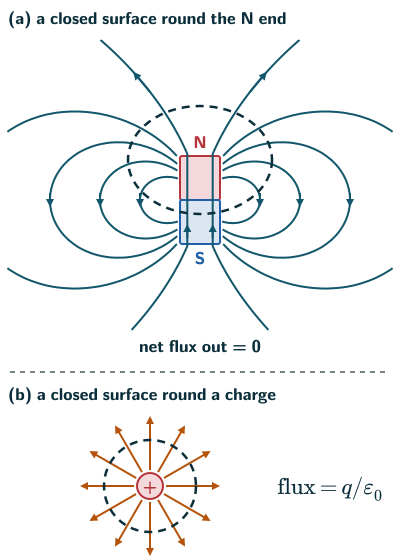
In plain words: electric field lines start on positive charges and end on negative ones, so a closed bag round a charge has more lines going out than coming in. Magnetic field lines have no local starting or ending points. Familiar bar-magnet lines form loops, but the general law also permits lines extending to infinity; it does not require every line to close on itself. So for any closed bag, the lines going in and the lines coming out balance exactly.
Net magnetic flux through a closed surface is zero
- In NCERT Figure 5.2(c), the electric dipole, the closed surface i encloses no net charge and as many lines leave it as enter it; the surface ii encloses a positive charge and has a net outward flux (NCERT page 142).
- For the magnetic field of a bar magnet or a solenoid (NCERT Figures 5.2(a)–(b)), both surfaces i and ii have as many lines leaving as entering: the net magnetic flux is zero, and this is true for any closed surface (page 142).
- In symbols: split a closed surface S into small outward-directed area elements ΔS. The flux through a sufficiently small element is approximately B·ΔS; the exact result is the limit as the elements shrink (NCERT Eq. (5.6), page 142):
Gauss’s law for magnetism (NCERT Eq. 5.6)
- Magnetic flux is a scalar, measured in weber (Wb): 1 Wb = 1 T m (NCERT Chapter 5 table, page 151, which writes the symbol as W).
- Compare the electric case, where the sum of E·ΔS over a closed surface equals q/ε0, with q the charge enclosed (NCERT page 142).
- A useful consequence (reasoned): for a surface that is not closed, any two surfaces with the same boundary and consistent orientation carry the same magnetic flux, since together they make a closed surface. This is why the flux “through a loop” has a definite value.
No isolated magnetic poles
- The difference between the two Gauss’s laws reflects the fact that isolated magnetic poles, also called monopoles, are not known to exist (NCERT page 143).
- So there are no sources or sinks of B. The simplest magnetic element is a dipole or a current loop, and all magnetic phenomena can be explained by arrangements of dipoles and current loops (page 143).
- Cutting a bar magnet never gives a single pole: each piece has a north and a south pole (NCERT page 137; Example 5.1(a), page 140).
- If monopoles did exist, the right-hand side of Gauss’s law would no longer be zero: it would be μ0qm, where qm is the magnetic charge (monopole strength) enclosed, just as the electric law has q/ε0 (NCERT Example 5.4(b), page 145).
- Closed loops need currents: a closed static magnetic field line on which B is non-zero has a non-zero circulation and must link a net current, including any bound current in matter; such lines cannot close around a region threaded by no current (NCERT Example 5.3(b), page 144). A toroid’s field lines are closed loops inside the winding, and each encloses current (Example 5.3(c)).
- Field lines are not lines of force: the force on a moving charge, qv × B, is always at right angles to B, so it is misleading to call magnetic field lines lines of force (NCERT Example 5.4(a), page 145).
- NCERT slip: NCERT’s box on Gauss (page 142) says he built the first electric telegraph in 1833 “along with Wilhelm Welser”. His partner was Wilhelm Weber: in 1833 Gauss and Weber built an electromagnetic telegraph in Göttingen, linking the observatory with the physics institute (University of Göttingen, Gauss exhibition, “Der elektromagnetische Telegraph”).
Solved examples
Example 1: Spotting wrong field lines (NCERT Example 5.3)
Which of these could be magnetic field lines: (a) straight lines spreading out in every direction from one point on a long wire; (b) straight lines crossing each other in empty space, beside small closed loops circling empty space; (c) closed circles inside a toroid; (d) perfectly straight lines running through a solenoid and straight on out of both ends; (e) lines running up through a bar magnet, out of its N face and in at its S face, with loops that leave its sides near N and re-enter them near S?
Answer: (a) No: lines cannot spread out from a source, since the net flux out of a surface round the wire would not be zero; these are the electric field lines of a charged wire, and a current-carrying wire’s magnetic field lines circle it. (b) No: field lines never cross, and a non-zero static field line cannot close around a region threaded by no current. (c) Yes: each loop encloses current. (d) No: the lines must curve out at the ends and close; perfectly straight confined lines would violate Ampere’s law. (e) Yes: not every line leaves through the N face, and the net flux round each pole is zero (NCERT pages 143–144).
Example 2: Flux through a hemisphere
A uniform field of 0.20 T points straight down into a horizontal circular hole of radius 5.0 cm, which is capped below by a hemispherical bowl. What is the magnetic flux out through the bowl?
Answer: the flat disc and the bowl together make a closed surface, so the net flux through them is zero. Into the disc goes BA = 0.20 × π × (0.050)2 ≈ 1.6 × 10⁻³ Wb, so the same flux leaves through the bowl (reasoned from NCERT Eq. (5.6)).
Example 3: Cutting a magnet
A bar magnet is cut across its middle. Does either half have only one pole?
Answer: No. Each half is a complete magnet with a north and a south pole, as the field lines run continuously through the magnet; isolated poles are not known (NCERT Example 5.1(a), page 140; page 143).
Example 4: Magnetic moment with zero charge
Can a system with zero net charge have a magnetic moment?
Answer: Yes. Its charges can average to zero while its current loops still add up to a net magnetic moment, as in the atoms of a paramagnetic material (NCERT Example 5.4(d), page 145).
Common mistakes to avoid
Common mistake
Thinking a surface round the N pole has net outward flux
Field lines leave the N end but also enter the surface through the magnet itself; the net flux through any closed surface is zero (NCERT page 142).
Common mistake
Calling magnetic field lines lines of force
The magnetic force on a moving charge is at right angles to B, not along the field lines (NCERT Example 5.4(a), page 145).
Common mistake
Expecting zero flux through an open surface
Gauss’s law is about closed surfaces. The flux through an open surface, such as the area of a coil, can be anything (reasoned from NCERT Eq. (5.6)).
Quick revision summary
- Gauss’s law for magnetism: the net magnetic flux through any closed surface is zero.
- Reason: no isolated magnetic poles (monopoles) are known; there are no sources or sinks of B.
- The simplest magnetic element is a dipole or current loop; static field lines that close on themselves must enclose a current.
- If monopoles existed, the flux through a closed surface would be μ times the enclosed magnetic charge.
- Two open surfaces with the same boundary and consistent orientation carry the same magnetic flux.
Formula sheet
- closed surface: ∮ B · dS = 0
- electric: ∮ E · dS = q/ε
- flux through an element: Δϕ = B · ΔS
- with monopoles: ∮ B · dS = μ0 qm
- unit: 1 Wb = 1 T m
Questions students ask
Why do magnetic monopoles not exist?
No one knows why magnetic monopoles do not exist, or whether any exist at all: NCERT states that isolated magnetic poles “are not known to exist” and adds, “We do not know why magnetic monopoles do not exist or why electric charge is quantised” (NCERT pages 143 and 151). The zero in Gauss’s law for magnetism records this experimental fact rather than explaining it. Beyond the NCERT text, theory allows them: grand unified theories predict very heavy ones (Particle Data Group, Review of Particle Physics, 2025 update, “Magnetic Monopoles”), and Dirac linked them to the quantisation of charge.
Have magnetic monopoles ever been found?
No magnetic monopole has ever been confirmed, despite decades of searches (beyond the NCERT text: Particle Data Group, Review of Particle Physics, 2025 update, “Magnetic Monopoles”). They have been sought in cosmic rays with detectors such as IceCube, at CERN’s Large Hadron Collider by ATLAS and MoEDAL, and in moon rock, meteorites and sea water; a few early candidates, such as one jump in the current of a superconducting loop in 1982, were never confirmed. The ‘monopoles’ of materials such as spin ice are quasi-particles inside a crystal: they are sources of H, not of B, so they do not break Gauss’s law for magnetism (Castelnovo, Moessner and Sondhi, Nature 451, 42, 2008).
What would the magnetic field of a monopole be, and what is the SI unit of magnetic charge?
A magnetic monopole of strength qm would have a radial field like that of a point charge, B = μ0qm/(4πr), pointing away from a north pole and towards a south one (beyond the NCERT text, reasoned by applying Gauss’s law with monopoles, from NCERT Example 5.4(b), page 145, to a sphere centred on it). In this form magnetic charge is measured in ampere metres, A m, because μ0qm must be a flux, in Wb = T m, and μ0 is in T m A. A pole of 1.0 A m would give about 6.3 × 10 T at 4.0 cm, and its field lines would start or end on it, as electric field lines do on charges.
Why is Gauss’s law for magnetism significant, and what follows from it?
Gauss’s law for magnetism is significant because it says that B has no sources or sinks: isolated magnetic poles are not known, and the simplest magnetic element is a dipole or a current loop (NCERT page 143). So magnetic field lines have no beginning or end, and the magnetic flux through a loop has one value, whatever consistently oriented surface the loop bounds, which Faraday’s law relies on. It is also one of Maxwell’s four equations, ∮ B·dS = 0, which hold for changing fields as well as for steady ones (NCERT Chapter 8, page 205).
Can Gauss’s law for magnetism be derived, or is it found by experiment?
For the fields of steady currents, Gauss’s law for magnetism can be derived from the Biot–Savart law (beyond the NCERT text, reasoned from NCERT page 113): each current element’s field circles the line of the element, with the same size all round each circle, so every line of it that enters a closed surface also leaves it, and adding the elements gives zero net flux. At bottom, though, it is an experimental law: a single monopole would break it, and none has been found (NCERT page 143). In vector calculus it is written ∇·B = 0, a form beyond Class 12 that follows from the integral form by the divergence theorem (NIST Digital Library of Mathematical Functions, §1.6(v)).
Which chapter covers Gauss’s law for magnetism, and is it in the JEE and NEET syllabus?
Gauss’s law for magnetism is in NCERT Class 12 Physics Part I, Chapter 5, Magnetism and Matter, as Section 5.3, Magnetism and Gauss’s Law (pages 142–145), and it returns in Chapter 8 as one of Maxwell’s equations (page 205). Neither the JEE Main syllabus nor the NEET (UG) 2026 syllabus names it: their Unit 13 lists “magnetic field lines” among the bar-magnet topics, and Gauss’s law for magnetism is what explains why those lines have no ends. Gauss’s law for electrostatics, by contrast, is named in both, in Unit 11 (see Gauss’s law).
Practice questions
Try each question first, then open the answer to check your working.
-
Q1. State Gauss’s law for magnetism.
Show answerHide answer
The net magnetic flux through any closed surface is zero (NCERT page 143).
-
Q2. Why does Gauss’s law for magnetism differ from Gauss’s law for electrostatics?
Show answerHide answer
Because isolated magnetic poles, unlike electric charges, are not known to exist: there are no sources or sinks of B (NCERT page 143).
-
Q3. A closed surface encloses the north pole of a bar magnet only. What is the net magnetic flux through it?
Show answerHide answer
Zero: the lines leaving through the outside are balanced by the lines entering through the part of the magnet inside the surface (NCERT page 142).