The bar magnet
NCERT Class 12 Physics Chapter 5 Sections 5.1–5.2
Quick answer
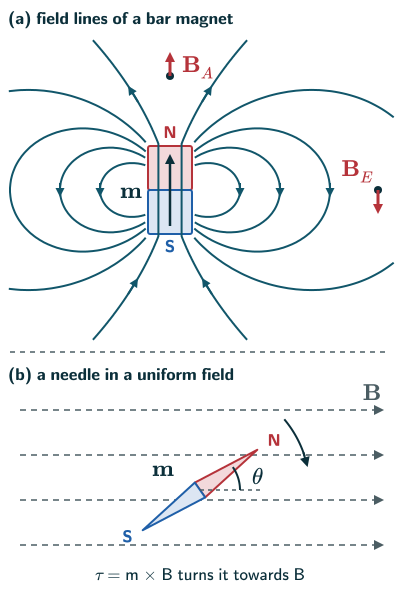
A bar magnet behaves as a magnetic dipole of moment m, like a solenoid carrying a current: its field lines form closed loops, leaving the north pole and entering the south pole. In a uniform field it feels a torque τ = m × B and has potential energy U = −m · B, but no net force. Far away its field is (μ/4π)(2m/r) along m on the axis and (μ/4π)(m/r) opposite to m on the equator.
With your textbook
NCERT Physics Part I (Class 12), Chapter 5 “Magnetism and Matter”, Sections 5.1–5.2 “Introduction” and “The Bar Magnet”, pages 136–142.
Open the official NCERT chapter (PDF, 1.9 MB, ncert.nic.in) (opens in a new tab)
Checked against the 2026-27 reprint on .
What is a bar magnet?
The bar magnet
Iron filings sprinkled round a short bar magnet line up in a pattern like the field of an electric dipole (NCERT Section 5.2, page 137):
The pattern of iron filings suggests that the magnet has two poles similar to the positive and negative charge of an electric dipole.
NCERT Physics Part I (Class 12), Section 5.2, page 137
A bar magnet behaves as a magnetic dipole of magnetic moment m, pointing from its south pole to its north pole. Far away its field is that of a current loop or a solenoid with the same moment, and in a uniform field it feels a torque m × B (NCERT pages 137–141).
In plain words: a bar magnet acts like a tiny coil of current. Its field loops out of the north end, round the outside and back into the south end, just like the field of a short solenoid. Put it in a field and the torque tends to align it; damping lets it settle, as a compass needle does.
The magnetic field lines
- The pattern of iron filings lets you draw the magnetic field lines. For a bar magnet and for a current-carrying finite solenoid the patterns are alike, and at large distances both look like the field lines of an electric dipole (NCERT pages 137–138, Figure 5.2).
- They form continuous closed loops. Unlike electric field lines of a dipole, which begin on a positive charge and end on a negative one, magnetic field lines run on through the magnet itself (page 137).
- The tangent to a field line at a given point gives the direction of the net magnetic field B at that point (page 138); strictly, only where B is non-zero (reasoned).
- The more lines cross unit area, the stronger the field B (page 138); strictly, the area is taken perpendicular to the field (reasoned).
- Field lines never cross: if they did, the field would not have one direction at the crossing point (page 138).
- They can be traced with a small compass needle, moved from point to point (page 138).
- NCERT avoids the old name “lines of force”, because magnetic field lines do not show the direction of the force on a moving charge (NCERT footnote, page 137); that force is at right angles to B.
Bar magnet as an equivalent solenoid
- Ampere suggested that all magnetism comes from circulating currents (NCERT page 138; Section 4.9). The similar field lines of a bar magnet and a solenoid suggest that a bar magnet can be thought of as a large number of circulating currents (page 139). NCERT adds that this is only partly true: electrons and protons also carry an intrinsic magnetic moment (NCERT Section 4.9.2, page 129).
- Cutting a bar magnet in half is like cutting a solenoid: you get two smaller solenoids with weaker magnetic properties, each with a north and a south pole. The field lines stay continuous, coming out of one face and going into the other (page 139). If the uniform magnetisation is unchanged, each half has half the original magnetic moment (reasoned, as in Q2).
- A test: move a small compass needle round a bar magnet and round a current-carrying finite solenoid; the needle turns the same way in both cases (page 139).
- Far along its axis, the field of a finite solenoid of magnetic moment m is (NCERT Eq. (5.1), page 139):
Far axial field of a solenoid or bar magnet (NCERT Eq. 5.1)
- This is also the far axial field of a bar magnet, found by experiment. So a bar magnet’s magnetic moment equals that of the equivalent solenoid that gives the same field (page 139). For a solenoid of N turns, area A and current I, that moment is m = NIA (NCERT Eq. (4.24)).
The dipole in a uniform magnetic field
- A small compass needle of magnetic moment m in a uniform field B feels a restoring torque (NCERT Eq. (5.2), page 139):
Torque on a magnetic dipole (NCERT Eq. 5.2)
- Its size is mB sin θ, where θ is the angle between m and B (page 139).
- For a dipole with fixed moment magnitude, working out the energy as for an electric dipole gives the magnetic potential energy (NCERT Eq. (5.3), page 139):
Potential energy of a magnetic dipole (NCERT Eq. 5.3)
- This puts the zero of energy at θ = 90°, the needle at right angles to the field. The energy is least, −mB, at θ = 0, the most stable position, and greatest, +mB, at θ = 180°, the most unstable one (page 139).
- From U = −mB cos θ, m is measured in J T−1, the same as A m2 from m = NIA; its dimensions are [L2 A] (NCERT Eqs. (4.22) and (4.24), page 126).
- In a uniform field a magnet feels a torque but no net force. An iron nail near a bar magnet is in a non-uniform field, gets an induced moment, and so feels a force of attraction as well as a torque (NCERT Example 5.1(b), pages 139–140).
- Oscillations (beyond NCERT, from Eq. (5.2)): neglecting damping and other restoring torques, for small angles the restoring torque is about mBθ, so a needle of moment of inertia I oscillates with period T = 2π√(I/(mB)). This is how the arrangement of NCERT Figure 5.3(b) can find B or m.
The electrostatic analog
- Comparing Eqs. (5.1)–(5.3) with the equations for an electric dipole, the field of a bar magnet far away follows from that of an electric dipole by the replacements E → B, p → m and 1/(4πε0) → μ0/4π (NCERT Section 5.2.4, page 140).
- The same pattern holds for the torque in a field, p × E → m × B, and the energy, −p·E → −m·B (NCERT Table 5.1, page 141).
- The difference: an electric dipole is made of two charges, but no isolated magnetic poles (monopoles) are known. Cutting a magnet never separates its poles (NCERT pages 137 and 140).
Field of a bar magnet on its axis and on its equator
For distances r much larger than the size l of the magnet (NCERT Eqs. (5.4)–(5.5), page 140):
Equatorial field (NCERT Eq. 5.4)
Axial field (NCERT Eq. 5.5)
- On the axis the field points along m; on the equator (the normal bisector) it points opposite to m and is half as strong at the same distance (reasoned from NCERT Eqs. (5.4)–(5.5)).
- NCERT notes that Eq. (5.5) is Eq. (5.1) in vector form (page 141).
- Both fall off as 1/r3, like an electric dipole’s field (reasoned).
Solved examples
Example 1: Two needles (NCERT Example 5.2)
A small magnetised needle P at O points up the page. An identical needle Q is placed at points round it, as in NCERT Figure 5.4: Q1 and Q2 close to O on its left and right, both pointing right; Q3 to Q6 on one circle centred on O: Q5 to the left pointing up, Q3 to the right pointing down, Q4 above pointing down, Q6 below pointing up. Which are not in equilibrium, which are stable and unstable, and which has the lowest energy?
Answer: Hold each needle’s centre fixed: these are tests of rotational equilibrium, since the non-uniform field can also exert a net force. P’s field points along mP (up) on its axis and opposite to it (down) on its equator. Q1 and Q2 are at right angles to the field: not in equilibrium. Q3 and Q6 point along the field: stable. Q4 and Q5 point against it: unstable. Q3 and Q6 are at the same distance and the axial field is twice the equatorial one, so Q6 has the lowest energy (NCERT pages 141–142).
Example 2: Field of a short magnet (NCERT Exercise 5.7)
A short bar magnet has a moment of 0.48 J T−1. Find the field 10 cm from its centre (a) on the axis, (b) on the equator.
Answer: (a) BA = 10−7 × 2 × 0.48/(0.10)3 = 9.6 × 10⁻⁵ T (0.96 G), along the axis from S to N, the direction of m. (b) BE = 10−7 × 0.48/(0.10)3 = 4.8 × 10⁻⁵ T (0.48 G), from N to S, opposite to m (NCERT Eqs. (5.4)–(5.5), page 140).
Example 3: Moment from torque (NCERT Exercise 5.1)
A short bar magnet at 30° to a uniform field of 0.25 T feels a torque of 4.5 × 10⁻² N m. Find its magnetic moment.
Answer: m = τ/(B sin θ) = 0.045/(0.25 × 0.5) = 0.36 J T−1 (NCERT Eq. (5.2), page 139). NCERT’s exercise gives the torque in joules; a torque is better written in N m, which has the same dimensions as the joule but is a different quantity.
Example 4: Turning a magnet (NCERT Exercise 5.5)
A bar magnet of moment 1.5 J T−1 lies along a uniform field of 0.22 T. How much work does an external torque do to turn it slowly, without changing its kinetic energy, (i) to right angles with the field, (ii) to face against it, and what is the torque in each position?
Answer: W = Ufinal − Uinitial with U = −mB cos θ. (i) W = 0 − (−0.33) = 0.33 J, and the torque there is mB = 0.33 N m. (ii) W = 0.33 − (−0.33) = 0.66 J, and the torque is zero (NCERT Eqs. (5.2)–(5.3), page 139).
Common mistakes to avoid
Common mistake
Thinking field lines start at N and end at S
Outside the magnet they run from N to S, but they carry on through the magnet from S to N: magnetic field lines are closed loops (NCERT page 137).
Common mistake
Expecting a net force in a uniform field
A magnet in a uniform field feels only a torque. A net force needs a non-uniform field, as near another magnet (NCERT Example 5.1(b), page 140).
Common mistake
Giving the equatorial field the direction of m
On the equator the field points opposite to m, BE = −(μ/4π)m/r; only on the axis does it point along m (NCERT Eqs. (5.4)–(5.5)).
Quick revision summary
- A bar magnet is a magnetic dipole; its field lines are closed loops, leaving N and entering S outside, running S to N inside.
- It behaves like an equivalent solenoid; cutting it gives two weaker magnets, each with half the moment if the uniform magnetisation stays unchanged, never an isolated pole.
- In a uniform field: τ = m × B (restoring), U = −m·B; stable at θ = 0, unstable at 180°; no net force.
- Far fields: on the axis (μ/4π)(2m/r) along m; on the equator (μ/4π)(m/r) opposite to m.
- Electric to magnetic: E → B, p → m, 1/4πε → μ/4π.
Formula sheet
- τ = m × B
- U = −m · B
- axis: B = (μ/4π)(2m/r), along m
- equator: B = (μ/4π)(m/r), opposite to m
- small oscillations: T = 2π√(I/(mB))
Questions students ask
Is the bar magnet as an equivalent solenoid deleted from NCERT or from the JEE and NEET syllabus?
No, the bar magnet as an equivalent solenoid is not deleted: it is NCERT Class 12 Physics Part I, Chapter 5, Section 5.2.2 (pages 138–139), and Unit 13 of the JEE Main syllabus and of the NEET (UG) 2026 syllabus both list “bar magnet as an equivalent solenoid” and the field of a bar magnet along its axis and perpendicular to it. NCERT treats the analogy mostly in words: it compares the field lines and compass deflections of a magnet and a finite solenoid, then states the far axial field (μ0/4π)(2m/r) without working it out (NCERT page 139). So the derivation from the solenoid’s turns is not in the current book.
What is the difference between a bar magnet and a solenoid?
A bar magnet and a current-carrying solenoid give a similar pattern of field lines outside, each with a north and a south end, but a bar magnet’s field comes from its magnetised material, a hard ferromagnet, while a solenoid’s comes from the current in its wire, which can be switched off, reversed or changed (NCERT pages 138–139 and 149). A solenoid’s moment, m = NIA, is set by its turns, current and area, but a bar magnet’s is fixed by its magnetisation and volume (NCERT Eq. (5.7), page 145).
What is the pole strength of a bar magnet, and how is it related to its magnetic moment?
Pole strength qm is the magnetic charge given to each pole in the old pole model, which pictures a bar magnet as poles +qm and −qm a distance 2a apart, like the charges of an electric dipole, with magnetic moment m = qm × 2a from S to N (beyond the NCERT text, by the dipole analogy of NCERT Table 5.1, page 141). Its SI unit is the ampere metre, A m, since m is in A m: a magnet of moment 0.90 A m with poles 4.5 cm apart has a pole strength of 20 A m. The 2026–27 NCERT book does not use pole strength: isolated poles have not been observed, and it treats a bar magnet as an equivalent solenoid (NCERT pages 137 and 139).
Why do the axial and equatorial field formulas of a bar magnet hold only far from the magnet?
The formulas (μ0/4π)(2m/r) on the axis and (μ0/4π)(m/r) on the equator treat the magnet as a point dipole, so NCERT gives them only for r much larger than the magnet’s size (NCERT Eqs. (5.4)–(5.5), page 140). Beyond the NCERT text, the ideal model of two point poles 2a apart has, at exterior axial points r > a, the exact field (μ0/4π) × 2mr/(r − a), by NCERT’s dipole analogy (Table 5.1) applied to the exact axial field of an electric dipole (NCERT Chapter 1, page 39). This is a model, not an exact result for a real bar of finite cross-section. On the axis the dipole formula is about 2% below this at r = 10a and about 21% below at r = 3a, so “short magnet” in a numerical means the far-field formulas may be used.
Is the magnetic field of a bar magnet uniform?
No, the magnetic field of a bar magnet is non-uniform: its field lines curve round from pole to pole and spread out, so both the size and the direction of B change from point to point (NCERT page 138, where Figure 5.2(a) shows the field stronger around region ii than around region i). Far from the magnet the field falls as 1/r, so moving out along the axis from 8.0 cm to 16 cm cuts it to one-eighth (NCERT Eq. (5.5), page 140). A nearly uniform field, with straight, parallel and evenly spaced field lines, is found instead well inside a long solenoid.
Is the earth’s magnetism in the Class 12 NCERT book and the JEE and NEET syllabus?
The earth’s magnetism has no section in the 2026–27 NCERT Class 12 Physics Part I: Chapter 5 says only, in its introduction, that the earth behaves as a magnet whose field points roughly from the geographic south to the north (NCERT page 136). Neither the JEE Main nor the NEET (UG) 2026 syllabus names the earth’s field, declination, dip or the horizontal component in Unit 13, though numericals still use the earth’s field as data, as NCERT Example 6.3 does (see Faraday’s law). Beyond the NCERT text, the field at the earth’s surface is roughly 25 to 65 µT (NOAA National Centers for Environmental Information, Geomagnetism FAQ).
Practice questions
Try each question first, then open the answer to check your working.
-
Q1. A short bar magnet of moment 0.32 J T−1 is free to turn in a uniform field of 0.15 T. Which orientations are stable and unstable, and what are the potential energies? (NCERT Exercise 5.2)
Show answerHide answer
Stable: m along B, U = −mB = −0.048 J. Unstable: m against B, U = +mB = +0.048 J (NCERT Eq. (5.3), page 139).
-
Q2. A bar magnet is cut into two halves (i) across its length, (ii) along its length. What do you get?
Show answerHide answer
In either case, two smaller magnets, each with a north and a south pole (NCERT Example 5.1(a), page 140). For a uniformly magnetised bar whose magnetisation remains unchanged, each half has moment m/2 (reasoned: moment = magnetisation × volume, NCERT Eq. (5.7)).
-
Q3. At the same distance from a short magnet, how does the field on its axis compare with the field on its equator?
Show answerHide answer
It is twice as large. On the axis it points along m; on the equator it points opposite to m (NCERT Eqs. (5.4)–(5.5), page 140).