Magnetic properties of materials
NCERT Class 12 Physics Chapter 5 Section 5.5
Quick answer
Diamagnetic substances have negative susceptibility and move towards weaker magnetic field; paramagnetic substances have small positive susceptibility and are weakly attracted, while ferromagnets often respond strongly through domain alignment. A superconductor in the ideal bulk Meissner state has χ = −1. Independent localised paramagnetic moments obey Curie’s law away from saturation, and a ferromagnet loses spontaneous magnetic order above its Curie temperature.
With your textbook
NCERT Physics Part I (Class 12), Chapter 5 “Magnetism and Matter”, Section 5.5 “Magnetic Properties of Materials”, pages 147–149.
Open the official NCERT chapter (PDF, 1.9 MB, ncert.nic.in) (opens in a new tab)
Checked against the 2026-27 reprint on .
How do materials respond to a magnetic field?
Magnetic properties of materials
Materials are classed by their magnetic susceptibility χ (NCERT Section 5.5, page 147): diamagnetic if χ is negative, paramagnetic if χ is small and positive, and ferromagnetic if χ is large and positive. A diamagnetic substance is pushed out of a strong field:
Diamagnetic substances are those which have tendency to move from stronger to the weaker part of the external magnetic field.
NCERT Physics Part I (Class 12), Section 5.5.1, page 147
Paramagnetic substances are weakly pulled into a strong field, and ferromagnetic ones strongly (NCERT pages 148–149).
In plain words: a magnet very slightly repels water and copper, very slightly attracts aluminium and oxygen, and strongly attracts iron. The difference lies in what the atoms’ tiny magnetic moments do: in diamagnets they have none to begin with and an opposing one is induced; in paramagnets they exist but point every which way; in ferromagnets they line up together in large regions.
NCERT Table 5.2 summarises the usual static response with μr = 1 + χ (page 147; ε is a small positive number). The large ferromagnetic values describe a typical high-response regime, not every field or magnetic history:
- Diamagnetic: −1 ≤ χ < 0, 0 ≤ μr < 1 and μ < μ0.
- Paramagnetic: 0 < χ < ε, 1 < μr < 1 + ε and μ > μ0.
- Ferromagnetic: χ ≫ 1, μr ≫ 1 and μ ≫ μ0.
Diamagnetism
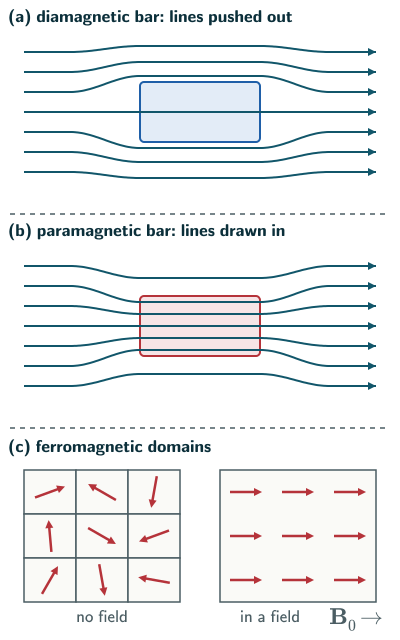
- A magnet repels a diamagnetic substance. In a field, the field lines are pushed out of a diamagnetic bar and the field inside is reduced, usually only by about one part in 105. In a non-uniform field the bar moves from the strong field towards the weak (NCERT page 147, Figure 5.7(a)).
- Classical picture: electrons orbiting in an atom act as current loops with orbital magnetic moments. In a diamagnetic substance each atom’s moments add up to zero. When a field is applied, electrons whose orbital moment points along the field slow down and those whose moment points against it speed up, by induction (Lenz’s law, which NCERT takes up in Chapter 6). The atom gets a net moment opposite to the field, hence the repulsion (NCERT page 148). Atomic orbitals and intrinsic spin require quantum mechanics; this circulating-charge picture explains the induced orbital contribution qualitatively.
- Examples: bismuth, copper, lead, silicon, nitrogen (at STP), water and sodium chloride (page 148).
- Diamagnetism is present in all substances, but it is so weak that paramagnetism or ferromagnetism usually hides it (page 148; NCERT Points to Ponder 6, page 152).
- Superconductors are the most exotic diamagnets: NCERT describes them as metals, cooled to very low temperatures, that show both perfect conductivity and perfect diamagnetism. The field lines are completely expelled, χ = −1 and μr = 0, and this perfect diamagnetism is the Meissner effect (page 148). Beyond the NCERT text: the field is expelled only below the critical temperature and below a critical field, and even then it enters a thin surface layer, the London penetration depth; perfect diamagnetism is distinct from zero electrical resistance (Wikipedia, “Meissner effect”). Superconductors also include metal alloys and some oxide ceramics, and in type-II superconductors a mixed state can let some field lines through in vortices (Wikipedia, “Type-II superconductor”). A superconductor repels a magnet and, by Newton’s third law, is repelled by it. NCERT adds that superconducting magnets can be used, for example, to run magnetically levitated trains (page 148).
- NCERT slip: NCERT’s Points to Ponder 5 (page 152) says the BCS theory of superconductivity, proposed in 1957, was recognised by a Nobel Prize in 1970. The Nobel Prize in Physics 1972 was awarded jointly to John Bardeen, Leon Neil Cooper and John Robert Schrieffer for this theory (NobelPrize.org, “The Nobel Prize in Physics 1972”).
Paramagnetism
- Paramagnetic substances are weakly magnetised in a field and are weakly attracted by a magnet, moving from weak field to strong (NCERT page 148).
- In the localised-moment model, their atoms, ions or molecules have permanent magnetic dipole moments, but ceaseless random thermal motion leaves them pointing every way, so there is no net magnetisation, much as for the permanent dipoles of a polar dielectric. A strong enough field, especially at low temperature, lines the moments up along B0 (page 148).
- In a field, the field lines are drawn into a paramagnetic bar and the field inside is enhanced, usually by about one part in 105 (NCERT page 148; Figure 5.7(b), page 147).
- Examples: aluminium, sodium, calcium, oxygen (at STP) and copper chloride (page 148). Beyond the NCERT text: the atomic-dipole picture is not universal: conduction electrons give metals a weak Pauli paramagnetism that is more or less independent of temperature, rather than Curie’s inverse-temperature law (Wikipedia, “Paramagnetism”).
Ferromagnetism
- Ferromagnetic substances are strongly magnetised in a field and strongly attracted, moving from weak field to strong (NCERT page 149).
- Their atoms have dipole moments, as in a paramagnet, but they interact so that they line up spontaneously over a macroscopic region called a domain; explaining this cooperative effect needs quantum mechanics (page 149).
- At first the domains point randomly and there is no bulk magnetisation. In a field B0 the domains turn along it, and those already along it grow, until they align and amalgamate into a single “giant” domain. This is seen under a microscope using a liquid suspension of a powdered ferromagnetic substance (NCERT page 149, Figure 5.8). Strictly, that picture is the strong-field limit near saturation; a weaker applied field need not produce one single domain (reasoned).
- The field lines are then highly concentrated in the material. Ferromagnetic elements include iron, cobalt, nickel and gadolinium, and the relative magnetic permeability is more than 1000 (page 149); give NCERT’s “more than 1000” in an exam. NCERT adds that at a high enough temperature a ferromagnet becomes a paramagnet (page 149); for gadolinium this happens near room temperature, its Curie temperature being about 292 K (Wikipedia, “Ferromagnetism”). Strictly, the permeability depends on field, history and material, so it is not always that large (reasoned).
- NCERT slip: NCERT gives a typical domain size of 1 mm and says a domain holds about 1011 atoms (page 149). These do not fit together: iron has about 8.5 × 1028 atoms per cubic metre, so a 1 mm cube holds about 1020 atoms, while 1011 atoms fill a cube only about 1 µm across (reasoned from iron’s standard density, 7.87 g cm−3, and molar mass, 55.8 g mol−1).
Hard and soft ferromagnets
- In some ferromagnetic materials the magnetisation persists when the outside field is removed. These are hard ferromagnets, such as Alnico (an alloy of iron, aluminium, nickel, cobalt and copper) and naturally occurring lodestone. They make permanent magnets, for example compass needles (NCERT page 149).
- In others, such as soft iron, the magnetisation disappears when the outside field is removed. These are soft ferromagnets (NCERT page 149); give that in an exam. Beyond the NCERT text: J. Bahrdt (CERN-2010-004, Fig. 5) classes a magnetic material as soft by its small coercive field, below 200 Oe, so soft iron is easy to demagnetise, and a little remanent magnetisation can remain at zero applied field: “soft” does not mean exactly zero remanence (reasoned from that definition). Soft iron strengthens a field. NCERT Chapter 4 notes that a soft iron core inside a solenoid makes a large field possible, leaving the reason to this chapter (page 122), and puts a cylindrical soft iron core inside a moving-coil galvanometer to make the field radial and stronger (page 129).
- Substances that keep their ferromagnetism for a long time at room temperature are called permanent magnets (NCERT Summary point 8, page 150).
Effect of temperature on magnetic properties
- Localised-moment paramagnets: χ and μr depend on the temperature as well as the material. A stronger field or a lower temperature increases the magnetisation, until it saturates with all the dipoles lined up (NCERT page 148). The simple form (beyond NCERT, Curie’s law): χ = C/T, with C a constant for the material and T the absolute temperature, valid for approximately independent localised moments far from saturation; it does not describe all paramagnetic metals. Since M = χH, M = CH/T: the magnetisation is proportional to the applied field and inversely proportional to T.
- Ferromagnets: at a high enough temperature a ferromagnet becomes a paramagnet: the domain structure breaks up, and the magnetisation disappears gradually as the temperature rises (NCERT page 149). Strictly, the spontaneous magnetisation falls to zero at the transition, though an applied field can still induce some (reasoned).
- That temperature is the Curie temperature TC (beyond NCERT). For nickel it is about 630 K (358 °C in J. Bahrdt, “Permanent magnets including undulators and wigglers”, Table 10). Above the transition, a useful approximation is the Curie–Weiss law, χ = C/(T − θCW), where the fitted Weiss temperature is approximately TC in the simple mean-field ferromagnet model; it is not an exact law at all temperatures.
- Diamagnets: their susceptibility hardly depends on temperature (standard result, beyond NCERT), since it comes from induced orbital moments, not from moments that heat jostles. Superconductors are the exception: they show perfect diamagnetism only when cooled to very low temperatures (NCERT page 148), strictly below the material’s critical temperature and critical field (Wikipedia, “Meissner effect”).
Solved examples
Example 1: Classify by χ
Three materials have χ = −2 × 10⁻⁵, +3 × 10⁻⁵ and +5000. Classify each and give μr.
Answer: −2 × 10⁻⁵: diamagnetic, μr = 0.999 98. +3 × 10⁻⁵: paramagnetic, μr = 1.000 03. +5000: ferromagnetic, μr = 5001 (NCERT pages 146–147).
Example 2: Curie’s law
A paramagnetic salt has χ = 2.0 × 10⁻⁴ at 300 K. Assuming Curie’s law remains valid, estimate χ at 150 K.
Answer: with χ = C/T, halving T doubles χ: 4.0 × 10⁻⁴ (beyond NCERT, Curie’s law).
Example 3: Inside a superconductor
A superconductor is in its Meissner state, with internal H = 1.0 × 10⁴ A/m. Neglect surface penetration and assume the critical field is not exceeded. Find bulk B and M.
Answer: χ = −1, so M = χH = −1.0 × 10⁴ A/m, opposite to H, and B = μ0(H + M) = 0: the field is fully expelled (NCERT page 148; Eqs. (5.12)–(5.13)).
Example 4: Which way do they move?
Small pieces of bismuth, aluminium and iron hang near one pole of a strong magnet. Which way does each move?
Answer: bismuth (diamagnetic) moves away, towards the weaker field; aluminium (paramagnetic) moves towards the pole, weakly; iron (ferromagnetic) is pulled strongly towards it (NCERT pages 147–149).
Common mistakes to avoid
Common mistake
Thinking only some materials are diamagnetic
Diamagnetism is present in all materials; it is simply masked when the material is also paramagnetic or ferromagnetic (NCERT page 148).
Common mistake
Expecting a paramagnet to stay magnetised
In the localised-moment paramagnet, thermal disorder gives zero average magnetisation in equilibrium at zero field. Ferromagnets can retain remanence, especially hard ones; soft magnets may also retain some (NCERT pages 148–149).
Common mistake
Calling soft iron a permanent magnet
NCERT: soft iron loses its magnetisation when the field is removed, while hard materials such as Alnico keep it and make permanent magnets (page 149). Strictly, soft iron is easily demagnetised because its coercive field is small, and a little remanence may persist (J. Bahrdt, CERN-2010-004; reasoned).
Quick revision summary
- Diamagnetic: χ small and negative, repelled, moves to weaker field; induced moments oppose the field; present in all materials; superconductors have χ = −1 in the ideal bulk Meissner state.
- Paramagnetic: χ small and positive, weakly attracted; for independent localised moments, thermal disorder gives Curie’s law χ = C/T away from saturation; metallic Pauli paramagnetism is different.
- Ferromagnetic: χ ≫ 1, strongly attracted; moments line up in domains that turn and grow in a field; μr more than 1000 (NCERT).
- Hard ferromagnets (Alnico, lodestone) keep their magnetisation and make permanent magnets; soft ones (soft iron) lose it when the field is removed, though a little remanence can remain.
- At a high enough temperature, the Curie temperature (the name is beyond NCERT), a ferromagnet becomes paramagnetic.
Formula sheet
- diamagnetic: −1 ≤ χ < 0, μ < μ
- paramagnetic: 0 < χ ≪ 1, μ > μ
- ferromagnetic: χ ≫ 1, μ ≫ μ
- ideal bulk Meissner state: χ = −1, B = 0 inside
- independent localised moments, unsaturated: χ = C/T
Questions students ask
Why does a ferromagnet lose its magnetism when heated above its Curie temperature?
A ferromagnet loses its magnetism when heated because thermal agitation grows until it beats the interaction that keeps neighbouring atomic moments lined up in each domain, so the domains break up and, above the Curie temperature, the material is only paramagnetic (NCERT page 149; the Curie temperature is beyond the NCERT text). A magnetic ordering transition does not itself require a change of crystal structure. In the ideal reversible case, the material can regain ferromagnetic order on cooling and can be magnetised again; this is not a promise that heating a real magnet cannot oxidise it or change its structure and performance (J. Bahrdt, CERN-2010-004, Section 5.2). That source gives Curie temperatures of about 770 °C for iron, 1130 °C for cobalt and 850 °C for Alnico, but only 310 °C for neodymium–iron–boron magnets.
Why is a diamagnetic substance pushed towards the weaker part of a magnetic field?
For a small isotropic body with a linearly induced moment m = αB, the effective magnetic energy in a prescribed external field is U = −½αB, relative to zero field. A diamagnet has α < 0, so the energy rises with field strength and the force points towards weaker field; the factor ½ appears because the moment grows as the field is applied, unlike a fixed permanent dipole (beyond NCERT: Berry and Geim, European Journal of Physics 18, 307–313, 1997, Eq. 2). In a uniform field this energy is the same everywhere, so only a non-uniform field moves it (NCERT page 147); a paramagnet’s moment lines up with B, which sends it the other way. The push is tiny, but a strong field can float a diamagnet: a live frog has floated in about 16 T (Michael Berry and Andre Geim, European Journal of Physics 18, 307, 1997).
Why is ferromagnetism so much stronger than paramagnetism?
Ferromagnetism is far stronger because in a ferromagnet the atomic moments are already lined up with one another over whole domains by their mutual interaction, so an applied field has only to turn the domains and grow the favoured ones, while in a paramagnet it must line up each atomic moment on its own against thermal agitation (NCERT pages 148–149). At room temperature, beyond the NCERT text, the energy of an atomic moment of one Bohr magneton, 9.27 × 10 J T, in a 1 T field is only about 1/440 of kT at 20 °C (NIST CODATA 2022), so few moments line up. Hence χ ≪ 1 for paramagnets, while iron has μr > 1000 (NCERT page 149), strictly only in a suitable field regime.
Are hysteresis and the Curie law in the NCERT Class 12 book and the JEE and NEET syllabus?
Hysteresis and the Curie law are not in the 2026–27 NCERT Chapter 5, which says only that heat changes a paramagnet’s χ and can make a ferromagnet paramagnetic (NCERT pages 148–149); hysteresis appears only as a transformer’s core loss (NCERT Chapter 7, page 196). Neither the JEE Main nor the NEET (UG) 2026 syllabus names them, though Unit 13 of both lists the effect of temperature. Beyond the NCERT text, hysteresis is a ferromagnet’s B lagging behind H: over a cycle B traces a loop, non-zero at H = 0 and zero only at a reverse coercive field, large for hard and small for soft magnets (J. Bahrdt, CERN-2010-004, CC BY).
How can you tell whether a substance is paramagnetic or diamagnetic?
Whether a substance is paramagnetic or diamagnetic can be found by experiment, from the sign of its susceptibility or how it moves in a non-uniform field, or predicted from its electrons: atoms and molecules with unpaired electrons are paramagnetic, like oxygen, and those with all paired are diamagnetic, like nitrogen (NCERT page 148; for the electron rule, NCERT Class 11 Chemistry Part I, Section 4.7.5: see molecular orbital theory). The rule is for separate atoms and molecules, not metals: a copper atom has an unpaired electron, yet copper is diamagnetic (NCERT page 148), and iron is ferromagnetic (NCERT page 149).
Practice questions
Try each question first, then open the answer to check your working.
-
Q1. Name the effect in which a superconductor expels a magnetic field completely.
Show answerHide answer
The Meissner effect (NCERT page 148).
-
Q2. Why is a paramagnetic substance not magnetised when there is no outside field?
Show answerHide answer
Its atomic dipoles point in random directions because of thermal motion, so they cancel out (NCERT page 148).
-
Q3. Which kind of ferromagnet would you choose for the core of an electromagnet, and why?
Show answerHide answer
A soft one, such as soft iron: its large permeability makes the field strong while the current flows, and its magnetisation disappears when the current is switched off (NCERT page 149; Chapter 4, page 122); strictly, a little remanence can remain (J. Bahrdt, CERN-2010-004; reasoned).