Molecular orbital theory, bond order and magnetism
NCERT Class 11 Chemistry Chapter 4 Section 4.7
Quick answer
Molecular orbital theory describes electrons in orbitals belonging to the molecule, built approximately from atomic orbitals of compatible symmetry and energy. In the elementary diatomic model, bond order is half the difference between bonding and antibonding electrons, while unpaired electrons indicate paramagnetism. This count predicts net covalent bonding but does not prove stability or exclude weak binding beyond the model.
With your textbook
NCERT Chemistry Part I (Class 11), Chapter 4 “Chemical Bonding and Molecular Structure”, Section 4.7 “Molecular Orbital Theory”, pages 125–129.
Open the official NCERT chapter (PDF, 4.5 MB, ncert.nic.in) (opens in a new tab)
Checked against the 2026-27 reprint on .
What is molecular orbital theory?
Molecular orbital (MO) theory
Molecular orbital theory treats the electrons of a molecule as filling molecular orbitals that spread over the whole molecule, just as the electrons of an atom fill atomic orbitals (NCERT Section 4.7, pages 125–129):
- atomic orbitals of comparable energy and proper symmetry combine, and the number of molecular orbitals formed equals the number of atomic orbitals combined;
- two atomic orbitals give a bonding molecular orbital, lower in energy, and an antibonding one, higher in energy;
- electrons fill the molecular orbitals by the aufbau principle, Pauli’s exclusion principle and Hund’s rule, and the filling gives the bond order, stability and magnetic nature of the molecule.
NCERT credits the theory to F. Hund and R. S. Mulliken (1932).
In plain words: valence bond theory keeps each electron pair between two atoms. MO theory instead mixes the atoms’ orbitals into new orbitals that belong to the whole molecule. Each mixing gives one orbital that holds the nuclei together (bonding) and one that pushes them apart (antibonding). Fill them with the molecule’s electrons and count: more electrons in bonding orbitals than in antibonding ones means a bond.
Main features
The salient features of MO theory (NCERT Section 4.7, pages 125–126):
- Electrons in a molecule are present in molecular orbitals, as electrons of atoms are in atomic orbitals.
- Atomic orbitals of comparable energies and proper symmetry combine to form molecular orbitals.
- An electron in an atomic orbital is influenced by one nucleus; in a molecular orbital it is influenced by two or more nuclei. An atomic orbital is monocentric, a molecular orbital polycentric.
- The number of molecular orbitals formed equals the number of atomic orbitals that combine.
When two atomic orbitals combine, two molecular orbitals are formed.
NCERT Chemistry Part I (Class 11), Section 4.7, page 126
- The bonding molecular orbital has lower energy, and hence greater stability, than the corresponding antibonding molecular orbital.
- A molecular orbital is a wave function over a group of nuclei; its squared magnitude gives the one-electron probability density.
- Molecular orbitals are filled by the aufbau principle, obeying Pauli’s exclusion principle and Hund’s rule, exactly as atomic orbitals are filled.
Linear combination of atomic orbitals (LCAO)
The Schrödinger equation cannot be solved exactly for any system with more than one electron, so molecular orbitals are built approximately, by the linear combination of atomic orbitals (LCAO) (NCERT Section 4.7.1, page 126). For H2, the two 1s orbitals ψA and ψB are added or subtracted. The following expressions omit normalisation factors; in general LCAO also uses unequal coefficients:
Molecular orbitals by LCAO
σ = ψA + ψB (bonding)
σ* = ψA − ψB (antibonding)
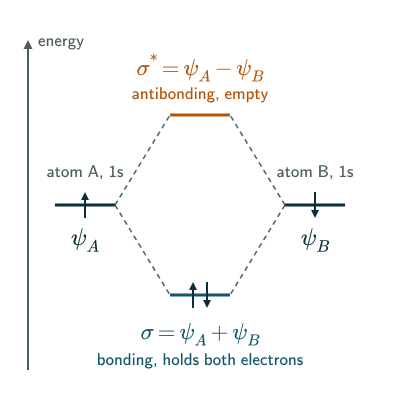
Qualitatively, this is interference of the electron waves (NCERT pages 126–127):
- Bonding orbital: the waves reinforce each other (constructive interference), so electron density builds up between the nuclei. At a fixed internuclear distance the nucleus–nucleus repulsion is unchanged, but the full electronic energy changes, and the bonding combination is lower in energy than the separated 1s reference in this elementary picture.
- Antibonding orbital: the waves cancel (destructive interference). Most of the density lies away from the space between the nuclei, and there is a nodal plane (zero electron density) between them, and the total energy is less favourable than for the bonding combination. Electrons placed here destabilise the molecule.
NCERT’s simple picture raises σ* above the atomic orbitals by as much as σ is lowered, so the total energy of the two molecular orbitals equals that of the two atomic orbitals (page 127). Beyond the NCERT text: a fuller treatment shows the antibonding orbital is raised more than the bonding one is lowered. So when bonding and antibonding electrons are equal in number, the elementary model predicts no net covalent bond, as for He2. Weak dispersion-bound helium dimers nevertheless exist; their binding requires physics beyond this elementary count.
Conditions for the combination of atomic orbitals
Appreciable interaction between atomic orbitals requires compatible symmetry and energies; in the elementary treatment (NCERT Section 4.7.2, page 127):
- They have the same or nearly the same energy. A large energy mismatch usually makes mixing weak, rather than mathematically forbidden; similar-energy orbitals mix most effectively (for two different atoms what matters is energy, not the label: in HF the H 1s orbital combines with an F 2p orbital of similar energy).
- They have the same symmetry about the molecular axis (taken as z). A 2pz orbital of one atom combines with 2pz of the other, but not with 2px or 2py, even though their energies are the same.
- They have nonzero, appreciable overlap. For compatible orbitals, stronger overlap generally increases bonding/antibonding splitting; the antibonding combination still has a node.
Types of molecular orbitals
Molecular orbitals of diatomic molecules are labelled σ (sigma), π (pi), δ (delta) and so on (NCERT Section 4.7.3, page 127):
- σ orbitals are symmetrical about the bond axis. Two 1s orbitals give σ1s and σ*1s; with z as the bond axis, two 2pz orbitals also give σ orbitals, σ2pz and σ*2pz.
- π orbitals are not symmetrical about the bond axis: those from 2px and 2py have positive lobes above and negative lobes below the molecular plane. They are π2px, π2py and π*2px, π*2py. A bonding π orbital has more electron density above and below the internuclear axis; the antibonding π* orbital has a node between the nuclei.
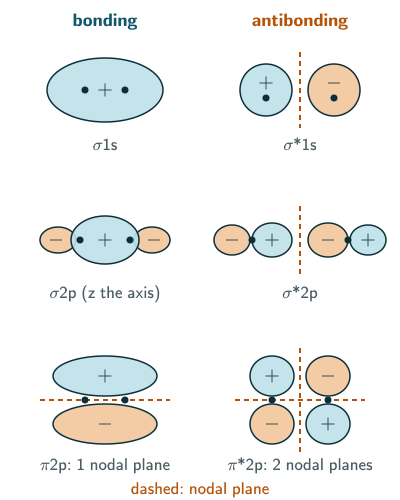
NCERT’s text on page 127 sends the reader to Fig. 4.20(a) on page 124 for the σ1s and σ*1s contours, but Fig. 4.20 is on page 128.
The sum/difference entries below refer to the chosen same-phase 1s functions; for other orbital drawings, coefficients must account for lobe signs.
| Property | Bonding MO | Antibonding MO |
|---|---|---|
| formed by | adding, ψA + ψB | subtracting, ψA − ψB |
| energy | below the atomic orbitals | above the atomic orbitals |
| density between nuclei | high (for π, above and below the axis) | low; a nodal plane |
| electrons in it | stabilise the molecule | destabilise it |
| labels | σ, π | σ*, π* |
Energy level diagram
The 1s orbitals of two atoms give σ1s and σ*1s. In the same way the 2s and 2p orbitals (eight atomic orbitals on two atoms) give eight molecular orbitals (NCERT Section 4.7.4, pages 127–128):
- antibonding: σ*2s, σ*2pz, π*2px, π*2py;
- bonding: σ2s, σ2pz, π2px, π2py.
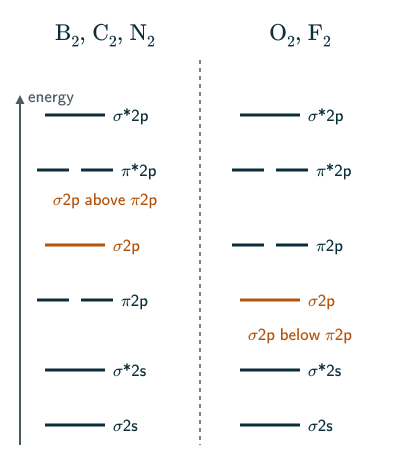
Their order, found from spectroscopic data for the second-period diatomic molecules, comes in two forms (pages 128–129):
- O2 and F2: σ1s < σ*1s < σ2s < σ*2s < σ2pz < (π2px = π2py) < (π*2px = π*2py) < σ*2pz
- Li2, Be2, B2, C2, N2: σ1s < σ*1s < σ2s < σ*2s < (π2px = π2py) < σ2pz < (π*2px = π*2py) < σ*2pz
The key difference: up to N2, σ2pz lies above the π2p pair. NCERT’s Fig. 4.21 (page 131) labels the two cases “with 2s–2p mixing” and “without 2s–2p mixing”. In the lighter atoms the 2s and 2pz orbitals (same σ symmetry) are close in energy and mix, which pushes σ2pz up; the π orbitals cannot take part, and in O and F the 2s–2p gap is larger.
Electronic configuration and molecular behaviour
The distribution of electrons among the molecular orbitals is the electronic configuration of the molecule, and it tells us a great deal (NCERT Section 4.7.5, page 129). Write Nb for the number of electrons in bonding orbitals and Na for the number in antibonding orbitals.
Elementary bonding prediction: Nb > Na gives positive net covalent bond order. This count alone does not establish thermodynamic stability, resistance to electron loss or the absence of weak correlation/dispersion binding.
Bond order (b.o.) is defined as one half the difference between the number of electrons present in the bonding and the antibonding orbitals
NCERT Chemistry Part I (Class 11), Section 4.7.5, page 129
Bond order
Bond order = ½(Nb − Na)
- Stability by bond order: a positive value predicts net covalent bonding in this model; zero means no net covalent bond in this model, not universal nonexistence.
- Nature of the bond: bond orders of 1, 2 and 3 correspond to single, double and triple bonds.
- Bond length and bond enthalpy: bond order is an approximate measure of bond length; the bond length decreases as the bond order increases (NCERT Section 4.7.5, page 129), and the bond enthalpy increases (NCERT Section 4.3.4, page 109).
- Magnetic nature: if every occupied molecular orbital holds two electrons, the substance is diamagnetic (repelled by a magnetic field); if one or more holds a single electron, it is paramagnetic (attracted), as O2 is.
Full treatments of H2, He2, Li2, C2 and O2, and of the row B2 to Ne2 with bond energies and lengths, are on the next topic, bonding in homonuclear diatomic molecules (NCERT Section 4.8); the examples below only count electrons.
Solved examples
Example 1: Bond orders of N<sub>2</sub> and the oxygen species (NCERT Exercise 4.40, page 135)
What is meant by bond order? Calculate the bond order of N2, O2, O2+ and O2−.
Bond order is ½(Nb − Na). N2 (14 electrons, π below σ2p): σ1s2 σ*1s2 σ2s2 σ*2s2 (π2px2 = π2py2) σ2pz2; Nb = 10, Na = 4. O2 (16 electrons): σ1s2 σ*1s2 σ2s2 σ*2s2 σ2pz2 (π2px2 = π2py2) (π*2px1 = π*2py1); Nb = 10, Na = 6. O2+ has one π* electron fewer (Na = 5); O2− one more (Na = 7).
Answer: N2 ½(10 − 4) = 3; O2 ½(10 − 6) = 2; O2+ ½(10 − 5) = 2.5; O2− ½(10 − 7) = 1.5.
Example 2: The elementary prediction for Be<sub>2</sub> (NCERT Exercise 4.35, page 135)
Use the elementary MO diagram to calculate Be2’s bond order, and state the limitation of this prediction.
Each Be atom has 4 electrons, so Be2 has 8: σ1s2 σ*1s2 σ2s2 σ*2s2. Nb = 4 and Na = 4.
Answer: elementary bond order ½(4 − 4) = 0, the intended NCERT prediction of no net covalent bond. However, spectroscopy has observed bound Be2; electron correlation and configuration mixing beyond this simple diagram are essential. Do not turn the model result into a claim of absolute nonexistence.
Example 3: H<sub>2</sub> against H<sub>2</sub><sup>+</sup>
Which has the stronger and shorter bond, H2 or H2+?
H2: σ1s2, bond order ½(2 − 0) = 1. H2+: σ1s1, bond order ½(1 − 0) = 0.5.
Answer: H2; its bond order is higher, so its bond is stronger and shorter. H2+ still exists (bond order above zero) and is paramagnetic.
Example 4: Why the energy order matters for B<sub>2</sub>
B2 is found to be paramagnetic. Show that only the order with π2p below σ2pz explains this.
B2 has 10 electrons; the first 8 fill σ1s, σ*1s, σ2s and σ*2s. With the B2–N2 order, the last 2 go into the two equal π2p orbitals, one each with parallel spins (Hund’s rule): π2px1 π2py1, two unpaired electrons. With the O2 order they would pair in σ2pz2, with none unpaired.
Answer: π2p below σ2pz gives 2 unpaired electrons (paramagnetic, as observed); bond order ½(6 − 4) = 1 either way.
Common mistakes to avoid
Common mistake
Using the O<sub>2</sub> order for every molecule
Up to N2, the π2p pair lies below σ2pz. Using the O2 order for B2 or C2 gives the wrong magnetic behaviour.
Common mistake
Forgetting the 1s electrons
Count every electron and put the first four in σ1s and σ*1s. Starting N2’s 14 electrons at σ2s overfills the 2p levels and gives bond order 1 instead of 3.
Common mistake
Reading “antibonding” as “no effect”
Electrons in antibonding orbitals actively weaken the bond: each one cancels the effect of a bonding electron in the bond order.
Common mistake
Filling degenerate orbitals in pairs
π2px and π2py (and π*2px, π*2py) have equal energy. By Hund’s rule each gets one electron before either gets two, which is why O2 has two unpaired electrons.
Quick revision summary
- MO theory (Hund and Mulliken): electrons occupy molecular orbitals over the whole molecule; n atomic orbitals give n molecular orbitals.
- LCAO: σ = ψA + ψB (bonding, density between nuclei, lower energy); σ* = ψA − ψB (antibonding, nodal plane, higher energy).
- Combining orbitals need similar energy, the same symmetry about the axis and good overlap.
- σ orbitals are symmetrical about the bond axis, π orbitals are not.
- Order up to N2: … σ*2s < π2p < σ2pz < π*2p < σ*2pz; for O2 and F2, σ2pz comes below π2p.
- Bond order ½(Nb − Na): positive predicts net covalent bonding in the elementary model; comparable higher-order bonds tend to be shorter and stronger; unpaired electrons mean paramagnetic.
Formula sheet
- Bond order = ½ × (bonding electrons − antibonding electrons)
- Bonding MO: ψA + ψB; antibonding MO: ψA − ψB
- Up to N: σ1s < σ*1s < σ2s < σ*2s < π2p < σ2p < π*2p < σ*2p
- O and F: σ1s < σ*1s < σ2s < σ*2s < σ2p < π2p < π*2p < σ*2p
Questions students ask
What is the difference between valence bond theory and molecular orbital theory?
Valence bond theory describes a bond as the overlap of two atomic orbitals holding an electron pair localised between two atoms, while molecular orbital theory combines the atomic orbitals into new orbitals that spread over the whole molecule and fills them with all of its electrons. Valence bond theory, with hybridisation and resonance, gives a simple picture of shapes and of single, double and triple bonds; elementary molecular orbital theory conveniently explains what the simple localised pair model does not, such as the paramagnetism of O2 and the bond order of odd-electron F2+ (1.5). Both are quantum mechanical approximations and usually agree on the number of bonds.
Is molecular orbital theory correct?
Molecular orbital theory is an approximation, not an exact description: the LCAO method that NCERT uses builds molecular orbitals approximately because the Schrödinger equation cannot be solved exactly for any molecule with more than one electron. Within that limit it is very successful, correctly predicting, for example, that O2 is paramagnetic and that He2 has no net covalent bond in the elementary diagram (although a very weak dispersion-bound dimer is known), and refined versions of it are the basis of most modern computer calculations on molecules. Valence bond theory, refined in the same way, gives equally good results, so the two are best seen as complementary descriptions of the same bonds.
What is a non-bonding molecular orbital?
A non-bonding molecular orbital is one whose energy stays about the same as that of the atomic orbital it comes from, because that orbital finds no partner of matching symmetry and similar energy on the other atom; electrons in it neither strengthen nor weaken the bond and are left out of the bond order. In HF, with z as the bond axis, the H 1s orbital combines with fluorine’s 2pz, but fluorine’s 2px and 2py have the wrong symmetry to combine with 1s, so they stay non-bonding and hold two of fluorine’s three lone pairs. The term is beyond the NCERT text, whose examples are homonuclear diatomic molecules.
What is the difference between molecular orbital theory and VSEPR theory?
VSEPR theory predicts only the shape of a molecule, from the number of electron pairs round its central atom, while molecular orbital theory describes the energies of all the electrons in the molecule and so predicts its bond order, bond length, stability and magnetism. VSEPR says nothing about bond strength, stability or magnetism, such as why the N≡N bond is so much stronger than the F–F bond; at NCERT level, molecular orbital theory is applied only to diatomic molecules, which are linear anyway, so it is not used to find shapes. For the shapes of polyatomic molecules use VSEPR theory or hybridisation.
Practice questions
Try each question first, then open the answer to check your working.
-
Q1. Write the important conditions required for the linear combination of atomic orbitals to form molecular orbitals (NCERT Exercise 4.34, page 135).
Show answerHide answer
(1) The combining atomic orbitals must have the same or nearly the same energy. (2) They must have the same symmetry about the molecular axis. (3) They must have nonzero overlap compatible with their symmetry.
-
Q2. Give three differences between a bonding and an antibonding molecular orbital.
Show answerHide answer
A bonding MO forms by addition of the atomic wave functions, has lower energy than the atomic orbitals and has high electron density between the nuclei, so its electrons stabilise the molecule. An antibonding MO forms by subtraction, has higher energy and a nodal plane between the nuclei, so its electrons destabilise the molecule.
-
Q3. Find the bond order of He2+. Can it exist? Is it paramagnetic?
Show answerHide answer
He2+ has 3 electrons: σ1s2 σ*1s1. Bond order ½(2 − 1) = 0.5, which is positive, so it can exist. It has one unpaired electron, so it is paramagnetic.