Quantum mechanical model of the atom
NCERT Class 11 Chemistry Chapter 2 Section 2.6
Quick answer
An atomic orbital is a one-electron wave function; its squared magnitude gives probability density, not a fixed electron path. Orbitals are labelled by n, l and the magnetic quantum number, while each electron has spin ½ and spin projection +½ or −½ along a chosen axis. Ground-state configurations follow energy minimisation, with the approximate aufbau filling order, at most two opposite-spin electrons per orbital (Pauli), and single occupation before pairing in degenerate orbitals (Hund).
With your textbook
NCERT Chemistry Part I (Class 11), Chapter 2 “Structure of Atom”, Section 2.6 “Quantum Mechanical Model of Atom”, pages 53–67.
Open the official NCERT chapter (PDF, 5.5 MB, ncert.nic.in) (opens in a new tab)
Checked against the 2026-27 reprint on .
What is the quantum mechanical model of the atom?
The quantum mechanical model
The quantum mechanical model is the picture of the atom that comes from solving Schrödinger’s equation (NCERT Section 2.6, pages 53–67):
- an electron in an atom is described by a wave function ψ, called an atomic orbital, labelled by three quantum numbers, n, l and ml; a fourth, ms, gives its spin projection (the electron’s spin quantum number itself is s = ½);
- the electron has no definite path: |ψ| at a point gives the probability density of finding it there;
- its energy is quantised, and electrons fill the orbitals in order of increasing energy, at most two per orbital (aufbau, Pauli and Hund).
In plain words: Bohr gave the electron a track to run on. Quantum mechanics takes the track away. All it tells us is where the electron is likely to be, as a cloud that is dense in some places and thin in others. Each kind of cloud, an orbital, has its own size, shape and direction, and holds at most two electrons. Fill these clouds from the lowest energy upwards and you get the electron arrangement of every element.
Schrödinger’s equation
Classical mechanics describes falling stones and orbiting planets well, but fails for electrons, atoms and molecules, because it ignores the dual behaviour of matter and the uncertainty principle (NCERT page 53). Quantum mechanics, which takes both into account, was developed by Werner Heisenberg and Erwin Schrödinger (NCERT gives 1926 for both; Heisenberg’s version appeared in 1925). Applied to large objects, it gives the same results as classical mechanics.
Schrödinger’s equation, built on de Broglie’s wave–particle duality, won him the Nobel Prize in Physics in 1933 (page 53). For a stationary state of a system with a time-independent Hamiltonian, the time-independent equation is
Schrödinger’s equation
Here Ĥ, the Hamiltonian, is a mathematical operator built from the total energy of the system: the kinetic energies of all the electrons and nuclei, the attraction between electrons and nuclei, and the repulsions among the electrons and among the nuclei. Solving the equation gives the allowed energies E and the wave functions ψ (page 53). The mathematics is left to higher classes.
The hydrogen atom. For hydrogen the solutions give the allowed energy levels and, for each, the electron’s wave functions. The three quantum numbers n, l and ml come out of the solution naturally; Bohr had to assume his. The basic non-relativistic Coulomb solution gives hydrogen’s main energy levels and orbital shapes. Fine structure, hyperfine structure and the Lamb shift require spin, relativistic and further quantum corrections; the elementary equation alone does not predict every spectral detail.
Atoms with more electrons. The equation cannot be solved exactly for an atom with more than one electron, but approximate methods show that its orbitals are much like hydrogen’s, only somewhat contracted by the larger nuclear charge. One real difference: their energies depend on both n and l, not on n alone (page 54).
Main features of the model (NCERT page 54):
- The energy of an electron in an atom is quantised.
- The quantised levels follow from the electron’s wave nature: they are the allowed solutions of Schrödinger’s equation.
- The exact position and exact velocity of an electron cannot both be known, so its path can never be known; we can speak only of the probability of finding it at a point.
- An atomic orbital is the wave function ψ of an electron in an atom. An atom has many possible orbitals; in each the electron has a definite energy, and an orbital holds at most two electrons.
- The probability of finding the electron at a point is proportional to |ψ| there, the probability density, which is non-negative and is zero at nodes.
Orbit and orbital
Orbit and orbital are not synonymous.
NCERT Chemistry Part I (Class 11), Section 2.6.1, page 56
| Feature | Bohr orbit | Atomic orbital |
|---|---|---|
| What it is | a circular path | a wave function, ψ |
| The electron’s path | definite | not known; only probabilities |
| Physical meaning | a historical model path, not a quantum electron trajectory | its squared magnitude gives probability density |
| Labelled by | n | n, l and ml |
The wave function ψ is not itself a probability density; its squared magnitude |ψ| is. Relative phases of wave functions also matter, for example in interference. |ψ| is a probability per unit volume, so |ψ| multiplied by a small volume gives the probability of finding the electron in that small volume. Adding up such pieces gives the probability over any region (NCERT box, page 56).
Quantum numbers
Orbitals differ in size, shape and orientation, and three quantum numbers pin each one down; a fourth describes the electron’s spin (NCERT Section 2.6.1, pages 54–57).
Principal quantum number, n = 1, 2, 3, …. It fixes the shell and decides the size and, to a large extent, the energy of the orbital. Shells n = 1, 2, 3, 4 are also called K, L, M, N. A shell contains n orbitals. As n increases the orbital gets larger, the electron lies farther from the nucleus, and its energy rises. For hydrogen and hydrogen-like ions (He+, Li2+, …) the energy depends on n alone.
Azimuthal quantum number, l (also called the orbital angular momentum or subsidiary quantum number). For a given n, l = 0, 1, 2, …, (n − 1): n values, so shell n has n subshells. l fixes the shape of the orbital, and in an atom with many electrons it also affects the energy. Subshells are named by letter:
| l | 0 | 1 | 2 | 3 | 4 | 5 |
|---|---|---|---|---|---|---|
| Subshell | s | p | d | f | g | h |
So shell 2 has the 2s and 2p subshells; shell 3 has 3s, 3p and 3d (NCERT Table 2.4). l is called the angular momentum quantum number because it fixes the electron’s orbital angular momentum, √(l(l + 1)) h/2π: zero for an s electron and √2 h/2π for a p electron (beyond the NCERT text).
Magnetic quantum number, ml. It gives the orientation of the orbital in space. For a given l it takes the 2l + 1 values −l, …, 0, …, +l, one for each orbital of the subshell: one s orbital, three p, five d and seven f.
Spin quantum number, ms. The first three numbers could not explain why some lines in the spectra of many-electron atoms are doublets or triplets. In 1925 George Uhlenbeck and Samuel Goudsmit proposed a fourth: the electron has an intrinsic spin angular momentum, whose projection along a chosen axis has two possible values, ms = +½ (↑, spin up) or −½ (↓, spin down) (page 56). NCERT compares this with the earth spinning on its axis; that picture helps, but the electron is not a little spinning ball, and its spin is a built-in property, like its charge. An orbital can hold at most two electrons, and they must have opposite spins.
Counting up, shell n has n subshells, n orbitals and at most 2n electrons:
| n | Subshells | Orbitals | Electrons |
|---|---|---|---|
| 1 | 1s | 1 | 2 |
| 2 | 2s 2p | 4 | 8 |
| 3 | 3s 3p 3d | 9 | 18 |
| 4 | 4s 4p 4d 4f | 16 | 32 |
In short (page 56): n gives the shell, size and most of the energy; l the subshell and shape; ml the orientation; ms the spin. The orbital with n = 2, l = 1, ml = 0 is one of the three 2p orbitals.
Shapes of atomic orbitals
A plot of ψ against the distance r from the nucleus looks different for each orbital (NCERT Section 2.6.2, Fig. 2.12, page 57). According to Max Born, ψ at a point gives the probability density there. For the 1s orbital the probability density is greatest at the nucleus and falls steadily with distance. For 2s it falls to zero, rises to a small second maximum, and then dies away. A region where the probability density falls to zero is a node. The wave function itself behaves similarly (NCERT Fig. 2.12(a)): for 1s, ψ is largest at the nucleus and falls steadily; for 2s, ψ starts positive, passes through zero at the node, turns negative, then rises back towards zero. Squaring removes the sign, so ψ is never negative.
Orbital shapes are drawn as boundary surface diagrams: a surface of constant probability density that encloses about 90% of the chance of finding the electron (page 58). A 100% surface cannot be drawn, because a bound orbital has a tail extending arbitrarily far from the nucleus. Nodes are exceptions where the density is exactly zero.
Boundary surface diagram for a s orbital is actually a sphere centred on the nucleus.
NCERT Chemistry Part I (Class 11), Section 2.6.2, page 58
- s orbitals are spherical: the electron is equally likely in every direction at a given distance. Size grows with n: 4s > 3s > 2s > 1s.
- p orbitals each have two lobes on either side of a plane through the nucleus, where the probability density is zero. The three p orbitals of a shell have the same size, shape and energy but point along the x, y and z axes: px, py, pz. There is no simple match between ml = −1, 0, +1 and x, y, z: only pz corresponds to a single value, ml = 0, while px and py are mixtures of +1 and −1. Size and energy grow with n: 4p > 3p > 2p (pages 58–59).
- d orbitals (l = 2) first appear at n = 3, since l cannot exceed n − 1. The five are dxy, dyz, dxz, dx2−y2 and dz2. The first four have the same four-lobed shape; dz2 is different. In an isolated atom’s central-field approximation, the five 3d orbitals are degenerate (page 59); external fields or a chemical environment can split them.
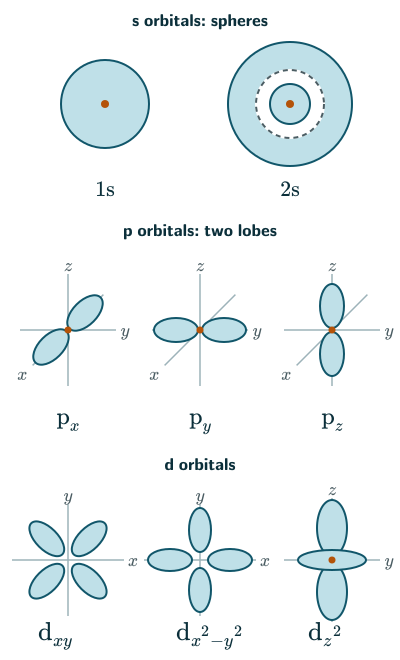
Nodes. There are two kinds (page 59):
- radial nodes, spheres where the probability density is zero: an orbital has n − l − 1 of them (so ns has n − 1, np has n − 2);
- angular nodes, planes (or cones) through the nucleus: an orbital has l of them. For pz the xy-plane is a nodal plane; dxy has two, the xz- and yz-planes. Likewise dyz has the xy- and xz-planes, dxz the xy- and yz-planes, and dx2−y2 the planes x = y and x = −y; dz2 has no nodal plane, and its two angular nodes are cones (beyond the NCERT text).
Number of nodes
Radial: n − l − 1; angular: l; total: n − 1
Energies of orbitals
Hydrogen. The energy depends only on n (NCERT Section 2.6.3, page 60):
1s < 2s = 2p < 3s = 3p = 3d < 4s = 4p = 4d = 4f < …
Orbitals of equal energy are degenerate. The electron in the 1s orbital is in the ground state, the most stable state; in 2s, 2p or higher it is in an excited state.
Atoms with many electrons. Here the energy depends on n and l. Within a shell, s < p < d < f, and at higher levels the subshells can overlap: 4s < 3d and 6s < 5d (page 60); likewise 5s < 4d and 6s < 4f. The reason is the repulsion between electrons:
- inner electrons shield an outer electron from part of the nuclear charge, so it feels only an effective nuclear charge, Zeffe, smaller than Ze;
- an s electron spends more time close to the nucleus than a p electron of the same shell, and a p electron more than a d electron, so in the same shell Zeff falls as l rises: s electrons are held most tightly and have the lowest energy (page 61);
- the energy of a given orbital falls as the atomic number rises: E2s(H) > E2s(Li) > E2s(Na) > E2s(K).
A useful approximate filling rule gives the order for many neutral ground-state atoms; orbital energies also depend on electron occupation and ionic charge:
the lower the value of (n + l) for an orbital, the lower is its energy. If two orbitals have the same value of (n + l), the orbital with lower value of n will have the lower energy.
NCERT Chemistry Part I (Class 11), Section 2.6.3, page 61
| Orbital | n | l | n + l |
|---|---|---|---|
| 3p | 3 | 1 | 4 |
| 4s | 4 | 0 | 4 |
| 3d | 3 | 2 | 5 |
| 4p | 4 | 1 | 5 |
| 5s | 5 | 0 | 5 |
So 3p (n = 3) comes before 4s, and 3d, 4p and 5s, all with n + l = 5, come in order of n (NCERT Table 2.5 runs from 1s to 4p; 5s is added here).
Filling the orbitals: aufbau, Pauli and Hund
Electrons go into orbitals according to three rules (NCERT Section 2.6.4, pages 61–63).
Aufbau principle (German aufbau, “building up”):
In the ground state of the atoms, the orbitals are filled in order of their increasing energies.
NCERT Chemistry Part I (Class 11), Section 2.6.4, page 62
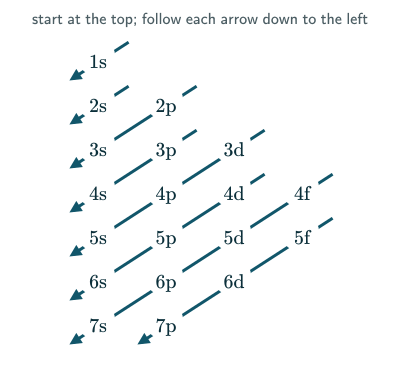
The useful order of energies (page 62) is
1s, 2s, 2p, 3s, 3p, 4s, 3d, 4p, 5s, 4d, 5p, 6s, 4f, 5d, 6p, 7s, …
It is the (n + l) rule in practice, and the diagonal diagram gives it at a glance. Potassium’s outermost electron, for example, goes into 4s rather than 3d. The order is a rough guide: where orbitals are close in energy, exceptions occur.
Pauli exclusion principle. Wolfgang Pauli stated it in 1925 (NCERT dates it 1926):
No two electrons in an atom can have the same set of four quantum numbers.
NCERT Chemistry Part I (Class 11), Section 2.6.4, page 62
Two electrons in the same orbital share n, l and ml, so they must differ in ms: an orbital holds at most two electrons, with opposite spins. Hence an s subshell holds 2 electrons, p 6, d 10 and f 14, and shell n holds at most 2n (page 62).
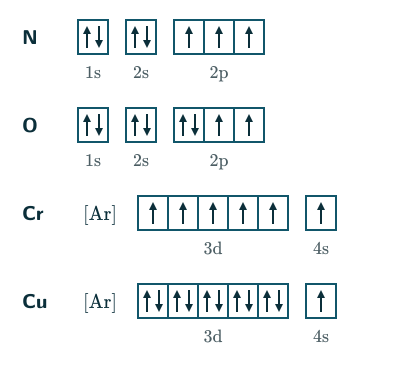
Hund’s rule of maximum multiplicity. In a set of degenerate orbitals (a p, d or f subshell), electrons do not pair up until every orbital of the subshell has one electron (pages 62–63). The single electrons have parallel spins. So pairing begins with the 4th electron in a p subshell, the 6th in d and the 8th in f.
Electronic configurations
The distribution of electrons into orbitals of an atom is called its electronic configuration.
NCERT Chemistry Part I (Class 11), Section 2.6.5, page 63
It is written in two ways (page 63):
- the sapbdc notation, giving each subshell with its number of electrons as a superscript, such as 1s2 2s2 2p3 for nitrogen;
- the orbital diagram, a box for each orbital and an arrow for each electron (↑ for +½, ↓ for −½). With the orbitals labelled, it shows their occupations and spin projections; individual electrons are indistinguishable.
Building up the elements (pages 63–64):
- H 1s1 and He 1s2; the third electron of lithium cannot enter 1s (Pauli), so Li is 1s2 2s1 and Be 1s2 2s2.
- From boron (1s2 2s2 2p1) to neon (1s2 2s2 2p6) the 2p orbitals fill.
- Sodium to argon repeat the pattern in 3s and 3p. Writing [Ne] for the neon core, Na is [Ne] 3s1 and Ar is [Ne] 3s2 3p6. Electrons in completely filled inner shells are core electrons; for main-group atoms, those in the outermost shell are valence electrons. Transition-metal bonding can also involve electrons from an incomplete (n − 1)d subshell.
- Potassium and calcium put one and two electrons into 4s, which is lower than 3d.
- From scandium to zinc the five 3d orbitals fill, then 4p from gallium to krypton.
- Rubidium to xenon repeat this with 5s, 4d and 5p; caesium and barium fill 6s; lanthanum to mercury fill 4f and 5d; then come 6p, 7s, 5f and 6d.
NCERT says the elements after uranium are all short-lived and made artificially (page 64); in fact traces of neptunium and plutonium occur in uranium ores, and plutonium-244 has a half-life of about 80 million years. NCERT’s Table 2.6 (pages 66–67) lists the configurations; its footnote calls elements 112 and above not yet named, but all elements up to 118 were named by 2016.
Why bother? Almost all of modern chemistry explains behaviour through electron arrangements: why atoms combine, why some elements are metals, why helium and argon are unreactive while the halogens are reactive (page 64). These questions have no answer in Dalton’s model.
Stability of half-filled and completely filled subshells
The ground state electronic configuration of the atom of an element always corresponds to the state of the lowest total electronic energy.
NCERT Chemistry Part I (Class 11), Section 2.6.6, page 64
In chromium and copper the 4s and 3d subshells are very close in energy. An electron moves from 4s into 3d when that leaves 3d exactly half-filled or completely filled: Cr is [Ar] 3d5 4s1, not 3d4 4s2, and Cu is [Ar] 3d10 4s1, not 3d9 4s2 (page 64). Half-filled and filled sets such as p3, p6, d5, d10, f7 and f14 are especially stable, for two reasons (page 65; NCERT’s pages 63 and 64 call this “Section 2.6.7”, but it is Section 2.6.6):
- Symmetrical distribution. The electrons of a half-filled or filled subshell are spread evenly in space, so they shield one another relatively little and are held more strongly by the nucleus.
- Exchange energy. The antisymmetry of a many-electron wave function produces an exchange contribution that favours parallel spins in different orbitals. The textbook “exchange” picture counts same-spin electron pairs; it does not mean electrons literally swap places and release a packet of energy each time. Half-filled and filled configurations have many such pairs. For d5, NCERT Fig. 2.18 counts 4 + 3 + 2 + 1 = 10 exchanges. Exchange energy is also the reason behind Hund’s rule.
In general, k electrons of the same spin in a subshell can make k(k − 1)/2 exchanges (beyond the NCERT text). Count the ↑ and ↓ electrons separately and add: d6 has 10 + 0 = 10, d10 has 10 + 10 = 20. So 3d5 (all parallel) has 10, while 3d4 has only 6: one reason chromium prefers 3d5 4s1. The same extra stability is why nitrogen (2p3, all single) has a higher first ionisation enthalpy than oxygen (2p4, one pair), and phosphorus than sulphur (NCERT Unit 3). These are qualitative guides: the observed ground state minimises the total energy, including orbital energies, repulsion, exchange and correlation; half-filled or filled subshells are not a universal rule overriding all other contributions. NCERT warns that exceptions to the filling order also exist elsewhere; its Table 2.6 marks several more as exceptional, among them niobium, molybdenum, ruthenium, rhodium, palladium and silver.
Solved examples
Example 1: Orbitals in the third shell (NCERT Problem 2.17, page 57)
How many orbitals are there for n = 3?
l = 0, 1, 2. One 3s orbital (ml = 0), three 3p (ml = −1, 0, +1) and five 3d (ml = −2 to +2): 1 + 3 + 5 = 9. Check: n = 3 = 9.
Answer: 9 orbitals.
Example 2: Naming orbitals (NCERT Problem 2.18, page 57)
Give the s, p, d, f name of the orbital with (a) n = 2, l = 1; (b) n = 4, l = 0; (c) n = 5, l = 3; (d) n = 3, l = 2.
Write n, then the letter for l (0 s, 1 p, 2 d, 3 f).
Answer: (a) 2p; (b) 4s; (c) 5f; (d) 3d.
Example 3: Counting nodes
How many radial and angular nodes do the 3p, 4d and 5s orbitals have?
Radial nodes = n − l − 1; angular nodes = l.
- 3p: n = 3, l = 1: 1 radial, 1 angular.
- 4d: n = 4, l = 2: 1 radial, 2 angular.
- 5s: n = 5, l = 0: 4 radial, 0 angular.
Answer: in each case the total is n − 1: 2, 3 and 4.
Example 4: Ordering by the (n + l) rule
Use the approximate (n + l) filling rule to order 4s, 3d, 4p, 5s and 4f. Do not interpret this as a universal energy order for every atom and ion.
n + l: 4s 4; 3d 5; 4p 5; 5s 5; 4f 7. Among the three with 5, lower n comes first: 3d, then 4p, then 5s.
Answer: 4s < 3d < 4p < 5s < 4f.
Example 5: Iron and chromium
Write the configurations of Fe (Z = 26) and Cr (Z = 24), and count their unpaired electrons.
Fe: 26 electrons, filled in order: [Ar] 3d6 4s2. Hund: five 3d orbitals take one electron each, and the sixth pairs, so 4 are unpaired.
Cr: aufbau alone gives [Ar] 3d4 4s2, but the half-filled 3d is more stable, so Cr is [Ar] 3d5 4s1 (NCERT page 64). Five single 3d electrons and one 4s: 6 unpaired.
Answer: Fe [Ar] 3d6 4s2, 4 unpaired; Cr [Ar] 3d5 4s1, 6 unpaired.
Unpaired electrons give iron and chromium atoms, and ions such as Fe2+, a magnetic moment; in iron metal these moments line up in domains, so metallic iron is ferromagnetic, not paramagnetic (NCERT Class 12 Physics Part I, page 149). For a free atom or high-spin ion when orbital contributions are neglected, u unpaired electrons give the approximate spin-only magnetic moment is √(u(u + 2)) BM: 4.90 BM for free Fe or high-spin Fe2+ (u = 4) and 6.93 BM for Cr (u = 6). This formula appears in the Class 12 d-block unit.
Example 6: Exchanges in chromium
Count the possible exchanges between parallel 3d electrons in 3d4 and in 3d5.
With k parallel electrons, each pair can exchange once: k(k − 1)/2.
3d4: 4 × 3/2 = 6. 3d5: 5 × 4/2 = 10, matching NCERT Fig. 2.18 (4 + 3 + 2 + 1).
Answer: 6 and 10; the larger exchange energy of 3d5 helps make Cr [Ar] 3d5 4s1.
Common mistakes to avoid
Common mistake
Letting l run from 1 to n
l runs from 0 to n − 1. So there is no 1p, 2d or 3f orbital, and d orbitals start at n = 3, f at n = 4.
Common mistake
Pairing too early
By Hund’s rule nitrogen’s three 2p electrons occupy three different orbitals with parallel spins. Drawing a pair and an empty box is wrong.
Common mistake
Removing 3d electrons first from a transition metal
4s fills before 3d, but when a transition-metal atom forms a positive ion, the 4s electrons leave first. So Fe2+ is [Ar] 3d6, not [Ar] 3d4 4s2 (beyond the Class 11 text; NCERT Class 12 Chemistry, Unit 4, page 95, gives the rule).
Common mistake
Matching p orbitals to values of the magnetic quantum number
There is no simple match between ml = −1, 0, +1 and px, py, pz (NCERT page 59); only pz has a single value, ml = 0. Just remember that there are three p orbitals, at right angles to one another.
Common mistake
Confusing probability density with radial probability
For hydrogen 1s, |ψ| is largest at the nucleus, but the probability of finding the electron in a thin shell at distance r, 4πr|ψ| dr, is zero at the nucleus and peaks at 52.9 pm, Bohr’s radius (beyond the NCERT text).
Quick revision summary
- An orbital is a wave function ψ from Schrödinger’s equation, Ĥψ = Eψ; |ψ| is the probability density. An orbit is not an orbital.
- n = 1, 2, 3, … (shell, size, energy); l = 0 to n − 1 (subshell s, p, d, f; shape); ml = −l to +l (2l + 1 orientations); ms = ±½ (spin).
- Shell n: n subshells, n orbitals, at most 2n electrons; subshells hold 2, 6, 10, 14.
- s spherical; p two lobes (px, py, pz); five d orbitals, dz2 shaped differently. Nodes: n − l − 1 radial, l angular, n − 1 in all.
- In the non-relativistic hydrogen model, energy depends on n only. In many-electron atoms it also depends on subshell and occupation; (n + l) is an approximate filling guide, not an exact universal energy law.
- Filling: aufbau (1s 2s 2p 3s 3p 4s 3d 4p 5s …), Pauli (no two electrons with all four quantum numbers the same) and Hund (no pairing until each orbital has one electron).
- Half-filled and filled subshells are extra stable (symmetry, exchange energy): Cr [Ar] 3d5 4s1, Cu [Ar] 3d10 4s1.
Formula sheet
- Ĥψ = Eψ
- Shell n: n subshells, n orbitals, 2n electrons
- l = 0, 1, …, n − 1; m = −l, …, +l (2l + 1 values); m = ±½
- Nodes: radial n − l − 1, angular l, total n − 1
- (n + l) rule: lower n + l, lower energy; equal n + l, lower n first
- Exchanges = k(k − 1)/2 for each set of k parallel electrons; add the two spin sets
Questions students ask
Who proposed the quantum mechanical model of the atom?
The quantum mechanical model of the atom was built mainly by Erwin Schrödinger, whose wave equation of 1926 gives the allowed energies and orbitals of an electron, on the foundations of de Broglie’s matter waves (1924) and Werner Heisenberg’s matrix mechanics (1925). Max Born showed in 1926 that the square of the wave function gives the probability density of finding the electron at a point, and Heisenberg’s uncertainty principle (1927) explained why the electron has no definite path. No single scientist created it, but Schrödinger’s equation is at its centre, which is why it is also called the wave mechanical model.
What is the difference between the aufbau principle, Pauli’s exclusion principle and Hund’s rule?
The aufbau principle, Pauli’s exclusion principle and Hund’s rule answer three different questions about filling orbitals: aufbau says which orbital fills next (the lowest in energy, by the (n + l) rule), Pauli says how many electrons one orbital can hold (two, with opposite spins, since no two electrons can share all four quantum numbers), and Hund says how electrons spread over orbitals of equal energy (singly, with parallel spins, before any pairing). In carbon, 1s2 2s2 2p2, aufbau fills 1s and 2s before 2p, Pauli puts two electrons of opposite spin in each s orbital, and Hund puts the two 2p electrons in different 2p orbitals with the same spin.
Why is Hund’s rule called the rule of maximum multiplicity?
Hund’s rule is called the rule of maximum multiplicity because placing electrons singly, with parallel spins, in orbitals of equal energy makes their total spin S, and so the spin multiplicity 2S + 1, as large as possible, and that arrangement has the lowest energy. Oxygen’s 2p4, with one pair and two parallel single electrons, has S = 1 and a multiplicity of 3; putting its four 2p electrons into two pairs would give S = 0 and a multiplicity of only 1. The rule applies only to a set of orbitals of equal energy, so it says nothing about an s subshell, which has a single orbital. NCERT uses the rule’s name but does not define multiplicity.
Why is the electronic configuration of potassium 2, 8, 8, 1 and not 2, 8, 9?
Potassium is 2, 8, 8, 1 because its 19th electron goes into the 4s orbital, which is lower in energy than 3d: by the (n + l) rule, 4s has 4 + 0 = 4 and 3d has 3 + 2 = 5. So potassium is 1s2 2s2 2p6 3s2 3p6 4s1, and its third shell, though it can hold 2n = 18 electrons, has only 8. The third shell reaches 18 only later, as the 3d orbitals fill from scandium (2, 8, 9, 2) to zinc (2, 8, 18, 2).
Is the quantum mechanical model in the JEE Main 2027 and NEET (UG) 2026 syllabuses?
Yes, the quantum mechanical model is in the JEE Main 2027 and NEET (UG) 2026 Chemistry syllabuses, Unit 2 (Atomic Structure), which list its important features, atomic orbitals as one-electron wave functions, the variation of ψ and ψ with r for 1s and 2s orbitals, quantum numbers, the shapes of s, p and d orbitals, electron spin, the aufbau, Pauli and Hund rules, electronic configurations and the extra stability of half-filled and filled orbitals. Quantum mechanics itself is listed only as ‘elementary ideas’, and NCERT does not solve Schrödinger’s equation. The shapes of f orbitals are not listed.
Practice questions
Try each question first, then open the answer to check your working.
-
Q1. Which of these sets of quantum numbers are not possible, and why? (a) n = 0, l = 0, ml = 0, ms = +½; (b) n = 1, l = 0, ml = 0, ms = −½; (c) n = 1, l = 1, ml = 0, ms = +½; (d) n = 2, l = 1, ml = 0, ms = −½; (e) n = 3, l = 3, ml = −3, ms = +½; (f) n = 3, l = 1, ml = 0, ms = +½ (NCERT Exercise 2.30, pages 70–71).
Show answerHide answer
Not possible: (a), because n cannot be 0; (c), because l must be less than n (for n = 1, l = 0 only); (e), because for n = 3, l can be at most 2. Sets (b), (d) and (f) are possible.
-
Q2. Arrange these electrons in order of increasing energy, and say which have the same energy: 1. n = 4, l = 2; 2. n = 3, l = 2; 3. n = 4, l = 1; 4. n = 3, l = 2; 5. n = 3, l = 1; 6. n = 4, l = 1 (values of ml and ms do not affect the energy; NCERT Exercise 2.62, pages 72–73).
Show answerHide answer
They are 4d, 3d, 4p, 3d, 3p and 4p, with n + l = 6, 5, 5, 5, 4 and 5. By the (n + l) rule: 5 (3p) < 2 = 4 (3d) < 3 = 6 (4p) < 1 (4d). Electrons 2 and 4 have the same energy, and so do 3 and 6. In NCERT’s full question, electrons 3 and 6 also share ml = 0 and ms = +½, so they cannot be in the same atom (Pauli).
-
Q3. How many unpaired electrons are there in (a) P, (b) Si, (c) Cr, (d) Fe and (e) Kr (NCERT Exercise 2.66, page 73)?
Show answerHide answer
(a) P, [Ne] 3s2 3p3: 3. (b) Si, [Ne] 3s2 3p2: 2. (c) Cr, [Ar] 3d5 4s1: 6. (d) Fe, [Ar] 3d6 4s2: 4. (e) Kr, all subshells filled: 0.