Group 17 elements: the halogens
Beyond NCERT In the JEE Main and NEET syllabus; the Class 12 book has no section for it.
Quick answer
Group 17, the halogens, has seven valence electrons and includes fluorine, chlorine, bromine, iodine, astatine and tennessine. Fluorine through iodine form diatomic elements, with standard aqueous oxidising power decreasing down that series. Fluorine has oxidation state minus one in compounds, chlorine has the most negative electron gain enthalpy, and hydrogen fluoride is a weak acid in dilute water.
What are the group 17 elements?
Group 17: the halogens
Group 17 is the fifth group of the p-block: fluorine (F), chlorine (Cl), bromine (Br), iodine (I), the radioactive astatine (At) and the synthetic tennessine (Ts). They are the halogens, “salt formers”: with metals they form salts such as sodium chloride (Wikipedia, “Halogen”). Each atom has seven valence electrons, ns np, one short of the next noble gas.
- They gain one electron readily: their electron gain enthalpies are highly negative (NCERT Class 11 Chemistry, page 84).
- They are strong oxidising agents. In NCERT’s words:
The power of these elements as oxidising agents decreases as we move down from fluorine to iodine in group 17 of the periodic table.
NCERT Chemistry Part II (Class 11), Section 7.3.1, page 243
- Fluorine is unlike the rest: being the most electronegative element, it never shows a positive oxidation state (NCERT Class 11 Chemistry, page 244).
In plain words: the halogens are the most eager electron-takers among the non-metals. Fluorine is the fiercest of all; the eagerness fades down the group, so chlorine pulls electrons from bromide and iodide, but not the other way round.
Scope: ordinary molecular and bulk-property trends below concern fluorine through iodine. Astatine has limited experimental chemistry and tennessine has no established bulk chemistry. Elemental halogens have oxidation state zero; fluorine is −1 in its compounds.
No 2026–27 NCERT textbook has a chapter on the p-block; the JEE Main 2027 and NEET (UG) 2026 syllabuses list it in Unit 10. NCERT’s Class 11 chapters on periodicity and on redox reactions cover much of the halogens’ chemistry, and this page brings it together with labelled facts and data from beyond the NCERT books.
Electronic configuration ns np and oxidation states
| Element | Z | Electronic configuration |
|---|---|---|
| F | 9 | [He] 2s2 2p5 |
| Cl | 17 | [Ne] 3s2 3p5 |
| Br | 35 | [Ar] 3d10 4s2 4p5 |
| I | 53 | [Kr] 4d10 5s2 5p5 |
| At | 85 | [Xe] 4f14 5d10 6s2 6p5 |
| Ts | 117 | [Rn] 5f14 6d10 7s2 7p5 |
- The configurations follow the aufbau order (NCERT Class 11 Chemistry, Unit 2).
- −1. By gaining one electron each halogen reaches a noble gas configuration (NCERT Class 11 Chemistry, page 84), and −1 is the state in all halides.
- Fluorine is only −1: it cannot show a positive oxidation state (NCERT Class 11 Chemistry, page 244; Wikipedia, “Fluorine”).
- Positive states. Chlorine, bromine and iodine show positive states with oxygen, in their oxoacids and oxoanions (NCERT Class 11 Chemistry, page 240). For chlorine they run +1, +3, +5 and +7, as in ClO−, ClO2−, ClO3− and ClO4− (NCERT Problem 7.5, Class 11 Chemistry, page 244). The highest, +7, is the group valence (NCERT Class 11 Chemistry, page 241).
- NCERT slip (Class 11 Chemistry, page 241): the table of highest oxidation states lists HClO as the chlorine compound with +7. In HClO, hypochlorous acid, chlorine is +1 (1 + x − 2 = 0). The +7 compound is HClO4, perchloric acid (1 + x − 8 = 0), as the ClO4− of NCERT’s own Problem 7.5 shows (page 244). In an exam, write HClO4 for +7.
- NCERT slip (Class 11 Chemistry, page 84): Problem 3.3 says element 117 has “not yet been discovered”. It was first made in 2010 and is now named tennessine, Ts (Wikipedia, “Halogen”); NCERT’s own Table 3.5 (page 80) already gives that name. NCERT’s answer still stands: element 117 belongs to group 17, with the configuration [Rn] 5f14 6d10 7s2 7p5. In an exam, place it in group 17 as NCERT does.
Atomic radius, ionisation enthalpy and electronegativity down the group
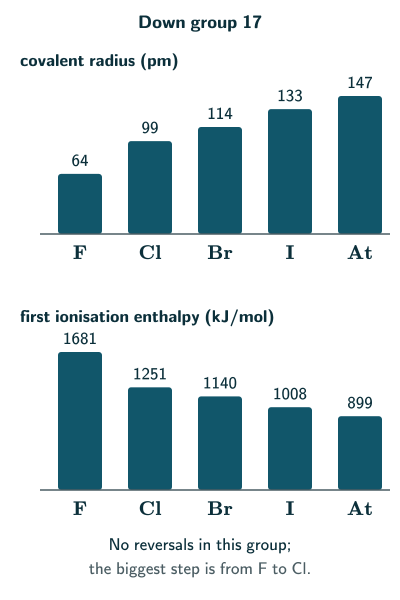
Covalent radius in pm, first ionisation enthalpy ΔiH1 in kJ mol−1, and electronegativity (EN) on the Pauling scale:
| Element | Radius | ΔiH1 | EN |
|---|---|---|---|
| F | 64 | 1681 | 3.98 |
| Cl | 99 | 1251 | 3.16 |
| Br | 114 | 1140 | 2.96 |
| I | 133 | 1008 | 2.66 |
| At | 147 | 899 | 2.2 |
Radii follow the Pyykkö–Atsumi molecular single-bond scale (2009); ionisation enthalpies are rounded atomic values (NIST), and electronegativities use the stated Pauling scale. All three are as tabulated in the Wikipedia data pages “Atomic radii of the elements”, “Molar ionization energies of the elements” and “Electronegativities of the elements”, the data pages cited below. NCERT gives the same radii for F to I, but 140 pm for At, and electronegativities of 4.0, 3.0, 2.8, 2.5 and 2.2 (NCERT Class 11 Chemistry, Tables 3.6(b) and 3.8(b), pages 86 and 91).
- Atomic radius increases down the group: the valence electrons are in shells further from the nucleus (NCERT Class 11 Chemistry, page 86).
- Ionisation enthalpy is very high and falls down the group (data page). The halogens hardly lose electrons; they gain them.
- Electronegativity decreases down the group; fluorine is the most electronegative element of all (NCERT Class 11 Chemistry, page 91).
- Electron gain enthalpy is large and negative, as it is towards the upper right of the periodic table, but it is not most negative for fluorine (NCERT Class 11 Chemistry, Table 3.7 and page 90), in kJ mol−1:
| Element | ΔegH |
|---|---|
| F | −328 |
| Cl | −349 |
| Br | −325 |
| I | −295 |
| At | −270 |
An electron added to fluorine’s small 2p shell is strongly repelled by the electrons already there; in chlorine’s larger 3p shell it is repelled much less, so chlorine’s value is the most negative (NCERT Class 11 Chemistry, page 90).
Astatine’s −270 is NCERT’s value. Leimbach and colleagues measured astatine’s electron affinity as 2.41578 eV, approximately 233 kJ mol−1 (Nature Communications, 2020), against iodine’s 295 (NCERT’s Table 3.7, page 90, gives −295), so astatine stays the least negative of the group. In an exam, use NCERT’s −270.
Physical properties
Melting and boiling points in K, density in g cm−3 (fluorine: g L−1 at 0 °C and 1 atm):
| Element | m.p. | b.p. | Density |
|---|---|---|---|
| F | 53 | 85 | 1.7 g L−1 |
| Cl | 172 | 239 | 1.5649 (liquid, −35 °C) |
| Br | 266 | 332 | 3.1028 |
| I | 387 | 458 | 4.933 |
Values from the Wikipedia data pages for melting points, boiling points (CRC values) and densities; astatine is too radioactive for reliable bulk values.
- States. The halogens are the only group with members in three states at room conditions: fluorine and chlorine are gases, bromine a liquid and iodine a solid (Wikipedia, “Halogen”; data pages).
- Melting and boiling points rise down the group, because the larger molecules have stronger London dispersion forces between them (Wikipedia, “Halogen”).
- Colour deepens down the group (Wikipedia, “Iodine”). Fluorine is a pale yellow gas (Wikipedia, “Fluorine”); chlorine is named for its greenish-yellow colour, and iodine for the violet of its vapour, which condenses to black crystals (Wikipedia, “Halogen”). Bromine is reddish brown (NCERT Chemistry Part II (Class 12), Unit 6, page 165), and solid iodine in a closed vessel fills it with violet vapour (NCERT Class 11 Chemistry, Unit 6, page 170).
- Molecules. All the stable halogens form diatomic molecules, X2. The F–F bond is very weak, much weaker than Cl–Cl or Br–Br (Wikipedia, “Halogen” and “Fluorine”).
Chemical properties: hydrides, oxides and halides
- Standard aqueous oxidising power falls down the group (NCERT Class 11 Chemistry, page 243; Wikipedia, “Halogen”). Fluorine is the most reactive of all the elements (Wikipedia, “Halogen”).
- The standard electrode potentials show it: E⊖ is 2.87 V for F2/F−, 1.36 V for Cl2/Cl−, 1.09 V for Br2/Br− and 0.54 V for I2/I− (NCERT Class 11 Chemistry, Table 7.1, page 251). Fluorine heads the list although chlorine’s electron gain enthalpy is more negative. One reason is its weak bond: the bond enthalpies run Cl–Cl 243 > Br–Br 192 > F–F 155 > I–I 151 kJ mol−1 (NCERT Class 11 Chemistry, Table 5.3(a), page 154), so F2 costs relatively little to split into atoms. Strong hydration of the small fluoride ion is another major contribution; electron affinity alone does not determine aqueous reduction potential.
- So a halogen displaces the ones below it from their halides: Cl2 + 2Br− → 2Cl− + Br2, Cl2 + 2I− → 2Cl− + I2 and Br2 + 2I− → 2Br− + I2 (NCERT Class 11 Chemistry, page 243). These reactions are the basis of the layer test for bromide and iodide (NCERT page 243).
- Fluorine even attacks water, taking its oxygen: 2F2 + 2H2O → 4HF + O2 (NCERT Class 11 Chemistry, page 243).
- Hydrides, HX. All the halogens form hydrogen halides, H2 + X2 → 2HX; the reaction grows less vigorous down the group, explosive for fluorine even in the dark and cold (Wikipedia, “Halogen”); with iodine it is reversible, H2 + I2 ⇌ 2HI (NCERT Class 11 Chemistry, Unit 6, page 174).
- Acid strength. All form acids in water. HF is a weak acid in dilute water, Ka = 3.5 × 10⁻⁴ (NCERT Class 11 Chemistry, Table 6.6, page 195), while HCl, HBr and HI are strong acids (NCERT Class 11 Chemistry, pages 192–193). Down a group, acid strength rises as the H–X bond weakens (NCERT Class 11 Chemistry, Section 6.11.7, page 200), giving the usual intrinsic trend HF < HCl < HBr < HI. In water HCl, HBr and HI are effectively levelled to strong acids by the solvent; the H–X bond enthalpies are 569, 431, 368 and 297 kJ mol−1 (NCERT Table 5.3(a), page 154). The weak H–I bond also makes HI the least stable to heat, and the strongest reducing agent of the four, since I2 is the weakest oxidant (reasoned).
- Boiling and melting points. Only HF forms hydrogen bonds, so it has the highest boiling point of the series, 19.5 °C; from HCl to HI the boiling point rises with the van der Waals forces (Wikipedia, “Hydrogen halide”). Its melting point, −83.6 °C, is not the highest: HI melts at −50.8 °C (Wikipedia, “Hydrogen fluoride” and “Hydrogen iodide”).
- Oxides. Chlorine forms many oxides, such as Cl2O (+1), ClO2 (+4) and Cl2O7 (+7) (Wikipedia, “Chlorine oxide”; NCERT Class 11 Chemistry, Table 3.9, page 93, lists Cl2O7). With fluorine, oxygen is the less electronegative partner: in OF2 oxygen is +2 (NCERT Class 11 Chemistry, page 92), and in O2F2 it is +1 (page 240).
- Oxoacids. Chlorine forms four: hypochlorous acid HClO (also written HOCl), chlorous acid HClO2, chloric acid HClO3 and perchloric acid HClO4, with chlorine +1, +3, +5 and +7 (Wikipedia, “Chlorine”). Their strength rises with the oxidation state, HClO < HClO2 < HClO3 < HClO4, because the anion’s negative charge is spread over more and more oxygen atoms (Wikipedia, “Chlorine”). At the two ends, HClO is a weak acid, Ka = 3.0 × 10⁻⁸ (NCERT Class 11 Chemistry, Table 6.6, page 195), and HClO4 a strong one (pages 192–193). Chlorine water holds HClO: Cl2 + H2O ⇌ HCl + HClO (Wikipedia, “Halogen”).
- Halides and interhalogens. All the halogens react with sodium, giving NaF, NaCl, NaBr and NaI (Wikipedia, “Halogen”). Halogens also combine with each other in interhalogen compounds, XYn, with n = 1, 3, 5 or 7, such as ClF3 and IF7; they are generally more reactive than the halogens themselves, except F2 (Wikipedia, “Halogen”). Weak bonds are part of the reason, though not a rule for every interhalogen: in ClF the Cl–F bond, 255 kJ mol−1, is stronger than Cl–Cl, 243 (NCERT Class 11 Chemistry, Table 5.3(a), page 154), but the mean Cl–F bond in ClF3 is much weaker (practice Q8 works out by how much). Reaction rates and products also depend on the full pathway; mean bond energy alone cannot rank reactivity. ClF3 is T-shaped, with its two lone pairs in equatorial positions, and BrF5 is a square pyramid (NCERT Class 11 Chemistry, Tables 4.7 and 4.8, pages 115 and 117).
- In alkali, chlorine disproportionates, from 0 to −1 and +1: Cl2 + 2OH− → ClO− + Cl− + H2O, which is how household bleach is made; bromine and iodine “follow the same trend as exhibited by chlorine” (NCERT Class 11 Chemistry, page 244). Beyond the NCERT text: their hypohalites differ in stability, and the hypoiodite ions formed disproportionate at once to iodide and iodate (Wikipedia, “Iodine”). The hypochlorite can disproportionate further, 3ClO− → 2Cl− + ClO3− (NCERT Problem 7.5, page 244), but below about 70 °C this step is slow (Wikipedia, “Chlorine”). So hot alkali gives chlorate: 3Cl2 + 6OH− → 5Cl− + ClO3− + 3H2O (reasoned).
Anomalous behaviour of fluorine
Fluorine differs from the rest because it is very small, the most electronegative element and has no d orbitals in its valence shell (NCERT Class 11 Chemistry, page 93).
- −1 in compounds. Fluorine shows no positive oxidation state, so it does not disproportionate; with alkali it gives OF2 instead: 2F2 + 2OH− → 2F− + OF2 + H2O (NCERT Class 11 Chemistry, page 244).
- Strongest oxidising agent. F2 displaces every other halogen and even attacks water; NCERT adds that “there is no way to convert F– ions to F2 by chemical means”, so F2 is made by electrolysis (NCERT Class 11 Chemistry, pages 243–244).
- NCERT slip (Class 11 Chemistry, page 244): a chemical route does exist. Christe reported a chemical synthesis of elemental fluorine in 1986, from K2MnF6 and SbF5 (Inorganic Chemistry, “Chemical synthesis of elemental fluorine”; Wikipedia, “Fluorine”); electrolysis remains the practical and industrial route. In an exam, give NCERT’s answer: fluorine is obtained by electrolysis.
- Weak F–F bond. The F–F bond, 155 kJ mol−1, is far weaker than Cl–Cl, 243 (NCERT Class 11 Chemistry, Table 5.3(a), page 154), and close to the easily broken peroxide bond, which adds to fluorine’s reactivity (Wikipedia, “Fluorine”).
- Less negative electron gain enthalpy than chlorine’s, because of crowding in the small 2p shell (NCERT Class 11 Chemistry, page 90).
- Hydrogen fluoride forms hydrogen bonds, has the highest boiling point of the hydrogen halides, and is the only weak acid among them (Wikipedia, “Hydrogen halide” and “Halogen”).
Solved examples
Example 1: Which displacements happen?
Predict whether a reaction occurs: (a) Br2 + 2Cl−; (b) Cl2 + 2I−; (c) I2 + 2Br−.
Answer: For ordinary aqueous halide tests, the standard-potential order predicts oxidation of the halide ions below the added halogen. Nonstandard activities can change cell potentials; fluorine also reacts with the water itself. (a) No: bromine is a weaker oxidising agent than chlorine. (b) Yes: Cl2 + 2I− → 2Cl− + I2. (c) No: iodine is weaker than bromine (NCERT Class 11 Chemistry, page 243).
Example 2: Oxidation states of chlorine
Find the oxidation state of chlorine in Cl2O, HClO2, KClO3, Cl2O7 and ClF3.
Answer: Cl2O: 2x − 2 = 0, +1. HClO2: 1 + x − 4 = 0, +3. KClO3: 1 + x − 6 = 0, +5. Cl2O7: 2x − 14 = 0, +7. ClF3: fluorine is −1, so x − 3 = 0, +3 (reasoned; rules for oxidation numbers).
Example 3: Bleach from chlorine
In Cl2 + 2OH− → ClO− + Cl− + H2O, show that chlorine is both oxidised and reduced, and find the volume of Cl2 at 273.15 K and 1 bar needed for 0.50 mol of ClO− (molar volume 22.7 L mol−1).
Answer: Chlorine goes from 0 in Cl2 to +1 in ClO− (oxidised) and to −1 in Cl− (reduced): a disproportionation (NCERT Class 11 Chemistry, page 244). One Cl2 gives one ClO−, so 0.50 mol Cl2 is needed: 0.50 × 22.7 = 11.4 L (reasoned).
Example 4: Why HF boils highest but is the weakest acid
HF boils at 19.5 °C, far above HCl. Yet in water it is a weak acid while HCl is strong. Explain both.
Answer: HF alone forms hydrogen bonds between its molecules, which must be broken to boil it (Wikipedia, “Hydrogen halide”). In water the H–F bond, 569 kJ mol−1, is the strongest of the H–X bonds (H–Cl 431; NCERT Class 11 Chemistry, Table 5.3(a), page 154), so HF gives up its proton least readily: down a group, acid strength rises as the H–X bond weakens (NCERT Class 11 Chemistry, Section 6.11.7, page 200).
Common mistakes to avoid
Common mistake
Giving fluorine the most negative electron gain enthalpy
Chlorine’s is the most negative, −349 against −328 kJ mol−1 for fluorine: the added electron is crowded in fluorine’s small 2p shell. Fluorine is, however, the most electronegative element.
Common mistake
Giving fluorine positive oxidation states
Fluorine is −1 in all its compounds. Only Cl, Br and I show +1, +3, +5 and +7.
Common mistake
Calling HF the strongest hydrohalic acid
HF is a weak acid; HI is the strongest. HF does have the highest boiling point, because of hydrogen bonding.
Common mistake
Writing HClO for chlorine’s +7 state
HClO is hypochlorous acid, with chlorine +1. Chlorine’s +7 is in HClO4 and Cl2O7.
Quick revision summary
- Group 17 (halogens): F, Cl, Br, I, At (and Ts); valence configuration ns np.
- Oxidation states: −1 for all; Cl, Br, I also +1, +3, +5, +7; F −1 in compounds, 0 as F.
- Radius rises, ionisation enthalpy and electronegativity fall; electron gain enthalpy is most negative for Cl, not F.
- Oxidising power F > Cl > Br > I: each halogen displaces those below it from their salts.
- Acid strength HF < HCl < HBr < HI, as the H–X bond weakens: HF is weak, the rest strong; HF has the highest boiling point (hydrogen bonding), though not the highest melting point.
- Chlorine’s oxoacids grow stronger with its oxidation state, HClO < HClO < HClO < HClO; hot alkali turns chlorine into chloride and chlorate.
- Fluorine is anomalous: −1 in compounds, no disproportionation, weak F–F bond, attacks water.
Formula sheet
- Valence configuration: ns np
- Oxidising power: F > Cl > Br > I
- Cl + 2Br → 2Cl + Br
- 2F + 2HO → 4HF + O
- Cl + 2OH → ClO + Cl + HO
- Electron gain enthalpy (NCERT): Cl → F → Br → I (most negative first)
- Acid strength: HF < HCl < HBr < HI
- Acid strength: HClO < HClO < HClO < HClO
Questions students ask
Why are group 17 elements called halogens?
Group 17 elements are called halogens, a name NCERT uses too (NCERT Class 11 Chemistry, Unit 3, page 84); beyond the NCERT text, it means “salt formers”, from the Greek hals, salt, and genein, to beget, because with metals they form salts such as sodium chloride (Wikipedia, “Halogen”). Johann Schweigger proposed the word in 1811 as a name for chlorine, but Humphry Davy’s “chlorine” stayed, and in 1826 Jöns Jacob Berzelius gave “halogen” to fluorine, chlorine and iodine (same article). The elements’ own names have meanings too: chlorine from chloros, greenish-yellow, bromine from bromos, stench, and iodine from iodes, violet (same article).
Why are halogens coloured?
Halogens are coloured because their X2 molecules absorb part of the visible light and we see the colours that are left: beyond the NCERT text, iodine absorbs most strongly at 520–540 nm, green light, which lifts an electron from a π* orbital into the empty σ* orbital (Wikipedia, “Iodine”, for solutions in non-polar solvents), so iodine looks violet, the complementary colour (reasoned). Down the group the colour deepens, from very pale yellow fluorine to violet iodine (same article), because the π*–σ* gap narrows as the atoms grow, so the absorbed light moves to longer, lower-energy wavelengths (reasoned).
What is the difference between halogens and halides?
Halogens are the group 17 elements themselves, which exist as X2 molecules and act as oxidising agents, while halides are their compounds with less electronegative elements, in which the halogen is −1, as the ion X− in salts such as NaCl or bonded covalently, as in HCl (oxidation states). In redox reactions a halide ion can only lose electrons, acting as a reducing agent: chemical oxidants turn Cl−, Br− and I− back into the halogens, while industrial fluorine is produced electrolytically. Chemical fluorine synthesis is possible under specialised conditions (Christe, Inorganic Chemistry, 1986), so “only by electrolysis” is too absolute.
Why do interhalogen compounds have the formula XY, XY3, XY5 or XY7?
Common neutral, closed-shell interhalogens have the formula XYn with n odd, 1, 3, 5 or 7; this is not a rule excluding ions or radicals: beyond the NCERT text, Wikipedia (“Interhalogen”) puts this down to the halogens’ odd valence, X being the larger, less electronegative halogen. X puts one of its seven valence electrons into each of n bonds and pairs the other 7 − n as (7 − n)/2 lone pairs, a whole number only for odd n, so every electron is paired: the molecules are diamagnetic (reasoned). Relative size helps explain how many Y atoms fit, but a radius ratio alone does not prove molecular stability: iodine, I/F = 133/64 ≈ 2.1 (this page’s radii), reaches IF7, the only XY7, while chlorine, 99/64 ≈ 1.5, and bromine stop at ClF5 and BrF5 (same article).
Are interhalogen compounds in the JEE Main 2027 and NEET (UG) 2026 syllabus?
Interhalogen compounds are not named in the JEE Main 2027 or the NEET (UG) 2026 syllabus: Unit 10, p-Block Elements, gives groups 13 to 18 only a general introduction, configuration, trends in properties and the unique behaviour of the first element, and names no compound. Halogens appear elsewhere: in halogenation and addition reactions (Units 15 and 17), in Unit 16, Organic Compounds Containing Halogens, in detecting and estimating halogens in organic compounds (Units 13 and 20) and as the anions Cl−, Br− and I− of Unit 20’s salt analysis. The p-block syllabus as a whole is on the group 13 page.
Why are group 17 elements diatomic?
The stable halogens, fluorine to iodine, are diatomic because each atom is one electron short of an octet, so two atoms share one pair: as NCERT shows for Cl2, each atom gives one electron to the shared pair and both reach argon’s octet (NCERT Class 11 Chemistry, Unit 4, page 102). One bond completes both octets, leaving no unpaired electron for more bonds (reasoned). The X–X bond lengthens down the group, 144 pm in F2, 199 in Cl2, 228 in Br2 and 267 in I2 (NCERT Class 11 Chemistry, Table 4.3, page 108), and beyond the NCERT text iodine molecules split reversibly into atoms at high temperatures (Wikipedia, “Iodine”).
Practice questions
Try each question first, then open the answer to check your working.
-
Q1. Why does fluorine show only the −1 oxidation state, while chlorine shows +1 to +7 as well?
Show answerHide answer
Fluorine is the most electronegative element, so in every compound it takes electrons and is −1; it cannot show a positive state (NCERT Class 11 Chemistry, page 244). Chlorine is less electronegative than oxygen and fluorine, so bonded to them it shows positive states, +1 to +7 (NCERT Class 11 Chemistry, pages 240 and 244).
-
Q2. Chlorine water is added to potassium iodide solution. What is seen, and why?
Show answerHide answer
Iodine is set free and forms brown triiodide in excess iodide, I2 + I− ⇌ I3−: the solution turns brown, and CCl4 shaken with it turns violet as the iodine moves into it (Wikipedia, “Iodine”: brown in water, violet in CCl4). Cl2 + 2KI → 2KCl + I2: chlorine is the stronger oxidising agent and takes electrons from iodide ions (NCERT Class 11 Chemistry, page 243).
-
Q3. Arrange F, Cl, Br and I in order of increasing electronegativity, and say which has the most negative electron gain enthalpy.
Show answerHide answer
I < Br < Cl < F (NCERT Class 11 Chemistry, Table 3.8(b), page 91: 2.5, 2.8, 3.0, 4.0). Chlorine has the most negative electron gain enthalpy, −349 kJ mol−1 (NCERT Class 11 Chemistry, Table 3.7, page 90).