s, p, d and f blocks of the periodic table
NCERT Class 11 Chemistry Chapter 3 Section 3.6
Quick answer
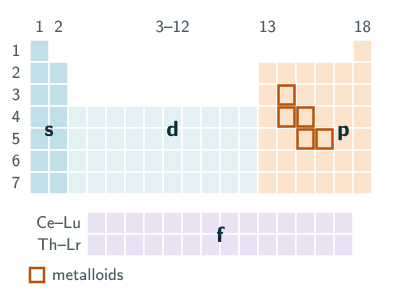
The periodic table has s, p, d and f blocks, named for the subshell being filled across each series. The s-block includes groups 1 and 2 plus helium by configuration; the p-block is groups 13–18 except helium, the d-block groups 3–12, and the f-block the two inner-transition series. Hydrogen and helium are non-metal exceptions to the mainly metallic s-block; actual configurations have further exceptions.
With your textbook
NCERT Chemistry Part I (Class 11), Chapter 3 “Classification of Elements and Periodicity in Properties”, Section 3.6 “Electronic Configurations and Types of Elements: s-, p-, d-, f- Blocks”, pages 82–85.
Open the official NCERT chapter (PDF, 3.4 MB, ncert.nic.in) (opens in a new tab)
Checked against the 2026-27 reprint on .
What are the s, p, d and f blocks?
The four blocks
The elements are grouped into four blocks according to the type of orbital that receives the last electron in the aufbau order (NCERT Section 3.6, pages 82–85):
- s-block: groups 1 and 2 plus helium by configuration, ns1 or ns2; reactive metals except hydrogen and helium;
- p-block: groups 13 to 18 except helium, ns2 np1 to ns2 np6; metals, metalloids and non-metals, ending in the noble gases;
- d-block (including the transition elements): groups 3 to 12, (n − 1)d1–10 ns0–2; all metals;
- f-block (inner transition elements): the lanthanoids and actinoids, (n − 2)f1–14 (n − 1)d0–1 ns2; all metals.
The s- and p-blocks together are the representative or main group elements. These configuration patterns are general guides; f-series exceptions are discussed below.
In plain words: as you move along a period, electrons are being added to some subshell, and the block simply names which kind. The two columns on the left are filling an s subshell, the six on the right a p subshell, the ten in the middle a d subshell one shell further in, and the two rows at the bottom an f subshell two shells further in. Because the block tells you where the outer electrons are, it also tells you a lot about how the element behaves.
How the blocks are assigned
The aufbau principle and electronic configurations give the periodic classification its theoretical basis: elements in a group have similar outer electronic configurations, and the block depends on the orbitals being filled (NCERT Fig. 3.3, page 83). NCERT’s “same number and same distribution” of outer electrons (page 82) holds in the s and p blocks, apart from helium (below); in the d block the distribution can change down a group, as in group 10: Ni 3d8 4s2, Pd 4d10, Pt 5d9 6s1. The number of columns in a block equals the number of electrons its subshell holds: 2 for s, 6 for p, 10 for d and 14 for f.
| Block | Groups | Outer configuration |
|---|---|---|
| s | 1, 2; also He by configuration | ns1–2 |
| p | 13 to 18, except He | ns2 np1–6 |
| d | 3 to 12 | (n − 1)d1–10 ns0–2 |
| f | lanthanoids, actinoids | (n − 2)f1–14 (n − 1)d0–1 ns2 |
The group number follows from the outer electrons (beyond the NCERT text): for the s-block metals it is the number of ns electrons (He is in group 18); for the d-block, the (n − 1)d plus ns electrons (titanium, 3d2 4s2, is in group 4); for the p-block, 10 plus the ns and np electrons (sulphur, 3s2 3p4, is in group 16).
Two exceptions (page 82):
- Helium is strictly an s-block element (1s2), but it is placed in group 18 with the noble gases because it has a completely filled valence shell and behaves like them.
- Hydrogen has one s electron, so it could go in group 1, but it can also gain one electron to reach a noble gas configuration, like the group 17 halogens. It is usually placed in group 1, but some tables, including NCERT’s schematic discussion, show it separately to emphasise its special character.
The s-block elements
The group 1 alkali metals (excluding H, ns1) and group 2 alkaline earth metals (ns2) form the metallic part of the s-block (NCERT Section 3.6.1, pages 82–84). They are all reactive metals with low ionisation enthalpies. They readily lose their outer electron(s) to form 1+ ions (group 1) or 2+ ions (group 2). Metallic character and reactivity increase down each group.
Because of high reactivity they are never found pure in nature.
NCERT Chemistry Part I (Class 11), Section 3.6.1, page 84
Their compounds are mainly ionic, except those of lithium and beryllium, which have marked covalent character (page 84); lithium and beryllium resemble magnesium and aluminium, the diagonal relationship of NCERT Section 3.7.
The p-block elements
Groups 13 to 18, excluding helium, form the p-block (NCERT Section 3.6.2, page 84). The outer configuration runs from ns2 np1 to ns2 np6 across each period.
- Each period ends with a noble gas, ns2 np6 (He has 1s2). All its valence orbitals are full, the arrangement is very hard to change by adding or removing electrons, and the noble gases have very low chemical reactivity.
- Just before them come two important families containing reactive non-metals, the halogens (group 17) and the chalcogens (group 16). The common lighter members have negative first electron gain enthalpies. Group 16 also includes heavier metalloids/metals. Adding a second electron to an isolated singly negative ion costs energy; stable 2− ions in compounds require stabilisation by the surrounding lattice or medium.
- Non-metallic character increases from left to right across a period; metallic character increases down a group.
The d-block elements (transition elements)
Groups 3 to 12 in the centre of the table are filling an inner d subshell, the (n − 1)d, so they are the d-block elements (NCERT Section 3.6.3, page 84). Their general outer configuration is (n − 1)d1–10 ns0–2. Almost all have one or two ns electrons; palladium, 4d10 5s0, is the only one with none, which is why NCERT starts the range at ns0.
- They are all metals.
- They mostly form coloured ions, show variable oxidation states and paramagnetism, and are often used as catalysts.
- Zinc, cadmium and mercury, (n − 1)d10 ns2, have a full d subshell and show few of these typical transition-element properties.
A transition element has an incomplete d subshell in its atom or can form a cation with an incomplete d subshell; Zn, Cd and Hg are usually excluded because their atoms and common ions have full d subshells. The name transition reflects that they form a bridge between the reactive s-block metals and the less active elements of groups 13 and 14 (page 84).
The f-block elements (inner transition elements)
The two rows at the bottom are the lanthanoids, cerium (Z = 58) to lutetium (Z = 71), and the actinoids, thorium (Z = 90) to lawrencium (Z = 103). Their commonly quoted pattern is (n − 2)f1–14 (n − 1)d0–1 ns2, describing the progressive filling of an f subshell two shells in (NCERT Section 3.6.4, page 84). They are all metals. The pattern is not universal: Th has 6d2 7s2 with no 5f electron, and Lr has a 7p electron in its ground state. Classification follows the series, not a literal last-f-electron rule for every atom.
Within each series, the properties of the elements are quite similar.
NCERT Chemistry Part I (Class 11), Section 3.6.4, page 84
The early actinoids have a more complicated chemistry than the lanthanoids because they show many oxidation states. All the actinoids are radioactive; many have been made only in nanogram amounts or less, by nuclear reactions, and their chemistry is not fully studied. The elements after uranium are the transuranium elements (page 84).
Metals, non-metals and metalloids
NCERT’s Fig. 3.3 also divides the elements by properties (Section 3.6.5, page 85; the count of non-metals is from the unit summary, page 95):
| Property | Metals | Non-metals |
|---|---|---|
| Position | left side | top right |
| How many | over 78% of elements | fewer than 20 |
| State | solids (not Hg) | solids, gases (Br liquid) |
| Melting point | usually high | usually low |
| Conduction | generally good | generally poor; graphite is an exception |
| Solid form | malleable, ductile | brittle |
Mercury is a liquid metal, and gallium (303 K) and caesium (302 K) melt only just above room temperature. Boron and carbon are non-metals with high melting points (page 85).
Across a row, elements change from metallic on the left to non-metallic on the right; down a group, they become more metallic. The change is gradual. Elements along the zig-zag border, such as silicon, germanium, arsenic, antimony and tellurium, show properties of both, and are called semi-metals or metalloids (page 85).
Solved examples
Example 1: Elements 117 and 120 (NCERT Problem 3.3, page 84)
In which group would you place the elements with Z = 117 and 120, and what are their configurations?
117 is one before element 118, a noble gas, so it is in group 17: [Rn] 5f14 6d10 7s2 7p5. 120 comes two after 118, so it starts period 8 in group 2: [Og] 8s2.
Answer: 117 in group 17 (halogens); 120 in group 2 (alkaline earth metals). NCERT says neither element has been discovered and writes [Uuo] for the noble gas core. Element 117 has since been made and named tennessine (Ts), as NCERT’s own Table 3.5 shows, and element 118 is now oganesson (Og). Element 120 is still unknown.
Example 2: Increasing metallic character (NCERT Problem 3.4, page 85)
Arrange Si, Be, Mg, Na and P in order of increasing metallic character.
Metallic character increases down a group and decreases from left to right. Na, Mg, Si and P are in period 3, left to right; Be is above Mg.
Be is a metal and Si a metalloid, so Be is more metallic. Periodic trends support this comparison qualitatively; there is no rule assigning a numerical weight to a horizontal versus vertical step.
Answer: P < Si < Be < Mg < Na.
Example 3: Placing elements from their configurations (NCERT Exercise 3.30, page 97)
Locate the elements with outer configurations (i) ns2 np4 for n = 3; (ii) (n − 1)d2 ns2 for n = 4; (iii) (n − 2)f7 (n − 1)d1 ns2 for n = 6.
(i) 3s2 3p4: period 3, p-block, six outer electrons, group 16 (sulphur, Z = 16).
(ii) 3d2 4s2: period 4, d-block, group 2 + 2 = 4 (titanium, Z = 22).
(iii) 4f7 5d1 6s2: period 6, f-block, a lanthanoid (gadolinium, Z = 64).
Answer: S, period 3, group 16; Ti, period 4, group 4; Gd, period 6, f-block (a lanthanoid, without an individual group number in the usual 1–18 layout).
Example 4: Which statement is wrong? (NCERT Exercise 3.34, page 98)
Which statement is incorrect? (a) The p-block has 6 columns because a p subshell holds 6 electrons. (b) The d-block has 8 columns because a d subshell holds 8 electrons. (c) Each block has as many columns as electrons its subshell can hold. (d) The block shows the l value of the last subshell to receive electrons.
A d subshell has 5 orbitals and holds 10 electrons, so the d-block has 10 columns (groups 3 to 12).
Answer: (b).
Common mistakes to avoid
Common mistake
Putting helium in the s-block column
Helium’s configuration (1s2) is s-type, but it is placed in group 18 because its shell is full and it behaves like a noble gas.
Common mistake
Calling zinc a typical transition metal
Zinc, cadmium and mercury are in the d-block, but with a full d subshell they show few transition properties: their ions are colourless, and zinc and cadmium have only one common oxidation state, +2. Strictly they are not transition elements at all, since they have no incomplete d subshell in the atom or in their common ions.
Common mistake
Counting f-block columns as part of groups 3 to 12
The lanthanoids and actinoids sit in separate rows. In NCERT’s table, La and Ac occupy group 3; the 14 elements after each form the f-block. La is [Xe] 5d1 6s2 and Ac [Rn] 6d1 7s2: their differentiating electron enters a d orbital, so NCERT counts the lanthanoids as Ce to Lu (14), not La to Lu (15). Thorium, [Rn] 6d2 7s2, has no 5f electron at all, yet is counted as the first actinoid.
Common mistake
Using the period alone to judge metallic character
Combine both trends: down a group more metallic, across a period less. Be is less metallic than Mg, below it, but more metallic than the metalloid Si. Do not treat the number of group and period steps as a quantitative scoring rule.
Quick revision summary
- Blocks follow the subshell-filling pattern: s (groups 1–2 plus He by configuration), p (13–18 except He), d (3–12), f (lanthanoids Ce–Lu, actinoids Th–Lr).
- s-block: ns1–2, H and He excepted, reactive metals with low ionisation enthalpy, 1+ and 2+ ions, never free in nature.
- p-block: ns2 np1–6; noble gases generally weakly reactive; halogens readily gain one electron, while adding a second electron to a gaseous anion costs energy.
- d-block: (n − 1)d1–10 ns0–2; metals with coloured ions, variable oxidation states, paramagnetism, catalysis; Zn, Cd, Hg atypical.
- f-block: (n − 2)f1–14 (n − 1)d0–1 ns2; similar properties within a series; actinoids radioactive.
- Metals (over 78%) on the left, non-metals top right, metalloids (Si, Ge, As, Sb, Te) on the border. H and He are special cases.
- Counts: the d-block has 40 elements (four series of 10, with La and Ac), the f-block 28.
Formula sheet
- s-block: ns; p-block: nsnp
- d-block: (n − 1)dns
- f-block: typical (n − 2)f(n − 1)dns; exceptions include Th and Lr
- Columns per block = electrons per subshell: 2, 6, 10, 14
- Group number: s metals = ns electrons (He is group 18); d = (n − 1)d + ns electrons; p = 10 + ns + np electrons
Questions students ask
What is the difference between d-block and f-block elements?
The d-block elements, most of which are transition elements, progressively fill the (n − 1)d subshell, one shell inside the outermost, in groups 3 to 12, while the f-block elements (inner transition elements) fill the (n − 2)f subshell, two shells in, in the two rows of lanthanoids and actinoids below the table. That deeper subshell is why the f-block elements are called inner transition elements, and why the members of each f series are more alike than those of a d series: the f electrons barely change the outer electrons that take part in bonding. The d-block elements mostly show several oxidation states, while the lanthanoids mostly show +3, and all the actinoids are radioactive.
Which group do the f-block elements belong to?
The f-block elements have no group number of their own in the 1 to 18 numbering: the 14 lanthanoids and 14 actinoids are written in two rows below the table. In NCERT’s layout each series fits after La or Ac. The association with group 3 does not assign every f-block element to that group: give the series and period, lanthanoids in period 6 and actinoids in period 7.
Is boron a metalloid?
Boron is not a metalloid in NCERT: its Class 11 text gives silicon, germanium, arsenic, antimony and tellurium as examples of metalloids and counts boron, with carbon, among the non-metals, as an exception with a high melting point. Many other books and charts do count boron as a metalloid, because it is a hard, black semiconductor whose chemistry is covalent. For an NCERT-based answer, give Si, Ge, As, Sb and Te as the metalloids (NCERT’s Fig. 3.3 also shades Po and At) and treat boron as a non-metal.
What is the difference between s-block and p-block elements?
The s-block elements (groups 1 and 2 plus He by configuration, ns1–2) receive their last electron in an s orbital and, apart from hydrogen and helium, are reactive metals, while the p-block elements (groups 13 to 18 except He, ns2 np1–6) receive it in a p orbital and include metals, metalloids, non-metals and the noble gases. The s-block metals have low ionisation enthalpies, lose their one or two outer electrons to form mainly ionic compounds and give basic oxides (beryllium’s is amphoteric); the p-block non-metals, especially the halogens, have high ionisation enthalpies and very negative electron gain enthalpies, gain or share electrons and give acidic oxides.
Is the s-block deleted from the JEE Main 2027 and NEET (UG) 2026 syllabuses?
No, the s-block itself is still in both syllabuses: Unit 9 of JEE Main 2027 and NEET (UG) 2026, Classification of Elements and Periodicity in Properties, lists the “s, p, d and f block elements”, so the place, ns1 and ns2 configurations and general properties of the s-block elements (NCERT Section 3.6.1) remain. What went is the separate chapter on the s-block elements, the detailed chemistry of the alkali and alkaline earth metals and their compounds: it is no longer in the NCERT Class 11 textbook, and the inorganic units of both syllabuses are only classification, the p-block (groups 13 to 18), the d- and f-block elements and coordination compounds.
Practice questions
Try each question first, then open the answer to check your working.
-
Q1. Write the general outer electronic configuration of s-, p-, d- and f-block elements (NCERT Exercise 3.29, page 97).
Show answerHide answer
s: ns1–2; p: ns2 np1–6; d: (n − 1)d1–10 ns0–2; f: commonly (n − 2)f1–14 (n − 1)d0–1 ns2, with exceptions such as Th and Lr.
-
Q2. Arrange B, Al, Mg and K in order of metallic character (NCERT Exercise 3.38, page 99).
Show answerHide answer
K > Mg > Al > B (option (d)). K is lowest and furthest left; B is at the top of group 13.
-
Q3. Give two reasons why some periodic tables show hydrogen separately.
Show answerHide answer
It has one s electron and can lose it like the alkali metals (group 1), but it can also gain one electron to reach helium’s configuration, like the halogens (group 17). Its resemblance to both groups motivates a separate position in some layouts, though group 1 is the common placement.