Genesis of periodic classification
NCERT Class 11 Chemistry Chapter 3 Section 3.2
Quick answer
Döbereiner (1829) found triads of similar elements in which the middle atomic weight is about the average of the other two, but the rule fitted only a few elements. Newlands (1865) saw that every eighth element resembled the first, which held only up to calcium. Mendeleev (1869) stated that properties are a periodic function of atomic weight, broke the weight order where properties required, and left gaps for undiscovered elements, such as gallium and germanium, whose properties he predicted correctly.
With your textbook
NCERT Chemistry Part I (Class 11), Chapter 3 “Classification of Elements and Periodicity in Properties”, Section 3.2 “Genesis of Periodic Classification”, pages 75–77.
Open the official NCERT chapter (PDF, 3.4 MB, ncert.nic.in) (opens in a new tab)
Checked against the 2026-27 reprint on .
How did periodic classification begin?
The genesis of periodic classification
The periodic table grew out of a series of attempts to arrange the elements by atomic weight so that similar elements fell together (NCERT Section 3.2, pages 75–77):
- Döbereiner’s triads (1829): groups of three similar elements in which the middle one’s atomic weight is about the average of the other two;
- Newlands’ law of octaves (1865): in order of atomic weight, every eighth element resembles the first;
- Mendeleev’s periodic law (1869): the properties of the elements are a periodic function of their atomic weights. Mendeleev left gaps for undiscovered elements and predicted their properties.
In plain words: chemists noticed that some elements came in look-alike families. Each attempt to explain the pattern went further. Döbereiner spotted families of three, Newlands saw a repeat every eight elements, and Mendeleev built a whole table, bold enough to leave holes for elements nobody had yet found and to describe them in advance. When those elements turned up with the predicted properties, his table was accepted.
Döbereiner’s triads
The German chemist Johann Döbereiner was the first to look for trends among the properties of elements. By 1829 he had noticed groups of three similar elements, triads, in which the middle element’s atomic weight (today’s relative atomic mass) was about half-way between those of the other two, and its properties were in between too (NCERT page 75).
| Triad | Atomic weights | Average of outer two |
|---|---|---|
| Li, Na, K | 7, 23, 39 | 23 |
| Ca, Sr, Ba | 40, 88, 137 | 88.5 |
| Cl, Br, I | 35.5, 80, 127 | 81.25 |
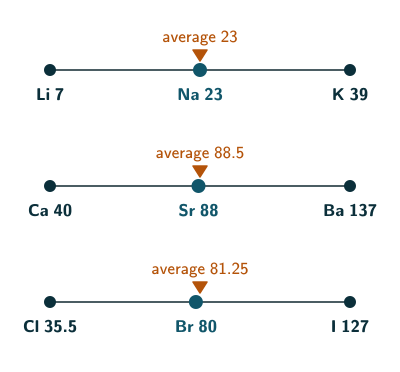
This law of triads worked for only a few elements, so it was dismissed as coincidence (page 75). In 1862 the French geologist A. E. B. de Chancourtois arranged the known elements by increasing atomic weight on a cylinder to show the recurrence of properties, but this too attracted little attention.
Newlands’ law of octaves
In 1865 the English chemist John Alexander Newlands arranged the elements in increasing order of atomic weight and noticed that every eighth element had properties like the first (NCERT page 75).
The relationship was just like every eighth note that resembles the first in octaves of music.
NCERT Chemistry Part I (Class 11), Section 3.2, page 75
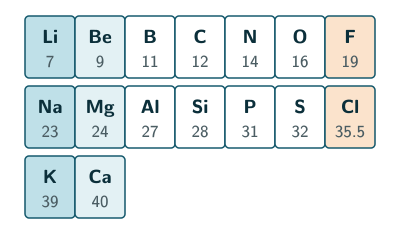
Two notes on the figure:
- NCERT’s Table 3.2 gives silicon an atomic weight of 29; it is 28 (28.09), and the figure uses 28.
- The noble gases were unknown in 1865 (argon was discovered in 1894). Had they been known, the repeat in this region would have been every ninth element, not every eighth.
The law of octaves held only up to calcium (page 75). Beyond it, the heavier elements did not fit a repeat of eight, and the idea was not widely accepted at the time. Newlands’ work was recognised later: the Royal Society, London, awarded him its Davy Medal in 1887.
Lothar Meyer and Mendeleev
The periodic law as we know it owes most to the Russian chemist Dmitri Mendeleev (1834–1907) and the German chemist Lothar Meyer (1830–1895). Working independently, in 1869 both proposed that when elements are arranged by increasing atomic weight, similar physical and chemical properties appear at regular intervals (NCERT pages 75–76).
Lothar Meyer plotted physical properties such as atomic volume, melting point and boiling point against atomic weight and obtained a repeating pattern; on his atomic-volume curve the alkali metals sit at the peaks. Unlike Newlands, he saw that the length of the repeat changes. By 1868 he had a table much like the modern one, but it was published only after Mendeleev’s (page 76).
Mendeleev was the first to publish the periodic law:
The properties of the elements are a periodic function of their atomic weights.
NCERT Chemistry Part I (Class 11), Section 3.2, page 76
He arranged the elements in rows and columns in order of atomic weight, with similar elements in the same column, or group. NCERT Fig. 3.1 (page 77) shows a later version of his table: Groups I to VIII plus Group 0 for the noble gases, in twelve horizontal series. Its bottom rows give each group’s highest oxide, R2O, RO, R2O3, RO2, R2O5, RO3, R2O7 and RO4 for Groups I to VIII, and the hydrides RH4, RH3, RH2 and RH for Groups IV to VII. His system was more thorough than Meyer’s: he used a wider range of physical and chemical properties, especially the formulas and properties of the elements’ compounds (page 76). Two bold decisions made his table succeed:
- He broke the atomic-weight order when properties demanded it. Iodine (atomic weight 126.9) is lighter than tellurium (127.6; NCERT Fig. 3.1), yet Mendeleev placed iodine after tellurium, in Group VII with fluorine, chlorine and bromine, because its properties match theirs. He thought the atomic weights might be wrong.
- He left gaps for undiscovered elements and predicted their properties. Gallium and germanium were unknown in 1869; he left a gap below aluminium and one below silicon, calling the missing elements eka-aluminium and eka-silicon (page 76). Scandium filled a third gap, which he called eka-boron (beyond the NCERT text).
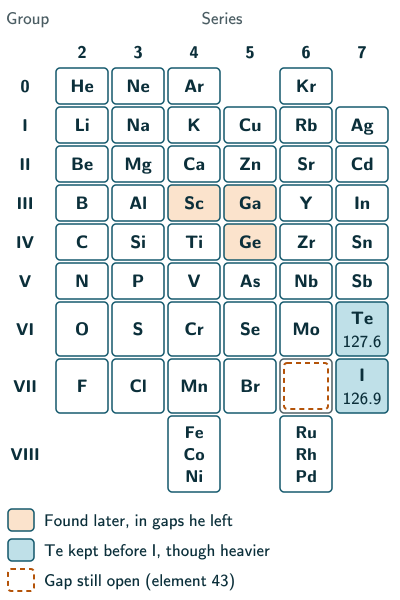
When gallium and germanium were discovered, their properties matched his predictions closely (NCERT Table 3.3, page 76):
| Property | Eka-aluminium | Gallium |
|---|---|---|
| Atomic weight | 68 | 70 |
| Density (g cm) | 5.9 | 5.94 |
| Melting point (K) | low | 302.93 |
| Oxide | E2O3 | Ga2O3 |
| Chloride | ECl3 | GaCl3 |
| Property | Eka-silicon | Germanium |
|---|---|---|
| Atomic weight | 72 | 72.6 |
| Density (g cm) | 5.5 | 5.36 |
| Melting point (K) | high | 1231 |
| Oxide | EO2 | GeO2 |
| Chloride | ECl4 | GeCl4 |
(For germanium’s melting point NCERT gives 1231 K; the accepted value is 1211 K, which still fits Mendeleev’s “high”.) The boldness of these quantitative predictions, and their success, made Mendeleev and his table famous (page 76). The modern form of the table, based on atomic number instead of atomic weight, is the subject of the modern periodic law (NCERT Section 3.3).
Solved examples
Example 1: Testing a triad
Check Döbereiner’s rule for lithium (7), sodium (23) and potassium (39).
Average of the outer two = (7 + 39) ÷ 2 = 46 ÷ 2 = 23.
Answer: 23, exactly sodium’s atomic weight.
Example 2: A triad that is only close
Check the rule for chlorine (35.5), bromine (80) and iodine (127).
Average = (35.5 + 127) ÷ 2 = 162.5 ÷ 2 = 81.25. Bromine’s atomic weight is 80, so the rule is off by 1.25, about 1.6%.
Answer: close, but not exact. The rule held for only a few such groups, which is why it was dismissed as coincidence (NCERT page 75).
Example 3: Counting an octave
In Newlands’ order Na, Mg, Al, Si, P, S, Cl, K, …, which element is the eighth counting from sodium, and does it resemble sodium?
Counting Na as 1: Na 1, Mg 2, Al 3, Si 4, P 5, S 6, Cl 7, K 8.
Answer: potassium, which is indeed an alkali metal like sodium.
Example 4: How good were Mendeleev’s predictions?
Mendeleev predicted an atomic weight of 72 and a density of 5.5 g cm for eka-silicon. Germanium has 72.6 and 5.36 g cm (NCERT Table 3.3). Find the percentage errors.
Atomic weight: (72.6 − 72) ÷ 72.6 × 100 = 0.83%.
Density: (5.5 − 5.36) ÷ 5.36 × 100 = 2.6%.
Answer: 0.83% for atomic weight and 2.6% for density, for an element no one had seen.
Example 5: What Mendeleev used and whether he kept to it (NCERT Exercise 3.2, page 96)
Which property did Mendeleev use to classify the elements, and did he stick to it?
He used atomic weight, arranging the elements in increasing order of it. He did not follow it strictly: where properties disagreed with the order, as with tellurium and iodine, he kept similar elements together and assumed the atomic weights were wrong.
Answer: atomic weight; no, he put similarity of properties first.
Common mistakes to avoid
Common mistake
Calling Döbereiner’s triads a general law
The triad rule worked for only a few groups of three and was dismissed as coincidence. It was a first hint of families, not a classification of all the elements.
Common mistake
Extending the law of octaves to all elements
Newlands’ octaves held only up to calcium. Heavier elements do not repeat every eight.
Common mistake
Saying Mendeleev arranged elements strictly by atomic weight
He used atomic-weight order but broke it, as with tellurium and iodine, to keep elements with similar properties in the same group.
Common mistake
Forgetting the gaps
Mendeleev’s table is famous not only for its arrangement but for its gaps, eka-aluminium (gallium) and eka-silicon (germanium), whose properties he predicted correctly.
Quick revision summary
- Döbereiner (1829): triads such as Li, Na, K, in which the middle atomic weight is about the average of the outer two; worked only for a few elements.
- de Chancourtois (1862): elements by atomic weight on a cylinder; little noticed.
- Newlands (1865): law of octaves, every eighth element resembles the first; true only up to calcium; Davy Medal 1887.
- Lothar Meyer and Mendeleev (1869), independently: properties recur periodically with atomic weight. Meyer plotted atomic volume and other properties against atomic weight.
- Mendeleev’s periodic law: properties are a periodic function of atomic weights. He broke the weight order where properties required (Te, I) and left gaps for eka-aluminium (Ga) and eka-silicon (Ge), predicting their properties.
Formula sheet
- Triad rule: middle atomic weight ≈ (first + third)/2
- Li, Na, K: (7 + 39)/2 = 23
- Octaves: element 8 resembles element 1 (Li → Na → K)
- Mendeleev: properties = periodic function of atomic weight
- Mendeleev’s highest oxides, Groups I–VIII: RO, RO, RO, RO, RO, RO, RO, RO
Questions students ask
What were the limitations of Mendeleev’s periodic table?
Mendeleev’s periodic table had four main limitations, three of them due to ordering by atomic weight: some pairs had to be placed against the weight order (tellurium before iodine, cobalt before nickel); hydrogen, which resembles both the alkali metals and the halogens, had no fixed place; isotopes, which differ in atomic weight, would each have needed a place of their own; and it could not tell how many elements were still missing, since atomic weight does not rise in equal steps. Nor could it explain why the properties repeat. Ordering by atomic number, and the electronic configurations behind it, solved all but one of these: hydrogen remains a special case, usually shown in group 1 but drawn separately in some tables because it also resembles the halogens.
Why did Mendeleev leave gaps in his periodic table?
Mendeleev left gaps in his periodic table because he insisted that every element sit in the group whose properties it shared: where the next known element by atomic weight did not fit the next place, he left that place empty and said that an undiscovered element belonged there. He named three of these elements with the Sanskrit prefix eka- (“one”, meaning one place below a known element): eka-boron, eka-aluminium and eka-silicon, found as scandium (1879), gallium (1875) and germanium (1886). When their properties matched his forecasts, the gaps became the strongest evidence for his table.
What is the difference between Döbereiner’s triads and Newlands’ law of octaves?
Döbereiner’s triads (1829) were small families of three similar elements in which the middle element’s atomic weight is about the average of the other two, while Newlands’ law of octaves (1865) put all the known elements in one list by atomic weight and found that every eighth element resembled the first. So a triad compares elements within one family, while the octaves showed one pattern repeating through the whole list, the idea of periodicity. Each worked only in part, triads for a few families and octaves only up to calcium; lithium, sodium and potassium fit both.
Are Döbereiner’s triads and Mendeleev’s table in the JEE Main 2027 and NEET (UG) 2026 syllabuses?
No, neither the JEE Main 2027 nor the NEET (UG) 2026 chemistry syllabus names Döbereiner’s triads, Newlands’ octaves or Mendeleev’s periodic table: their Unit 9, Classification of Elements and Periodicity in Properties, starts from the modern periodic law and the present form of the periodic table. The early attempts are part of NCERT Class 11 Unit 3 (Section 3.2) and so of school exams. Mendeleev’s law is still worth knowing as the contrast to the modern law, which replaced atomic weight by atomic number.
Practice questions
Try each question first, then open the answer to check your working.
-
Q1. Check Döbereiner’s rule for calcium (40), strontium (88) and barium (137).
Show answerHide answer
(40 + 137) ÷ 2 = 88.5, close to strontium’s 88.
-
Q2. Why was Newlands’ law of octaves not widely accepted?
Show answerHide answer
It held only up to calcium; for heavier elements every eighth element is not similar to the first, so it could not classify all the known elements.
-
Q3. Give two features of Mendeleev’s table that made it more successful than earlier attempts.
Show answerHide answer
(1) He kept elements with similar properties together, even breaking the atomic-weight order where needed (tellurium and iodine). (2) He left gaps for undiscovered elements and predicted their properties, which were confirmed when gallium and germanium were found.