Periodic trends in properties of elements
NCERT Class 11 Chemistry Chapter 3 Section 3.7
Quick answer
Periodic trends are recurring patterns in atomic size, ionisation enthalpy, electron gain enthalpy, electronegativity and chemical behaviour. Across a main-group period, radius generally falls while ionisation enthalpy and electronegativity rise; down a group, the broad trends reverse. Exceptions arise from subshell filling, shielding and the definition or reaction being compared.
With your textbook
NCERT Chemistry Part I (Class 11), Chapter 3 “Classification of Elements and Periodicity in Properties”, Section 3.7 “Periodic Trends in Properties of Elements”, pages 85–95.
Open the official NCERT chapter (PDF, 3.4 MB, ncert.nic.in) (opens in a new tab)
Checked against the 2026-27 reprint on .
What are periodic trends?
Periodic trends in properties
Many properties of the elements change in a regular way across a period and down a group (NCERT Section 3.7, pages 85–95):
- across a period (left to right): atomic radius generally decreases, ionisation enthalpy generally increases, electron gain enthalpy tends to become more negative, electronegativity generally increases, and metallic character decreases;
- down a group: the reverse, broadly, in each case.
The causes are the nuclear charge, the shell the outer electrons occupy, and how well inner electrons shield them. The same trends explain valence, the behaviour of the second-period elements, and chemical reactivity.
In plain words: along a row, protons are added to the nucleus but the new electrons go into the same shell, so the outer electrons are pulled in more tightly. Atoms get smaller, harder to ionise and keener to gain electrons. Down a group, each step adds a whole new shell, so the outer electrons sit farther out and are shielded by more inner electrons. Atoms get bigger and lose their outer electrons more easily.
Atomic radius
An atom has no sharp edge, and there is no unique hard-sphere boundary. Its size (of order 10−10 m) is conventionally inferred from distances between atoms (NCERT Section 3.7.1, page 86):
- covalent radius: half the bond length between two identical atoms joined by a single bond. The Cl–Cl bond is 198 pm, so the radius of chlorine is 99 pm;
- metallic radius: half the distance between neighbouring atoms in a metal crystal. In copper this distance is 256 pm, so the metallic radius is 128 pm.
NCERT uses “atomic radius” for either, as appropriate (page 86).
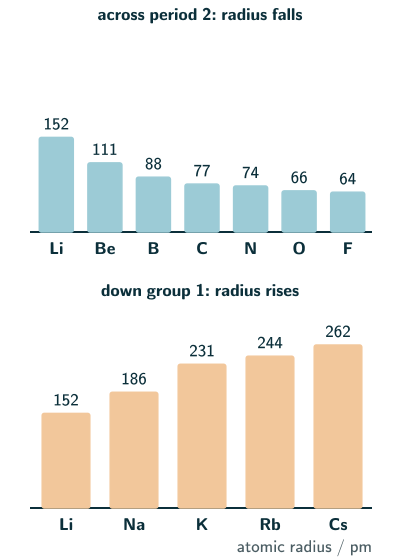
- Across a period the radius decreases. The outer electrons stay in the same shell while the effective nuclear charge increases, so they are pulled closer (page 86).
- Down a group the radius increases. The principal quantum number rises, and the inner shells shield the outer electrons from the nucleus (page 86). Group 17 runs F 64, Cl 99, Br 114, I 133, At 140 pm.
NCERT leaves noble gases out of this comparison because their tabulated radii are non-bonded (van der Waals) radii, which should be compared with other van der Waals radii, not covalent radii (page 86). This is a choice of radius definition, not a claim that noble gases cannot bond: xenon forms compounds.
Ionic radius
Ionic radii are found from the distances between cations and anions in ionic crystals, and broadly follow atomic-size trends (NCERT page 87). Values depend on oxidation state, coordination number and sometimes spin state; compare a consistent dataset under comparable conditions.
- A cation is smaller than its atom: it has fewer electrons but the same nuclear charge. Na is 186 pm; Na+ is 95 pm.
- An anion is larger than its atom: the added electrons increase the repulsion and lower the effective nuclear charge. F is 64 pm; F− is 136 pm.
Isoelectronic species have the same number of electrons, such as O2−, F−, Na+ and Mg2+ (10 each). Among them, the greater the nuclear charge, the smaller the radius: the cation with the larger positive charge is smaller, and the anion with the larger negative charge is larger (page 87). NCERT’s footnote on page 87 gives the stricter sense used for molecules: same number of atoms, same number of valence electrons and same structure (CO and N2, for example), which Langmuir called isosteric. For atoms and simple ions, as in NCERT’s text and exercises, isoelectronic just means the same total number of electrons.
Ionisation enthalpy
A quantitative measure of the tendency of an element to lose electron is given by its Ionization Enthalpy.
NCERT Chemistry Part I (Class 11), Section 3.7.1, page 87
It is the energy needed to remove an electron from an isolated gaseous atom in its ground state (NCERT Eqs. 3.1–3.2, pages 87–88):
First and second ionisation enthalpy
X(g) → X+(g) + e− (ΔiH1); X+(g) → X2+(g) + e− (ΔiH2)
It is measured in kJ mol−1 and is always positive, since energy is always needed. Each successive ionisation enthalpy is larger, because the electron is removed from an increasingly positive ion. “Ionisation enthalpy” on its own means the first (page 88).
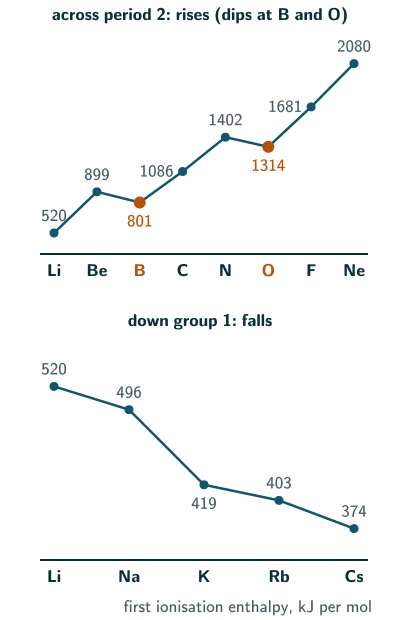
Why the trends? Two factors compete: the attraction of the electron to the nucleus, and the repulsion of the other electrons (page 88). Inner (core) electrons shield a valence electron, so it feels less than the full nuclear charge; lithium’s 2s electron, for example, is shielded by its 1s2 core.
- Across a period the electrons enter the same shell and shielding barely increases, so the rising nuclear charge wins: ionisation enthalpy increases (page 89).
- Down a group the outer electron is farther away and better shielded, which outweighs the larger nuclear charge: ionisation enthalpy decreases (page 89).
Two dips in period 2 (page 89):
- B < Be: beryllium loses a 2s electron, boron a 2p electron. A 2s electron penetrates closer to the nucleus and is held more tightly, so boron’s 2p electron is easier to remove.
- O < N: nitrogen’s three 2p electrons are in separate orbitals (Hund’s rule), but oxygen has two electrons paired in one 2p orbital, and the extra repulsion makes one of them easier to remove. (Nitrogen’s half-filled 2p is also extra stable.)
Electron gain enthalpy
The electron gain enthalpy, ΔegH, is the enthalpy change when an electron is added to a neutral gaseous atom to form a negative ion (NCERT Eq. 3.3, page 89):
Electron gain enthalpy
X(g) + e− → X−(g) (ΔegH)
For many elements energy is released, so ΔegH is negative. The halogens have very negative values, since one electron completes a noble gas configuration. The noble gases have large positive values, since the added electron must enter a new, higher shell (page 90).
| Element | ΔegH (kJ mol−1) | Element | ΔegH |
|---|---|---|---|
| F | −328 | O | −141 |
| Cl | −349 | S | −200 |
| Br | −325 | Se | −195 |
| I | −295 | Te | −190 |
| Li | −60 | He | +48 |
| Na | −53 | Ne | +116 |
(Selected values from NCERT Table 3.7, page 90. Positive noble-gas entries are estimates for energetically unfavourable attachment, not stable isolated ground-state anions.)
- In general, ΔegH becomes more negative across a period (a smaller atom with a larger effective nuclear charge attracts the added electron more) and less negative down a group (page 90). The variation is less regular than for ionisation enthalpy.
- Exception: O and F are less negative than S and Cl. The added electron goes into the small n = 2 shell and is strongly repelled by the electrons already there; in the larger n = 3 shell the repulsion is much less (page 90). So chlorine, not fluorine, has the most negative electron gain enthalpy.
Electron affinity, Ae, is the energy released when an electron attaches to an isolated atom, positive for energy release. In NCERT’s ideal-gas thermal convention, relating the zero-temperature energy to the enthalpy at temperature T gives ΔegH = −Ae − (5/2)RT (NCERT footnote, page 90); (5/2)RT is only 6.2 kJ mol−1 at 298 K.
Electronegativity
A qualitative measure of the ability of an atom in a chemical compound to attract shared electrons to itself is called electronegativity.
NCERT Chemistry Part I (Class 11), Section 3.7.1, page 90
Unlike an isolated-atom ionisation energy, electronegativity is a scale-dependent descriptor inferred from quantities such as bond energies; it is not a single directly measured atomic observable. Its useful value can depend on bonding environment (pages 90–91). Several scales exist (Pauling, Mulliken–Jaffe, Allred–Rochow); the Pauling scale is the most used. Linus Pauling arbitrarily gave fluorine, the most electronegative element, the value 4.0. NCERT dates this 1922; Pauling published his scale in 1932.
On this scale period 2 runs Li 1.0, Be 1.5, B 2.0, C 2.5, N 3.0, O 3.5, F 4.0, in steps of 0.5; period 3 runs Na 0.9 to Cl 3.0; and group 17 runs F 4.0, Cl 3.0, Br 2.8, I 2.5, At 2.2 (NCERT Table 3.8, page 91).
Electronegativity generally increases across a period and decreases down a group, following the atomic radius: the smaller the atom, the more strongly its nucleus attracts the shared electrons. The trend matches that of ionisation enthalpy (page 91). Non-metals tend to gain electrons, so electronegativity rises with non-metallic character and falls with metallic character (page 92).
Trends in chemical properties
Valence and oxidation state. The valence of a representative element is usually the number of outer electrons, or eight minus that number (NCERT Section 3.7.2, page 92).
Today the term oxidation state is often used (see oxidation number). It is a formal charge assigned by giving bonding electrons to the more electronegative partner, not generally the atom’s actual charge (page 92). In OF2, fluorine (more electronegative) is −1 and oxygen +2; in Na2O, oxygen is −2 and sodium +1. Valences and typical formulas follow the groups (NCERT page 92 and Table 3.9, page 93):
| Group | Valence | Hydride | Oxide |
|---|---|---|---|
| 1 | 1 | LiH | Li2O |
| 2 | 2 | CaH2 | MgO |
| 13 | 3 | B2H6 | Al2O3 |
| 14 | 4 | CH4 | CO2 |
| 15 | 3, 5 | NH3 | P4O10 |
| 16 | 2, 6 | H2O | SO3 |
| 17 | 1, 7 | HCl | Cl2O7 |
| 18 | usually 0; Xe can reach 8 | none in this introductory table | XeO3, XeO4 |
Transition elements and actinoids are known for their variable valence (page 93).
Anomalous second-period elements. The first member of groups 1, 2 and 13–17 (lithium to fluorine) differs in many ways from the rest of its group (page 93). Lithium and beryllium form compounds with marked covalent character, unlike the mainly ionic compounds of their heavier group-mates, and they resemble magnesium and aluminium, the second element of the next group. NCERT’s table on page 93 shows the size match: Li+ 76 pm against Mg2+ 72 pm. It heads these values “M+”, but its Be (31 pm) and Mg (72 pm) entries are Be2+ and Mg2+ radii, and its Na+ value (102 pm) differs from page 87’s 95 pm because a different set of radii is used.
This sort of similarity is commonly referred to as diagonal relationship in the periodic properties.
NCERT Chemistry Part I (Class 11), Section 3.7.2, page 93
The reasons (page 93):
- small size, a large charge-to-radius ratio and high electronegativity;
- the compact 2s/2p valence shell limits ordinary second-period compounds to an octet and usually at most four bonds. Boron forms [BF4]−, whereas larger aluminium can accommodate six fluoride ligands in [AlF6]3−. NCERT invokes vacant d orbitals, but modern bonding descriptions do not require promotion into d orbitals to explain hypervalence; size, charge and delocalised bonding matter;
- a much greater ability to form pπ–pπ multiple bonds, to themselves (C=C, C≡C, N=N, N≡N) and to other second-period elements (C=O, C=N, C≡N, N=O).
Periodic trends and chemical reactivity
All these properties come from the electronic configuration (NCERT Section 3.7.3, pages 94–95). Across a period, radius falls, ionisation enthalpy rises and electron gain enthalpy becomes more negative. NCERT therefore describes high reactivity near the alkali-metal and halogen ends, excluding the noble gases. This is a broad pattern rather than a ranking valid for every reaction or medium:
- on the left (alkali metals), by easy loss of an electron to form a cation: these are reducing;
- on the right (halogens, just before the noble gases), by easy gain of an electron to form an anion: these are oxidising.
The oxides show the same pattern (page 94):
- the oxide of the element on the extreme left is the most basic (Na2O), that on the extreme right the most acidic (Cl2O7);
- oxides in the centre are amphoteric (Al2O3, As2O3), reacting as acids with bases and as bases with acids, or neutral (CO, NO, N2O).
Down a group of main-group elements, ionisation enthalpy generally falls and metallic character rises. Among the transition metals the atomic radius changes much less across the 3d series, and less still across the 4f series (page 94). Down a transition-metal group the trend reverses (page 95): the 5d metals generally have higher ionisation enthalpies than the 3d and 4d metals, because the 4f electrons shield poorly (the lanthanoid contraction, which also makes Zr and Hf almost the same size), and relativistic effects also matter for heavy elements. Gold and platinum are relatively unreactive, but no single ionisation-enthalpy rule ranks every reaction.
NCERT Fig. 3.7 (page 91) summarises all these trends.
Solved examples
Example 1: Largest and smallest (NCERT Problem 3.5, page 87)
Which of Mg, Mg2+, Al and Al3+ is largest and which smallest?
Radius falls across period 3, so Mg > Al. Cations are smaller than their atoms. Mg2+ and Al3+ are isoelectronic (10 electrons), and Al3+, with the larger nuclear charge, is smaller.
Answer: largest Mg, smallest Al3+.
Example 2: Predicting aluminium’s ionisation enthalpy (NCERT Problem 3.6, page 89)
Na, Mg and Si have first ionisation enthalpies of 496, 737 and 786 kJ mol−1. Is aluminium’s value closer to 575 or 760 kJ mol−1?
Aluminium loses a 3p electron, which is shielded by the 3s electrons and held less tightly than magnesium’s 3s electron, so its value should be below magnesium’s, like boron below beryllium.
Answer: closer to 575 kJ mol−1 (the measured value is 577).
Example 3: Electron gain enthalpies (NCERT Problem 3.7, page 90)
Of P, S, Cl and F, which has the most negative electron gain enthalpy and which the least?
Across period 3 the values become more negative (P, then S, then Cl). Fluorine is above chlorine, but its small 2p shell repels the added electron, so it is less negative than chlorine.
Answer: most negative Cl, least negative P.
Example 4: Predicting formulas (NCERT Problem 3.8, page 92)
Predict the formulas of the compounds of (a) silicon and bromine; (b) aluminium and sulphur.
(a) Si (group 14) has valence 4, Br (group 17) valence 1: SiBr4. (b) Al (group 13) has valence 3, S (group 16) valence 2: Al2S3.
Answer: SiBr4 and Al2S3.
Example 5: Oxidation state and covalency (NCERT Problem 3.9, page 94)
Are the oxidation state and the covalency of Al in [AlCl(H2O)5]2+ the same?
Oxidation state: let Al be x; water is neutral and Cl is −1, so x + (−1) + 5(0) = +2 and x = +3. Covalency: Al forms six bonds, one to Cl and five to water molecules.
Answer: no; the oxidation state is +3 and the covalency 6.
Example 6: Acidic and basic oxides (NCERT Problem 3.10, page 94)
Show by reaction with water that Na2O is basic and Cl2O7 is acidic.
Na2O + H2O → 2NaOH (a strong base); Cl2O7 + H2O → 2HClO4 (a strong acid). Litmus shows the difference.
Answer: Na2O gives a base and Cl2O7 an acid in water.
Example 7: The ionisation enthalpy of hydrogen (NCERT Exercise 3.15, page 96)
The ground-state energy of the electron in a hydrogen atom is −2.18 × 10⁻¹⁸ J. Find the ionisation enthalpy in J mol−1.
Removing the electron takes 2.18 × 10⁻¹⁸ J per atom (Bohr’s model). Per mole, multiply by the Avogadro constant: 2.18 × 10−18 J × 6.022 × 1023 mol−1 = 1.313 × 10⁶ J mol−1.
Answer: 1.31 × 10⁶ J mol−1 (1313 kJ mol−1).
Common mistakes to avoid
Common mistake
Expecting fluorine to have the most negative electron gain enthalpy
Chlorine’s is the most negative (−349 against −328 kJ mol−1), because the added electron is crowded in fluorine’s small 2p shell. Fluorine is still the most electronegative element. In magnitude, Cl (349) > F (328) > Br (325) > I (295); in group 16, S > Se > Te > O.
Common mistake
Calling ionisation enthalpy a steady rise across a period
Boron (below beryllium) and oxygen (below nitrogen) are exceptions; so are aluminium and sulphur in period 3.
Common mistake
Confusing electron gain enthalpy with electronegativity
Electron gain enthalpy is a measurable energy change for an isolated gaseous atom. Electronegativity is a relative descriptor of attraction for shared electrons, inferred on a chosen scale rather than measured as one isolated-atom observable.
Quick revision summary
- Atomic radius (covalent or metallic): generally decreases across a period and increases down a group. Cations are smaller and anions larger than their atoms; in an isoelectronic series, more nuclear charge means a smaller ion.
- Ionisation enthalpy: X(g) → X+(g) + e−, always positive, successive values larger; increases across a period (dips at B and O), decreases down a group.
- Electron gain enthalpy: X(g) + e− → X−(g); generally more negative across a period and less negative down a group, with important exceptions; Cl most negative; noble gases positive.
- Electronegativity (Pauling, F = 4.0): increases across a period, decreases down a group; tracks non-metallic character.
- Valence equals outer electrons or 8 minus them. The second-period elements are anomalous (small size, only 4 valence orbitals, pπ–pπ bonds); Li–Mg and Be–Al show the diagonal relationship.
- Reactivity is often high among alkali metals and halogens, with noble gases excluded and reaction conditions important; oxides go from basic (left) through amphoteric or neutral to acidic (right).
Formula sheet
- Ionisation: X(g) → X(g) + e (always positive; second > first)
- Electron gain: X(g) + e → X(g)
- Electron gain enthalpy = −(electron affinity) − (5/2)RT (NCERT ideal-gas thermal convention)
- Covalent radius = ½ × bond length (Cl: 198/2 = 99 pm)
- Valence = outer electrons or 8 − outer electrons
Questions students ask
What is the difference between electron gain enthalpy and electron affinity?
Electron gain enthalpy and electron affinity describe the same process, adding an electron to an isolated gaseous atom, with opposite signs: ΔegH is the enthalpy change, negative when energy is released, while the electron affinity, Ae, is the energy released, counted as positive. So a more negative electron gain enthalpy means a higher electron affinity, and a question asking for the highest electron affinity wants the most negative ΔegH. In NCERT’s ideal-gas convention, the zero-temperature affinity and finite-temperature enthalpy also differ by a thermal correction of (5/2)RT, about 6.2 kJ mol−1 at 298 K.
Is ionisation enthalpy the same as ionisation energy and ionisation potential?
Ionisation enthalpy, ionisation energy and ionisation potential all measure the energy needed to remove an electron from an isolated gaseous atom, so for most purposes they are the same quantity. In the ideal-gas thermal approximation used here, the ionisation enthalpy at temperature T exceeds the zero-temperature ionisation energy by (5/2)RT, only 6.2 kJ mol−1 at 298 K; ionisation potential is the older name, quoted per atom in electronvolts, the voltage needed to ionise the atom. To convert, 1 eV per atom = 96.49 kJ mol−1, so 5.0 eV is about 4.8 × 10² kJ mol−1 (two significant figures).
Can electron gain enthalpy be positive?
Yes, electron gain enthalpy is positive for atoms that have to be forced to accept an electron, so that energy is absorbed and the anion X− is unstable. The noble gases have large positive values (NCERT estimates: helium +48, neon +116 kJ mol−1) because attachment beyond a closed shell is unfavourable, and beryllium and magnesium have positive values because their ns subshell is full and the electron must go into a higher np orbital. Nitrogen’s value is close to zero, slightly positive in most data, because the added electron must pair up in its half-filled 2p3 set.
What is the order of electronegativity of the common elements?
The electronegativity order of the common non-metals on the Pauling scale is F > O > Cl > N > Br > I > S > C > H, with revised values 3.98, 3.44, 3.16, 3.04, 2.96, 2.66, 2.58, 2.55 and 2.20. NCERT’s Table 3.8 uses Pauling’s older one-decimal values (F 4.0, O 3.5, N and Cl 3.0, Br 2.8, C, S and I 2.5), so an NCERT-based question may treat nitrogen and chlorine, or carbon, sulphur and iodine, as equal. Fluorine is the most electronegative element, and caesium, at 0.79 (0.7 in NCERT), one of the least.
Does electronegativity have a unit?
Electronegativity has no unit on the Pauling scale: it is a relative number, anchored by giving one element a fixed value (fluorine 4.0 in NCERT) and found for the others from bond energies. Pauling took the extra bond energy Δ of a polar bond A–B over the average for the non-polar bonds A–A and B–B, measured in electronvolts, and set the difference in electronegativity equal to √(Δ/1 eV), which is a pure number.
Is electronegativity in the JEE Main 2027 and NEET (UG) 2026 syllabuses?
Yes, electronegativity is in both the JEE Main 2027 and the NEET (UG) 2026 syllabuses, but under chemical bonding, not under periodicity: Unit 9, Classification of Elements and Periodicity in Properties, names atomic and ionic radii, ionisation enthalpy, electron gain enthalpy, valence, oxidation states and chemical reactivity, while “concept of electronegativity” is listed under covalent bonding in Unit 3, Chemical Bonding and Molecular Structure. Its periodic trend across a period and down a group is what makes bond polarity predictable, so learn the two together.
Practice questions
Try each question first, then open the answer to check your working.
-
Q1. The species N3−, O2−, F−, Na+, Mg2+ and Al3+: (a) what do they have in common? (b) Arrange them in order of increasing ionic radius (NCERT Exercise 3.12, page 96).
Show answerHide answer
(a) All have 10 electrons: they are isoelectronic. (b) The larger the nuclear charge, the smaller the ion: Al3+ < Mg2+ < Na+ < F− < O2− < N3−.
-
Q2. The actual first ionisation enthalpies of period 2 are in the order Li < B < Be < C < O < N < F < Ne. Explain why (i) Be is higher than B, and (ii) O is lower than N and F (NCERT Exercise 3.16, page 96).
Show answerHide answer
(i) Boron loses a 2p electron, which is shielded more and held less tightly than beryllium’s 2s electron. (ii) Oxygen has a pair of electrons in one 2p orbital, and their repulsion makes one easier to remove than any of nitrogen’s three unpaired 2p electrons; fluorine, with a larger nuclear charge in the same shell, holds its electrons more tightly.
-
Q3. Which has the more negative electron gain enthalpy: (i) O or F; (ii) F or Cl (NCERT Exercise 3.20, page 97)?
Show answerHide answer
(i) F: one more electron completes its octet, and its nuclear charge is larger. (ii) Cl: the added electron enters the larger 3p shell, where it is repelled less than in fluorine’s small 2p shell.