Bohr’s model for the hydrogen atom
NCERT Class 11 Chemistry Chapter 2 Section 2.4
Quick answer
Bohr proposed that the electron in a hydrogen atom moves only in certain circular orbits, in which its angular momentum is a whole-number multiple of h/2π and it does not radiate. The nth orbit has radius n × 52.9 pm and energy −2.18 × 10 J divided by n, and a jump between orbits emits or absorbs a photon whose energy equals the difference. This explains the hydrogen line spectrum, but not the spectra of atoms with more than one electron.
With your textbook
NCERT Chemistry Part I (Class 11), Chapter 2 “Structure of Atom”, Section 2.4 “Bohr’s Model for Hydrogen Atom”, pages 46–49.
Open the official NCERT chapter (PDF, 5.5 MB, ncert.nic.in) (opens in a new tab)
Checked against the 2026-27 reprint on .
What is Bohr’s model of the hydrogen atom?
Bohr’s model (1913)
Niels Bohr kept Rutherford’s nucleus but added Planck’s quantum idea (NCERT Section 2.4, pages 46–49):
- the electron moves round the nucleus only in certain circular orbits, stationary states, of fixed radius and energy, and in them it does not radiate;
- it absorbs or emits energy only when it jumps between orbits, as a photon of frequency ν = ΔE/h;
- in an allowed orbit its angular momentum is a whole-number multiple of h/2π: mevr = nh/2π.
For hydrogen this gives orbit radii rn = na0 (a0 = 52.9 pm) and energies En = −RH/n, with RH = 2.18 × 10 J, which explain its line spectrum.
In plain words: Rutherford’s electron should spiral into the nucleus. Bohr simply declared that it doesn’t, as long as it stays in one of the discrete allowed orbits. Light is given out only when the electron drops from one allowed orbit to a lower one, and the photon carries away exactly the energy difference. Because only certain energies are allowed, only certain colours appear: a line spectrum.
Bohr’s postulates
NCERT lists four postulates (pages 46–47):
- The electron moves round the nucleus in a circular path of fixed radius and energy: an orbit, stationary state or allowed energy state. The orbits are concentric round the nucleus.
- The energy of the electron in an orbit stays constant. It moves to a higher orbit only by absorbing the right amount of energy, and to a lower one by emitting energy.
- The frequency of the radiation absorbed or emitted in a jump between two states is fixed by the energy difference, ΔE (Bohr’s frequency rule, NCERT Eq. 2.10).
- The angular momentum of the electron is quantised (NCERT Eq. 2.11).
The energy of an electron in the orbit does not change with time.
NCERT Chemistry Part I (Class 11), Section 2.4, page 46
The frequency rule, for a jump between states of energies E1 (lower) and E2 (higher):
Bohr’s frequency rule
For an electron of mass me moving at speed v in a circle of radius r, the angular momentum is mevr, and Bohr’s quantum condition is
Quantised angular momentum
with n = 1, 2, 3, …
Thus an electron can move only in those orbits for which its angular momentum is integral multiple of h/2π.
NCERT Chemistry Part I (Class 11), Section 2.4, page 47
Radius and energy of the orbits
Bohr’s results for the hydrogen atom (NCERT Eqs. 2.12–2.13, page 47):
Radius and energy of the nth orbit (hydrogen)
Here n is the principal quantum number and RH = 2.18 × 10 J (NCERT calls it the Rydberg constant; 2.18 × 10 J = 13.6 eV). NCERT’s page 47 says the principal quantum number is treated in “Section 2.6.2”; quantum numbers are in Section 2.6.1 (2.6.2 is the shapes of orbitals). The first orbit, the Bohr orbit, has radius 52.9 pm, and the electron normally stays in it (n = 1). The ground-state energy is E1 = −2.18 × 10 J, and E2 = −0.545 × 10 J (page 47). As n increases, the orbit gets larger and the energy rises towards zero.
Why is the energy negative? A free electron at rest, infinitely far from the nucleus (n = ∞), is given zero energy. A bound electron has less energy than that, so its energy is negative (NCERT box, page 47).
This negative sign means that the energy of the electron in the atom is lower than the energy of a free electron at rest.
NCERT Chemistry Part I (Class 11), Section 2.4, page 47
The most negative energy, at n = 1, belongs to the most stable orbit. Removing the electron completely (to n = ∞) from the ground state takes 2.18 × 10 J (13.6 eV), the ionisation energy of hydrogen; per mole that is 2.18 × 10 J × 6.022 × 10 mol ≈ 1.31 × 10 kJ mol (the measured value is 1312 kJ mol). Lifting it from n = 1 to n = 2, the first excitation energy, takes 13.6 eV × (1 − 1/4) = 10.2 eV.
Hydrogen-like ions. Bohr’s theory also works for ions with a single electron, such as He, Li and Be. With nuclear charge Z (NCERT Eqs. 2.14–2.15, page 48):
One-electron species of atomic number Z
The energy becomes more negative and the radius smaller as Z increases: the electron is held more tightly. The electron’s speed increases with Z and decreases with n (page 48); in the first orbit of hydrogen it is about 2.19 × 10 m s (NCERT Exercise 2.59), and the derivation below gives vn = 2.19 × 10 × Z/n m s.
Where the results come from (beyond the NCERT chemistry text, which leaves the derivation to higher classes; the JEE Main and NEET syllabuses both list it). The electrostatic attraction supplies the centripetal force for the circular orbit:
To eliminate v, put v = nh/(2πmer), from the quantum condition, into the force equation. Solving for r gives
For Z = 1 and n = 1 the first factor is a0 = 5.29 × 10 m. Putting rn back into v = nh/(2πmer) gives the speed:
which is 2.19 × 10 × Z/n m s. From the force equation, mev = Ze/(4πε0r), so the kinetic energy is ½mev = Ze/(8πε0r) and the potential energy −Ze/(4πε0r), so the total is −Ze/(8πε0r). Putting in rn:
The first factor works out to 2.18 × 10 J. Note that the total energy is minus the kinetic energy, and half the potential energy: KE : PE : E = 1 : −2 : −1.
Explaining the hydrogen spectrum
When the electron moves from an orbit ni to an orbit nf, the energy change is (NCERT Eqs. 2.16–2.17, page 48)
Energy of a transition
with RH = 2.18 × 10 J. For absorption, nf > ni, so ΔE is positive: energy is taken in. For emission, ni > nf, so ΔE is negative: energy is released (page 48). Dividing by h and by hc gives the frequency and wavenumber of the photon (NCERT Eqs. 2.18–2.21):
- ν = 3.29 × 10 × (1/ni2 − 1/nf2) Hz (take the magnitude for emission);
- ν̄ = 1.09677 × 10 × (1/ni2 − 1/nf2) m (take the magnitude for emission).
The second has the same form as Rydberg’s experimental formula, and the constant agrees: 2.18 × 10 J ÷ hc ≈ 1.097 × 10 m, against Rydberg’s 109 677 cm = 1.09677 × 10 m. Each line is one particular jump; an excited sample can produce many different allowed jumps; the observed lines depend on the populated states and transition probabilities, and the brightness of a line depends on how many photons of that wavelength are emitted (page 48).
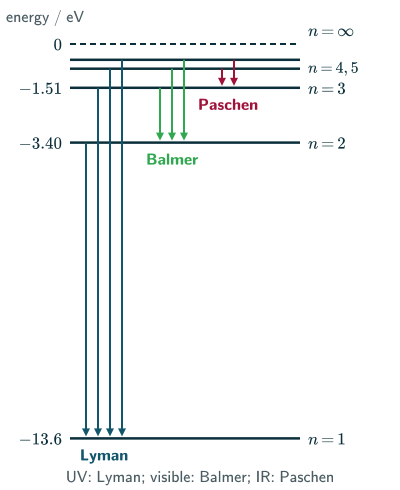
Jumps down to n = 1 give the Lyman series (ultraviolet), to n = 2 the Balmer series (its familiar first four lines are visible, while higher lines and the limit are near ultraviolet), to n = 3 the Paschen series (infrared), and so on. Within a series, the longest wavelength comes from the smallest jump (n1 + 1 → n1) and the shortest from the series limit (∞ → n1): 656 nm and 365 nm for Balmer, 122 nm and 91.2 nm for Lyman.
Limitations of Bohr’s model
Bohr’s model explained the stability and line spectrum of hydrogen and of hydrogen-like ions. But it fails (NCERT Section 2.4.2, page 49) to explain:
- the fine structure of hydrogen’s lines: with good instruments, lines turn out to be doublets, two closely spaced lines;
- the spectrum of any atom with more than one electron, even helium;
- the splitting of spectral lines in a magnetic field (Zeeman effect) or an electric field (Stark effect);
- the ability of atoms to form molecules by chemical bonds.
The deeper reasons, the wave nature of the electron and the uncertainty principle, come in the next topic.
Solved examples
Example 1: A Balmer line (NCERT Problem 2.10, page 49)
Find the frequency and wavelength of the photon emitted when the electron of a hydrogen atom drops from n = 5 to n = 2.
ΔE = 2.18 × 10 J × (1/5 − 1/2) = 2.18 × 10 × (0.04 − 0.25) = −4.58 × 10 J: energy is emitted.
ν = |ΔE|/h = (4.58 × 10 J) ÷ (6.626 × 10 J s) = 6.91 × 10 Hz.
λ = c/ν = (3.0 × 10 m s) ÷ (6.91 × 10 s) = 4.34 × 10 m = 434 nm.
Answer: 6.91 × 10 Hz and 434 nm, a blue-violet line of the Balmer series.
Example 2: The helium ion (NCERT Problem 2.11, page 49)
Find the energy of the first orbit of He and its radius.
For He, Z = 2 and n = 1: E1 = −2.18 × 10 J × 2/1 = −8.72 × 10 J.
r1 = 52.9 pm × 1/2 = 26.45 pm = 0.02645 nm.
Answer: −8.72 × 10 J per ion; 26.5 pm to three significant figures (26.45 pm before rounding), half the hydrogen Bohr radius.
Example 3: How many lines? (NCERT Exercise 2.15, page 70)
A large sample of hydrogen atoms is excited to n = 6 and then returns to the ground state. In the usual level-counting model, what is the maximum number of different emission lines? (NCERT Exercise 2.15 is interpreted as an ensemble, not one atom.)
Every pair of levels from 1 to 6 can give a line: 6 → 5, 6 → 4, …, 2 → 1. The number of pairs is n(n − 1)/2 = 6 × 5/2 = 15.
Answer: up to 15 distinct lines in this level-counting model, assuming the relevant transitions are represented across the sample. A single atom in one cascade emits at most five photons.
Example 4: Up to the fifth orbit and back (NCERT Exercise 2.18, page 70)
How much energy is needed to move the electron of a hydrogen atom from the first to the fifth Bohr orbit, and what is the wavelength for a direct return from the fifth orbit to the ground state? NCERT gives the ground-state energy as −2.18 × 10 erg, which is −2.18 × 10 J.
ΔE = 2.18 × 10 J × (1/1 − 1/5) = 2.18 × 10 × 0.96 = 2.093 × 10 J.
With hc = 6.626 × 10 × 3.0 × 10 = 1.9878 × 10 J m, λ = hc/ΔE = (1.9878 × 10 J m) ÷ (2.093 × 10 J) = 9.50 × 10 m = 95.0 nm.
Answer: 2.09 × 10 J; 95.0 nm, in the ultraviolet (a Lyman line).
Example 5: Which Paschen line? (NCERT Exercise 2.55, page 72)
A Paschen line (ending at n = 3) is observed at 1285 nm. Find the starting orbit, using ν = 3.29 × 10 × (1/3 − 1/n) Hz.
ν = c/λ = (3.0 × 10) ÷ (1285 × 10) = 2.335 × 10 Hz.
1/9 − 1/n = 2.335 × 10 ÷ 3.29 × 10 = 0.0710, so 1/n = 0.1111 − 0.0710 = 0.0401 and n ≈ 25.
Answer: n = 5; the line is in the infrared.
Example 6: Same wavelength in H and He (NCERT Exercise 2.33, page 71)
Which transition in hydrogen has the same wavelength as the n = 4 → n = 2 transition of He?
For a one-electron species the wavenumber is proportional to Z(1/n12 − 1/n22), with n1 the lower level and n2 the upper. For He: 2 × (1/2 − 1/4) = 4 × 3/16 = 3/4. For hydrogen (Z = 1) we need 1/n12 − 1/n22 = 3/4, which is 1/1 − 1/2.
Answer: n = 2 → n = 1 in hydrogen (the first Lyman line).
Common mistakes to avoid
Common mistake
Forgetting Z for hydrogen-like ions
For He, Li and so on, the energy carries a factor Z and the radius a factor 1/Z. Using the hydrogen values for He gives an energy four times too small in magnitude.
Common mistake
Getting the sign of ΔE wrong
ΔE = Ef − Ei. Moving up (absorption) is positive, moving down (emission) negative. For the photon’s frequency and wavelength, use the size of ΔE.
Common mistake
Counting lines for a single atom
A single hydrogen atom dropping from n = 6 can give at most 5 lines (6 → 5 → 4 → 3 → 2 → 1). The formula n(n − 1)/2 = 15 is for a large number of atoms, where every jump happens somewhere. If the atoms fall only as far as n1 (not to the ground state), count the jumps between n2 and n1: (n2 − n1)(n2 − n1 + 1)/2, so 5 → 2 gives 3 × 4/2 = 6 lines.
Common mistake
Thinking a larger n means a lower energy
The energy rises towards zero as n increases: E2 = −0.545 × 10 J is higher than E1 = −2.18 × 10 J. Higher orbits are less tightly bound.
Common mistake
Mixing up the two Rydberg constants
NCERT’s chemistry text calls two numbers the Rydberg constant: RH = 2.18 × 10 J, an energy (page 47), and Rydberg’s 109 677 cm, a wavenumber (page 45), which physics books write as R = 1.097 × 10 m. They are linked by RH = hcR = 13.6 eV; check the unit before you substitute.
Quick revision summary
- Bohr: electrons move in fixed, non-radiating orbits; a radiative jump absorbs or emits a photon of frequency ν = |Ef − Ei|/h; angular momentum mevr = nh/2π.
- Hydrogen: rn = n × 52.9 pm; En = −2.18 × 10 J/n (−13.6 eV/n); negative because a bound electron has less energy than a free one at rest.
- Hydrogen-like ions: En ∝ −Z/n, rn ∝ n/Z; speed vn = 2.19 × 10 × Z/n m s; KE : PE : E = 1 : −2 : −1.
- Hydrogen: ionisation energy 13.6 eV (≈ 1312 kJ mol); first excitation energy 10.2 eV.
- ΔE = RH(1/ni2 − 1/nf2) reproduces Rydberg’s formula; n(n − 1)/2 lines from level n to the ground state in many atoms, (n2 − n1)(n2 − n1 + 1)/2 from n2 down to n1.
- Longest wavelength of a series: the smallest jump; shortest: the series limit, ∞ → n1.
- Fails for fine structure, many-electron atoms, Zeeman and Stark effects and chemical bonding.
Formula sheet
- ν = |Ef − Ei|/h (photon frequency)
- mvr = nh/2π
- r = na, a = 52.9 pm; r = 52.9 n/Z pm
- E = −2.18 × 10 Z/n J (−13.6 Z/n eV)
- v = 2.19 × 10 Z/n m s; KE : PE : E = 1 : −2 : −1
- ΔE = 2.18 × 10 Z × (1/n − 1/n) J, n lower, n upper (absorbed going up, emitted coming down)
- ν̄ = 1.09677 × 10 Z × (1/n − 1/n) m (n lower, n upper)
- Lines from n down to n (many atoms) = (n − n)(n − n + 1)/2; to the ground state, n(n − 1)/2
Questions students ask
How is Bohr’s model different from Rutherford’s model?
Bohr’s model keeps Rutherford’s tiny, positive nucleus but allows the electron only certain circular orbits, of fixed radius and energy, in which it does not radiate, whereas in Rutherford’s model the electron could orbit at any distance and, by classical theory, should radiate energy and spiral into the nucleus. These non-radiating orbits, picked out by mevr = nh/2π, make the atom stable and give it fixed energy levels, so light is emitted only when the electron jumps between levels, as a line spectrum. Rutherford’s model could explain neither the stability of atoms nor their line spectra.
Why does Bohr’s model work only for hydrogen and hydrogen-like ions?
Bohr’s model works only for species with a single electron, such as H, He+, Li2+ and Be3+, because it includes only the electron’s attraction to the nucleus; in an atom with two or more electrons, the electrons also repel one another, and the model has no way to handle that repulsion, so even helium’s spectrum is beyond it. It also misses finer details of hydrogen itself, such as the fine structure of its lines. The deeper reasons, the electron’s wave nature and the uncertainty principle, are explained in NCERT Section 2.5, under Reasons for the Failure of the Bohr Model (pages 52–53).
What is the value of the Bohr radius?
The Bohr radius, a0, the radius of the first orbit of the hydrogen atom in Bohr’s model, is 52.9 pm, which is 0.529 Å or 5.29 × 10 m. It follows from a0 = ε0h/(πmee), and the nth orbit of a one-electron species of atomic number Z has radius 52.9n/Z pm. In the quantum mechanical model the same distance reappears as the most probable distance of a hydrogen 1s electron from the nucleus.
What is the difference between the radii of the nth and (n + 1)th Bohr orbits?
The radii of the nth and (n + 1)th Bohr orbits differ by (2n + 1)a0/Z, because rn = na0/Z and (n + 1) − n = 2n + 1; so the gap widens as n increases. In hydrogen the first and second orbits are 3 × 52.9 = 158.7 pm apart, but the third and fourth are 7 × 52.9 = 370.3 pm apart. The energy gaps do the opposite: they shrink as n rises, so the levels crowd together towards E = 0.
What is the difference between Bohr’s model and the quantum mechanical model?
Bohr’s model puts the electron on a definite circular orbit with one quantum number, n, that Bohr assumed, while the quantum mechanical model gives only the probability of finding the electron in an orbital, labelled by n, l and ml, which come out of Schrödinger’s equation. Bohr’s model contradicts the uncertainty principle and works only for one-electron species; the quantum mechanical model obeys it and applies, with approximations, to every atom. For hydrogen both give En = −13.6 eV/n, so Bohr’s simpler model is still used for one-electron species (orbit and orbital compared).
Practice questions
Try each question first, then open the answer to check your working.
-
Q1. (i) The energy of the first orbit of hydrogen is −2.18 × 10 J. What is the energy of the fifth orbit? (ii) Find the radius of the fifth Bohr orbit (NCERT Exercise 2.16, page 70).
Show answerHide answer
(i) E5 = −2.18 × 10 J/5 = −8.72 × 10 J. (ii) r5 = 5 × 52.9 pm = 1322.5 pm ≈ 1.32 nm.
-
Q2. How much energy is needed to ionise a hydrogen atom whose electron is in the n = 5 orbit? Compare it with the energy needed from n = 1 (NCERT Exercise 2.14, page 70).
Show answerHide answer
From n = 5 to n = ∞: 2.18 × 10 J/5 = 8.72 × 10 J. From n = 1 it is 2.18 × 10 J, which is 25 times as much.
-
Q3. Using En = −2.18 × 10/n J, find the energy needed to remove an electron completely from the n = 2 orbit, and the longest wavelength of light, in cm, that can do it (NCERT Exercise 2.19, page 70).
Show answerHide answer
Energy = 2.18 × 10/2 = 5.45 × 10 J. Longest wavelength: λ = hc/E = (6.626 × 10 × 3.0 × 10) ÷ (5.45 × 10) = 3.65 × 10 m = 3.65 × 10 cm.