Towards the quantum mechanical model
NCERT Class 11 Chemistry Chapter 2 Section 2.5
Quick answer
In 1924 de Broglie proposed that moving matter, like light, behaves as a wave, with a wavelength equal to Planck’s constant divided by the momentum. In 1927 Heisenberg showed that the exact position and the exact momentum of an electron cannot both be known at the same time. Together these rule out the fixed orbits of Bohr’s model and led to the quantum mechanical model of the atom.
With your textbook
NCERT Chemistry Part I (Class 11), Chapter 2 “Structure of Atom”, Section 2.5 “Towards Quantum Mechanical Model of the Atom”, pages 49–53.
Open the official NCERT chapter (PDF, 5.5 MB, ncert.nic.in) (opens in a new tab)
Checked against the 2026-27 reprint on .
What led beyond Bohr’s model?
Two ideas that replaced fixed orbits
Two developments showed why Bohr’s model had to be replaced (NCERT Section 2.5, pages 49–53):
- Dual behaviour of matter (de Broglie, 1924): every moving particle also behaves as a wave, of wavelength λ = h/mv = h/p.
- Heisenberg’s uncertainty principle (1927): the exact position and the exact momentum of an electron cannot both be known at the same time; Δx × Δp ≥ h/4π.
Together they mean an electron cannot move along a definite orbit, which leads to the quantum mechanical model of the atom.
In plain words: light had turned out to be both a wave and a stream of particles. De Broglie turned the idea round: if waves can act like particles, particles should act like waves. For a cricket ball the wave is far too short ever to notice, but for an electron it is about the size of an atom, so it matters. And a wave is spread out, so asking exactly where the electron is, and exactly how fast it moves, at the same instant has no precise answer.
Dual behaviour of matter
The French physicist, de Broglie, in 1924 proposed that matter, like radiation, should also exhibit dual behaviour i.e., both particle and wavelike properties.
NCERT Chemistry Part I (Class 11), Section 2.5.1, page 49
A photon of wavelength λ carries momentum p = h/λ. De Broglie proposed the same link for a particle of mass m and speed v, whose non-relativistic momentum is p = mv (NCERT Eq. 2.22, page 50):
de Broglie wavelength
The larger the momentum, the shorter the wavelength. Because h is so small, wave behaviour is most readily observed for small momenta; mass alone is not the criterion. Ordinary fast-moving macroscopic objects have extremely short wavelengths.
The prediction was confirmed when a beam of electrons was found to undergo diffraction, which only waves do. The electron microscope uses the wave nature of electrons, just as an ordinary microscope uses the wave nature of light, and magnifies about 15 million times (page 50).
It needs to be noted that according to de Broglie, every object in motion has a wave character.
NCERT Chemistry Part I (Class 11), Section 2.5.1, page 50
A 0.1 kg ball at 10 m s has a wavelength of only 6.626 × 10 m (Example 1), far too short to detect, so this ordinary ball’s centre-of-mass wave effects are negligible in the stated situation (page 50).
Wavelength from kinetic energy (beyond the NCERT text). A non-relativistic particle of kinetic energy K has momentum p = √(2mK), as shown in kinetic energy and momentum, so
Wavelength from kinetic energy
An electron accelerated from rest through a potential difference V gains K = eV. Putting in the electron’s mass and charge, and assuming its final speed is much less than c:
Electron accelerated through V volts
λ ≈ 1.23/√V nm
So at the same kinetic energy, a lighter particle has the longer wavelength: λ ∝ 1/√m.
Bohr’s condition as a standing wave
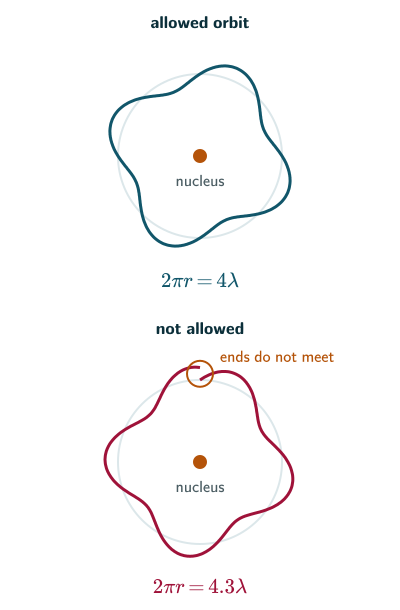
As a historical semiclassical argument, de Broglie’s idea reproduces Bohr’s quantum condition mevr = nh/2π (NCERT Exercise 2.32, page 71). Picture the electron as a wave running round the orbit. The wave survives only if it joins itself smoothly, like a standing wave on a closed loop. With no fixed ends, the wave must match itself after one full turn, so a whole number of wavelengths must fit in the circumference (not half-wavelengths, as on a string fixed at both ends). Otherwise successive turns of the wave cancel out.
Whole number of waves in an orbit
Putting λ = h/mev gives 2πr = nh/mev, that is, mevr = nh/2π: Bohr’s quantised angular momentum, now with a reason behind it. The whole number n is the number of wavelengths round the orbit.
Heisenberg’s uncertainty principle
Werner Heisenberg stated the principle in 1927, as a consequence of the dual behaviour of matter and radiation (NCERT Section 2.5.2, page 50).
It states that it is impossible to determine simultaneously, the exact position and exact momentum (or velocity) of an electron.
NCERT Chemistry Part I (Class 11), Section 2.5.2, page 50
In symbols (NCERT Eq. 2.23, page 51), with Δx and Δpx the standard deviations of position and momentum along the same direction in identically prepared states:
Uncertainty principle
Since p = mv, the same statement for velocity is
In terms of velocity
The smaller Δx, the larger Δvx must be, and the other way round.
A way to picture it. To locate an electron we must shine “light” on it, of wavelength smaller than the precision we want. Such short-wavelength photons carry a large momentum, p = h/λ, and knock the electron as they hit it. We learn where it was, but its velocity is changed by an amount we cannot know (page 51). NCERT compares this with trying to measure the thickness of a sheet of paper with an unmarked metre stick. The limit is not a fault of the instruments: it is built into nature. The deeper reason is the wave nature itself. A wave squeezed into a small region Δx must contain a spread of wavelengths, and since p = h/λ, that is a spread of momenta Δp. The smaller Δx, the larger Δp.
Significance. The path, or trajectory, of a body is fixed by its position and velocity at each instant. If these cannot both be known exactly, an electron has no definite path (page 51).
One of the important implications of the Heisenberg Uncertainty Principle is that it rules out existence of definite paths or trajectories of electrons and other similar particles.
NCERT Chemistry Part I (Class 11), Section 2.5.2, page 51
Usually negligible for ordinary macroscopic motion. The smallest possible product Δv × Δx, h/4πm, depends on the mass (NCERT pages 51–52):
- a speck of 1 mg (10 kg): h/4πm = 5.3 × 10 m s;
- an electron (9.11 × 10 kg): h/4πm = 5.79 × 10 m s.
NCERT rounds these to about 10 and 10 m s. For the speck this lower bound is extremely small; actual measurement uncertainties may be much larger. NCERT then locates an electron to within 10 m, which gives an uncertainty in velocity of about 5.79 × 10 ÷ 10 ≈ 6 × 10 m s (NCERT: of the order of 10 m s), and calls this too large for Bohr’s fixed orbits. That number alone does not upset an orbit: it is under 1% of the electron’s speed in the first orbit, and 10 m is about 200 times the radius of a hydrogen atom. The real case is stronger. To place the electron on an orbit, Δx must be much smaller than 52.9 pm. Then Δv becomes huge: for Δx = 0.1 Å it is 5.79 × 10 m s (Example 4), more than the electron’s speed in the first orbit. So a fixed orbit cannot be defined (reasoned). NCERT concludes that the precise statements of the position and momentum of electrons have to be replaced by statements of probability, and that this is what happens in the quantum mechanical model of the atom (page 52). In an exam, give NCERT’s argument: an uncertainty in velocity of the order of 10 m s is too large for fixed Bohr orbits (page 52). Strictly, quantum mechanics gives separate probability distributions for position and for momentum, not one exact classical trajectory (reasoned from the uncertainty principle).
Why Bohr’s model fails
Bohr treated the electron as a charged particle moving in a well-defined circular orbit (NCERT page 52). That picture fails on two counts:
- it ignores the electron’s wave character;
- a definite orbit needs the electron’s position and velocity to be known exactly at the same time, which the uncertainty principle forbids.
Bohr model of the hydrogen atom, therefore, not only ignores dual behaviour of matter but also contradicts Heisenberg uncertainty principle.
NCERT Chemistry Part I (Class 11), Section 2.5.2, page 52
So there was no point in extending Bohr’s model to other atoms. A new theory was needed, one that builds in wave–particle duality and agrees with the uncertainty principle: quantum mechanics (page 53).
Solved examples
Example 1: The wavelength of a ball (NCERT Problem 2.12, page 50)
Find the de Broglie wavelength of a ball of mass 0.1 kg moving at 10 m s.
λ = h/mv = (6.626 × 10 J s) ÷ (0.1 kg × 10 m s) = 6.626 × 10 m (1 J = 1 kg m s).
Answer: 6.626 × 10 m, far too small to detect.
Example 2: An electron of known kinetic energy (NCERT Problem 2.13, page 50; also Exercise 2.21, page 70)
An electron (mass 9.1 × 10 kg) has kinetic energy 3.0 × 10 J. Find its wavelength.
From K.E. = ½mv: v2 = 2 K.E./m = (6.0 × 10 J) ÷ (9.1 × 10 kg) = 6.59 × 10 m s, so v = 812 m s.
λ = h/mv = (6.626 × 10 J s) ÷ (9.1 × 10 kg × 812 m s) = 8.967 × 10 m.
Answer: about 9.0 × 10 nm to two significant figures (approximately 896.7 nm before rounding), comparable with near-infrared light.
Example 3: The “mass” of a photon (NCERT Problem 2.14, page 50)
NCERT asks for the mass of a photon of wavelength 3.6 Å and uses m = h/λc (since a photon travels at c).
Here λc = 3.6 × 10 m × 3 × 10 m s = 0.108 m s, so m = (6.626 × 10 J s) ÷ (0.108 m s) = 6.135 × 10 kg.
Answer: 6.135 × 10 kg. Two corrections to NCERT’s page 50:
- NCERT prints 6.135 × 10 kg; the division gives 6.135 × 10 kg, 10 times smaller.
- A photon has no rest mass. What h/λc gives is its momentum divided by c: p = h/λ = 1.84 × 10 kg m s, and p/c = 6.135 × 10 kg. Read it as a “mass equivalent”, not as the mass of the photon at rest.
Example 4: Locating an electron (NCERT Problem 2.15, page 52)
A microscope locates an electron in an atom to within 0.1 Å. What is the minimum uncertainty in the corresponding velocity component? Treat the quoted position uncertainty as Δx.
Δvmin = h/(4π Δx m) = (6.626 × 10 J s) ÷ (4 × 3.14 × 0.1 × 10 m × 9.11 × 10 kg) = 5.79 × 10 m s.
Answer: Δv ≥ about 5.79 × 10 m s (about 6 × 10 at the stated precision), larger than the electron’s speed in Bohr’s first orbit (2.19 × 10 m s).
Example 5: A golf ball (NCERT Problem 2.16, page 52)
A golf ball of mass 40 g moves at 45 m s, and its speed is measured to within 2%. Estimate the minimum uncertainty in its position, treating 2% of the speed as the standard deviation of one velocity component.
Δv = 45 × 2/100 = 0.9 m s, and m = 40 × 10 kg.
Then 4πm Δv = 4 × 3.1416 × 0.040 kg × 0.9 m s = 0.4524 kg m s, so Δxmin = h/(4πm Δv) = (6.626 × 10 J s) ÷ (0.4524 kg m s) = 1.46 × 10 m.
Answer: the quantum lower bound is Δx ≥ 1.46 × 10 m, about 10 times smaller than a nuclear diameter. This does not mean the apparatus achieves that precision; it means this bound is negligible for the golf-ball measurement. (NCERT’s working cites “equation (2.22)”, the de Broglie relation; the uncertainty principle is Eq. 2.23.)
Example 6: The electron in Bohr’s first orbit (NCERT Exercises 2.59, page 72, and 2.32, page 71)
The electron in the first Bohr orbit of hydrogen moves at 2.19 × 10 m s. Find its de Broglie wavelength and compare it with the orbit’s circumference (radius 52.9 pm).
mev = 9.11 × 10 kg × 2.19 × 10 m s = 1.995 × 10 kg m s, so λ = h/mev = (6.626 × 10 J s) ÷ (1.995 × 10 kg m s) = 3.32 × 10 m = 332 pm.
Circumference = 2π × 52.9 pm = 332 pm.
Answer: 332 pm, exactly one wavelength fits round the first orbit (n = 1), as 2πr = nλ requires.
Common mistakes to avoid
Common mistake
Using h/mv for a photon
A photon has no rest mass, so λ = h/mv does not apply to it. Use p = h/λ (and E = pc) for light; λ = h/mv is for non-relativistic particles with mass.
Common mistake
Forgetting SI units
Put the mass in kilograms (40 g = 0.040 kg) and lengths in metres (1 Å = 10 m, 1 pm = 10 m) before using h in J s; then λ and Δx come out in metres.
Common mistake
Using h/2π instead of h/4π
In NCERT’s form the uncertainty product is Δx × Δp ≥ h/4π. Using h/2π doubles every answer. Many books write Δx × Δp ≥ ħ/2, with ħ = h/2π: that is the same as h/4π, so do not read ħ/2 as h/2π.
Common mistake
Blaming the instruments
The uncertainty principle is not about clumsy measurement. Even a perfect instrument cannot fix both position and momentum exactly, because the electron behaves as a wave.
Common mistake
Comparing wavelengths without fixing what is equal
At the same momentum, λ = h/p is the same whatever the mass. At the same speed, λ ∝ 1/m, so an electron’s wavelength is about 1836 times a proton’s. At the same kinetic energy, λ ∝ 1/√m. Through the same accelerating voltage, K = qV, so λ = h/√(2mqV): four times the voltage halves λ, and a proton’s wavelength is √8 ≈ 2.83 times an α-particle’s (at equal kinetic energy the ratio is 2).
Common mistake
Thinking big objects have no wave
Every moving object has a de Broglie wavelength (page 50); for everyday masses it is simply far too short to detect.
Quick revision summary
- de Broglie (1924): matter has dual behaviour; λ = h/mv = h/p. Confirmed by electron diffraction; used in the electron microscope.
- In terms of kinetic energy, λ = h/√(2mK); for an electron accelerated through V volts, λ ≈ 1.23/√V nm, so λ ∝ 1/√V.
- An orbit holds a whole number of waves: 2πr = nλ, which gives Bohr’s mevr = nh/2π.
- Heisenberg (1927): position and momentum cannot both be known exactly; Δx × Δp ≥ h/4π, Δx × Δv ≥ h/(4πm).
- The bound applies to all particles; it is usually negligible for ordinary macroscopic motion. Quantum states give probability distributions rather than exact classical trajectories.
- Bohr’s model ignores the electron’s wave nature and contradicts the uncertainty principle.
Formula sheet
- λ = h/mv = h/p
- λ = h/√(2mK); electron through V volts: λ ≈ 1.23/√V nm
- 2πr = nλ (gives mvr = nh/2π)
- Δx × Δp ≥ h/4π
- Δx × Δv ≥ h/(4πm)
Questions students ask
What is the de Broglie wavelength of the electron in the nth Bohr orbit?
The de Broglie wavelength of the electron in the nth Bohr orbit of a one-electron species is λ = 2πrn/n, because exactly n wavelengths fit round the orbit; with rn = 52.9n/Z pm this gives λ = 2π × 52.9n/Z pm ≈ 332n/Z pm. So the wavelength grows in proportion to n and falls as 1/Z: about 997 pm in the third orbit of hydrogen and about 166 pm in the first orbit of He+. The same result follows from λ = h/mev with the orbital speed vn = 2.19 × 10 × Z/n m s.
How does the de Broglie wavelength depend on temperature?
For the particles of a gas, a characteristic de Broglie wavelength falls as 1/√T: for a classical ideal gas the average kinetic energy is 3kBT/2, so λ = h/√(2mK) becomes λ = h/√(3mkBT). This is the wavelength corresponding to the root-mean-square momentum, not the mean of the wavelengths of all gas particles. For a neutron at 300 K it gives about 145 pm, close to the spacing of atoms in a crystal, which is why such slow ‘thermal neutrons’ are used for diffraction. Some questions take K = kBT instead, giving λ = h/√(2mkBT), so check which one is meant.
What is the difference between a de Broglie wavelength and an ordinary wavelength?
A de Broglie wavelength belongs to the matter wave of a moving particle, such as an electron, and is fixed by the particle’s momentum, λ = h/mv, while an ordinary wavelength is the crest-to-crest distance of a wave of electric and magnetic fields, as in light, or of a vibrating medium, as in sound. A matter wave is not a vibration of anything material: the square of its amplitude gives the probability density of finding the particle at a point, and its wavelength shortens whenever the particle speeds up. For a photon the two ideas agree, since light also obeys λ = h/p.
What does the graph of de Broglie wavelength against momentum look like?
The graph of de Broglie wavelength against momentum is a rectangular hyperbola, because λ = h/p keeps the product λp constant: doubling the momentum halves the wavelength. Plotted against 1/p, the wavelength gives a straight line through the origin with slope h, the same for every particle. For electrons accelerated through V volts, λ ≈ 1.23/√V nm, so a graph of λ against 1/√V is also a straight line through the origin.
Are de Broglie’s relation and the uncertainty principle in the JEE Main 2027 and NEET (UG) 2026 syllabuses?
Yes, de Broglie’s relation and Heisenberg’s uncertainty principle are both in the JEE Main 2027 and NEET (UG) 2026 Chemistry syllabuses, Unit 2 (Atomic Structure), which lists ‘dual nature of matter, de Broglie’s relationship, Heisenberg uncertainty principle’. De Broglie’s relation appears again in Physics Unit 17, Dual Nature of Matter and Radiation, as ‘matter waves: wave nature of particle, de Broglie relation’, but the uncertainty principle is in the Chemistry syllabus only. The two relations are λ = h/mv and Δx × Δp ≥ h/4π.
Practice questions
Try each question first, then open the answer to check your working.
-
Q1. Find the wavelength of an electron moving at 2.05 × 10 m s (NCERT Exercise 2.20, page 70).
Show answerHide answer
mev = 9.11 × 10 kg × 2.05 × 10 m s = 1.868 × 10 kg m s, so λ = h/mev = (6.626 × 10 J s) ÷ (1.868 × 10 kg m s) = 3.55 × 10 m, about 35.5 pm.
-
Q2. The electrons in an electron microscope move at 1.6 × 10 m s. Find their de Broglie wavelength (NCERT Exercise 2.57, page 72).
Show answerHide answer
λ = (6.626 × 10) ÷ (9.11 × 10 × 1.6 × 10) = 4.55 × 10 m = 455 pm.
-
Q3. An electron’s position is measured to within ± 0.002 nm. Find the minimum uncertainty in the corresponding momentum component, treating the quoted value as Δx. If its momentum were h/(4π × 0.05 nm), would there be any problem in defining it (NCERT Exercise 2.61, page 72)?
Show answerHide answer
Δpmin = h/(4πΔx) = (6.626 × 10) ÷ (4π × 0.002 × 10) = 2.64 × 10 kg m s. The momentum itself would be (6.626 × 10) ÷ (4π × 0.05 × 10) = 1.05 × 10 kg m s. The minimum spread is 25 times the stated momentum scale, so no sharply defined classical momentum can be assigned. A mean momentum can still be specified together with this large spread. (NCERT prints the momentum as “h/4πm × 0.05 nm”; it is read here as h/(4π × 0.05 nm), the only reading that gives a momentum.)