Developments leading to Bohr’s model
NCERT Class 11 Chemistry Chapter 2 Section 2.3
Quick answer
Light travels as a wave, with speed equal to frequency times wavelength, but is emitted and absorbed in quanta of energy hν, as Planck proposed in 1900. Einstein used these quanta, or photons, to explain the photoelectric effect: a photon ejects an electron only if its energy is at least the metal’s work function, and the rest becomes kinetic energy. Atoms emit light only at fixed wavelengths, and the hydrogen lines fit Rydberg’s formula, evidence that atomic energies are quantised.
With your textbook
NCERT Chemistry Part I (Class 11), Chapter 2 “Structure of Atom”, Section 2.3 “Developments Leading to the Bohr’s Model of Atom”, pages 37–46.
Open the official NCERT chapter (PDF, 5.5 MB, ncert.nic.in) (opens in a new tab)
Checked against the 2026-27 reprint on .
What led to Bohr’s model?
The two developments behind Bohr’s model
Two sets of results prepared the way for Bohr’s model of the atom (NCERT Section 2.3, pages 37–46):
- Electromagnetic radiation has a dual character. It travels as a wave, with c = νλ. But it is emitted and absorbed in packets, quanta or photons, each of energy E = hν (Planck, 1900). The photoelectric effect (Einstein, 1905) shows the particle side directly.
- Atoms give line spectra. Excited atoms emit light only at certain wavelengths. For hydrogen these fit Rydberg’s formula, ν̄ = 109 677 (1/n12 − 1/n22) cm, which hints that an atom’s energy is quantised.
In plain words: by 1900 light was firmly a wave. Then two puzzles appeared. Hot bodies and the photoelectric effect behaved as if light came in packets of energy, and atoms gave off light only at sharp, fixed colours. Bohr put the two together: if light comes in packets and atoms emit only certain packets, an atom’s electron can have only certain energies.
Electromagnetic radiation as a wave
James Clerk Maxwell (1870) explained that an accelerating charged particle produces oscillating electric and magnetic fields, which travel as electromagnetic waves (NCERT Section 2.3.1, page 37). Light is one example. The electric and magnetic fields are perpendicular to each other and to the direction of travel, and unlike sound, electromagnetic waves need no medium (pages 37–38).
The kinds of radiation differ only in wavelength λ and frequency ν, which together make the electromagnetic spectrum (NCERT Fig. 2.7, page 38):
| Region | Frequency (Hz) | Example use |
|---|---|---|
| Radio | about 10 | broadcasting |
| Microwave | about 10 | radar |
| Infrared | about 10 | heating |
| Visible | 4.0–7.5 × 10 | seeing |
| Ultraviolet | about 10 | part of sunlight |
In a vacuum all electromagnetic radiation travels at the same speed, c = 3.0 × 10 m s (2.997925 × 10 m s more precisely) (page 38). Frequency, wavelength and speed are linked, as for any wave:
Speed, frequency and wavelength
The SI unit of frequency is the hertz (Hz, s), the number of waves passing a point per second. Spectroscopists also use the wavenumber, ν̄ = 1/λ, usually in cm (page 39).
It is defined as the number of wavelengths per unit length.
NCERT Chemistry Part I (Class 11), Section 2.3.1, page 39
Planck’s quantum theory
The wave theory explained diffraction and interference, but not four observations (NCERT Section 2.3.2, pages 39–40): black-body radiation, the photoelectric effect, the way the heat capacity of solids changes with temperature, and the line spectra of atoms.
A black body is an ideal body that absorbs and emits radiation of all frequencies; a cavity with a tiny hole comes close (page 40). The intensity of its radiation at each wavelength depends only on its temperature: it rises to a maximum and then falls, and the maximum shifts to shorter wavelengths as the temperature rises (NCERT Fig. 2.8). NCERT’s example is an iron rod heated in a furnace: it glows dull red, then a brighter red, then white, and NCERT adds that it turns blue when the temperature is very high (page 40). (Iron itself melts, at about 1540 °C, long before its glow could look blue; a bluish glow needs a far hotter body, such as the hottest stars.) The physics of this radiation is in black-body radiation.
Max Planck (1900) explained the curves by assuming that atoms can emit or absorb energy only in discrete amounts (pages 40–41).
He gave the name quantum to the smallest quantity of energy that can be emitted or absorbed in the form of electromagnetic radiation.
NCERT Chemistry Part I (Class 11), Section 2.3.2, page 41
Energy of a quantum
Here h = 6.626 × 10 J s is Planck’s constant. For radiation of one fixed frequency ν, the energy exchanged in whole quanta can be 0, hν, 2hν, 3hν, …; different frequencies have different quantum energies, like standing on the steps of a staircase but never between them (page 41).
A handy shortcut: since hc ≈ 1240 eV nm, a photon of wavelength λ in nanometres has energy E ≈ 1240/λ electronvolts (1 eV = 1.602 × 10 J). Red light at 620 nm carries about 2.0 eV per photon.
The photoelectric effect
In 1887 Heinrich Hertz found that some metals, such as potassium, rubidium and caesium, give off electrons when light falls on them (NCERT page 41). The results (pages 41–42):
- in the ordinary single-photon regime, emission begins without an observable energy-accumulation delay when above-threshold light arrives;
- at fixed frequency above threshold, the emission rate is proportional to light intensity when other conditions are unchanged;
- for each metal there is a threshold frequency ν0 below which no electrons come out, however bright the light; above it, the electrons’ kinetic energy increases with the frequency, but not with the brightness.
Classical physics, in which the energy of light depends on its brightness, cannot explain points 1 and 3. Einstein (1905) explained them with Planck’s quanta (page 42). The discussion here assumes ordinary single-photon emission; intense-field multiphoton effects are outside this model. Light is a stream of photons, each of energy hν. One photon gives all its energy to one electron. It must supply at least the work function W0 = hν0 to free the electron, and the rest becomes the electron’s kinetic energy (NCERT Eq. 2.7). Electrons that start below the surface lose some energy on the way out, so ½mev here is the maximum kinetic energy of the ejected electrons:
Einstein’s photoelectric equation
Brighter light has more photons, so more electrons, but each photon still has the same energy. The kinetic energy here is the electron’s kinetic energy, ½mv.
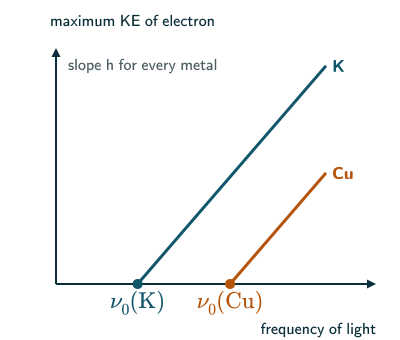
NCERT’s work functions (Table 2.2, page 42): Li 2.42, Na 2.3, K 2.25, Mg 3.7, Cu 4.8, Ag 4.3 eV.
Two corrections to NCERT’s page 42:
- NCERT says the kinetic energy of the ejected electron “is proportional to the frequency”. It is not proportional: it is a straight line that starts at ν0, KE = h(ν − ν0), as Problem 2.9 and the figure show. Doubling the frequency does not double the kinetic energy.
- NCERT gives potassium’s threshold frequency as 5.0 × 10 Hz and says yellow light of 5.1–5.2 × 10 Hz ejects electrons. But its own Table 2.2 gives potassium W0 = 2.25 eV, which means ν0 = (2.25 × 1.602 × 10 J) ÷ (6.626 × 10 J s) = 5.44 × 10 Hz, a threshold wavelength of about 551 nm (green). For the stated work function of 2.25 eV, yellow light at about 580 nm carries insufficient energy for single-photon emission. Use the work function given in the problem; actual values depend on the surface, so this numerical inconsistency does not establish a universal threshold for every potassium sample.
In experiments, the maximum kinetic energy is measured by the stopping potential V0, the reverse voltage that just stops the fastest electrons: KEmax = eV0 (beyond the NCERT text; NCERT Exercise 2.53 uses it). Three points to note:
- like the kinetic energy, V0 depends on the frequency of the light, not on its intensity;
- since eV0 = hν − W0, a graph of V0 against ν is a straight line of slope h/e;
- at a fixed power, light of higher frequency carries fewer photons per second, because each photon carries more energy (compare Example 4).
Dual behaviour of radiation
The only way to resolve the dilemma was to accept the idea that light possesses both particle and wave-like properties, i.e., light has dual behaviour.
NCERT Chemistry Part I (Class 11), Section 2.3.2, page 42
Light shows its wave nature (interference, diffraction) as it travels, and its particle nature when it interacts with matter (page 42). Electrons, too, turn out to have both natures, the starting point of the quantum mechanical model.
Atomic spectra
White light passed through a prism spreads into a continuous spectrum, violet (7.50 × 10 Hz) merging into blue, green and so on to red (4 × 10 Hz) (NCERT Section 2.3.3, page 44). Atoms behave differently:
- an emission spectrum is the radiation given out by atoms that have absorbed energy (by heating or irradiation) and are returning to lower energy states;
- an absorption spectrum is what remains when continuous radiation passes through a sample: dark lines where the sample absorbed, like a photographic negative of the emission spectrum (page 44).
Gaseous atoms emit only at specific wavelengths, with dark gaps between: a line spectrum (page 44).
Each element has a unique line emission spectrum.
NCERT Chemistry Part I (Class 11), Section 2.3.3, page 44
So line spectra identify elements like fingerprints. Robert Bunsen (1811–1899) was one of the first to use them; rubidium, caesium, thallium, indium, gallium and scandium were discovered this way, and helium was found in the sun before it was found on the Earth (page 44).
The line spectrum of hydrogen
An electric discharge breaks hydrogen molecules into excited atoms, which emit radiation at discrete frequencies (page 44). In 1885 Balmer found that the visible lines fit a simple formula (NCERT Eq. 2.8, page 45), and Johannes Rydberg extended it to every series of hydrogen lines:
Rydberg’s formula for hydrogen
ν̄ = 109 677 (1/n12 − 1/n22) cm, with n1 = 1, 2, … and n2 = n1 + 1, n1 + 2, …
109 677 cm is the Rydberg constant for hydrogen (page 45). Each value of n1 gives a series (NCERT Table 2.3):
| Series | n1 | n2 | Region |
|---|---|---|---|
| Lyman | 1 | 2, 3, … | ultraviolet |
| Balmer | 2 | 3, 4, … | visible |
| Paschen | 3 | 4, 5, … | infrared |
| Brackett | 4 | 5, 6, … | infrared |
| Pfund | 5 | 6, 7, … | infrared |
Only four Balmer lines are visible: n2 = 3, 4, 5 and 6 give 656, 486, 434 and 410 nm. From n2 = 7 (397 nm) on, the lines lie in the near ultraviolet and crowd together towards the series limit, n2 → ∞, where ν̄ = 109 677/4 cm and λ = 364.7 nm. The Lyman series limit is at 1/(109 677 cm) = 91.2 nm.
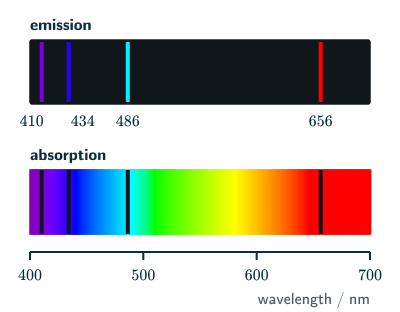
Hydrogen has the simplest line spectrum; heavier atoms have more complex ones. But every element’s lines are unique and regular (page 46), and explaining that regularity is what Bohr’s model set out to do.
Solved examples
Example 1: A radio station’s wavelength (NCERT Problem 2.3, page 39)
The Vividh Bharati station of All India Radio, Delhi, broadcasts at 1368 kHz. Find the wavelength, and the part of the spectrum it belongs to.
λ = c/ν = (3.00 × 10 m s) ÷ (1368 × 10 s) = 219.3 m.
Answer: 219 m to the three significant figures of 3.00 × 10 m s (219.3 m before rounding), a radio wavelength.
Example 2: Wavenumber and frequency (NCERT Problem 2.5, page 39)
Yellow radiation has a wavelength of 5800 Å. Find (a) its wavenumber and (b) its frequency.
λ = 5800 Å = 5800 × 10 m.
(a) ν̄ = 1/λ = 1 ÷ (5800 × 10 m) = 1.724 × 10 m = 1.724 × 10 cm.
(b) ν = c/λ = (3 × 10 m s) ÷ (5800 × 10 m) = 5.172 × 10 s.
Answer: 1.724 × 10 m; 5.172 × 10 Hz. (In part (b) NCERT labels the frequency with the wavenumber symbol, ν̄; it is the frequency, ν.)
Example 3: One mole of photons (NCERT Problem 2.6, page 43)
Find the energy of one mole of photons of frequency 5 × 10 Hz.
One photon: E = hν = 6.626 × 10 J s × 5 × 10 s = 3.313 × 10 J.
One mole: 3.313 × 10 J × 6.022 × 10 mol = 1.995 × 10 J mol (multiplying by the Avogadro constant).
Answer: about 2 × 10 kJ mol at the stated precision of 5 × 10 Hz; the unrounded intermediate result is 199.5 kJ mol.
Example 4: Photons from a bulb (NCERT Problem 2.7, page 43)
An ideal source emits 100 W of monochromatic light of wavelength 400 nm (take 100 W as emitted optical power). How many photons does it emit per second?
Energy of one photon: E = hc/λ = (6.626 × 10 J s × 3 × 10 m s) ÷ (400 × 10 m) = 4.969 × 10 J.
100 W = 100 J s, so photons per second = (100 J s) ÷ (4.969 × 10 J) = 2.012 × 10 s.
Answer: 2.012 × 10 photons per second.
Example 5: The work function of sodium (NCERT Problem 2.8, page 43)
Radiation of wavelength 300 nm ejects electrons from sodium with kinetic energy 1.68 × 10 J mol. Find the minimum energy needed to remove an electron, and the longest wavelength that will eject one.
Photon energy: with hc = 6.626 × 10 × 3.0 × 10 = 1.9878 × 10 J m, hc/λ = (1.9878 × 10 J m) ÷ (300 × 10 m) = 6.626 × 10 J, or 6.626 × 10 × 6.022 × 10 = 3.99 × 10 J mol.
Minimum energy = 3.99 × 10 − 1.68 × 10 = 2.31 × 10 J mol, that is, (2.31 × 10) ÷ (6.022 × 10) = 3.84 × 10 J per electron.
Longest wavelength: λ = hc/E = (1.9878 × 10 J m) ÷ (3.84 × 10 J) = 5.18 × 10 m = 518 nm.
Answer: 3.84 × 10 J per electron; about 518 nm, green light. (NCERT gets 517 nm: 517.7 cut short instead of rounded.)
Example 6: Kinetic energy from the threshold frequency (NCERT Problem 2.9, page 43)
A metal’s threshold frequency is 7.0 × 10 s. Find the kinetic energy of an electron ejected by radiation of frequency 1.0 × 10 s.
KE = h(ν − ν0) = 6.626 × 10 J s × (10.0 − 7.0) × 10 s = 1.988 × 10 J.
Answer: the unrounded maximum kinetic energy is 1.988 × 10 J, or about 2 × 10 J with the precision of the supplied frequencies.
Common mistakes to avoid
Common mistake
Thinking brighter light ejects faster electrons
At fixed frequency in the ordinary single-photon regime, greater intensity supplies more photons and increases emission rate. The maximum kinetic energy depends on frequency and the surface work function, not intensity. Multiphoton processes at intense laser fields lie outside this elementary model.
Common mistake
Calling kinetic energy proportional to frequency
KE = h(ν − ν0) is a straight line that starts at ν0, not a line through the origin. Its slope, h, is the same for every metal.
Common mistake
Mixing up frequency and wavenumber
Frequency ν = c/λ is in s (Hz); wavenumber ν̄ = 1/λ is in m or cm. Convert wavelength to the right unit first: 1 Å = 10 m, 1 nm = 10 m.
Common mistake
Forgetting to convert per photon to per mole
Energies from E = hν are per photon (per atom or electron). Multiply by 6.022 × 10 mol to get J mol, and divide by 1.602 × 10 J to get eV.
Quick revision summary
- Electromagnetic waves need no medium; c = νλ = 3.0 × 10 m s in a vacuum; wavenumber ν̄ = 1/λ.
- Planck (1900): energy comes in quanta, E = hν, h = 6.626 × 10 J s.
- Photoelectric effect: no time lag; number of electrons ∝ intensity; threshold ν0; Einstein: hν = hν0 + ½mev (maximum KE), with W0 = hν0; stopping potential eV0 = KEmax.
- Shortcut: E (eV) ≈ 1240/λ (nm).
- Light has dual behaviour: wave when it travels, particle when it interacts with matter.
- Atoms give line spectra, unique to each element. Hydrogen: ν̄ = 109 677 (1/n12 − 1/n22) cm; Lyman (UV), Balmer (visible for n2 = 3–6; limit 364.7 nm), Paschen, Brackett, Pfund (IR).
Formula sheet
- c = νλ; ν̄ = 1/λ
- E = hν = hc/λ; h = 6.626 × 10 J s
- hν = hν + ½mv; W = hν
- KEmax = eV (stopping potential)
- E (eV) ≈ 1240/λ (nm)
- ν̄ = 109 677 (1/n − 1/n) cm
Questions students ask
How does the photoelectric effect show that light is made of particles?
The photoelectric effect shows light’s particle nature because its results fit packets of energy hν, not a continuous wave: below a threshold frequency no electrons come out however bright the light, the electrons’ maximum kinetic energy depends on the frequency but not on the brightness, and emission starts with no time lag even in dim light. A wave would spread its energy over the whole surface, so bright light of any frequency should eject electrons, faster ones the brighter it is, after a delay in dim light. Einstein (1905) explained all three results by letting one photon give its whole energy to one electron, and his 1921 Nobel Prize in Physics cited this work.
What is the difference between Planck’s quantum theory and the electromagnetic wave theory?
In the electromagnetic wave theory, light is emitted and absorbed continuously, in any amount, and its energy depends on its intensity; in Planck’s quantum theory it is emitted and absorbed only in whole packets, quanta, each of energy E = hν, so the energy of each packet depends on the frequency. Planck (1900) needed quanta to explain black-body radiation, which the wave theory could not, and Einstein (1905) took the idea further by treating light itself as a stream of photons. The wave theory still describes how light travels, in interference and diffraction, so light is said to have a dual nature.
What are the value, unit and dimensions of Planck’s constant?
Planck’s constant is h = 6.626 × 10 J s, or 4.136 × 10 eV s; since 2019 it has been fixed exactly, at 6.62607015 × 10 J s, and used to define the kilogram. Its SI unit, the joule second, equals kg m s, so its dimensional formula is [M L T], the same as that of angular momentum. So Bohr’s condition, mevr = nh/2π, is dimensionally sound: the electron’s angular momentum comes in units of h/2π.
Is black-body radiation in the JEE Main 2027 and NEET (UG) 2026 syllabuses?
No, black-body radiation is not named in the JEE Main 2027 or NEET (UG) 2026 syllabus: Chemistry Unit 2 lists the nature of electromagnetic radiation, the photoelectric effect and the spectrum of the hydrogen atom, and Physics lists only ‘radiation’ under heat transfer. It has not been deleted from NCERT Class 11 Chemistry, though, which still uses it (Section 2.3.2) as the puzzle that led Planck to E = hν, an equation both exams use constantly. So know what a black body is and how its glow changes with temperature; the radiation laws are on the physics page on black-body radiation.
What is the difference between the photoelectric effect and thermionic emission?
The photoelectric effect and thermionic emission both free electrons from a metal surface, and both must supply at least the metal’s work function, but in the photoelectric effect the energy comes from light and in thermionic emission from heat. In the photoelectric effect one photon gives its energy hν to one electron, so emission depends on the light’s frequency and happens even from a cold metal; in thermionic emission the metal is heated until its fastest electrons have enough thermal energy to escape. The heated cathodes of X-ray tubes and of old television picture tubes give out electrons by thermionic emission.
Practice questions
Try each question first, then open the answer to check your working.
-
Q1. Find the wavelength, frequency and wavenumber of a light wave whose period is 2.0 × 10 s (NCERT Exercise 2.7, page 69).
Show answerHide answer
Frequency is the number of waves per second, the reciprocal of the period: ν = 1/T = 1 ÷ (2.0 × 10 s) = 5.0 × 10 Hz. λ = c/ν = (3.0 × 10 m s) ÷ (5.0 × 10 s) = 6.0 × 10 m (6.0 cm). ν̄ = 1/λ = 1 ÷ (6.0 × 10 m) = 16.7 m (0.167 cm). This is a microwave.
-
Q2. A photon of wavelength 4 × 10 m strikes a metal whose work function is 2.13 eV. Find (i) the photon’s energy in eV, (ii) the kinetic energy of the photoelectron, and (iii) its speed (1 eV = 1.602 × 10 J; NCERT Exercise 2.9, page 69).
Show answerHide answer
(i) E = hc/λ = (6.626 × 10 × 3.0 × 10) ÷ (4 × 10) = 4.969 × 10 J = 3.102 eV. (ii) KE = 3.102 − 2.13 = 0.972 eV = 1.557 × 10 J. (iii) v2 = 2 KE/me = (3.114 × 10 J) ÷ (9.11 × 10 kg) = 3.418 × 10 m s, so v ≈ 5.85 × 10 m s.
-
Q3. Electrons are emitted with zero velocity from a metal exposed to radiation of wavelength 6800 Å. Find the threshold frequency and the work function (NCERT Exercise 2.12, page 69).
Show answerHide answer
Zero velocity means the radiation is exactly at the threshold. ν0 = c/λ = (3.0 × 10) ÷ (6800 × 10) = 4.41 × 10 Hz. W0 = hν0 = 6.626 × 10 × 4.41 × 10 = 2.92 × 10 J, about 1.82 eV.