Mole concept and molar mass
NCERT Class 11 Chemistry Chapter 1 Section 1.8
Quick answer
A mole is the amount of substance containing exactly 6.02214076 × 10 specified entities, such as atoms, molecules or ions. Molar mass is mass per mole, commonly in g mol; at school precision its numerical value equals the atomic, molecular or formula mass in u. Calculate amount as n = m/M or n = N/NA, stating which particles are counted.
With your textbook
NCERT Chemistry Part I (Class 11), Chapter 1 “Some Basic Concepts of Chemistry”, Section 1.8 “Mole Concept and Molar Masses”, page 18.
Open the official NCERT chapter (PDF, 4.0 MB, ncert.nic.in) (opens in a new tab)
Checked against the 2026-27 reprint on .
What is a mole?
The mole and molar mass
The mole (symbol mol) is the SI unit of amount of substance. One mole contains exactly 6.02214076 × 10 elementary entities: atoms, molecules, ions, electrons or any other specified particles. This number is the numerical value of the Avogadro constant, NA = 6.022 × 10 mol (to four figures), and is called the Avogadro number.
The molar mass M is mass divided by amount of substance; its common chemistry unit is g mol and its SI unit is kg mol. At school precision, its value in g mol is numerically equal to its atomic, molecular or formula mass in u (NCERT Section 1.8, page 18).
The mole, symbol mol, is the SI unit of amount of substance. One mole contains exactly 6.02214076 × 10 elementary entities.
NCERT Chemistry Part I (Class 11), Section 1.8, page 18
In plain words: a dozen means 12 things, a score 20 and a gross 144 (page 18). A mole is a chemist’s counting word for 6.022 × 10 things. It is chosen so that one mole of a substance has a mass in grams equal to its formula mass in u. 18.02 g of water is one mole of water molecules, and 12 g of carbon-12 is (to the precision needed here) one mole of carbon atoms.
The Avogadro constant
It may be emphasised that the mole of a substance always contains the same number of entities, no matter what the substance may be.
NCERT Chemistry Part I (Class 11), Section 1.8, page 18
So 1 mol of hydrogen atoms is 6.022 × 10 atoms, 1 mol of water is 6.022 × 10 molecules, and 1 mol of sodium chloride is 6.022 × 10 formula units of NaCl (page 18).
NCERT shows where the number came from. A mass spectrometer gives the mass of one carbon-12 atom as 1.992648 × 10 g; one mole of carbon-12 weighs 12 g, so the number of atoms in it is N = (12 g mol)/
Since 2019 the Avogadro constant is no longer measured this way. Its value is fixed by definition at exactly 6.022 140 76 × 10 mol, and the mole is defined from it (NCERT Table 1.2, page 8). NCERT’s page 18 writes the number out in full as 602 213 670 000 000 000 000 000, which is the older measured value 6.0221367 × 10. Written out, the defined value is 602 214 076 000 000 000 000 000. For all calculations at this level, 6.022 × 10 is enough.
The same number appears in physics as Avogadro’s number.
Molar mass
The mass of one mole of a substance in grams is called its molar mass.
NCERT Chemistry Part I (Class 11), Section 1.8, page 18
The molar mass in grams per mole has the same number as the atomic, molecular or formula mass in u:
| Substance | Mass of one particle (u) | Molar mass (g mol) |
|---|---|---|
| Water, H2O | 18.02 | 18.02 |
| NaCl | 58.5 | 58.5 |
| Carbon-12 | 12 | 12 |
This works because the gram and the unified mass unit are linked through the Avogadro constant: 6.022 × 10 × 1 u is very nearly 1 g (NA × 1 u ≈ 1 g mol. NIST’s 2022 CODATA value differs from 1 g mol by about 1.05 parts in a billion).
Moving between mass, moles and particles
The amount of substance n links everything:
Moles from mass and from number of particles
Here m is the mass in grams, M the molar mass in g mol and N the number of particles. For a gas, the volume of one mole is the same for every (ideal) gas at a given temperature and pressure (Avogadro’s law). NCERT uses 22.7 L per mole (page 20) without stating conditions; 22.7 L is the value at 273.15 K and 1 bar, today’s STP. Older books take STP as 273 K and 1 atm, which gives 22.4 L. If a question says only “STP”, check which value its answers use.
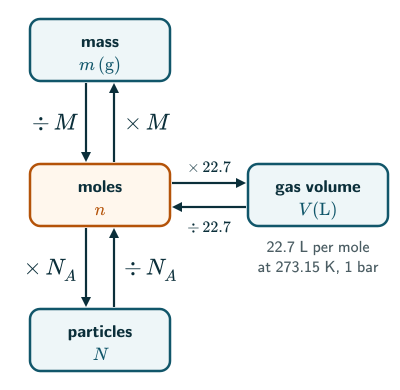
Count the particles you mean. 1 mol of CaCl2 contains 3 mol of ions (1 mol Ca and 2 mol Cl). Approximately 18 g (one mole at school precision) of H2O made of H and O contains approximately 8 mol of neutrons. One mole of H2O molecules contains 2 mol of H atoms, 1 mol of O atoms, 3 mol of atoms in all and 10 mol of electrons.
Solved examples
Example 1: Mass of one carbon-12 atom (NCERT Exercise 1.30, page 28)
What is the mass of one C atom in grams?
One mole of C atoms has a mass of 12 g (exact before 2019; now an excellent approximation at school precision), so one atom has mass 12 g ÷ (6.022 × 10) ≈ 1.993 × 10 g.
Answer: about 1.993 × 10 g, matching the mass-spectrometer value of 1.992648 × 10 g on NCERT page 18.
Example 2: Counting atoms (NCERT Exercise 1.33, page 28)
Calculate the number of atoms in (i) 52 moles of Ar; (ii) 52 u of He; (iii) 52 g of He (He = 4.0 u).
(i) 52 mol × 6.022 × 10 mol ≈ 3.131 × 10 atoms.
(ii) One He atom has a mass of 4.0 u, so 52 u is 52/4.0 = 13 atoms.
(iii) 52 g ÷ 4.0 g mol = 13 mol, and 13 × 6.022 × 10 ≈ 7.8 × 10 atoms.
Answer: 3.1 × 10 (two significant figures for 52 mol); 13; 7.8 × 10. Read the unit: u is the mass of single atoms, g the mass of moles.
Example 3: Which has the most atoms? (NCERT Exercise 1.28, page 28)
Which has the largest number of atoms: (i) 1 g of Au(s); (ii) 1 g of Na(s); (iii) 1 g of Li(s); (iv) 1 g of Cl2(g)? Use Au = 197.0, Na = 23.0, Li = 6.94 and Cl = 35.5.
Moles of atoms: (i) 1/197.0 ≈ 0.00508; (ii) 1/23.0 ≈ 0.0435; (iii) 1/6.94 ≈ 0.144; (iv) 1/71.0 mol of Cl2 molecules, each with 2 atoms, so 2/71.0 ≈ 0.0282 mol of atoms.
Answer: (iii) 1 g of lithium, about 0.144 × 6.022 × 10 ≈ 8.68 × 10 atoms. The lightest atom gives the most atoms per gram.
Example 4: Moles of atoms in ethane (NCERT Exercise 1.10, page 26)
In three moles of ethane, C2H6, find (i) the moles of carbon atoms; (ii) the moles of hydrogen atoms; (iii) the number of ethane molecules.
Each molecule has 2 C and 6 H atoms. (i) 3 × 2 = 6 mol of C atoms. (ii) 3 × 6 = 18 mol of H atoms. (iii) 3 × 6.022 × 10 ≈ 1.807 × 10 molecules.
Answer: 6 mol C; 18 mol H; about 1.807 × 10 molecules.
Example 5: From grams to molecules and atoms
How many molecules and how many atoms are there in 9.0 g of water (M = 18.02 g mol)?
n = 9.0/18.02 ≈ 0.4994 mol. Molecules = 0.4994 × 6.022 × 10 ≈ 3.0 × 10. Each molecule has 3 atoms, so atoms ≈ 9.0 × 10.
Answer: about 3.0 × 10 molecules and 9.0 × 10 atoms (two significant figures, as in 9.0 g).
Common mistakes to avoid
Common mistake
Forgetting which particles are counted
“1 mol of oxygen” is ambiguous. 1 mol of O2 molecules is 2 mol of O atoms and weighs 32.00 g; 1 mol of O atoms weighs 16.00 g. Always say what the entities are.
Common mistake
Using u where grams are meant
52 u of helium is 13 atoms; 52 g is 13 moles. Both u and g are mass units and can describe any mass; their very different sizes make u convenient for particles and g for laboratory samples.
Common mistake
Using 22.7 L for liquids and solids, or at the wrong conditions
These particular molar-volume values apply to ideal gases at the stated temperature and pressure: 22.7 L at 273.15 K and 1 bar, 22.4 L at 273 K and 1 atm. When a question says only “STP”, check which one it means. A mole of liquid water takes only about 18 mL.
Common mistake
Treating the Avogadro constant as a pure number
NA has a unit, mol. Writing it keeps the units right: n × NA gives a number, and m/M gives moles.
Quick revision summary
- The mole is the SI unit of amount of substance: exactly 6.02214076 × 10 entities.
- Avogadro constant NA = 6.022 × 10 mol; one mole of anything contains this many entities.
- Molar mass in g mol has the same number as the atomic, molecular or formula mass in u.
- n = m/M = N/NA; for a gas at 273.15 K and 1 bar, 1 mol occupies about 22.7 L.
- Always state the entity: molecules, atoms, ions or electrons.
Formula sheet
- 1 mol = 6.02214076 × 10 entities (exact)
- Avogadro constant = 6.022 × 10 mol
- n = m/M
- n = N/NA
- Molar mass in g mol ≈ formula mass in u (same numerical value at school precision)
- Gas at 273.15 K and 1 bar: 1 mol ≈ 22.7 L (22.4 L at 273 K, 1 atm)
Questions students ask
What is the difference between molar mass and molecular mass?
Molecular mass is the mass of one molecule, in u, while molar mass is the mass of one mole of the substance (6.022 × 10 molecules), in g mol; the two have the same number. For benzene, C6H6, the molecular mass is 6 × 12.01 + 6 × 1.008 = 78.11 u, so its molar mass is 78.11 g mol. In the same way an element’s atomic mass (oxygen, 16.00 u) and its molar mass (16.00 g mol, once called the gram atomic mass) share a number, as do the formula mass and the molar mass of an ionic solid.
What is the difference between a mole and a molecule?
A molecule is a single particle, such as one H2O, while a mole is a counting unit for 6.022 × 10 particles of any kind, just as a dozen means 12 things. So one water molecule has a mass of 18.02 u, about 2.99 × 10 g, but one mole of water molecules has a mass of 18.02 g. A mole can count atoms, ions or formula units as well as molecules, so the particles must always be named.
How was Avogadro’s number found?
Avogadro’s number was first estimated by Johann Josef Loschmidt in 1865, from the kinetic theory of gases, and measured by Jean Perrin from the Brownian motion of tiny suspended particles, not by Amedeo Avogadro, who in 1811 only proposed that equal volumes of gases at the same temperature and pressure contain equal numbers of molecules. Perrin named the constant after Avogadro in 1909 and won the Nobel Prize in Physics in 1926. Later values came from X-ray measurements of crystals, most precisely of nearly perfect spheres of silicon-28, and since 2019 the value 6.022 140 76 × 10 mol has been fixed exactly by definition.
Why is the molar volume of a gas 22.7 L in NCERT but 22.4 L in other books?
The molar volume of an ideal gas is about 22.7 L at 273.15 K and 1 bar, the value NCERT Chemistry uses, and 22.4 L at the older STP of 273 K and 1 atm. IUPAC changed the standard pressure from 1 atm (101 325 Pa) to 1 bar (100 000 Pa) in 1982, and at the slightly lower pressure a mole of gas takes slightly more room: for one mole, V = RT/p = (8.314 × 273.15/100 000) m ≈ 0.0227 m = 22.7 L. The difference is about 1.3%, enough to change the last figure of an answer: 0.500 mol of a gas at 0 °C occupies 11.4 L at 1 bar but 11.2 L at 1 atm.
Why is the mole concept important in chemistry?
The mole concept is important because chemical equations count particles while chemists can only weigh substances or measure their volumes, and the mole joins the two: one mole of anything contains 6.022 × 10 particles and has a mass in grams equal to its formula mass in u. So N2 + 3H2 → 2NH3, which says that one molecule of nitrogen reacts with three of hydrogen, also says that 28.02 g of nitrogen reacts with 3 × 2.016 = 6.048 g of hydrogen. Every calculation of amounts in chemistry, from formulas to concentrations, goes through moles.
Practice questions
Try each question first, then open the answer to check your working.
-
Q1. How many moles of water are in 36 g of water (M = 18.02 g mol)?
Show answerHide answer
n = 36/18.02 ≈ 2.0 mol.
-
Q2. Find the mass of 0.25 mol of carbon dioxide (M = 44.01 g mol).
Show answerHide answer
m = nM = 0.25 × 44.01 ≈ 11 g (two figures, as in 0.25).
-
Q3. How many molecules and how many atoms are there in 4.4 g of CO2 (M = 44.01 g mol)?
Show answerHide answer
n = 4.4/44.01 ≈ 0.10 mol. Molecules ≈ 0.10 × 6.022 × 10 = 6.0 × 10. Each CO2 has 3 atoms, so atoms ≈ 1.8 × 10.