Dalton’s atomic theory
NCERT Class 11 Chemistry Chapter 1 Section 1.6
Quick answer
Dalton’s atomic theory (1808) says that matter is made of indivisible atoms, that atoms of an element are identical in mass, that compounds contain atoms of different elements in fixed ratios, and that reactions only rearrange atoms. It explained conservation of mass and the laws of definite and multiple proportions. It could not explain Gay-Lussac’s law of gaseous volumes or why atoms combine.
With your textbook
NCERT Chemistry Part I (Class 11), Chapter 1 “Some Basic Concepts of Chemistry”, Section 1.6 “Dalton’s Atomic Theory”, page 16.
Open the official NCERT chapter (PDF, 4.0 MB, ncert.nic.in) (opens in a new tab)
Checked against the 2026-27 reprint on .
What is Dalton’s atomic theory?
Dalton’s atomic theory (1808)
John Dalton proposed that matter is made of atoms and that chemical reactions only rearrange them. His four postulates (NCERT Section 1.6, page 16):
- Matter consists of indivisible atoms.
- All atoms of an element are identical, including in mass; atoms of different elements differ in mass.
- Compounds form when atoms of different elements combine in a fixed ratio.
- In a chemical reaction atoms are reorganised; they are neither created nor destroyed.
It explained the mass laws of chemical combination (conservation of mass, definite and multiple proportions), but not Gay-Lussac’s law of gaseous volumes, or why atoms combine.
In plain words: think of atoms as tiny, unbreakable building blocks, a different kind for each element. A compound is always built from the same blocks in the same numbers, and a reaction takes the blocks apart and puts them together in a new way, without adding or losing any.
Dalton’s postulates in NCERT’s words
The idea that matter is made of tiny indivisible particles goes back to the Greek philosopher Democritus (460–370 BC); the Greek atomos, which NCERT writes as “a-tomio”, means indivisible (NCERT page 16). NCERT also credits Acharya Kanada (spelt “Kanda” in NCERT, and dated by it to 600 BCE) with the idea of Paramanu, about 2500 years before Dalton (page 3). The idea came back as a scientific theory because of the experiments behind the laws of chemical combination. In 1808 Dalton published A New System of Chemical Philosophy, in which he proposed:
- Matter consists of indivisible atoms.
- All atoms of a given element have identical properties, including identical mass. Atoms of different elements differ in mass.
- Compounds are formed when atoms of different elements combine in a fixed ratio.
- Chemical reactions involve reorganisation of atoms. These are neither created nor destroyed in a chemical reaction.
NCERT Chemistry Part I (Class 11), Section 1.6, page 16
NCERT’s portrait caption on page 16 gives Dalton’s dates as 1776–1884. That is a misprint: John Dalton lived from 1766 to 1844, as NCERT itself says on page 3.
What the theory explained
Dalton’s theory could explain the laws of chemical combination.
NCERT Chemistry Part I (Class 11), Section 1.6, page 16
Each law follows from the postulates:
- Conservation of mass: atoms are only rearranged (postulate 4), and each atom keeps its own mass (postulate 2). The same atoms are present before and after, so the total mass cannot change.
- Definite proportions: a compound always has atoms in the same fixed ratio (postulate 3), and each kind of atom has a fixed mass. So its composition by mass is fixed. Water always has two H atoms per O atom, so it is always 2 × 1.008 : 16.00 = 2.016 : 16.00 hydrogen to oxygen by mass.
- Multiple proportions: when two elements form two compounds, the numbers of atoms differ by whole numbers. Carbon monoxide, CO, has one O atom per C atom and carbon dioxide, CO2, has two. So for a fixed mass of carbon, the masses of oxygen are in the ratio 1 : 2.
The physics view of the same theory, with Dalton’s explanation of the laws of definite and multiple proportions, is in ideas of atoms, old and new. NCERT Physics says Dalton’s theory together with Avogadro’s law explains gas volumes; that works only once Avogadro’s molecules of one element are added, which Dalton rejected.
What it could not explain
NCERT names two gaps (page 16):
- The law of gaseous volumes. Dalton and others believed atoms of the same kind cannot combine (NCERT Section 1.5.5, pages 15–16), so he had no H2 or O2 molecules. Dalton wrote water as HO, one atom of each (beyond the NCERT text). With single atoms, and equal volumes holding equal numbers of particles, 1 volume of hydrogen and 1 of oxygen should give 1 volume of water vapour. Gay-Lussac found 2 volumes of hydrogen, 1 of oxygen and 2 of vapour. One volume of oxygen gives two volumes of water, so each oxygen particle must be shared between two water particles, and a single indivisible atom cannot be shared. Avogadro’s molecules fit the volumes: NCERT calls them polyatomic, diatomic H2 and O2 as recognised now (page 15).
- Why atoms combine at all. The theory says nothing about the forces that hold atoms together. That was answered later by other scientists; it is the subject of NCERT Unit 4 (Chemical Bonding and Molecular Structure).
Later discoveries changed postulates 1 and 2 and limited postulate 4 (beyond the NCERT text here; NCERT Unit 2, Structure of Atom, covers the atom’s parts):
- Atoms are not indivisible: they are made of electrons, protons and neutrons.
- Atoms of one element are not all identical in mass: an element can have isotopes. Chlorine is about 75.8% Cl and 24.2% Cl, so its average atomic mass is 35.45 u, usually rounded to 35.5 u (NCERT Exercise 1.9, page 26).
- Isobars such as Ar and Ca have the same mass number (40 protons plus neutrons), not exactly the same atomic mass. NIST lists their masses as about 39.962384 u and 39.962591 u respectively. Their different proton numbers make them different elements; equal mass number must not be confused with equal mass.
- In nuclear reactions atoms of one element change into another, so postulate 4 holds only for chemical reactions.
Atom conservation (postulate 4) remains the basis of balancing ordinary chemical equations. Fixed composition (postulate 3) applies to stoichiometric compounds; some extended solids have variable composition, as discussed under the law of definite proportions.
Solved examples
Example 1: Conservation of mass from atoms
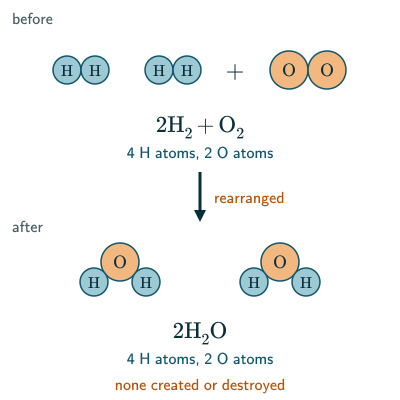
In 2H2 + O2 → 2H2O, count the atoms on each side, and find the total mass on each side using H = 1.008 u and O = 16.00 u.
Left: 2 molecules of H2 have 4 H atoms; 1 molecule of O2 has 2 O atoms. Right: 2 molecules of H2O have 4 H atoms and 2 O atoms.
Mass on the left = 4 × 1.008 + 2 × 16.00 = 4.032 + 32.00 = 36.03 u. Mass on the right = 2 × (2.016 + 16.00) = 36.03 u.
Answer: 4 H and 2 O atoms on each side; 36.03 u on each side. The same atoms, so the same mass.
Example 2: Multiple proportions from atoms
Nitrogen forms N2O, NO and NO2. Using N = 14.01 u and O = 16.00 u, find the mass of oxygen that combines with 28.02 g of nitrogen in each, and the ratio.
28.02 g of N is the mass of 2 × 14.01 g, so count oxygen per two N atoms: one N2O molecule has 1 O atom, two NO molecules have 2 O atoms, and two NO2 molecules have 4 O atoms. Counting two molecules does not change their molecular formulas.
Masses of oxygen: 16.00 g, 32.00 g and 64.00 g.
Answer: 16.00 g, 32.00 g and 64.00 g of oxygen, in the ratio 1 : 2 : 4, small whole numbers, because the numbers of O atoms differ by whole numbers.
Example 3: Why Dalton’s single atoms fail for gas volumes
Hydrogen and oxygen give water vapour in the volume ratio 2 : 1 : 2. Show that Dalton’s formula HO, with single atoms H and O, cannot give this ratio, but 2H2 + O2 → 2H2O can, if equal volumes contain equal numbers of particles.
With single atoms: H + O → HO. Equal numbers of particles means equal volumes, so 1 volume of H and 1 of O give 1 volume of HO: a 1 : 1 : 1 ratio, not 2 : 1 : 2. Any formula with single atoms fails: 2H + O → H2O gives 2 : 1 : 1.
With molecules: 2H2 + O2 → 2H2O. Two molecules of H2 and one of O2 give two of water, so the volumes are 2 : 1 : 2, as observed.
Answer: single indivisible atoms predict 1 : 1 : 1 (HO) or 2 : 1 : 1 (H2O), never 2 : 1 : 2. Oxygen must be O2, and with water as H2O, hydrogen is H2.
Common mistakes to avoid
Common mistake
Saying Dalton’s theory is wholly wrong
Two postulates were later changed and one limited: atoms are divisible, isotopes have different masses and isobars share only a mass number, and nuclear reactions change one element into another. But atoms really are rearranged, not created or destroyed, in every chemical reaction, and stoichiometric compounds have fixed atom ratios. These ideas are the basis of chemical equations.
Common mistake
Mixing up what it did and did not explain
It explained conservation of mass and the laws of definite and multiple proportions. It did not explain the law of gaseous volumes, or why atoms combine.
Common mistake
Thinking a molecule must contain different elements
Dalton’s own list says compounds form from atoms of different elements, but an element can also form molecules, such as H2 and O2. Missing this was why Dalton’s theory failed with gas volumes.
Quick revision summary
- Dalton (1808): matter is made of indivisible atoms; atoms of an element are identical in mass and differ from those of other elements; compounds have atoms in fixed ratios; reactions rearrange atoms without creating or destroying them.
- It explained conservation of mass and the laws of definite and multiple proportions.
- It failed to explain Gay-Lussac’s gaseous volumes (Dalton had no H2 or O2 molecules) and why atoms combine.
- Modern changes: atoms contain electrons, protons and neutrons; isotopes of one element have different masses; isobars of different elements have the same mass number, not exactly the same mass; nuclear reactions change atoms.
Formula sheet
- 2H + O → 2HO: 4 H and 2 O atoms on each side
- Water: 2 H atoms per O atom, so H : O by mass = 2.016 : 16.00
- CO and CO: 1 and 2 O atoms per C atom, so O masses 1 : 2
- Isotopes: Cl and Cl, same element, different masses
Questions students ask
Why do some books give five or six postulates of Dalton’s atomic theory?
Some books give five or six postulates of Dalton’s atomic theory because they split NCERT’s four into smaller statements and sharpen its ‘fixed ratio’ to ‘small whole-number ratios’. A common six-point list reads: matter is made of particles called atoms; atoms are indivisible and are neither created nor destroyed in a chemical reaction; atoms of an element are identical in mass and properties; atoms of different elements differ in mass and properties; atoms combine in small whole-number ratios to form compounds; and the relative number and kinds of atoms in a given compound are constant. The last two expand NCERT’s postulate 3, that atoms of different elements combine in a fixed ratio.
What is the difference between Democritus’s and Dalton’s ideas of the atom?
Democritus’s atom (about 400 BC) was a philosopher’s idea, reached by reasoning that matter cannot be divided for ever, while Dalton’s atomic theory (1808) was a scientific theory built on measured masses that explained the laws of conservation of mass and of definite and multiple proportions. Dalton gave each element its own kind of atom with a fixed relative mass that could be measured, and said that compounds contain atoms in fixed ratios; Democritus told atoms apart only by shape and size, had no idea of elements with fixed atomic masses, and had no experiments to test his idea (ideas of atoms, old and new).
How did Dalton arrive at his atomic theory?
John Dalton arrived at his atomic theory through his work on gases: studying how the gases of the air mix and dissolve in water, which also gave him Dalton’s law of partial pressures (1801), he pictured each gas as made of particles with their own size and weight. By 1803 he was comparing the masses in which elements combine, and he saw that whole atoms of fixed mass explain the laws of conservation of mass and definite proportions, as well as the law of multiple proportions that he stated himself. He published the theory, with a table of relative atomic weights, in A New System of Chemical Philosophy (1808).
Why did Dalton write the formula of water as HO?
Dalton wrote water as HO because he assumed, as a ‘rule of greatest simplicity’, that when two elements form only one known compound, it contains one atom of each. With hydrogen and oxygen combining in a mass ratio of about 1 : 8, this made an oxygen atom about 8 times as heavy as a hydrogen atom, half the true value of 16. Wrong formulas of this kind kept atomic masses confused for about 50 years, until Cannizzaro used Avogadro’s molecules, H2 and O2, to sort them out in 1860.
Is Dalton’s atomic theory in the JEE Main 2027 and NEET (UG) 2026 syllabuses?
Yes, Dalton’s atomic theory is in both syllabuses: Unit 1, Some Basic Concepts in Chemistry, of the JEE Main 2027 syllabus (NTA) and of the NEET (UG) 2026 syllabus (NMC) lists it together with the concept of atom, molecule, element and compound. The structure of the atom that replaced Dalton’s indivisible atom is Unit 2, Atomic Structure, in both.
Is Dalton’s atomic theory still true?
Dalton’s atomic theory is still the basis of chemistry in its central idea: matter is made of atoms, stoichiometric compounds contain them in fixed whole-number ratios, and a chemical reaction only rearranges them, which is why equations are balanced atom by atom. What has not survived is its picture of the atom itself: atoms contain electrons, protons and neutrons, isotopes of one element differ in mass, and nuclear reactions turn one element into another. With single atoms the theory also could not explain Gay-Lussac’s gaseous volumes, which needed Avogadro’s molecules such as H2 and O2.
Practice questions
Try each question first, then open the answer to check your working.
-
Q1. State the two things that NCERT says Dalton’s theory could not explain.
Show answerHide answer
It could not explain the law of gaseous volumes, and it could not give the reason why atoms combine (NCERT page 16).
-
Q2. Which postulate of Dalton’s theory explains the law of conservation of mass?
Show answerHide answer
Postulate 4: atoms are reorganised in a reaction and are neither created nor destroyed. With postulate 2 (each kind of atom has a fixed mass), the total mass stays the same.
-
Q3. Iron forms two chlorides, FeCl2 and FeCl3. Using Fe = 55.85 u and Cl = 35.45 u, find the mass of chlorine combined with 55.85 g of iron in each, and the ratio.
Show answerHide answer
FeCl2: 2 × 35.45 = 70.90 g. FeCl3: 3 × 35.45 = 106.35 g. Ratio 70.90 : 106.35 = 2 : 3, small whole numbers, as the law of multiple proportions requires.