Percentage composition
NCERT Class 11 Chemistry Chapter 1 Section 1.9
Quick answer
Percentage composition gives the mass per cent of each element in a compound: the mass of that element in one mole of the compound divided by the molar mass, times 100. Turning mass per cents into moles, dividing by the smallest and, if needed, multiplying to get whole numbers gives the empirical formula, the simplest whole-number ratio of atoms. The molecular formula is the empirical formula with every subscript multiplied by n, the molar mass divided by the empirical formula mass.
With your textbook
NCERT Chemistry Part I (Class 11), Chapter 1 “Some Basic Concepts of Chemistry”, Section 1.9 “Percentage Composition”, pages 18–20.
Open the official NCERT chapter (PDF, 4.0 MB, ncert.nic.in) (opens in a new tab)
Checked against the 2026-27 reprint on .
What is percentage composition?
Percentage composition, empirical and molecular formulas
The percentage composition of a compound gives the mass per cent of each element in it:
mass % of an element = (mass of that element in one mole of the compound ÷ molar mass of the compound) × 100
From the mass per cents we can find the empirical formula, the simplest whole-number ratio of the atoms. If the molar mass is also known, we can find the molecular formula, the actual number of each kind of atom in a molecule (NCERT Section 1.9, pages 18–20).
In plain words: percentage composition answers the question “how much of this compound, by mass, is each element?” Run the other way, it tells you what a new compound is made of. NCERT notes that it also lets you check whether a sample is pure (page 19). A composition mismatch can reveal impurity, but matching composition alone cannot prove purity or distinguish isomers. For a stoichiometric compound of fixed isotopic composition, the elemental mass ratio is fixed: the law of definite proportions.
In other words, one can check the purity of a given sample by analysing this data.
NCERT Chemistry Part I (Class 11), Section 1.9, page 19
Mass per cent of an element
Work it out from one mole of the compound: the mass of the element in one mole, divided by the molar mass, times 100.
Water, H2O (molar mass 18.02 g mol; NCERT page 19):
- hydrogen: (2 × 1.008)/18.02 × 100 = 11.19%;
- oxygen: 16.00/18.02 × 100 = 88.79%.
NCERT prints the hydrogen value as 11.18 (page 19), but 2.016/18.02 × 100 = 11.188…, which rounds to 11.19. The two percentages add to 99.98% because the molar mass 18.02 is itself rounded up from 18.016; with 18.016 they are 11.19% and 88.81%, which add to 100.00%.
Ethanol, C2H5OH (molar mass 2 × 12.01 + 6 × 1.008 + 16.00 = 46.068 g mol; page 19):
- carbon: 24.02/46.068 × 100 = 52.14%;
- hydrogen: 6.048/46.068 × 100 = 13.13%;
- oxygen: 16.00/46.068 × 100 = 34.73%.
The three add to 100.00%. Count every atom of each element: ethanol has six hydrogen atoms, five in C2H5 and one in OH.
Empirical and molecular formulas
An empirical formula represents the simplest whole number ratio of various atoms present in a compound, whereas, the molecular formula shows the exact number of different types of atoms present in a molecule of a compound.
NCERT Chemistry Part I (Class 11), Section 1.9.1, page 19
For example, glucose has the molecular formula C6H12O6 and the empirical formula CH2O; benzene is C6H6, empirical formula CH. Water, H2O, is the same both ways. NCERT’s heading for this subsection reads “Empirical Formula for Molecular Formula”; the subsection covers both: first the empirical formula, then the molecular formula from it.
The steps, as in NCERT Problem 1.2 (pages 19–20):
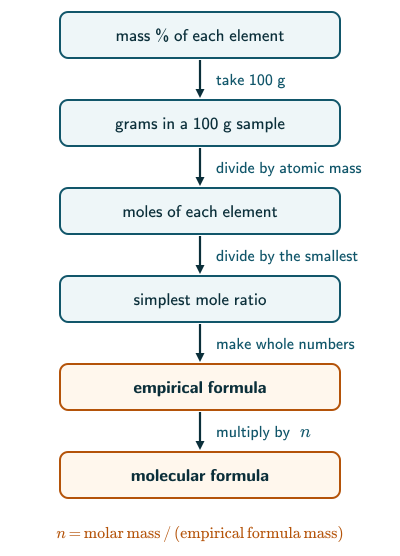
- Per cent to grams. Take 100 g of the compound, so each mass per cent becomes a mass in grams.
- Grams to moles. Divide each mass by the element’s atomic mass.
- Simplest ratio. Divide every number of moles by the smallest one.
- Whole numbers. If the ratios are not whole numbers, multiply all of them by a small number that makes them whole: a ratio of 1 : 1.5 becomes 2 : 3, 1 : 1.33 becomes 3 : 4, and 1 : 1.67 becomes 3 : 5. Keep three or four significant figures in the moles until this step. Write the empirical formula.
- Molecular formula. Find the empirical formula mass, divide the molar mass by it to get n, and multiply the empirical formula by n.
From empirical to molecular formula
Then molecular formula = n × empirical formula.
Solved examples
Example 1: Empirical and molecular formulas (NCERT Problem 1.2, pages 19–20)
A compound contains 4.07% hydrogen, 24.27% carbon and 71.65% chlorine. Its molar mass is 98.96 g mol. Find its empirical and molecular formulas (H = 1.008, C = 12.01, Cl = 35.453).
Step 1: 100 g contains 4.07 g H, 24.27 g C and 71.65 g Cl.
Step 2: moles of H = 4.07/1.008 = 4.04; moles of C = 24.27/12.01 = 2.021; moles of Cl = 71.65/35.453 = 2.021.
Step 3: dividing by the smallest, 2.021, gives H : C : Cl = 2 : 1 : 1.
Step 4: empirical formula CH2Cl.
Step 5: empirical formula mass = 12.01 + 2 × 1.008 + 35.453 = 49.48 g mol, so n = 98.96/49.48 = 2.
Answer: empirical formula CH2Cl; molecular formula C2H4Cl2.
Example 2: Mass per cent in sodium sulphate (NCERT Exercise 1.2, page 25)
Calculate the mass per cent of each element in sodium sulphate, Na2SO4 (Na = 22.99, S = 32.06, O = 16.00).
Molar mass = 2 × 22.99 + 32.06 + 4 × 16.00 = 45.98 + 32.06 + 64.00 = 142.04 g mol.
Na: 45.98/142.04 × 100 = 32.37%. S: 32.06/142.04 × 100 = 22.57%. O: 64.00/142.04 × 100 = 45.06%.
Answer: Na 32.37%, S 22.57%, O 45.06% (total 100.00%).
Example 3: An oxide of iron (NCERT Exercise 1.3, page 25)
An oxide of iron contains 69.9% iron and 30.1% oxygen by mass. Find its empirical formula (Fe = 55.85, O = 16.00).
Moles in 100 g: Fe = 69.9/55.85 = 1.252; O = 30.1/16.00 = 1.881.
Dividing by the smaller: Fe : O = 1 : 1.502. This is not a whole-number ratio, so multiply both by 2: Fe : O = 2 : 3.005 ≈ 2 : 3.
Answer: Fe2O3. Rounding 1.503 down to 1 would give FeO, which is wrong: a ratio close to 1.5 means multiply by 2.
Example 4: A welding gas (NCERT Exercise 1.34, page 28)
A welding fuel gas contains only carbon and hydrogen. Burning a sample gives 3.38 g of carbon dioxide, 0.690 g of water and nothing else. 10.0 L of the gas, measured at STP, weighs 11.6 g. Find (i) its empirical formula, (ii) its molar mass, (iii) its molecular formula (H = 1.008, C = 12.01, O = 16.00).
(i) Carbon in the CO2: 3.38 × 12.01/44.01 = 0.922 g, that is, 0.922/12.01 = 0.0768 mol. Hydrogen in the water: 0.690 × 2.016/18.02 = 0.0772 g, that is, 0.0772/1.008 = 0.0766 mol. C : H = 0.0768 : 0.0766 ≈ 1 : 1, so the empirical formula is CH.
(ii) One mole of an ideal gas occupies 22.7 L at 273.15 K and 1 bar, the value NCERT uses on page 20, and 22.4 L at the older STP of 273 K and 1 atm (see molar volume at STP). Molar mass = 11.6 g × 22.7 L/10.0 L ≈ 26.3 g mol, or 26.0 g mol with 22.4 L.
(iii) Empirical formula mass of CH = 13.02 g mol, so n = 26.3/13.02 ≈ 2 (26.0/13.02 ≈ 2 as well).
Answer: CH; about 26 g mol; C2H2 (ethyne, acetylene). With either molar volume, n comes out 2.
Common mistakes to avoid
Common mistake
Rounding a ratio like 1.5 to a whole number
Mole ratios ending in about .5 (×2), .33 or .67 (×3), .25 or .75 (×4), or .2, .4, .6, .8 (×5) are not rounding errors: multiply all the ratios by that number. Accept a nearby whole number only when consistent with the precision of the data; there is no universal 0.1 tolerance, and keep three or four significant figures in the moles until this step, because rounding early can turn 1.25 into 1.3.
Common mistake
Dividing the mass per cents by the smallest per cent
Convert grams to moles first, by dividing by the atomic masses. Dividing the percentages directly compares masses, not numbers of atoms.
Common mistake
Forgetting atoms that appear twice in a formula
In ethanol, C2H5OH, hydrogen appears in two places: six H atoms in all. In Na2SO4 there are two Na atoms, so the sodium mass is 2 × 22.99.
Common mistake
Missing the oxygen found by difference
If the sample is stated to contain only C, H and O, oxygen can be found by difference after C and H are determined. Without that restriction, a missing percentage might belong to another element, moisture or an impurity; it cannot simply be labelled oxygen. In combustion analysis, mass of C = (12/44) × mass of CO2 and mass of H = (2/18) × mass of H2O, not 1/18.
Common mistake
Forgetting that molar mass can come from vapour density
Beyond the NCERT text: a question may give the vapour density instead of the molar mass. When vapour density is the relative density to H2 at the same temperature and pressure, molar mass in g mol ≈ 2 × vapour density (using M(H2) ≈ 2 g mol and ideal gases). Check the reference gas: a value relative to air uses air’s molar mass instead.
Common mistake
Thinking the empirical formula is the molecule
CH is the empirical formula of both ethyne, C2H2, and benzene, C6H6. Only the molar mass tells them apart.
Quick revision summary
- Mass % of an element = (mass of the element in one mole of the compound ÷ molar mass) × 100. A mismatch in percentage composition can reveal impurity, but a match does not prove purity.
- Water: H 11.19%, O 88.79%. Ethanol: C 52.14%, H 13.13%, O 34.73%.
- Empirical formula: simplest whole-number ratio of atoms. Molecular formula: actual numbers of atoms.
- Steps: per cent to grams (100 g), grams to moles, divide by the smallest, make whole numbers.
- n = molar mass ÷ empirical formula mass; molecular formula = n × empirical formula.
Formula sheet
- Mass % of element = (mass of element in 1 mol of compound ÷ molar mass) × 100
- Moles of element in 100 g = mass % ÷ atomic mass
- n = molar mass ÷ empirical formula mass
- Molecular formula = n × empirical formula
- Water: H 11.19%, O 88.79%
Questions students ask
Can the empirical formula and the molecular formula be the same?
Yes, the empirical formula and the molecular formula are the same whenever the molar mass equals the empirical formula mass (n = 1), which happens when the subscripts of the molecular formula have no common factor. H2O, CH4, NH3 and CO2 are examples, while hydrogen peroxide, H2O2, is not (its empirical formula is HO). Ionic solids such as NaCl have no molecules, so they use formula units rather than molecular formulas. The empirical formula is the simplest elemental ratio; formula-unit notation may retain a polyatomic ion, as in Na2O2, whose empirical formula is NaO.
What is the difference between a molecular formula and a structural formula?
A molecular formula gives only the number of atoms of each element in a molecule, while a structural formula also shows how the atoms are joined. Ethanol, CH3CH2OH, and dimethyl ether, CH3OCH3, share the molecular formula C2H6O and so have the same percentage composition (C 52.14%, H 13.13%, O 34.73%), yet ethanol is a liquid that boils at 78 °C and dimethyl ether a gas that boils at −24 °C. Percentage composition and molar mass fix the molecular formula, but only the structure tells such isomers apart.
Is percentage composition the same as mass percentage?
Percentage composition is the same as mass percentage for a compound: it lists the mass percentage of each element, such as 11.2% hydrogen and 88.8% oxygen in water. ‘Mass percentage’ (w/w %) is also used for a solution, where it is the mass of solute in 100 g of solution; that value depends on how the solution was made, while the percentage composition of a pure compound is fixed by its formula.
What is the percentage composition of air?
Air has no fixed percentage composition, because it is a mixture, not a compound, but dry air is about 78.1% nitrogen, 20.9% oxygen, 0.93% argon and 0.04% carbon dioxide by volume. By mass the same air is about 75.5% nitrogen, 23.1% oxygen and 1.3% argon, because an oxygen molecule (32.00 u) is heavier than a nitrogen molecule (28.01 u). Water vapour, which varies from almost nothing to about 4% of the volume, is left out of these figures.
How do you find the percentage of water of crystallisation in a hydrate?
The percentage of water of crystallisation is the mass of water in one mole of the hydrate divided by the hydrate’s molar mass, times 100, counting every water molecule in the formula. Washing soda, Na2CO3·10H2O, has a molar mass of 2 × 22.99 + 12.01 + 3 × 16.00 + 10 × 18.02 = 286.19 g mol, of which 180.2 g is water, so it is 180.2/286.19 × 100 ≈ 62.97% water. Driving off all that water would cut the mass of a sample by about 63%.
Practice questions
Try each question first, then open the answer to check your working.
-
Q1. How much copper can be obtained from 100 g of copper sulphate, CuSO4 (NCERT Exercise 1.7, page 26)? Use Cu = 63.55, S = 32.06, O = 16.00.
Show answerHide answer
Molar mass of CuSO4 = 63.55 + 32.06 + 64.00 = 159.61 g mol. Copper is 63.55/159.61 of the mass, so 100 g contains 100 × 63.55/159.61 ≈ 39.8 g of copper.
-
Q2. A compound contains 40.0% C, 6.71% H and 53.3% O, and its molar mass is 180 g mol. Find its empirical and molecular formulas.
Show answerHide answer
Moles in 100 g: C = 40.0/12.01 = 3.33; H = 6.71/1.008 = 6.66; O = 53.3/16.00 = 3.33. Ratio 1 : 2 : 1, so the empirical formula is CH2O (30.03 g mol). n = 180/30.03 ≈ 6, so the molecular formula is C6H12O6.
-
Q3. Find the mass per cent of nitrogen in ammonia, NH3 (N = 14.01, H = 1.008).
Show answerHide answer
Molar mass = 14.01 + 3 × 1.008 = 17.034 g mol. Nitrogen = 14.01/17.034 × 100 ≈ 82.25%.