Uncertainty in measurement
NCERT Class 11 Chemistry Chapter 1 Section 1.4
Quick answer
Uncertainty in measurement means that every measured value is known only to a limited number of digits, set by the instrument and the skill of the person measuring, so chemists report it in significant figures: all the certain digits plus one uncertain digit. Sums and differences keep the fewest decimal places of the data, and products and quotients the fewest significant figures. Very large and very small numbers are written in scientific notation, and units are converted by the unit factor method, multiplying by factors such as 2.54 cm per inch that are equal to one.
With your textbook
NCERT Chemistry Part I (Class 11), Chapter 1 “Some Basic Concepts of Chemistry”, Section 1.4 “Uncertainty in Measurement”, pages 10–14.
Open the official NCERT chapter (PDF, 4.0 MB, ncert.nic.in) (opens in a new tab)
Checked against the 2026-27 reprint on .
How do chemists handle uncertain numbers?
Uncertainty in measurement
Every measurement carries some uncertainty, from the limits of the instrument and the skill of the person using it. Chemists handle this in three ways (NCERT Section 1.4, pages 10–14):
- scientific notation, N × 10 with 1 ≤ N < 10, for very large and very small numbers;
- significant figures, which show how many digits of a result can be trusted;
- dimensional analysis (the unit factor method), which converts a quantity from one unit to another while keeping track of the units.
Significant figures are meaningful digits which are known with certainty plus one which is estimated or uncertain.
NCERT Chemistry Part I (Class 11), Section 1.4.2, page 12
In plain words: a platform balance might report 9.4 g while an analytical balance reports 9.4213 g. The last reported digit is the uncertain one, and unless otherwise stated, an uncertainty of ±1 in the last digit is always understood (NCERT page 12): 11.2 mL means 11.2 ± 0.1 mL, between 11.1 and 11.3 mL. Strictly, the digits alone do not establish the uncertainty or guarantee that the true value lies in that interval: calibration, resolution and the measurement procedure also matter (reasoned).
Scientific notation
Chemists meet numbers like 602 200 000 000 000 000 000 000, the number of molecules in approximately 2 g of hydrogen gas when its molar mass is rounded to 2 g mol, and 0.000 000 000 000 000 000 000 001 66 g (NCERT page 11). NCERT calls the second the mass of an H atom. To three significant figures it is really 1 amu, 1.66 × 10 g; an H atom is slightly heavier, 1.6736 × 10 g (NCERT page 17). Such numbers are written as N × 10, where the digit term N lies between 1.000… and 9.999… and n is a positive, negative or zero whole number (NCERT Section 1.4.1, page 11):
- 232.508 = 2.32508 × 10: the decimal point moves 2 places to the left, so n = 2;
- 0.00016 = 1.6 × 10: the decimal point moves 4 places to the right, so n = −4.
Multiplying and dividing: multiply or divide the digit terms, and add or subtract the exponents (page 12). NCERT’s examples:
- (5.6 × 10) × (6.9 × 10) = 38.64 × 10 = 3.864 × 10;
- (9.8 × 10) × (2.5 × 10) = 24.50 × 10 = 2.450 × 10;
- (2.7 × 10) ÷ (5.5 × 10) = 0.4909 × 10 = 4.909 × 10.
Adding and subtracting: first write both numbers with the same exponent, then add or subtract the digit terms (page 12):
- 6.65 × 10 + 8.95 × 10 = (6.65 + 0.895) × 10 = 7.545 × 10;
- 2.5 × 10 − 4.8 × 10 = (2.5 − 0.48) × 10 = 2.02 × 10.
NCERT keeps every digit in these examples to show how the exponents work. With the significant-figure rules below, the answers would be reported as 3.9 × 10, 2.4 × 10 (the dropped 50 is exactly half and the 4 before it is even), 4.9 × 10, 7.54 × 10 (likewise 7.545 → 7.54) and 2.0 × 10.
Significant figures
The rules for counting significant figures (NCERT Section 1.4.2, pages 12–13):
- All non-zero digits are significant: 285 cm has three, 0.25 mL has two.
- Zeros before the first non-zero digit are not significant; they only fix the decimal point: 0.03 has one, 0.0052 has two.
- Zeros between non-zero digits are significant: 2.005 has four.
- Zeros at the end are significant if the number has a decimal point: 0.200 g has three. Without a decimal point they are ambiguous; in NCERT’s convention 100 has one significant figure, but 100. (with a point) has three, and 100.0 has four.
- Counted numbers, such as 2 balls or 20 eggs, are exact and have infinitely many significant figures.
In scientific notation every digit shown in the coefficient is significant; the exponent is not counted: 4.01 × 10 has three and 8.256 × 10 has four. So 100 can be written as 1 × 10, 1.0 × 10 or 1.00 × 10 for one, two or three significant figures (page 12).
NCERT’s rule 4 on page 12 prints “100 has only one significant figure, but 100 has three significant figures”. The decimal point after the second 100 has been lost in printing: it should read 100. (with a point), as above. The basics are also in counting significant figures.
Precision and accuracy
Precision refers to the closeness of various measurements for the same quantity.
NCERT Chemistry Part I (Class 11), Section 1.4.2, page 13
However, accuracy is the agreement of a particular value to the true value of the result.
NCERT Chemistry Part I (Class 11), Section 1.4.2, page 13
NCERT illustrates the difference with three students who each weigh a sample of true mass 2.00 g twice (NCERT Table 1.4, page 13):
| Student | Readings (g) | Average (g) |
|---|---|---|
| A | 1.95, 1.93 | 1.940 |
| B | 1.94, 2.05 | 1.995 |
| C | 2.01, 1.99 | 2.000 |
A’s readings are precise but not accurate, B’s are neither, and C’s are both precise and accurate (page 13). NCERT’s averages keep an extra digit; by the rules below they are 1.94, 2.00 (an exact 5 after the odd 9 rounds up) and 2.00 g.
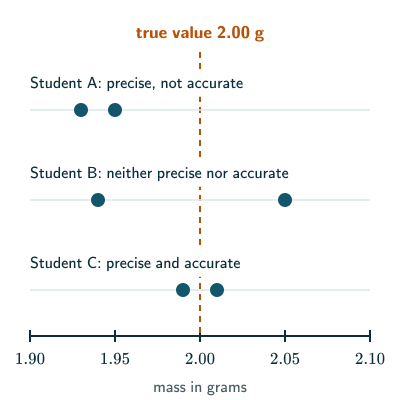
B’s average happens to land near 2.00 g, but its two readings are 0.11 g apart, showing poor repeatability. A mean close to the reference value does not by itself establish good accuracy. A good result needs both: readings that agree with each other and with the true value. Physics uses the same two words in accuracy and precision.
Calculating with significant figures
A result cannot be more certain than the data it comes from (NCERT page 13).
- Adding and subtracting: the result keeps no more digits after the decimal point than the number with the fewest. NCERT’s example: 12.11 + 18.0 + 1.012 = 31.122, reported as 31.1, because 18.0 has one decimal place.
- Multiplying and dividing: the result keeps no more significant figures than the number with the fewest. NCERT’s example: 2.5 × 1.25 = 3.125, reported as 3.1, because 2.5 has two significant figures.
Rounding off (NCERT page 13):
- if the digit to be removed is more than 5, raise the digit before it by one: 1.386 → 1.39;
- if it is less than 5, leave the digit before it: 4.334 → 4.33;
- if it is exactly 5, leave the digit before it if that digit is even and raise it if it is odd: 6.35 → 6.4 but 6.25 → 6.2.
NCERT’s examples drop only one digit. When several digits are to be dropped, look at the first dropped digit (if it is 5, also check whether any non-zero digit follows it) and round once: 1.346 to two significant figures is 1.3, because the first dropped digit is 4. Rounding in steps (1.346 → 1.35 → 1.4) gives a wrong answer. If the 5 is followed by other non-zero digits, the dropped part is more than half, so round up: 6.251 → 6.3. In a calculation with several steps, retain full calculator precision where possible (or several guard digits) in intermediate results and round only the final answer. More on this is in rounding off.
Dimensional analysis: the unit factor method
The method used to accomplish this is called factor label method or unit factor method or dimensional analysis.
NCERT Chemistry Part I (Class 11), Section 1.4.3, page 13
Every equality between units gives two unit factors, each equal to 1. From 1 in = 2.54 cm:
Multiplying a quantity by a unit factor does not change it. Choose the factor that has the wanted unit on top and the unwanted unit below, so that the unwanted unit cancels (NCERT pages 13–14). Units can be cancelled, multiplied, divided and squared just like numbers.
In chemistry, “dimensional analysis” means this unit-conversion method. Physics uses the same name for checking the dimensions [M L T] of an equation; that method, and how it converts units, is in converting units with dimensions.
Solved examples
Example 1: NCERT’s three conversions (NCERT Section 1.4.3, pages 13–14)
Convert (a) 3 in into cm; (b) 2 L of milk into m; (c) 2 days into seconds.
(a) 3 in × (2.54 cm/1 in) = 7.62 cm. The relation 1 in = 2.54 cm is exact by definition, so the factor never limits the significant figures, and NCERT treats the 3 in as exact. A measured 3 in would give 8 cm. Changing units never changes the count of significant figures: 2.0 kg = 2.0 × 10 g, not 2000 g.
(b) 1 m = 100 cm, so (1 m/100 cm) = 1 m/10 cm = 1. Then 2 L = 2 × 1000 cm, and 2000 cm × (1 m/10 cm) = 2 × 10 m.
(c) 2 days × (24 h/1 day) × (60 min/1 h) × (60 s/1 min) = 2 × 24 × 60 × 60 s = 172 800 s.
Answer: 7.62 cm; 2 × 10 m; 172 800 s. Every unwanted unit cancels.
Example 2: Scientific notation (NCERT Exercise 1.18, page 26)
Express in scientific notation: (i) 0.0048; (ii) 234 000; (iii) 8008; (iv) 500.0; (v) 6.0012.
(i) 4.8 × 10. (ii) 2.34 × 10, taking the end zeros as not significant (no decimal point). (iii) 8.008 × 10. (iv) 5.000 × 10: the zeros after the decimal point are significant, so they stay. (v) 6.0012 × 10.
Answer: 4.8 × 10; 2.34 × 10; 8.008 × 10; 5.000 × 10; 6.0012 × 10.
Example 3: Counting significant figures (NCERT Exercise 1.19, pages 26–27)
How many significant figures are in: (i) 0.0025; (ii) 208; (iii) 5005; (iv) 126 000; (v) 500.0; (vi) 2.0034?
(i) 2: the leading zeros do not count. (ii) 3. (iii) 4: zeros between non-zero digits count. (iv) 3: the end zeros, with no decimal point, do not. (v) 4. (vi) 5.
Answer: 2, 3, 4, 3, 4, 5.
Example 4: Rounding to three significant figures (NCERT Exercise 1.20, page 27)
Round to three significant figures: (i) 34.216; (ii) 10.4107; (iii) 0.04597; (iv) 2808.
(i) The first dropped digit is 1: 34.2. (ii) The first dropped digit is 1: 10.4. (iii) The significant digits are 4, 5, 9, 7; the first dropped digit is 7, so 0.0459 becomes 0.0460. The final zero is significant and must be kept. (iv) The first dropped digit is 8: 2810, better written 2.81 × 10 so that the number of significant figures is clear.
Answer: 34.2; 10.4; 0.0460; 2.81 × 10.
Example 5: How many significant figures in the answer? (NCERT Exercise 1.31, page 28)
Give the answers to the right number of significant figures: (i) 0.02856 × 298.15 × 0.112 ÷ 0.5785; (iii) 0.0125 + 0.7864 + 0.0215.
(i) A product and quotient: the data have 4, 5, 3 and 4 significant figures, so the answer gets 3. The calculator gives 1.64857…, reported as 1.65.
(iii) A sum: each number has four decimal places, so the sum keeps four: 0.0125 + 0.7864 + 0.0215 = 0.8204, which has four significant figures.
Answer: (i) 1.65 (three significant figures); (iii) 0.8204 (four).
Common mistakes to avoid
Common mistake
Counting the leading zeros
0.0052 has two significant figures, not four. Leading zeros only place the decimal point; write it as 5.2 × 10 and the count is obvious.
Common mistake
Dropping a significant final zero
Rounding 0.04597 to three significant figures gives 0.0460, not 0.046. The final zero tells the reader that the third figure is known.
Common mistake
Using the significant-figure rule for sums
For addition and subtraction, count decimal places, not significant figures: 25.37 − 4.8 is 20.6 (one decimal place), not 21 (two significant figures, as in 4.8). And 0.0125 + 0.7864 + 0.0215 = 0.8204 has four significant figures, though 0.0125 has only three.
Common mistake
Rounding in steps
Round once, looking at the first digit to be dropped: 1.346 to two significant figures is 1.3, not 1.35 → 1.4.
Common mistake
Turning the unit factor upside down
To convert inches to centimetres, multiply by (2.54 cm/1 in), not (1 in/2.54 cm). If the unwanted unit does not cancel, the factor is the wrong way up.
Quick revision summary
- Scientific notation: N × 10 with 1 ≤ N < 10. Multiply: multiply digit terms, add exponents. Add: same exponent first.
- Significant figures are the certain digits plus one uncertain digit (±1 in the last digit is understood unless otherwise stated; NCERT page 12).
- Non-zero digits and zeros between them count; leading zeros do not; trailing zeros without a decimal point can be ambiguous; exact counts have infinitely many.
- Precision: readings agree with each other. Accuracy: readings agree with the true value.
- Sums and differences keep the fewest decimal places; products and quotients keep the fewest significant figures.
- Round once, at the end, looking at the first digit dropped (and, if it is 5, at the digits after it); an exact 5 rounds to the even digit.
- Unit factor method: multiply by factors equal to 1, wanted unit on top.
Formula sheet
- Scientific notation: N × 10, with 1 ≤ N < 10
- (a × 10)(b × 10) = ab × 10; (a × 10)/(b × 10) = (a/b) × 10
- Add or subtract: same exponent first, then the digit terms
- Sums and differences: fewest decimal places
- Products and quotients: fewest significant figures
- Unit factor: (2.54 cm)/(1 in) = 1
Questions students ask
What is the difference between error and uncertainty in a measurement?
An error is the difference between a measured value and a reference value; a true value is usually unknown. Measurement uncertainty describes the dispersion of values reasonably attributed to the quantity, using information about the method, instrument, calibration and repeated readings (JCGM International Vocabulary of Metrology, 2.26). A result such as 2.04 ± 0.01 g must explain whether ±0.01 g is a standard uncertainty, an expanded uncertainty with stated coverage, or an assumed bound. It is not automatically a guaranteed interval. Uncorrected systematic effects can make a result inaccurate even when repeat readings are close.
How do you find the uncertainty of a measurement?
Use the uncertainty specified by the measurement procedure. NCERT’s ±1 in the last digit and the half-division rule are elementary conventions, not universal instrument uncertainties. For example, if a procedure assigns ±0.05 mL to 24.35 mL, the relative uncertainty is 0.05/24.35 × 100 ≈ 0.2%. Repeated readings reveal random scatter: the mean absolute deviation used in some school exercises describes that scatter; it is not automatically the uncertainty of the mean. For independent stable readings, the standard uncertainty of the mean from repeatability is the sample standard deviation divided by √n. Calibration and other systematic contributions must also be considered; see errors in measurement.
How can precision and accuracy be improved in an experiment?
Precision is improved by reducing random scatter: use an instrument with a finer scale, such as an analytical balance instead of a platform balance, read it the same careful way each time, and repeat independent measurements and average them to reduce the random uncertainty of the estimated mean. A finer scale improves resolution but does not alone guarantee better precision. Accuracy is improved by removing systematic errors, which repetition cannot remove: calibrate the instrument against a standard, correct any zero error, and use a sound method, such as weighing a crucible only after it has cooled to room temperature.
Is scientific notation the same as standard form or engineering notation?
Scientific notation writes a number as N × 10 with 1 ≤ N < 10, and NCERT Mathematics and British books call this standard form, though in American usage ‘standard form’ means the ordinary decimal number. Engineering notation is different: its power of 10 is always a multiple of 3, so the coefficient satisfies 1 ≤ N < 1000 and matches an SI prefix. For example, 0.047 m is 4.7 × 10 m in scientific notation but 47 × 10 m, or 47 mm, in engineering notation.
Are significant figures in the JEE Main 2027 and NEET (UG) 2026 chemistry syllabuses?
No, significant figures are not in the chemistry part of either syllabus: Unit 1, Some Basic Concepts in Chemistry, of the JEE Main 2027 syllabus (NTA) and of the NEET (UG) 2026 syllabus (NMC) does not list measurement, precision and accuracy, significant figures or dimensional analysis, though older JEE Main syllabuses did. They are examined in Physics, Unit 1 of both (Units and Measurements in JEE Main, Physics and Measurement in NEET), which lists least count, significant figures and errors in measurements, as on the significant figures page; CBSE Class 11 Chemistry (2026–27) still lists Uncertainty in Measurement.
Practice questions
Try each question first, then open the answer to check your working.
-
Q1. What do you mean by significant figures (NCERT Exercise 1.16, page 26)?
Show answerHide answer
They are the meaningful digits of a measured or calculated value: all the digits known with certainty plus one estimated, uncertain digit. Unless otherwise stated, an uncertainty of ±1 in the last digit is understood (NCERT page 12). Strictly, a real measurement needs an uncertainty evaluation for its procedure (reasoned).
-
Q2. Fill in the blanks (NCERT Exercise 1.21(b), page 27): (i) 1 km = … mm = … pm; (ii) 1 mg = … kg = … ng; (iii) 1 mL = … L = … dm.
Show answerHide answer
(i) 1 km = 10 m = 10 mm = 10 pm. (ii) 1 mg = 10 g = 10 kg = 10 ng. (iii) 1 mL = 10 L = 10 dm (since 1 L = 1 dm).
-
Q3. If the speed of light is 3.0 × 10 m s, find the distance light covers in 2.00 ns (NCERT Exercise 1.22, page 27).
Show answerHide answer
Distance = speed × time = 3.0 × 10 m s × 2.00 × 10 s = 0.60 m. The answer has two significant figures, because 3.0 has two.