Nature of matter
NCERT Class 11 Chemistry Chapter 1 Section 1.2
Quick answer
Matter has mass and occupies space, with familiar states solid (definite shape and volume), liquid (definite volume, variable shape) and gas (variable shape and volume). Matter can be a mixture of substances or a pure substance, classified as an element or compound. Particle arrangement explains physical state; chemical identity determines whether a substance is an element or compound.
With your textbook
NCERT Chemistry Part I (Class 11), Chapter 1 “Some Basic Concepts of Chemistry”, Section 1.2 “Nature of Matter”, pages 4–6.
Open the official NCERT chapter (PDF, 4.0 MB, ncert.nic.in) (opens in a new tab)
Checked against the 2026-27 reprint on .
What is matter?
Matter, its states and its kinds
Matter is anything that has mass and occupies space. The three familiar physical states considered here are:
- solid: definite shape and definite volume;
- liquid: definite volume, but it takes the shape of its container;
- gas: neither definite shape nor definite volume; it fills its container.
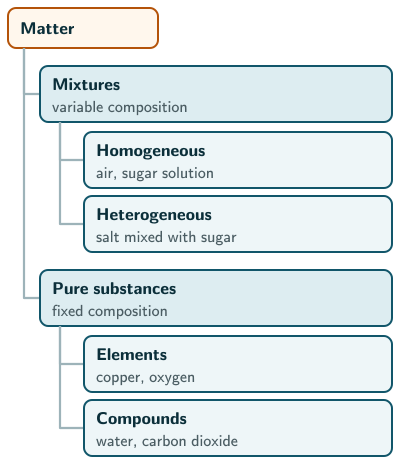
At the bulk level, matter is either a mixture (variable composition) or a pure substance (fixed composition). A pure substance is an element or a compound (NCERT Section 1.2, pages 4–6).
Anything which has mass and occupies space is called matter.
NCERT Chemistry Part I (Class 11), Section 1.2, page 4
In plain words: a book, a pen, water, air and living things are all matter. Light and sound are not matter: they are forms of energy (sound is a wave carried by matter). This topic sorts matter in two ways: by state (how its particles are arranged) and by kind (what particles it contains).
The three states of matter
The state depends on how the particles are arranged and how freely they move (NCERT Section 1.2.1, page 4):
- In a solid, the particles are held close together and mainly vibrate about fixed positions. Crystalline solids have long-range order; amorphous solids do not. So a solid keeps its own shape and volume.
- In a liquid, the particles are still close together but can move around one another. So a liquid keeps its volume but flows into the shape of its container.
- In a gas, the particles are far apart and move easily and fast. So a gas spreads out to fill the whole container, and it can be squeezed into a smaller volume.
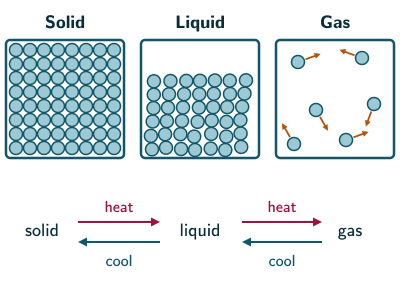
How far apart are the particles of a gas? A gram of liquid water at 100 °C takes about 1.04 cm, but a gram of steam at the same temperature and normal pressure takes about 1670 cm (Example 3). The same molecules spread through about 1600 times the volume, so they are on average about 12 times farther apart. The physics of this is in solids, liquids and gases at the molecular level.
These three states of matter are interconvertible by changing the conditions of temperature and pressure.
NCERT Chemistry Part I (Class 11), Section 1.2.1, page 5
On heating, a solid usually melts to a liquid, and the liquid on further heating turns into a gas (vapour). On cooling, a gas condenses to a liquid and the liquid freezes to a solid (page 5). Pressure works too: compressing a gas below its critical temperature can liquefy it, which is how LPG is kept liquid in a cylinder. Above the critical temperature, pressure alone cannot produce a liquid.
“Usually”, because some solids pass straight into vapour without melting; this is sublimation. Dry ice (solid CO2) always does so at normal pressure, and iodine and camphor sublime readily when warmed gently (beyond the NCERT text here).
Mixtures
A pure substance has particles that are all the same in chemical nature; a mixture contains two or more pure substances, its components, in any ratio (NCERT Section 1.2.2, page 5). So the composition of a mixture is variable: a sugar solution can be weak or strong, and it is still a sugar solution.
- Homogeneous mixture: the components mix completely, so the composition is the same throughout. Examples: sugar solution and air.
- Heterogeneous mixture: the composition is not uniform, and sometimes the different components can be seen. Examples: salt mixed with sugar, and grains and pulses with some dirt.
The components of a mixture keep their own properties and can be separated by physical methods such as hand-picking, filtration, crystallisation and distillation (page 5).
Elements and compounds
Pure substances, such as copper, silver, gold, water and glucose, have a fixed composition (NCERT page 5). Glucose always contains carbon, hydrogen and oxygen in the same ratio, and these cannot be separated by simple physical methods. Pure substances are of two kinds.
Particles of an element consist of only one type of atoms.
NCERT Chemistry Part I (Class 11), Section 1.2.2, page 5
Elements. Sodium, copper, silver, hydrogen and oxygen are elements (page 6). In metals such as sodium and copper, the atoms form an extended metallic lattice, rather than separate molecules. In others the particles are molecules made of two or more atoms of the same kind: hydrogen, nitrogen and oxygen gases consist of molecules H2, N2 and O2 (NCERT Fig. 1.3, page 6). An O2 molecule is still an element, because both its atoms are oxygen.
When two or more atoms of different elements combine together in a definite ratio, the molecule of a compound is obtained.
NCERT Chemistry Part I (Class 11), Section 1.2.2, page 6
Compounds. Water, ammonia, carbon dioxide and sugar are compounds (page 6). A water molecule, H2O, has two hydrogen atoms and one oxygen atom; a carbon dioxide molecule, CO2, has one carbon atom and two oxygen atoms (NCERT Fig. 1.4). Ionic compounds such as solid NaCl have an extended lattice of ions, not separate NaCl molecules: NaCl gives their simplest 1 : 1 ratio. Three facts set compounds apart:
- the elements are present in a fixed, definite ratio, characteristic of that compound (by mass, this is the law of definite proportions);
- the compound’s properties differ from those of its elements. Hydrogen burns with a pop and oxygen supports burning, yet water, made from the two, is used to put out fires (page 6);
- the constituents cannot be separated by physical methods, only by chemical methods.
| Property | Mixture | Compound |
|---|---|---|
| Composition | Variable | Fixed |
| Properties | Those of its components | New, different from its elements |
| Separation | Physical methods | Chemical methods only |
Solved examples
Example 1: Sorting substances
Classify each as an element, a compound, a homogeneous mixture or a heterogeneous mixture: (a) air; (b) copper; (c) glucose; (d) a sugar solution; (e) salt mixed with sugar; (f) oxygen gas; (g) carbon dioxide; (h) a single-phase solid solution of copper and zinc (alpha brass).
(a) Homogeneous mixture: several gases, uniform throughout. (b) Element, made of copper atoms. (c) Compound: C, H and O in a fixed ratio. (d) Homogeneous mixture. (e) Heterogeneous mixture: each crystal is either salt or sugar, so the composition changes from one pinch to another. (f) Element, even though its particles are O2 molecules. (g) Compound: one C and two O atoms per molecule. (h) Homogeneous mixture: the specified single-phase brass is uniform, though its composition can vary between samples.
Answer: elements (b), (f); compounds (c), (g); homogeneous mixtures (a), (d), (h); heterogeneous mixture (e).
Example 2: Water always has the same composition
In water, 2.016 g of hydrogen combine with 16.00 g of oxygen. Find the mass of hydrogen in (a) 9.0 g of water from a purified river sample and (b) 36 g of water from melted ice.
The ratio is fixed because every water molecule is H2O: 2 × 1.008 u of hydrogen for every 16.00 u of oxygen. So the mass fraction of hydrogen in water = 2.016/(2.016 + 16.00) = 2.016/18.016 ≈ 0.1119.
(a) 0.1119 × 9.0 g ≈ 1.0 g. (b) 0.1119 × 36 g ≈ 4.0 g.
Answer: about 1.0 g and 4.0 g. Whatever the source, every sample of pure water is about 11.2% hydrogen by mass, a fixed composition. A sugar solution has no such fixed ratio.
Example 3: How much room do gas particles take?
At 100 °C and normal atmospheric pressure, liquid water has a density of 0.958 g cm and steam a density of 0.598 g L. Compare the volumes of 1 g of each, and estimate how much farther apart the molecules are in steam.
Volume of 1 g of liquid = 1/0.958 ≈ 1.04 cm. Volume of 1 g of steam = 1/0.598 L ≈ 1.67 L ≈ 1670 cm.
Ratio of volumes ≈ 1670/1.04 ≈ 1600. Each molecule has about 1600 times as much room. The volume per molecule goes as the cube of the spacing, so the spacing grows by about ∛1600 ≈ 11.7.
Answer: about 1.04 cm against about 1670 cm, roughly 1600 times; the molecules in steam are about 12 times farther apart than in the liquid.
Common mistakes to avoid
Common mistake
Calling oxygen gas a compound because it is made of molecules
A molecule makes a compound only if its atoms are of different elements. O2, H2 and N2 are elements. Elements can have bigger molecules too: O3, P4, S8. But one kind of atom does not by itself make a pure substance: a mixture of O2 and O3 is a mixture of two forms of oxygen.
Common mistake
Judging homogeneous by eye
Milk, blood and fog look uniform but are heterogeneous mixtures (colloids: tiny droplets or particles spread through another substance). Clean air, a completely dissolved sugar solution and single-phase brass are homogeneous. Some brass alloys contain more than one solid phase, so appearance alone is insufficient (Copper Development Association, Introduction to Brasses).
Common mistake
Thinking homogeneous means pure
Air and sugar solution look the same throughout, but they are mixtures: their composition can change, and their components can be separated by physical methods.
Common mistake
Expecting a compound to behave like its elements
A compound has its own properties. Water does not burn like hydrogen or support burning like oxygen.
Common mistake
Saying gases have no volume
A gas does have a volume: the volume of its container. It has no definite volume of its own, because it expands or is compressed to fill whatever space it is in.
Quick revision summary
- Matter has mass and occupies space.
- Solids: definite shape and volume. Liquids: definite volume, no definite shape. Gases: neither.
- The states interconvert when temperature or pressure changes: heating melts and boils, cooling condenses and freezes.
- Mixtures have variable composition; homogeneous ones are uniform, heterogeneous ones are not. Physical methods separate them.
- Pure substances have fixed composition. Elements have one kind of atom (as atoms, like Na and Cu, or molecules, like O2). Compounds have atoms of different elements in a fixed ratio, new properties, and need chemical methods to separate.
Formula sheet
- Metal lattices: Na, Cu; molecular elements: H, N, O
- Compounds: HO (2 H : 1 O), CO (1 C : 2 O)
- Water: H : O by mass = 2.016 : 16.00 (about 1 : 8)
- Water is about 11.2% hydrogen by mass
Questions students ask
What is the difference between a pure substance and a mixture?
A pure substance has a fixed composition and fixed properties, while a mixture contains two or more substances in any proportion, so its composition and properties vary. A useful test is the melting or boiling point: a pure crystalline substance has a characteristic sharp melting point, and a pure liquid a characteristic boiling point, at a fixed pressure, provided it does not decompose (pure water boils at 100 °C at 1 atm), while a mixture usually changes state over a range, as salt water boils above 100 °C and its boiling point rises as the water boils away. A few liquid mixtures, called azeotropes, such as 95.6% ethanol and 4.4% water by mass, do boil at a fixed temperature, so the test is a guide, not a proof.
How many states of matter are there?
NCERT Class 11 Chemistry deals with three states of matter, solid, liquid and gas, but scientists recognise more. Plasma, an ionised gas containing free electrons and ions, is often called the fourth state: the Sun and other stars are made of it, and on Earth it occurs in lightning, auroras and neon signs. Not all plasmas are very hot: low-temperature plasmas can have relatively cool heavy particles (US Department of Energy, DOE Explains Plasma). A Bose–Einstein condensate, a cloud of certain atoms cooled to less than a millionth of a kelvin above absolute zero and first made in 1995, is sometimes called the fifth.
What is the difference between an atom and a molecule?
An atom is the smallest particle of an element that can take part in a chemical reaction, while a molecule is the smallest particle of an element or a compound that can exist on its own and still has the substance’s chemical properties; it is usually made of two or more atoms held together by chemical bonds. A molecule may contain atoms of one element, as in N2 and Cl2, or of different elements, as in NH3. The noble gases, such as argon, exist as separate atoms, so for them a single atom is the smallest particle that exists on its own, which physics calls a monatomic molecule.
Is the States of Matter chapter deleted from the JEE Main 2027 and NEET (UG) 2026 syllabuses?
Yes, the separate chapter States of Matter (gases and liquids) is no longer in the NCERT Class 11 Chemistry book or in the chemistry part of the JEE Main 2027 and NEET (UG) 2026 syllabuses. What remains is ‘matter and its nature’, the first item of Unit 1, Some Basic Concepts in Chemistry, in both, which this page covers. The ideal-gas equation and the kinetic picture of gases are examined in Physics, Unit 9, Kinetic Theory of Gases, of both syllabuses, as on the behaviour of gases page.
Practice questions
Try each question first, then open the answer to check your working.
-
Q1. Classify as element, compound or mixture: nitrogen gas, ammonia, air, gold, sugar solution.
Show answerHide answer
Elements: nitrogen gas (N2 molecules) and gold. Compound: ammonia (NH3). Mixtures: air and sugar solution (both homogeneous).
-
Q2. Why does a gas fill any container it is put in, while a liquid does not?
Show answerHide answer
In a gas the particles are far apart and move freely and fast, so they spread through all the space available. In a liquid the particles stay close together; they can move past one another, so the liquid takes the shape of the container, but its volume stays fixed.
-
Q3. Water contains 16.00 g of oxygen for every 18.016 g of water. Find the mass of oxygen in 45.0 g of water.
Show answerHide answer
45 × 16.00/18.016 ≈ 40.0 g of oxygen.