Methods of purification of organic compounds
NCERT Class 11 Chemistry Chapter 8 Section 8.8
Quick answer
Purification separates a compound from impurities using differences in properties such as volatility, solubility, adsorption or partition between phases. Common methods are sublimation, crystallisation, distillation, extraction and chromatography. Melting or boiling behaviour and chromatographic or spectroscopic results together help assess purity.
With your textbook
NCERT Chemistry Part II (Class 11), Chapter 8 “Organic Chemistry – Some Basic Principles and Techniques”, Section 8.8 “Methods of Purification of Organic Compounds”, pages 278–284.
Open the official NCERT chapter (PDF, 4.5 MB, ncert.nic.in) (opens in a new tab)
Checked against the 2026-27 reprint on .
How are organic compounds purified?
Methods of purification
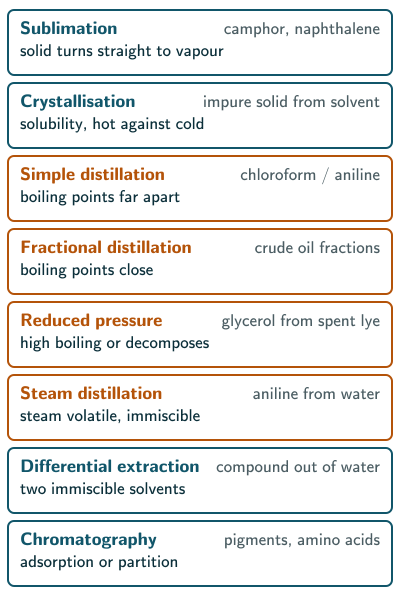
An organic compound extracted from a natural source or made in the laboratory must be purified. The method depends on the nature of the compound and of the impurity (NCERT Section 8.8, page 278). The common techniques are:
- sublimation, for solids that pass straight into vapour;
- crystallisation, using a difference in solubility;
- distillation, using a difference in boiling point: simple, fractional, under reduced pressure, or with steam;
- differential extraction, using a difference in solubility in two immiscible solvents;
- chromatography, using a difference in adsorption or in partition between two phases.
Purity is assessed by melting or boiling behaviour together with chromatographic or spectroscopic evidence; no single observation proves absolute purity.
In plain words: every method uses some physical property in which the compound differs from its impurities. If it sublimes and they do not, heat it; if it dissolves in hot solvent but crystallises on cooling while they stay dissolved, crystallise it; if it boils at a different temperature, distil it. Chromatography can achieve particularly fine separations, separating substances that differ only slightly in how strongly they are held by the stationary phase.
Sublimation
Some solids change from solid to vapour on heating without melting (see solid–vapour equilibrium). Heating such a mixture separates a sublimable compound, which collects as vapour and solidifies on a cool surface, from non-sublimable impurities (NCERT Section 8.8.1, page 279). Camphor, naphthalene, anthracene and benzoic acid are familiar organic solids that sublime; iodine is an inorganic one.
Crystallisation
Crystallisation is one of the most common ways to purify solid organic compounds. It uses the difference in solubility of the compound and the impurities in a suitable solvent (NCERT Section 8.8.2, page 279):
- dissolve the impure compound in a solvent in which it is sparingly soluble at room temperature but appreciably soluble when hot;
- hot-filter any insoluble impurities, then obtain a nearly saturated hot solution;
- cool: the desired compound crystallises, ideally leaving soluble impurities behind, and is filtered off; the filtrate (mother liquor) keeps the impurities and a little of the compound.
If the compound is very soluble in one solvent and only slightly soluble in another, a mixture of the two can be used. Coloured impurities are removed by adsorbing them on activated charcoal. When the impurities have solubilities close to that of the compound, repeated crystallisation is needed.
Distillation
Distillation separates volatile liquids from non-volatile impurities, and liquids whose boiling points differ enough (NCERT Section 8.8.3, pages 279–281). A liquid mixture generally produces vapour containing more than one component. Distillation works when vapour and liquid compositions differ enough; the vapour is condensed and collected in suitable fractions.
- Simple distillation: chloroform (boiling point 334 K) and aniline (457 K) are easily separated this way (NCERT Fig. 8.5). The early distillate is enriched in the more volatile component; separation is not automatically complete.
- Fractional distillation: when boiling points are close, the vapours form over the same temperature range and condense together. The vapour is passed through a fractionating column (packed with glass beads, or with bubble plates) fitted over the flask. Rising vapour meets descending liquid on the large surface; the higher-boiling component condenses and the lower-boiling one revaporises, so the vapour becomes richer in the more volatile component as it rises. A theoretical plate is an ideal equilibrium contact stage, rather than necessarily one physical plate or a perfectly pure fraction; columns with hundreds of plates are available commercially. Ordinary fractional distillation cannot separate a mixture beyond an azeotropic composition at a fixed pressure. Crude oil is separated into fractions this way in the petroleum industry (pages 279–280).
- Distillation under reduced pressure: for liquids with very high boiling points, or that decompose at or below their boiling points. A liquid boils when its vapour pressure equals the external pressure, so lowering the pressure with a water pump or vacuum pump lowers the boiling point (NCERT Fig. 8.8). Glycerol is recovered from spent lye in the soap industry this way (page 280).
- Steam distillation: for substances that are steam volatile and immiscible with water. Steam is passed through the heated mixture; the liquid boils when the sum of the vapour pressures of the organic liquid (p1) and of water (p2) equals the atmospheric pressure, p = p1 + p2. Since p1 is less than p, the organic liquid distils below its own boiling point, and while both liquid phases remain, the ideal immiscible mixture boils below the boiling point of either pure component at that pressure. At normal atmospheric pressure it therefore boils below about 373 K; how close depends on the organic liquid’s vapour pressure. Aniline is separated from an aniline–water mixture this way; the two layers of the distillate are then separated in a separating funnel (page 281).
Steam distillation
p1 + p2 = p (atmospheric)
so, at normal atmospheric pressure with both immiscible liquid phases present, boiling occurs below about 373 K
NCERT’s caption to Fig. 8.8 (page 281) says that a liquid boils at a temperature below its vapour pressure by reducing the pressure, which mixes up a temperature with a pressure. The point is that at reduced pressure the liquid boils at a temperature below its normal boiling point.
Differential extraction
A compound dissolved in water is shaken in a separatory funnel with an organic solvent in which it is more soluble. The two liquids must be immiscible so that they form two layers. The layers are run off separately, and the solvent is removed by distillation or evaporation to recover the compound (NCERT Section 8.8.4, page 281). If the compound is only a little more soluble in the organic solvent, a very large amount of solvent would be needed; then continuous extraction, in which the same solvent is used again and again, is employed.
Chromatography
Chromatography (from the Greek chroma, colour, because it was first used on coloured plant pigments) separates mixtures, purifies compounds and tests their purity (NCERT Section 8.8.5, pages 281–284). The mixture is applied to a stationary phase, a solid or a liquid, and a mobile phase, a solvent, a mixture of solvents or a gas, moves slowly over it. The components travel at different rates and separate.
Adsorption chromatography uses the different degrees to which compounds are adsorbed on an adsorbent such as silica gel or alumina (page 282).
- Column chromatography: the adsorbent is packed in a glass tube with a stopcock; the mixture is placed at the top and an eluant (a liquid or mixture of liquids) flows down slowly. The most readily adsorbed substances stay near the top; the others travel different distances down the column (NCERT Fig. 8.11, page 283).
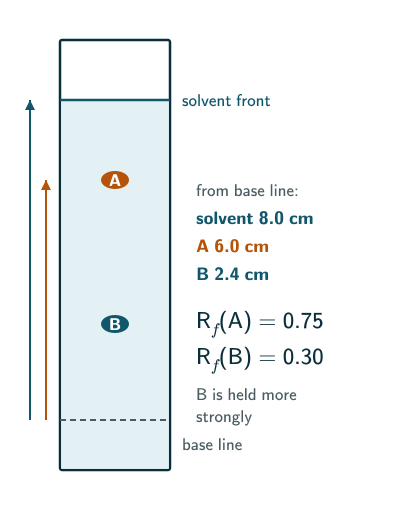
- Thin layer chromatography (TLC): a layer of adsorbent about 0.2 mm thick on a glass plate (a chromaplate). The mixture is spotted about 2 cm from one end and the plate stood in a closed jar of eluant. The solvent level must begin below the sample spots. As the eluant rises, the components move up different distances (page 283). Each is described by its retardation factor:
Retardation factor
Rf = (distance moved by the substance from the base line)/
Coloured spots are seen directly. Colourless ones are seen under ultraviolet light if they fluoresce or absorb UV and quench a fluorescent plate background, as brown spots in a covered jar with a few iodine crystals (if they adsorb iodine), or by spraying a reagent, such as ninhydrin for amino acids (page 283).
Partition chromatography depends on continuous differential partitioning of the components between a stationary and a mobile phase. In paper chromatography, the water trapped in chromatography paper is the stationary phase. A strip spotted near its base is hung in a solvent, which rises by capillary action; each component is held back by the paper according to its partition between the two phases. The developed strip is a chromatogram (NCERT Fig. 8.13, page 284).
Checking purity
Finally, purity is checked by the melting or boiling point: most pure compounds have sharp melting and boiling points. Newer methods use chromatographic and spectroscopic techniques (NCERT pages 278–279). A single spot on TLC in several solvent systems supports purity but is not proof: impurities may co-migrate or escape detection. Melting/boiling ranges also depend on pressure, decomposition and mixtures such as azeotropes. A purified compound is then tested for the elements it contains by qualitative analysis.
Solved examples
Example 1: Choosing a method
Suggest a method for each: (a) camphor mixed with calcium sulphate (NCERT Exercise 8.27, page 294); (b) chloroform and aniline; (c) aniline from an aniline–water mixture; (d) glycerol from spent lye; (e) the fractions of crude oil; (f) o-nitrophenol from p-nitrophenol.
(a) Camphor sublimes, calcium sulphate does not. (b) Boiling points 334 K and 457 K, far apart. (c) Aniline is steam volatile and immiscible with water. (d) Glycerol decomposes near its normal boiling point. (e) Many components with close boiling points. (f) o-Nitrophenol has an intramolecular hydrogen bond, so it is steam volatile; p-nitrophenol is held by intermolecular hydrogen bonds and is not.
Answer: (a) sublimation; (b) simple distillation; (c) steam distillation; (d) distillation under reduced pressure; (e) fractional distillation; (f) steam distillation.
Example 2: Calculating R<sub>f</sub>
On a TLC plate the solvent front is 8.0 cm from the base line, and spots A and B are 6.0 cm and 2.4 cm from it. Find their Rf values and say which is adsorbed more strongly.
Rf(A) = 6.0/8.0 = 0.75; Rf(B) = 2.4/8.0 = 0.30.
Answer: 0.75 and 0.30. B, with the smaller Rf, is held more strongly by the adsorbent.
Example 3: Why steam distillation works below about 373 K at normal atmospheric pressure
At 371 K (98 °C) the vapour pressure of water is about 94.3 kPa. Suppose a steam-volatile oil immiscible with water has a vapour pressure of 7.0 kPa at that temperature. Show that the mixture boils at about 371 K at a pressure of 101.3 kPa.
The two liquids do not mix, so each exerts its own vapour pressure: p = p1 + p2 = 7.0 + 94.3 = 101.3 kPa, equal to the atmospheric pressure.
Answer: the total reaches 101.3 kPa at 371 K, so the mixture boils there, below about 373 K at normal atmospheric pressure, even though the oil alone would boil far higher.
Example 4: Two compounds of different solubility (NCERT Exercise 8.19, page 293)
Describe how to separate two compounds with different solubilities in a solvent S.
Dissolve the mixture in the minimum of hot S and cool slowly. The component that reaches saturation first crystallises and is filtered off; this depends on both its solubility and initial amount. Concentrating and cooling the mother liquor gives the more soluble one; repeating the cycle purifies each.
Answer: fractional crystallisation.
Common mistakes to avoid
Common mistake
Measuring R<sub>f</sub> from the bottom of the plate
Both distances are measured from the base line where the spot was applied, not from the edge of the plate. Rf is always between 0 and 1.
Common mistake
Saying steam distillation works at 100 °C
At normal atmospheric pressure, with both water and the immiscible organic liquid present, the mixture boils below about 373 K because the two vapour pressures add up to the atmospheric pressure before water alone would boil.
Common mistake
Mixing up the stationary phases
In the adsorption TLC and column examples here the stationary phase is a solid adsorbent (silica gel, alumina); in paper chromatography it is the water held in the paper.
Quick revision summary
- Sublimation: sublimable solid from non-sublimable impurity.
- Crystallisation: hot saturated solution cooled; soluble impurities ideally stay in the mother liquor; charcoal removes colour.
- Distillation: simple (boiling points far apart), fractional (close), reduced pressure (high-boiling or decomposing), steam (steam volatile, immiscible with water; boils below about 373 K at normal atmospheric pressure).
- Differential extraction: separatory funnel, two immiscible solvents; continuous extraction for poor solubility.
- Chromatography: adsorption (column, TLC) and partition (paper); Rf = distance moved by substance/distance moved by solvent.
- Purity: melting/boiling behaviour plus chromatography or spectroscopy; one sharp point or one TLC spot is not conclusive.
Formula sheet
- Rf = distance moved by substance/distance moved by solvent (both from the base line)
- Steam distillation: p = p1 + p2
Questions students ask
Is purification of organic compounds deleted from the JEE Main 2027 and NEET (UG) 2026 syllabuses?
No, purification of organic compounds is not deleted: JEE Main 2027 (NTA) and NEET (UG) 2026 (NMC) both list ‘Purification – crystallization, sublimation, distillation, differential extraction and chromatography – principles and their applications’ under Unit 13, Purification and Characterisation of Organic Compounds. It is also NCERT Section 8.8, in the 2026–27 Class 11 Chemistry Part II, and the CBSE Class 11 syllabus for 2026–27 keeps ‘Methods of Purification of Organic Compounds’ in Unit 8. The topic covers which method suits a mixture, why steam distillation works below about 373 K at normal atmospheric pressure and how to read an Rf value from a TLC plate.
Does the Rf value have a unit, and why is it never more than 1?
The Rf value has no unit: it is the ratio of two distances, both measured from the base line in the same unit, so the units cancel. It can never be more than 1, because a substance is carried up by the solvent and cannot travel farther than the solvent front; an Rf close to 1 means the substance is hardly held by the stationary phase, and 0 means it has not left the base line. A spot 3.3 cm from the base line with the front at 5.5 cm gives Rf = 3.3/5.5 = 0.60, the same as 33 mm/55 mm.
Does a more polar compound have a higher or a lower Rf value?
Under otherwise identical normal-phase conditions on silica gel or alumina, a more polar compound often has a lower Rf value: these adsorbents are polar and hold polar molecules more strongly, so they move less with the solvent. A less polar compound spends more of its time in the mobile phase and runs higher; with a hexane–ethyl acetate solvent, for example, naphthalene runs close to the solvent front while benzoic acid, with its polar –COOH group, stays much lower. Solvent composition, ionisation and specific interactions also matter, and reversed-phase TLC can show a different trend. A more polar solvent generally competes better for the adsorbent and raises the Rf values, so the solvent is chosen to spread the spots well apart, roughly between 0.2 and 0.8.
What is the difference between fractional distillation and cracking?
Fractional distillation is a physical separation that sorts the compounds in a mixture, such as crude oil, by boiling point without forming new substances, while cracking is a chemical reaction that breaks large alkane molecules into smaller alkanes and alkenes by strong heating, often over a catalyst. In a refinery they work in sequence: crude oil is first fractionally distilled into fractions such as petrol, kerosene and diesel, and heavy fractions are then cracked to give more petrol and alkenes like ethene and propene. NCERT treats cracking as pyrolysis in Unit 9: dodecane heated to 973 K over Pt, Pd or Ni gives heptane and pentene.
Practice questions
Try each question first, then open the answer to check your working.
-
Q1. What is the difference between distillation, distillation under reduced pressure and steam distillation (NCERT Exercise 8.20)?
Show answerHide answer
Simple distillation boils the liquid at atmospheric pressure and is used when boiling points differ widely. Under reduced pressure the boiling point is lowered, for liquids that boil very high or decompose. Steam distillation passes steam through a water-immiscible, steam-volatile substance; the mixture boils below about 373 K at normal atmospheric pressure because the two vapour pressures add up to the atmospheric pressure.
-
Q2. A spot moves 3.6 cm while the solvent front moves 9.0 cm. Find Rf.
Show answerHide answer
Rf = 3.6/9.0 = 0.40.
-
Q3. Why is activated charcoal added during crystallisation?
Show answerHide answer
To adsorb coloured impurities, which are then filtered off with the charcoal from the hot solution, so the crystals that form on cooling are free of the coloured impurity.