Fundamental concepts in organic reaction mechanism
NCERT Class 11 Chemistry Chapter 8 Section 8.7
Quick answer
A reaction mechanism describes the steps by which bonds break and form and electrons move. Polar steps involve electron-pair donors and acceptors, while radical steps involve unpaired electrons. Induction, conjugation and hyperconjugation help explain reactivity, but rates and products also depend on activation barriers, solvent and conditions.
With your textbook
NCERT Chemistry Part II (Class 11), Chapter 8 “Organic Chemistry – Some Basic Principles and Techniques”, Section 8.7 “Fundamental Concepts in Organic Reaction Mechanism”, pages 271–278.
Open the official NCERT chapter (PDF, 4.5 MB, ncert.nic.in) (opens in a new tab)
Checked against the 2026-27 reprint on .
What is a reaction mechanism?
Reaction mechanism
In an organic reaction, the organic molecule (the substrate) reacts with an attacking reagent, often through one or more intermediates, to give the products (NCERT Section 8.7, page 271). A step-by-step account of the electron movement, the energy changes as bonds break and form, and the rates of the steps is the reaction mechanism.
- A covalent bond breaks by heterolysis, giving ions such as carbocations and carbanions, or by homolysis, giving free radicals.
- In polar reaction steps, reagents can act as nucleophiles (electron-pair donors) or electrophiles (electron-pair acceptors); radical reactions need a separate description.
- The electron density in a molecule is shifted by the inductive, resonance, electromeric and hyperconjugation effects, which explain where and how a reagent attacks.
In plain words: a mechanism is the story of a reaction told electron by electron. Bonds are pairs of electrons; when a reaction happens, those pairs move, and curved arrows record where they go. Knowing which parts of a molecule are rich or poor in electrons tells you where a reagent will attack, and intermediate stability helps compare possible paths. Actual rates and product ratios depend on activation barriers and conditions, not intermediate stability alone.
Fission of a covalent bond
A covalent bond can break in two ways (NCERT Section 8.7.1, pages 271–272).
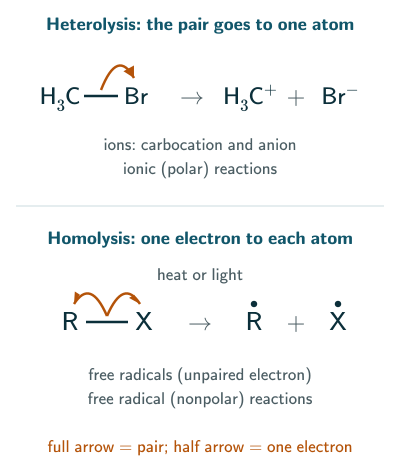
Heterolytic cleavage. The shared pair stays with one fragment. For cleavage of a neutral bond, the fragments carry opposite charges; the exact electron counts depend on the atoms. Formal heterolysis of bromomethane would give CH3+ and Br−.
- A species with a carbon bearing a sextet and a positive charge is a carbocation (earlier, carbonium ion). Carbocations are primary, secondary or tertiary according to whether one, two or three carbons are attached to the positive carbon: CH3CH2+ (ethyl, primary), (CH3)2CH+ (isopropyl, secondary), (CH3)3C+ (tert-butyl, tertiary). For these simple alkyl examples, the usual stability order is CH3+ < CH3CH2+ < (CH3)2CH+ < (CH3)3C+, because attached alkyl groups stabilise the charge by the inductive and hyperconjugation effects (below). A simple three-coordinate carbenium centre is sp2 hybridised and locally trigonal planar; its empty p orbital is perpendicular to the plane (NCERT Fig. 8.3(a), pages 271–272).
- If the leaving group takes no electrons, carbon keeps the pair: a species with a negative charge on carbon is a carbanion, such as H3C:−. Its carbon is generally sp3 hybridised and the structure is a distorted tetrahedron, the lone pair taking the fourth position (NCERT Fig. 8.3(b), page 272). Strictly, a carbanion conjugated with a π system can be planar (reasoned).
Simple free alkyl carbocations and carbanions are highly reactive, although suitable substitution, solvation or counterions can stabilise carbon-centred ions. The formal cleavage diagrams specify electron allocation, not proof that isolated ions form spontaneously in every solvent. Reactions that go through heterolytic cleavage are called ionic, heteropolar or polar reactions.
Homolytic cleavage. Each bonded atom takes one electron of the pair, usually on heating or in light. For a neutral R–X molecule the products are neutral free radicals, each with an unpaired electron; charged radicals also exist: R–X → R• + X•. Alkyl radicals, like carbocations, are primary, secondary or tertiary, and their stability rises in the same order: CH3• < CH3CH2• < (CH3)2CH• < (CH3)3C• (page 272). Reactions that go through homolysis, such as the chlorination of methane, are free radical, homopolar or nonpolar reactions.
Substrate, reagent, nucleophiles and electrophiles
The molecule whose carbon forms the new bond is the substrate and the other reactant is the reagent: in CH2=CH2 + Br2 → BrCH2CH2Br, ethene is the substrate. When a carbon–carbon bond forms, both reactants supply carbon and the choice is arbitrary: in C6H6 + CH3Cl → C6H5CH3 + HCl, NCERT takes benzene as the substrate (NCERT Section 8.7.2, page 272).
A reagent attacks a reactive site of the substrate. An electron-rich reagent attacks an electron-poor site, such as an atom with an incomplete shell or the positive end of a dipole; an electron-poor reagent attacks an electron-rich site, such as the π electrons of a double bond (page 273). This is the Lewis picture of acids and bases applied to carbon:
- A nucleophile (Nu:, nucleus seeking) brings an electron pair to the reactive site. Examples: negative ions with lone pairs, such as HO−, NC− and carbanions R3C:−; neutral molecules with lone pairs, such as H2O, R3N and R2NH. The reaction is nucleophilic.
- An electrophile (E+, electron seeking) takes an electron pair from the reactive site. Examples: carbocations such as CH3+, whose carbon has only a sextet, and neutral molecules with a polar group, such as the carbonyl group, >C=O, or alkyl halides, R3C–X, whose carbon carries a partial positive charge. The reaction is electrophilic.
Electron movement and curved arrows
The movement of electrons is shown by curved arrows (NCERT Section 8.7.3, pages 273–274). A full-headed arrow shows a pair of electrons: it starts where the pair is (a bond or a lone pair) and ends where the pair goes (a new bond position or an atom). A half-headed fish-hook arrow shows a single electron, as in homolysis. For example, HO− + CH3–Br → CH3OH + Br− is drawn with one arrow from a lone pair of HO− to the carbon and another from the C–Br bond to bromine (page 274).
Electron displacement effects
Electron density in a molecule can be displaced in two ways (NCERT Section 8.7.4, page 274):
- permanent displacements in the ground state, caused by an atom or group in the molecule: the inductive and resonance effects (and hyperconjugation);
- temporary displacements that appear only when a reagent approaches: the electromeric effect (polarisability effect).
Inductive effect
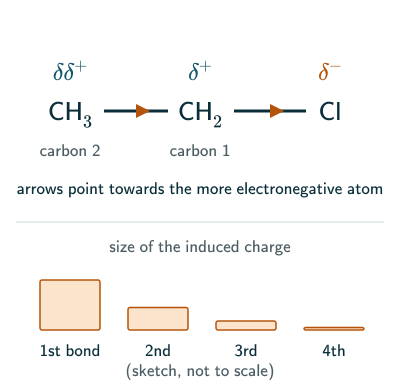
In a bond between atoms of different electronegativity, the electron density is pulled towards the more electronegative atom, giving a polar covalent bond (NCERT Section 8.7.5, page 274). In chloroethane, CH3CH2Cl, the C–Cl bond makes carbon 1 slightly positive (δ+) and chlorine slightly negative (δ−). Carbon 1 in turn draws electron density from the C1–C2 bond, so carbon 2 gets a smaller positive charge (δδ+). This polarisation of a σ bond by the polarisation of an adjacent σ bond is the inductive effect. It decreases rapidly as the number of intervening bonds increases and becomes vanishingly small after three bonds (NCERT page 274); three bonds is a rule of thumb, not an exact cutoff (reasoned).
- Electron-withdrawing groups (−I): halogens, nitro (–NO2), cyano (–CN), carboxy (–COOH), ester (–COOR) and aryloxy (–OAr, such as –OC6H5).
- Electron-donating groups (+I): alkyl groups such as methyl (–CH3) and ethyl (–C2H5).
These are relative to hydrogen. The inductive effect explains, for example, why chloroacetic acid is a stronger acid than acetic acid: the −I chlorine draws electron density from the O–H bond and stabilises the carboxylate ion. Acid strength depends on the free-energy change including conjugate-base stabilisation and solvation, rather than bond polarity alone (see factors affecting acid strength).
Resonance structures
Some molecules cannot be described by one Lewis structure (NCERT Section 8.7.6, pages 275–276; see resonance in Unit 4). Benzene drawn with alternating single and double bonds should have two bond lengths, but all its C–C bonds measure 139 pm, between C–C (154 pm) and C=C (134 pm). Its real structure is a resonance hybrid, commonly represented by the two equivalent Kekulé contributors; they are not the only possible contributors. In nitromethane, CH3NO2, the two N–O bonds are also of equal length, between N–O and N=O.
- The resonance (canonical, contributing) structures are hypothetical; none is the real molecule. They contribute in proportion to their stability.
- The hybrid is lower in energy than any contributing structure. The energy difference between the hybrid and the lowest-energy contributing structure is the resonance energy; important contributors of similar energy often give substantial stabilisation, but simply counting drawings does not quantify it.
- Resonance structures have the same positions of nuclei and the same number of unpaired electrons. The more stable ones have more covalent bonds, an octet on every atom (a duplet on H), less separation of opposite charges, a negative charge on the more electronegative atom, a positive charge on the more electropositive atom, and more dispersed charge (page 275).
Resonance effect
The resonance (or mesomeric, R or M) effect is the polarity produced in a molecule by the interaction of two π bonds, or of a π bond with a lone pair on an adjacent atom; it is transmitted through the chain (NCERT Section 8.7.7, page 276).
- +R effect: electrons move away from the group into the conjugated system, raising the electron density at certain positions, as from –NH2 in aniline. +R groups: halogens, –OH, –OR, –OCOR, –NH2, –NHR, –NR2, –NHCOR.
- −R effect: electrons move towards the group, as to –NO2 in nitrobenzene. −R groups: –COOH, –CHO, >C=O, –CN, –NO2.
Alternate single and double bonds in an open chain or a ring form a conjugated system, such as buta-1,3-diene, aniline and nitrobenzene; their π electrons are delocalised and the system develops polarity (page 277). In an exam, give NCERT’s sentence. Strictly, substituents produce that polarity: conjugation alone need not give a permanent dipole, as symmetrical buta-1,3-diene shows (reasoned).
Electromeric effect
The electromeric (E) effect is a temporary effect, shown by compounds with a multiple bond only in the presence of an attacking reagent: the complete transfer of a shared pair of π electrons to one of the atoms joined by the multiple bond, on the demand of the reagent. “The effect is annulled as soon as the attacking reagent is removed from the domain of the reaction” (NCERT Section 8.7.8, page 277). Strictly, a reaction that has already given products is not reversed by removing the excess reagent (reasoned).
- +E effect: the π electrons move to the atom to which the reagent becomes attached, as when H+ adds to an alkene.
- −E effect: the π electrons move to the atom to which the reagent does not attach. NCERT draws this on a C=C; the clean case is CN− attacking the carbon of a C=O group, where the π pair moves onto oxygen (as in Q4 (b)).
When the inductive and electromeric effects act in opposite directions, the electromeric effect predominates (page 277).
Hyperconjugation
Hyperconjugation is a general stabilising interaction: the σ electrons of a C–H bond of an alkyl group directly attached to an unsaturated system, or to an atom with an unshared p orbital, are partly delocalised into it (NCERT Section 8.7.9, pages 277–278). It is a permanent effect. In the ethyl cation, CH3CH2+, one C–H bond of the methyl group can line up with the empty p orbital of the positive carbon and share its electron density, which spreads out the positive charge (NCERT Fig. 8.4(a)).
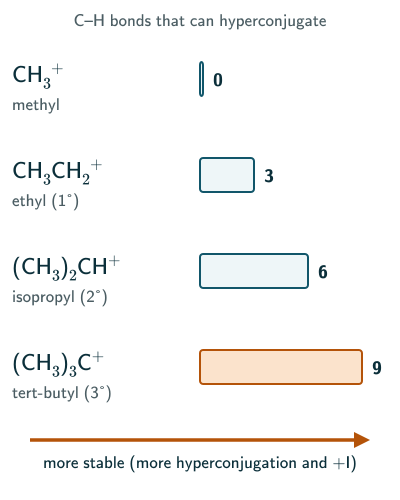
For the methyl/ethyl/isopropyl/tert-butyl comparison, more adjacent methyl groups supply more C–H donors: (CH3)3C+ has nine such C–H bonds, (CH3)2CH+ six, CH3CH2+ three and CH3+ none. More generally, C–C σ bonds can participate too, so an α hydrogen is not a universal requirement for every kind of hyperconjugation (reasoned). Hyperconjugation also occurs in alkenes such as propene and in alkylarenes; it may be pictured as giving the C–H bond partial ionic character, and so is also called no-bond resonance (page 278).
Types of organic reactions
Organic reactions fall into four broad classes (NCERT Section 8.7.10, page 278), studied in detail in the hydrocarbons unit (halogenation of alkanes, addition to alkenes) and in Class 12:
- substitution: one atom or group replaces another, CH3Br + HO− → CH3OH + Br−;
- addition: two molecules combine across a multiple bond, CH2=CH2 + Br2 → BrCH2CH2Br;
- elimination: atoms are removed from neighbouring carbons to form a multiple bond, CH3CH2OH → CH2=CH2 + H2O (concentrated H2SO4, heat; see preparation of alkenes);
- rearrangement: the carbon skeleton or the position of a group changes (Example 6 (d)).
Solved examples
Example 1: Heterolytic cleavage (NCERT Problem 8.11, page 273)
Show the intermediates formed when (a) CH3–SCH3, (b) CH3–CN and (c) CH3–Cu break heterolytically.
These are formal electron-bookkeeping cleavages, not predictions of spontaneous ion formation. The pair is assigned to the fragment favoured as an anion: CH3S− and CN− are stable anions. Copper is a metal, far less electronegative than carbon, so carbon keeps the pair.
Answer: (a) CH3+ + −SCH3; (b) CH3+ + −CN; (c) CH3− + Cu+, a carbanion. In each, the curved arrow runs from the bond to the atom that keeps the pair.
Example 2: Nucleophile or electrophile? (NCERT Problem 8.12, page 273)
Classify HS−, BF3, C2H5O−, (CH3)3N:, Cl+, CH3–C+=O, H2N:− and NO2+.
Nucleophiles have an unshared pair to donate: HS−, C2H5O−, (CH3)3N: and H2N:−. Electrophiles can accept a pair: BF3, Cl+ and CH3–C+=O have only six valence electrons at the reactive atom.
Answer: nucleophiles HS−, C2H5O−, (CH3)3N: and H2N:−; electrophiles BF3, Cl+, CH3–C+=O and NO2+. NO2+ does not fit NCERT’s reason: its nitrogen already has an octet (O=N+=O), and it accepts a pair as one N=O π pair shifts onto oxygen.
Example 3: Polarity and the inductive effect (NCERT Problems 8.14 and 8.15, page 275)
(a) Which bond is more polar: H3C–H or H3C–Br; H3C–NH2 or H3C–OH; H3C–OH or H3C–SH? (b) In which C–C bond of CH3CH2CH2Br is the inductive effect least?
(a) Compare each atom with carbon. O (3.5) is further from C (2.5) than N (3.0) or S (2.5), so C–O wins both times. For C–H and C–Br the differences are close (H lies below carbon, Br above), but the long C–Br bond has much the larger dipole (bromomethane, 1.8 D), so C–Br is more polar. NCERT’s reason, that Br is more electronegative than H, compares the wrong pair. (b) Number the carbons from Br: C1 carries Br. The effect is strongest in C1–C2 and weaker in C2–C3, the C–C bond farthest from Br.
Answer: (a) C–Br, C–O, C–O; (b) the C2–C3 bond. NCERT’s printed answer, the bond between carbon-3 and hydrogen, is not a C–C bond.
Example 4: Resonance structures (NCERT Problems 8.16 and 8.17, page 276)
(a) Write the resonance structures of the acetate ion, CH3COO−. (b) Rank the contributing structures of propenal, CH2=CH–CHO.
(a) A lone pair on O− forms a C=O bond while the C=O π pair moves onto the other oxygen: two equivalent structures, so both C–O bonds are the same length. (b) I: CH2=CH–CH=O, no charges. II: +CH2–CH=CH–O−, negative charge on oxygen. III: −CH2–CH=CH–O+, negative charge on carbon and positive on oxygen.
Answer: (a) two equivalent structures; (b) I > II > III. I has the most bonds and no charge separation; III places the positive charge on the more electronegative atom and hardly contributes.
Example 5: Carbocation stability (NCERT Problem 8.19, page 278)
Why is (CH3)3C+ more stable than CH3CH2+, and CH3+ the least stable?
(CH3)3C+ has nine C–H bonds next to the positive carbon that can hyperconjugate, CH3CH2+ only three; its three methyl groups also donate by the +I effect. In CH3+ the C–H bonds lie in the plane perpendicular to the empty p orbital, so they cannot overlap with it.
Answer: stability (CH3)3C+ > (CH3)2CH+ > CH3CH2+ > CH3+, following the number of hyperconjugating C–H bonds (9, 6, 3, 0).
Example 6: Classifying reactions (NCERT Exercise 8.14, page 293)
Classify: (a) CH3CH2Br + HS− → CH3CH2SH + Br−; (b) (CH3)2C=CH2 + HCl → (CH3)2CClCH3; (c) CH3CH2Br + HO− → CH2=CH2 + H2O + Br−; (d) (CH3)3C–CH2OH + HBr → (CH3)2CBrCH2CH3 + H2O.
Answer: (a) nucleophilic substitution (HS− replaces Br); (b) electrophilic addition across C=C; (c) elimination (H and Br removed to form C=C); (d) substitution with rearrangement: a methyl group moves, so Br ends up on the carbon that held three methyls. NCERT prints the product as (CH3)2CBrCH2CH2CH3, which has six carbons from a five-carbon reactant; the product is 2-bromo-2-methylbutane, (CH3)2CBrCH2CH3.
Common mistakes to avoid
Common mistake
Drawing the curved arrow backwards
A curved arrow starts at the electrons (a bond or a lone pair) and points to where they go. Never draw it from a positive charge to a negative one.
Common mistake
Confusing the inductive and resonance effects
The inductive effect acts through σ bonds and fades within about three bonds; the resonance effect acts through π systems and lone pairs. A group can act both ways: –OH and –NH2 are −I but +R, and halogens are −I and +R.
Common mistake
Calling carbanions planar
Simple three-coordinate carbenium centres are usually planar. Localised carbanions are often pyramidal, but conjugation can make a carbanion planar; inspect the actual electronic structure.
Common mistake
Using the carbocation order for carbanions
The elementary inductive comparison for localised alkyl carbanions predicts the reverse order: CH3− > primary > secondary > tertiary. This is not a universal experimental ranking: resonance, hybridisation, solvent and counterions matter. When counting hyperconjugating C–H bonds, count only H on carbons attached to C+: (CH3)3C–CH2+ has none (NCERT Exercise 8.38).
Common mistake
Treating the electromeric effect as permanent
The electromeric effect is temporary: it appears only in the presence of the attacking reagent and is annulled when the reagent is removed (NCERT page 277). The inductive, resonance and hyperconjugation effects are permanent. Strictly, a completed reaction is not reversed simply by removing the reagent (reasoned).
Quick revision summary
- Heterolysis: ions (carbocations, sp2, planar; carbanions, sp3, pyramidal); homolysis: free radicals.
- Stability of carbocations and of free radicals: methyl < primary < secondary < tertiary.
- Nucleophile: electron-pair donor (HO−, CN−, H2O, NH3); electrophile: electron-pair acceptor (carbocations, >C=O carbon, R–X carbon).
- Inductive effect: through σ bonds, permanent, fades after about three bonds; −I halogens, NO2, CN, COOH; +I alkyl groups.
- Resonance: hybrid of contributing structures, lower in energy; +R (–OH, –NH2, halogens) and −R (–NO2, –CN, –CHO, –COOH).
- Electromeric effect: temporary, on demand of the reagent; wins over the inductive effect when they oppose.
- Hyperconjugation: C–H σ electrons delocalised into an empty p orbital or a π system; more C–H bonds on carbons next to C+, more stable cation.
- Reaction types: substitution, addition, elimination, rearrangement.
Formula sheet
- Carbocation stability: CH < CHCH < (CH)CH < (CH)C
- Hyperconjugating C–H bonds: 0, 3, 6, 9
- Inductive effect: −I (halogens, NO, CN, COOH); +I (alkyl groups)
Questions students ask
What is the difference between hyperconjugation and resonance?
Ordinary π conjugation involves p orbitals and lone pairs, while hyperconjugation involves interaction of σ bonds, such as C–H or C–C, with neighbouring acceptor orbitals. The familiar school C–H examples need a suitably oriented adjacent hydrogen, but hyperconjugation in general does not. “No-bond” contributors are bookkeeping pictures; they do not mean the real molecule has released a proton. Both descriptions involve delocalisation, and stabilisation cannot be inferred by counting contributors alone.
Which is stronger, the inductive effect or the resonance effect?
There is no universal strength ranking independent of structure and reaction. In many conjugated aromatic examples, resonance donation outweighs induction, as it moves easily shifted π electrons or lone pairs through a whole conjugated system, while the inductive effect pulls σ electrons and fades quickly with distance. So –OH, –OCH3 and –NH2, which are −I but +R, make a benzene ring richer in electrons than benzene: phenol and aniline react with bromine water at room temperature. The halogens are the exception, as their −I effect is stronger: chlorobenzene undergoes electrophilic substitution more slowly than benzene, though their +R effect still directs attack to the ortho and para positions.
What is the order of the inductive effect of common groups?
Among common electron-withdrawing groups the −I effect falls in the order –NO2 > –CN > –F > –Cl > –Br > –I, the halogens following their electronegativity; –COOH and –COOR are also −I, but books rank them differently. Alkyl groups are +I, usually ranked (CH3)3C– > (CH3)2CH– > CH3CH2– > CH3–, with hydrogen as the zero. The halogen trend is illustrated by aqueous acid strengths near room temperature: fluoroacetic acid, FCH2COOH (pKa about 2.6), is stronger than iodoacetic acid, ICH2COOH (about 3.2), because fluorine, the stronger −I group, spreads out the negative charge of the carboxylate ion more.
What is the difference between the electromeric effect and the mesomeric effect?
The mesomeric (resonance) effect is a permanent shift of π electrons or lone pairs through a conjugated system, while the electromeric effect is a temporary, complete transfer of the π pair of a multiple bond to one of its two atoms, which happens only while an attacking reagent is present. The mesomeric effect needs conjugation, as with the lone pair on nitrogen next to the ring in aniline, and shows up in measured bond lengths and dipole moments; the electromeric effect also works at an isolated multiple bond, such as the C=C of propene attacked by H+, and helps describe a reaction step rather than the unperturbed ground state; product formation still depends on the full mechanism.
Is a carbocation the same as a carbonium ion?
A carbocation was called a carbonium ion in older books, as NCERT notes, but the two names now differ: carbocation is IUPAC’s general name for any ion whose positive charge sits mainly on carbon, while carbonium ion is used for nonclassical carbocations with multicentre bonding, including five-coordinate carbon, such as CH5+ (the methanium ion). Ions with a three-bonded, sp2 positive carbon, such as CH3+ and (CH3)3C+, are carbenium ions. These are the carbocations of Class 11, JEE and NEET, so ‘carbocation’ is the safe name to use in answers.
What is a carbocation rearrangement?
A carbocation rearrangement is a 1,2-shift of a hydrogen atom or alkyl group, with its bonding pair, from a carbon next to the positive carbon to it, turning a carbocation into a more stable one, such as secondary into tertiary. When HCl adds to 3-methylbut-1-ene, CH2=CH–CH(CH3)2, H+ gives the secondary cation CH3CH+CH(CH3)2, and a hydride shift gives the tertiary CH3CH2C+(CH3)2, so rearranged 2-chloro-2-methylbutane forms along with the expected 2-chloro-3-methylbutane. Example 6 (d) is a methyl shift.
Practice questions
Try each question first, then open the answer to check your working.
-
Q1. Which is more stable, O2NCH2CH2O− or CH3CH2O−, and why (NCERT Exercise 8.9)?
Show answerHide answer
O2NCH2CH2O−. The –NO2 group is strongly electron-withdrawing (−I) and spreads out the negative charge on oxygen; in CH3CH2O− the ethyl group (+I) pushes electron density towards the oxygen and concentrates the charge.
-
Q2. Which electron displacement effect explains these orders of acidity (NCERT Exercise 8.17)? (a) Cl3CCOOH > Cl2CHCOOH > ClCH2COOH; (b) CH3CH2COOH > (CH3)2CHCOOH > (CH3)3CCOOH.
Show answerHide answer
The inductive effect, in both. (a) Each chlorine is −I and stabilises the carboxylate ion, so more chlorines mean a stronger acid. (b) Alkyl groups are +I and destabilise the carboxylate ion, so more methyl groups mean a weaker acid. Give that in an exam.
NCERT slip (page 293): NCERT calls order (b) “correct”, but measured aqueous pKa values put 2-methylpropanoic acid (4.86) slightly ahead of propanoic acid (4.88), with 2,2-dimethylpropanoic acid (5.03) the weakest (Wikipedia, “Isobutyric acid”, “Propionic acid” and “Pivalic acid”); solvation as well as the +I effect matters (reasoned).
-
Q3. Classify the cleavage CH3O–OCH3 → 2CH3O• and name the intermediate (NCERT Exercise 8.16 (a)).
Show answerHide answer
Homolysis: each oxygen keeps one electron of the O–O bond (two fish-hook arrows). The products are free radicals (methoxy radicals).