Acids, bases and salts: Arrhenius, Brönsted and Lewis
NCERT Class 11 Chemistry Chapter 6 Section 6.10
Quick answer
Arrhenius acidity and basicity describe increased hydrogen-ion or hydroxide-ion concentration in water. Brönsted–Lowry acids donate protons and bases accept them, with conjugate partners differing by one proton. Lewis acids accept an electron pair and bases donate one, covering adduct formation as well as proton-centred acid–base reactions.
With your textbook
NCERT Chemistry Part I (Class 11), Chapter 6 “Equilibrium”, Section 6.10 “Acids, Bases and Salts”, pages 189–192.
Open the official NCERT chapter (PDF, 5.7 MB, ncert.nic.in) (opens in a new tab)
Checked against the 2026-27 reprint on .
What are acids, bases and salts?
Three definitions of acids and bases
Acids taste sour, turn blue litmus red and give hydrogen with some metals; bases taste bitter, feel soapy and turn red litmus blue; ordinary acid–base neutralisation often gives a salt, while a Lewis reaction can instead form a molecular adduct (NCERT Section 6.10, pages 189–192). These taste/touch descriptions are historical properties, not laboratory identification methods: never taste or touch an unknown reagent. Three definitions explain acid–base behaviour:
- Arrhenius: an acid gives H+(aq) ions in water; a base gives OH−(aq) ions;
- Brönsted–Lowry: an acid is a proton (H+) donor; a base is a proton acceptor;
- Lewis: an acid accepts an electron pair; a base donates an electron pair.
In plain words: the first definition is restricted to aqueous acidity/basicity. In NCERT’s narrow direct-dissociation account, the base contains OH; the broader aqueous definition counts anything that increases hydroxide concentration. The second is about passing a proton from one particle to another, so ammonia counts as a base and water can be either. The third drops the proton altogether: anything that can take a lone pair, such as BF3, is an acid.
Acids are everywhere (page 189): hydrochloric acid in gastric juice, secreted at 1.2–1.5 L a day; acetic acid in vinegar; citric and ascorbic acids in lemon and orange juice; tartaric acid in tamarind paste. The word comes from the Latin acidus, sour. Washing soda is a common base, and sodium chloride, barium sulphate and sodium nitrate are familiar salts.
Arrhenius concept
According to Arrhenius, acids dissociate in water to give hydrogen ions and bases give hydroxide ions, OH− (NCERT: “hydroxyl ions”) (NCERT Section 6.10.1, page 190):
- HX(aq) → H+(aq) + X−(aq), or HX(aq) + H2O(l) → H3O+(aq) + X−(aq);
- MOH(aq) → M+(aq) + OH−(aq).
A bare proton cannot exist free in water; it bonds to a water molecule as the trigonal pyramidal hydronium ion, H3O+. H+(aq) and H3O+(aq) both mean this hydrated proton.
Limitations. The Arrhenius concept is restricted to aqueous solutions. NCERT’s direct-dissociation version does not explain ammonia’s basicity because NH3 has no OH group. In the broader aqueous definition, a base increases [OH−] whether by dissociation or reaction with water, so ammonia and carbonate qualify. The Brönsted–Lowry model makes their proton-transfer mechanism explicit.
Brönsted–Lowry concept
The Danish chemist Johannes Brönsted and the English chemist Thomas M. Lowry gave a more general definition: acids are proton donors and bases are proton acceptors (NCERT Section 6.10.2, pages 190–191).
When ammonia dissolves in water, NH3(aq) + H2O(l) ⇌ NH4+(aq) + OH−(aq), water donates a proton (acid) and ammonia accepts it (base). In the reverse reaction NH4+ gives a proton to OH−, so NH4+ acts as an acid and OH− as a base.
The acid-base pair that differs only by one proton is called a conjugate acid-base pair.
NCERT Chemistry Part I (Class 11), Section 6.10.2, page 191
So OH− is the conjugate base of the acid H2O, and NH4+ is the conjugate acid of the base NH3. A conjugate acid has one proton more than its base; a conjugate base has one proton fewer than its acid. If a Brönsted acid is strong, its conjugate base is weak, and a strong base has a weak conjugate acid. The rule is a trend (the stronger the acid, the weaker its conjugate base). It does not make every weak acid’s conjugate base strong: acetic acid is weak, and acetate is a weak base too.
With hydrochloric acid, HCl(aq) + H2O(l) ⇌ H3O+(aq) + Cl−(aq): HCl donates a proton, water accepts it. HCl is a strong acid, so this equilibrium lies practically all the way to the right. Cl− is the conjugate base of HCl, and H3O+ the conjugate acid of H2O.
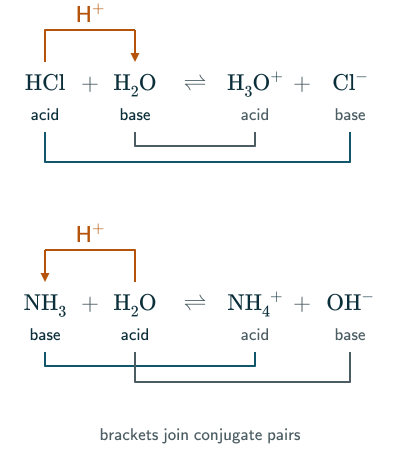
Water plays both parts. It acts as a base towards HCl (accepting a proton) and as an acid towards ammonia (donating one). Species that can do both are called amphiprotic. The word is not NCERT’s, but NCERT Problem 6.14 (page 191) names four such species: H2O, HCO3−, HSO4− and NH3. Do not confuse it with amphoteric (reacting with both acids and bases), NCERT’s word for oxides such as Al2O3 in periodic trends. Al2O3 is amphoteric but, with no hydrogen, not amphiprotic.
Lewis concept
G.N. Lewis in 1923 defined an acid as a species which accepts electron pair and base which donates an electron pair.
NCERT Chemistry Part I (Class 11), Section 6.10.3, page 192
A Brönsted base supplies an electron pair to bond to a proton; the pair is often a lone pair, but a π electron pair can also participate. But many Lewis acids have no proton. Boron trifluoride, which has only six electrons round boron (an exception to the octet rule), accepts the lone pair of ammonia:
BF3 + :NH3 → BF3:NH3
In the adduct boron changes from trigonal planar (sp2) to tetrahedral (sp3); nitrogen stays sp3 (NCERT Exercise 4.26; see hybridisation).
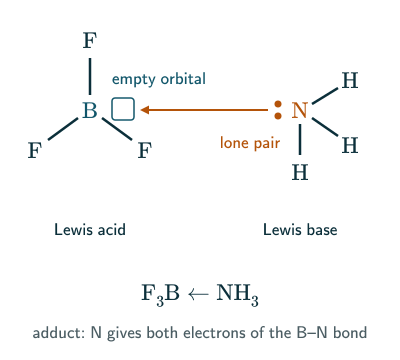
Electron-deficient molecules such as AlCl3, and metal cations such as Co3+ and Mg2+ (which have empty orbitals), act as Lewis acids; species with a lone pair to donate, such as H2O, NH3 and OH−, act as Lewis bases (page 192).
Solved examples
Example 1: Conjugate bases (NCERT Problem 6.12, page 191)
What are the conjugate bases of the Brönsted acids HF, H2SO4 and HCO3−?
A conjugate base has one proton fewer than its acid.
Answer: F−, HSO4− and CO32−.
Example 2: Conjugate acids (NCERT Problem 6.13, page 191)
Write the conjugate acids of the Brönsted bases NH2−, NH3 and HCOO−.
A conjugate acid has one proton more than its base.
Answer: NH3, NH4+ and HCOOH.
Example 3: Amphiprotic species (NCERT Problem 6.14, page 191)
H2O, HCO3−, HSO4− and NH3 can each act as a Brönsted acid and as a base. Give the conjugate acid and the conjugate base of each.
Add a proton for the conjugate acid; remove one for the conjugate base (“conj.” in the table).
| Species | Conj. acid | Conj. base |
|---|---|---|
| H2O | H3O+ | OH− |
| HCO3− | H2CO3 | CO32− |
| HSO4− | H2SO4 | SO42− |
| NH3 | NH4+ | NH2− |
Answer: as in the table. NH3 acts as a proton donor only towards a much stronger base in an appropriate medium; NH2− cannot persist in appreciable concentration in water because it rapidly takes a proton from water.
Example 4: Lewis acids and bases (NCERT Problem 6.15, page 192)
Classify OH−, F−, H+ and BCl3 as Lewis acids or bases.
OH− and F− have lone pairs to give (F− has four). H+ has an empty orbital and accepts a lone pair, for example from OH− or F−. BCl3, like BF3, has only six electrons round boron and accepts a lone pair from ammonia or amines.
Answer: Lewis bases: OH−, F−. Lewis acids: H+, BCl3.
Common mistakes to avoid
Common mistake
Adding or removing H instead of H
A conjugate pair differs by one proton, H+, so the charge changes by one: HCO3− → CO32−, not CO3−.
Common mistake
Calling ammonia a base because it contains OH
NH3 has no OH group. It is a Brönsted base because it accepts a proton from water, which produces the OH−; the Brönsted model explains how OH− forms. Ammonia also satisfies the broader aqueous Arrhenius criterion of increasing [OH−].
Common mistake
Thinking every Lewis acid has hydrogen
BF3, AlCl3, Co3+ and Mg2+ are Lewis acids with no proton at all. What they share is room for an electron pair.
Quick revision summary
- Arrhenius: acids give H+(aq), bases give OH−(aq); water only; the direct-dissociation version needs extension to describe NH3 reacting with water.
- Brönsted–Lowry: acid = proton donor, base = proton acceptor; conjugate pairs differ by one H+.
- The stronger the acid, the weaker its conjugate base (a weak acid such as acetic acid still has a weak conjugate base).
- Water, HCO3−, HSO4−, NH3 can be amphiprotic in appropriate media; ammonia’s acidic role requires a much stronger base than water.
- Lewis: acid = electron-pair acceptor (BF3, AlCl3, Mg2+); base = electron-pair donor (NH3, H2O, OH−).
Formula sheet
- Arrhenius: HX(aq) → H(aq) + X(aq); MOH(aq) → M(aq) + OH(aq)
- Brönsted–Lowry: acid ⇌ conjugate base + H
- Lewis: BF + :NH → BF:NH
Questions students ask
What is the difference between a Brönsted–Lowry acid and a Lewis acid?
A Brönsted–Lowry acid is defined by what it gives away, a proton (H+), while a Lewis acid is defined by what it takes, an electron pair, so the Lewis definition also covers substances with no hydrogen at all, such as BF3, AlCl3 and metal ions like Cu2+. The Brönsted–Lowry picture is the one used for acids and bases in water, with conjugate pairs, Ka and pH. The Lewis picture is used for reactions in which no proton moves, such as BF3 taking the lone pair of NH3, or four NH3 molecules binding to Cu2+ to form [Cu(NH3)4]2+.
What are the limitations of the Brönsted–Lowry theory?
The Brönsted–Lowry concept explains acids and bases only through the transfer of a proton, so it cannot account for acidic substances that have no proton to give, such as BF3, AlCl3, SO3 and CO2, or for acid–base reactions in which no proton moves, such as CaO + SO3 → CaSO4; these are explained by the wider Lewis concept. It also gives no fixed scale of acid strength: how far an acid ionises depends on the base, usually the solvent, it reacts with, so HCl, HBr and HI, all strong in water, are levelled by water. A less basic solvent or gas-phase measurements can distinguish their strengths; solvent dependence is a physical feature, not a failure of the proton-transfer definition.
Why is CO2 a Lewis acid?
CO2 is a Lewis acid because its carbon atom, bonded to two strongly electronegative oxygen atoms, is electron-poor, and one C=O π bond can shift its electron pair onto oxygen to make room for an incoming lone pair. So OH− adds to CO2 to give HCO3−, even though carbon already has a complete octet. SO2 and SO3 behave in the same way, which is why the acidic oxides of non-metals react with bases and with basic oxides.
Is every Lewis acid an electrophile?
Yes, in the broad sense every Lewis acid is an electrophile and every Lewis base a nucleophile, since both pairs of words mean an electron-pair acceptor and donor. The names are used differently: ‘Lewis acid’ and ‘Lewis base’ describe the equilibrium of forming an adduct, such as the BF3–NH3 adduct, while ‘electrophile’ and ‘nucleophile’ are used in organic chemistry for how fast a species attacks an electron-rich centre or an electron-poor carbon atom, a question of rate. Electrophiles such as NO2+ and nucleophiles such as OH− and CN− are met in the Class 11 unit Organic Chemistry: Some Basic Principles and Techniques.
Practice questions
Try each question first, then open the answer to check your working.
-
Q1. In H2PO4−(aq) + H2O(l) ⇌ HPO42−(aq) + H3O+(aq), identify the two conjugate acid–base pairs.
Show answerHide answer
H2PO4− (acid) and HPO42− (its conjugate base); H2O (base) and H3O+ (its conjugate acid).
-
Q2. Which of these are Lewis acids and which Lewis bases: BeCl2, PH3, Fe3+, Cl−?
Show answerHide answer
Lewis acids: BeCl2 (the isolated monomer has four valence electrons round beryllium; condensed BeCl2 has bridging/polymeric structures) and Fe3+ (a cation with empty orbitals). Lewis bases: PH3 (a lone pair on phosphorus, like NH3) and Cl− (four lone pairs, like F−).
-
Q3. NCERT (page 189) calls washing soda, sodium carbonate, a base, though it has no OH group. Which definition makes it a base?
Show answerHide answer
The Brönsted–Lowry explanation is that carbonate accepts a proton. It also satisfies the broader aqueous Arrhenius criterion because this reaction increases [OH−], though it does not directly dissociate into hydroxide ions: CO32−(aq) + H2O(l) ⇌ HCO3−(aq) + OH−(aq). (It is also a Lewis base, giving a lone pair to the proton.)