Heterogeneous equilibria
NCERT Class 11 Chemistry Chapter 6 Section 6.5
Quick answer
A heterogeneous equilibrium contains more than one phase. Present pure bulk solids and liquids have approximately unit activity, so they are omitted from the equilibrium expression. A coexistence relation such as the fixed carbon-dioxide pressure over calcium carbonate and lime applies while both solids remain; exhausting a phase gives a different boundary state.
With your textbook
NCERT Chemistry Part I (Class 11), Chapter 6 “Equilibrium”, Section 6.5 “Heterogeneous Equilibria”, pages 179–181.
Open the official NCERT chapter (PDF, 5.7 MB, ncert.nic.in) (opens in a new tab)
Checked against the 2026-27 reprint on .
What is a heterogeneous equilibrium?
Heterogeneous equilibrium
Equilibrium in a system having more than one phase is called heterogeneous equilibrium.
NCERT Chemistry Part I (Class 11), Section 6.5, page 179
- Examples: water and its vapour in a closed container, H2O(l) ⇌ H2O(g); a solid and its saturated solution, Ca(OH)2(s) ⇌ Ca2+(aq) + 2OH−(aq); calcium carbonate, lime and carbon dioxide, CaCO3(s) ⇌ CaO(s) + CO2(g).
- A pure bulk solid or liquid has activity one relative to its pure-phase standard state (neglecting small pressure corrections), so that activity factor drops out of the equilibrium expression.
- The pure solids or liquids must still be present at equilibrium, however little of them.
In plain words: a lump of chalk has the same “concentration” of chalk however big it is, because doubling the lump doubles its volume too. So the amount of a pure solid or liquid does not shift the balance, and it drops out of K. Only gases and dissolved species, whose concentrations can change, appear in the expression.
Why pure solids and liquids are left out
For a substance X, [X(s)] and [X(l)] are constant, whatever the amount of X; [X(g)] and [X(aq)] change as the amount of X in a given volume changes (NCERT pages 179–180). For the thermal decomposition of calcium carbonate (NCERT Eq. 6.16, page 180):
CaCO3(s) ⇌ CaO(s) + CO2(g)
NCERT’s concentration-based explanation starts with a formal expression = [CaO(s)][CO2(g)]/[CaCO3(s)]. Its solid concentration factors are fixed at the specified conditions and can be absorbed into a modified constant. The more general thermodynamic treatment instead assigns each present pure solid unit activity:
Calcium carbonate
K′c = [CO2(g)], or Kp = pCO2
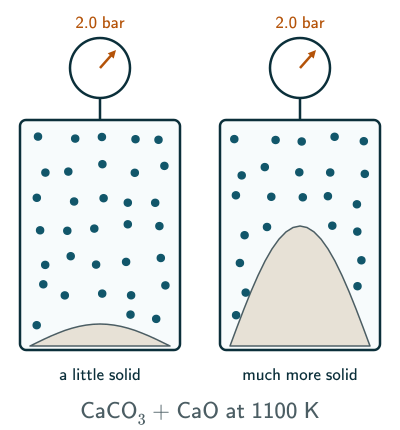
With both pure solids present and ideal-gas/ordinary-pressure approximations, a given temperature fixes the CO2 coexistence pressure. NCERT uses 2.0 × 10 Pa at 1100 K, giving a dimensionless constant of 2.0 after division by 1 bar. The dimensional pressure-product convention would call this 2.0 bar. Treat that number as stipulated textbook exercise data, not a recommended physical reference value. Extrapolating room-temperature ΔH and ΔS to 1100 K without heat-capacity corrections cannot establish an accurate replacement pressure. The calculations below consistently use the stipulated 2.0 bar value.
More examples of K
From NCERT (page 180):
- Nickel purification, Ni(s) + 4CO(g) ⇌ Ni(CO)4(g): Kc = [Ni(CO)4]/[CO]4.
- NCERT writes Ag2O(s) + 2HNO3(aq) ⇌ 2AgNO3(aq) + H2O(l). Since the aqueous acid and salt are strong electrolytes, the useful net ionic equation is Ag2O(s) + 2H+(aq) ⇌ 2Ag+(aq) + H2O(l). With dilute-solution water activity near one, K ≈ a(Ag+)/a(H+); the concentration approximation is [Ag+]/[H+]. Nitrate is a spectator, not an undissociated molecular species in this expression.
It must be remembered that for the existence of heterogeneous equilibrium pure solids or liquids must also be present (however small the amount may be) at equilibrium, but their concentrations or partial pressures do not appear in the expression of the equilibrium constant.
NCERT Chemistry Part I (Class 11), Section 6.5, page 180
Solved examples
Example 1: Carbon dioxide over hot graphite (NCERT Problem 6.6, pages 180–181)
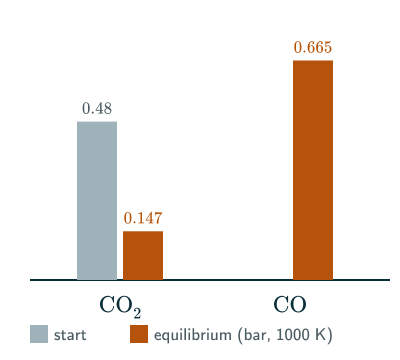
For CO2(g) + C(s) ⇌ 2CO(g), Kp = 3.0 at 1000 K. Initially pCO2 = 0.48 bar, pCO = 0, and pure graphite is present. Find the equilibrium partial pressures.
Let the CO2 pressure fall by x bar; then pCO = 2x and pCO2 = 0.48 − x. Assume ideal gases at fixed temperature and volume, with enough graphite left at equilibrium. Graphite is a pure solid and does not appear: (2x)2/(0.48 − x) = 3.0, so 4x2 = 3.0(0.48 − x) = 1.44 − 3x, that is 4x2 + 3x − 1.44 = 0. Here b2 − 4ac = 9 + 4 × 4 × 1.44 = 32.04, and x = [−3 + √(9 + 23.04)]/8 = (−3 + 5.660)/8 = 0.3325 (the other root is negative, which is impossible).
Answer: pCO = 2x = 0.665 bar (about 0.67) and pCO2 = 0.48 − x = 0.147 bar (about 0.15). NCERT rounds x to 0.33 first, so it prints 0.66 and 0.15 bar. It also has two slips: its line “4x2 = 1.44 − x” should read 1.44 − 3x (the next line is right), and it labels both results pCO2; the first is pCO.
Example 2: How much CaCO<sub>3</sub> decomposes?
1.0 mol of CaCO3 is heated to 1100 K in an evacuated 10.0 L vessel. How many moles decompose? (Kp = 2.00, so pCO2 = 2.00 bar; R = 0.0831 bar L mol−1 K−1.)
Decomposition stops when the CO2 pressure reaches 2.00 bar. n = pV/RT = 2.00 × 10.0/(0.0831 × 1100) = 20.0/91.4.
Answer: about 0.22 mol of CaCO3 decomposes; 0.78 mol is left, so solid is still present and the equilibrium holds.
Example 3: Writing K for iron oxide and hydrogen
Write Kc and Kp for Fe3O4(s) + 4H2(g) ⇌ 3Fe(s) + 4H2O(g).
The solids Fe3O4 and Fe are left out; only the gases appear, each to the power of its coefficient.
Answer: Kc = [H2O]4/[H2]4 and Kp = (pH2O)4/(pH2)4. Here Δn = 4 − 4 = 0 (gases only), so Kp = Kc. Counting the solids too would wrongly give Δn = (3 + 4) − (1 + 4) = 2.
Example 4: Ammonium hydrosulphide
Solid NH4HS is put in an evacuated flask and decomposes: NH4HS(s) ⇌ NH3(g) + H2S(g). At equilibrium some solid remains and the total pressure of the ideal gas mixture is 0.66 bar. Find Kp.
The two gases form in equal amounts, so pNH3 = pH2S = 0.66/2 = 0.33 bar. The solid does not appear.
Answer: Kp = pNH3 × pH2S = 0.33 × 0.33 ≈ 0.11 bar2.
Common mistakes to avoid
Common mistake
Putting solids or pure liquids into K
[CaCO3(s)], [C(s)], [H2O(l)] as solvent and the like are constants and are left out. Only gases and dissolved species appear. A liquid that is one part of a liquid mixture is not pure and does appear: in CH3COOH(l) + C2H5OH(l) ⇌ CH3COOC2H5(l) + H2O(l) the water is in Kc (NCERT Exercise 6.18, page 210).
Common mistake
Thinking more solid gives more gas
Adding CaCO3 or CaO does not change the equilibrium CO2 pressure at a given temperature; only the temperature does.
Common mistake
Forgetting that the solid must be there
If a solid phase is exhausted before the coexistence pressure is reached, the two-solid coexistence equality Q = K no longer applies. The final state can still be a stable boundary equilibrium with that phase absent; the thermodynamic constant itself remains defined.
Quick revision summary
- Heterogeneous equilibrium: more than one phase (solid with gas, liquid with gas, solid with solution).
- Pure solids and pure liquids have constant concentrations and are left out of K, but they must be present.
- CaCO3(s) ⇌ CaO(s) + CO2(g): Kp = pCO2, 2.00 bar in the stipulated NCERT exercise at 1100 K; the dimensionless constant is pCO2/(1 bar).
- Δn in Kp = Kc(RT)Δn counts gases only.
Formula sheet
- CaCO3(s) ⇌ CaO(s) + CO2(g): Kp = p(CO2)
- Ni(s) + 4CO(g) ⇌ Ni(CO)4(g): Kc = c(Ni(CO)4)/c(CO)4, where c(X) = [X] in mol/L
- Present pure bulk solids and liquids: activity ≈ 1, omitted from K
Questions students ask
What is the difference between homogeneous and heterogeneous equilibrium?
In a homogeneous equilibrium all the reactants and products are in one phase, such as a mixture of gases, N2(g) + 3H2(g) ⇌ 2NH3(g), or a single solution, while a heterogeneous equilibrium involves two or more phases, such as a solid with a gas or a solid with its saturated solution. The practical difference is in the equilibrium constant: in a heterogeneous equilibrium the pure solids and pure liquids are left out, so its pure-phase activity factors drop out; activities of gas, solution and non-pure phases still matter. Both obey the activity-based equilibrium law. For ideal gases with any pure solid/liquid factors omitted, the pressure/concentration conversion uses Δn for gases only.
Why is water not included in the equilibrium constant?
Water is left out of an equilibrium constant when it is a pure liquid phase or the solvent of a dilute solution, because its concentration, about 55.5 mol L, hardly changes as the reaction proceeds and is absorbed into K: for CH3COOH(aq) + H2O(l) ⇌ CH3COO−(aq) + H3O+(aq), Ka contains no [H2O]. Water is included when it is a gas, as in C(s) + H2O(g) ⇌ CO(g) + H2(g). In thermodynamic terms a pure liquid, or the solvent of a dilute solution, has an activity of practically 1, so it drops out of K.
How do you find Kp when a solid decomposes into two gases in a 2 : 1 ratio?
For a solid that gives two gases in a 2 : 1 ratio, such as ammonium carbamate, NH2COONH4(s) ⇌ 2NH3(g) + CO2(g), Kp = 4P/27, where P is the total pressure, because with the pure solid remaining as the only source of the two ideal gases and no inert gas contributing to P pNH3 = 2P/3 and pCO2 = P/3. So Kp = (2P/3)(P/3), and a total pressure of 0.30 bar gives Kp = 4 × 0.027/27 = 4.0 × 10 bar. The solid does not appear in Kp, and the shortcut fails if NH3 or CO2 was present at the start.
Is a saturated solution of a sparingly soluble salt a heterogeneous equilibrium?
Yes, a sparingly soluble salt in contact with its saturated solution is a heterogeneous equilibrium between a solid and its ions in solution, for example BaSO4(s) ⇌ Ba2+(aq) + SO42−(aq). The solid is left out of the equilibrium constant, which is therefore just the product of the ion concentrations, Ksp = [Ba2+][SO42−], the solubility product. As with CaCO3 and CO2, adding more solid does not change the ion concentrations at a given temperature, but some solid must remain for the equilibrium to exist.
Practice questions
Try each question first, then open the answer to check your working.
-
Q1. Write Kp for 2NaHCO3(s) ⇌ Na2CO3(s) + CO2(g) + H2O(g). If NaHCO3 alone is heated in an evacuated vessel and the total pressure at equilibrium is 0.20 bar, find Kp.
Show answerHide answer
Kp = pCO2 × pH2O. The two gases form in equal amounts, so each is 0.10 bar and Kp = 0.10 × 0.10 = 0.010 bar2.
-
Q2. At 1100 K, how many moles of CO2 are present at equilibrium over CaCO3 and CaO in a 25.0 L vessel? (Kp = 2.00; R = 0.0831 bar L mol−1 K−1.)
Show answerHide answer
pCO2 = 2.00 bar, so n = pV/RT = 2.00 × 25.0/(0.0831 × 1100) = 50.0/91.4, about 0.55 mol, provided both solids are still present.
-
Q3. A vessel holding CaCO3, CaO and CO2 at equilibrium at 1100 K is expanded to twice its volume at the same temperature; both solids remain. What is the final CO2 pressure, and is there now more or less CaCO3?
Show answerHide answer
Back to 2.00 bar, because Kp = pCO2 fixes it at that temperature. Twice the volume at the same pressure holds twice the moles of CO2, so more CaCO3 has decomposed: there is less CaCO3.