Buffer solutions and the Henderson equation
NCERT Class 11 Chemistry Chapter 6 Section 6.12
Quick answer
A buffer contains appreciable amounts of a weak acid and its conjugate base and resists small additions of acid or alkali. Henderson–Hasselbalch relates pH to their equilibrium activity ratio; using prepared concentrations is an approximation. Dilution can leave pH nearly unchanged at fixed temperature while reducing buffer capacity.
With your textbook
NCERT Chemistry Part I (Class 11), Chapter 6 “Equilibrium”, Section 6.12 “Buffer Solutions”, pages 202–204.
Open the official NCERT chapter (PDF, 5.7 MB, ncert.nic.in) (opens in a new tab)
Checked against the 2026-27 reprint on .
What is a buffer solution?
Buffer solution
The solutions which resist change in pH on dilution or with the addition of small amounts of acid or alkali are called Buffer Solutions.
NCERT Chemistry Part I (Class 11), Section 6.12, page 202
- An acidic buffer is a weak acid with its salt of a strong base, such as acetic acid with sodium acetate (around pH 4.76).
- A basic buffer is a weak base with its salt of a strong acid, such as ammonia with ammonium chloride (around pH 9.25).
- Its pH follows from the Henderson–Hasselbalch equation: pH = pKa + log([A−]/[HA]), the conjugate base A− over the acid HA.
In plain words: a buffer holds a weak acid and its conjugate base side by side. Add a little strong acid and the conjugate base mops up the H+; add a little alkali and the weak acid mops up the OH−. Either way the ratio of the two changes only slightly, so the pH hardly moves. Blood pH is maintained in a narrow range by buffers together with lungs and kidneys; urine pH varies with physiological conditions, and many medical and cosmetic preparations must be kept at a particular pH (NCERT page 202).
The calculations below use the dilute ideal-solution approximation at 298 K unless stated otherwise. Exact pH uses hydrogen-ion activity; concentration ratios approximate activity ratios.
Designing an acidic buffer
For a weak acid HA + H2O ⇌ H3O+ + A− (NCERT Section 6.12.1, page 203), Ka = [H3O+][A−]/[HA], so [H3O+] = Ka[HA]/[A−]. Taking −log of both sides gives pH = pKa − log([HA]/[A−]); turning the ratio over changes the sign of its log:
Henderson–Hasselbalch equation
pH = pKa + log([A−]/[HA])
= pKa + log([salt]/[acid])
In the usual buffer approximation, the weak acid is hardly ionised, so [HA] is practically the concentration of acid taken; and nearly all of the A− comes from the fully ionised salt, so [A−] is practically the concentration of salt (page 203).
- If [salt] = [acid], log 1 = 0 and pH = pKa. To make a buffer of a given pH, choose an acid whose pKa is close to it, then adjust the ratio. A buffer works well only while the ratio stays between about 0.1 and 10, that is, pH = pKa ± 1.
- For acetic acid, pKa = 4.76, so equal concentrations of acetic acid and sodium acetate give pH about 4.76.
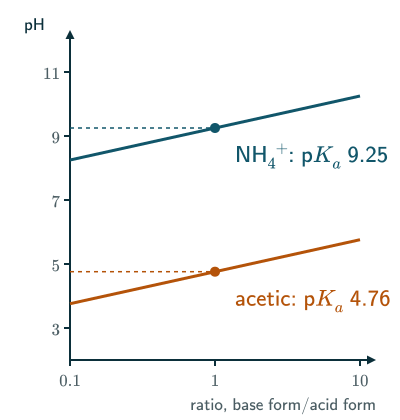
Dilution. For either kind of buffer, diluting changes [salt] and [acid] in the same proportion, so the prepared concentration ratio, and approximately the pH, stays the same at fixed temperature (page 204), as long as the solution is not so dilute that these approximations fail. Dilution reduces buffer capacity even when the pH hardly changes; changing ionic strength can also change activity coefficients.
Designing a basic buffer
For a weak base B and its conjugate acid BH+ (page 203):
Basic buffer
pOH = pKb + log([BH+]/[B])
At 298 K, since pH + pOH = 14 and pKa + pKb = 14, with Ka now the constant of the conjugate acid BH+:
Basic buffer in terms of pH
14 − pH = 14 − pKa + log([BH+]/[B])
pH = pKa − log([BH+]/[B])
= pKa + log([B]/[BH+])
This has the same form as the acidic case: base over acid. NCERT’s Eq. 6.42 (page 203) prints the ratio upside down, as log([BH+]/[B]); its own previous line (the first line above) gives the minus sign, which is the equation above. The same slip appears in its ammonia equation on page 204. Two more wording slips: the 9.25 is the pKa of the ammonium ion, NH4+, not “for ammonia” or “for the base” (ammonia’s pKb is 4.75), and it is misprinted “s9.25”.
With equal concentrations of ammonia and ammonium chloride the log term is zero and pH = 9.25.
How a buffer resists added acid or alkali
Take an acetic acid–sodium acetate buffer (beyond the NCERT text, but the reason buffers work):
- added H+ is taken up by acetate: CH3COO− + H+ → CH3COOH;
- added OH− is taken up by acetic acid: CH3COOH + OH− → CH3COO− + H2O.
The strong acid or alkali is replaced by a weak one, and only the ratio [salt]/[acid] shifts a little.
A buffer can also be made by part-neutralising a weak acid with a strong base: 0.10 mol CH3COOH + 0.05 mol NaOH leaves 0.05 mol of each, pH 4.76. With 0.10 mol NaOH all the acid is used up; sodium acetate alone is not a buffer.
Solved examples
Example 1: An acetate buffer
Find the pH of a solution 0.10 M in acetic acid and 0.10 M in sodium acetate (pKa = 4.76).
pH = pKa + log(0.10/0.10) = 4.76 + log 1.
Answer: pH = 4.76.
Example 2: Designing a buffer of pH 5.00
In what ratio must sodium acetate and acetic acid be mixed for pH 5.00?
5.00 = 4.76 + log([salt]/[acid]), so log([salt]/[acid]) = 0.24.
Answer: [salt]/[acid] = 100.24, about 1.74: for example 0.174 M sodium acetate with 0.100 M acetic acid.
Example 3: Buffer against water
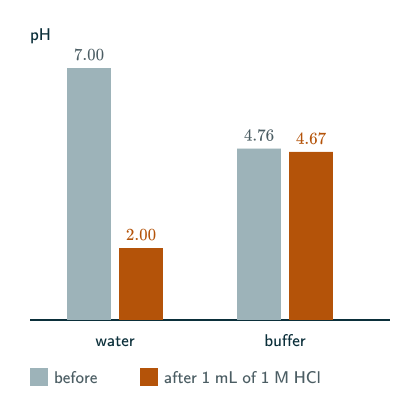
1.0 mL of 1.0 M HCl is added (a) to 100 mL of pure water; (b) to 100 mL of buffer that is 0.10 M in acetic acid and 0.10 M in sodium acetate. Find the new pH in each.
HCl added: 1.0 × 10−3 L × 1.0 M = 0.0010 mol (moles = molarity × volume; see reactions in solutions). (a) [H+] = 0.0010/0.101 L = 9.9 × 10⁻³ M. (b) The buffer had 0.010 mol each of acid and acetate; the HCl turns 0.0010 mol of acetate into acid, giving 0.011 mol acid and 0.0090 mol acetate (both in the same 101 mL, so the mole ratio equals the concentration ratio), so pH = 4.76 + log(0.0090/0.011).
Answer: (a) pH 2.00, a fall of 5 units; (b) pH 4.67, a fall of only 0.09.
Example 4: An ammonia buffer (compare NCERT Problem 6.22)
Find the pH of a solution 0.10 M in NH3 and 0.20 M in NH4Cl (pKb of NH3 = 4.75).
pOH = pKb + log([BH+]/[B]) = 4.75 + log(0.20/0.10) = 4.75 + 0.30 = 5.05. Or directly: pH = pKa + log([B]/[BH+]) = 9.25 + log(0.10/0.20) = 9.25 − 0.30.
Answer: pH ≈ 8.95, the same as NCERT Problem 6.22.
Common mistakes to avoid
Common mistake
Turning the ratio upside down
For any buffer the ratio is base form over acid form: [A−]/[HA], or [B]/[BH+] with pKa of BH+. More salt in an acidic buffer raises the pH; more salt in a basic buffer lowers it.
Common mistake
Using a strong acid and its salt
HCl with NaCl is not a buffer: Cl− is far too weak a base to take up added H+. A buffer needs a weak acid (or base) with its conjugate partner.
Common mistake
Expecting a buffer to resist any amount
A buffer copes only with small additions. Once one partner is used up, the pH changes sharply.
Quick revision summary
- Buffer: resists pH change on dilution or on adding small amounts of acid or alkali.
- Acidic buffer: weak acid + its salt; pH = pKa + log([salt]/[acid]); acetate buffer about 4.76.
- Basic buffer: weak base + its salt; pOH = pKb + log([salt]/[base]); NH3/NH4Cl about 9.25.
- Equal concentrations give pH = pKa; choose an acid with pKa near the pH wanted.
- Dilution approximately preserves pH at fixed temperature while reducing buffer capacity.
Formula sheet
- pH = pKa + log(salt/acid) (acidic buffer)
- pOH = pKb + log(salt/base) (basic buffer)
- Basic buffer: pH = pKa + log(base/salt), with pKa = 14 − pKb at 298 K
Questions students ask
What are some examples of buffer solutions in daily life?
Blood is normally regulated near pH 7.35 to 7.45 by buffers, respiration and kidney function. A major buffer is the carbonic acid–hydrogencarbonate buffer, H2CO3 ⇌ H+ + HCO3−: at body temperature its pKa is about 6.1 (counting dissolved CO2 as carbonic acid), and blood holds about 20 times as much HCO3− as H2CO3, so pH = 6.1 + log 20 ≈ 7.4. Inside cells the H2PO4−/HPO42− pair, pKa 7.21, buffers near pH 7, as phosphate buffers do in the laboratory. Citric acid with sodium citrate buffers many soft drinks, jams and medicines.
What is buffer capacity, and why is it largest when pH = pKa?
Buffer capacity is the local differential amount of strong base added per litre per unit rise in pH (or acid per unit fall), evaluated for small additions at a specified pH. For a weak-acid/conjugate-base pair at fixed total concentration, neglecting water’s contribution and activity effects, its contribution is maximal near equal concentrations, pH = pKa. This is not an exact finite one-pH-unit dose. Adding 0.010 mol L of H+ to an acetate buffer 0.050 M in each form lowers pH by 0.18; for 0.080 M acid and 0.020 M acetate the fall is 0.35.
How is a buffer solution related to the common ion effect?
A buffer of a weak acid and its salt relies on the common ion effect: the acetate ions from sodium acetate push the ionisation CH3COOH ⇌ H+ + CH3COO− back, so almost all the acid stays un-ionised and [HA] and [A−] are simply the concentrations of acid and salt taken, as the prepared-concentration approximation to Henderson–Hasselbalch assumes. The common ion effect on its own only lowers the ionisation of the weak acid; the buffer action comes from having large amounts of both partners, one to take up added H+ and the other added OH−.
When can the Henderson–Hasselbalch equation be used?
Henderson–Hasselbalch written in equilibrium activities is an exact rearrangement of Ka: pH = pKa + log(aA−/aHA). Using prepared acid/salt concentrations instead requires their ionisation/hydrolysis changes to be small and activity coefficients close to 1. For 1.0 × 10 M each of acetic acid and sodium acetate, solving the ideal mass balance gives pH about 4.88; inserting the prepared equal concentrations gives 4.76. The approximation fails, not the activity equation. Ratios about 0.1–10 describe a useful buffering range, not a mathematical restriction on the identity.
Are buffer solutions in the JEE Main 2027 and NEET (UG) 2026 syllabuses?
Yes, buffer solutions are listed under ionic equilibrium in Unit 6, Equilibrium, of both the JEE Main 2027 syllabus (NTA) and the NEET (UG) 2026 syllabus (NMC). Buffer calculations find the pH of an acidic or basic buffer from the Henderson–Hasselbalch equation, the ratio of salt to acid needed for a given pH, or the small change in pH when a little strong acid or alkali is added.
Practice questions
Try each question first, then open the answer to check your working.
-
Q1. Find the pH of a solution 0.20 M in formic acid and 0.10 M in sodium formate (Ka = 1.8 × 10⁻⁴, NCERT Table 6.6).
Show answerHide answer
pKa = −log(1.8 × 10⁻⁴) = 3.74. pH = 3.74 + log(0.10/0.20) = 3.74 − 0.30 = 3.44.
-
Q2. The buffer of Example 1 is diluted ten times with water. What is its new pH?
Show answerHide answer
Both concentrations become 0.010 M; the ratio is still 1, so the approximate pH remains 4.76; the buffer capacity is reduced.
-
Q3. Which pair would you use for a buffer of pH about 9: acetic acid/sodium acetate or ammonia/ammonium chloride? Why?
Show answerHide answer
Ammonia/ammonium chloride: the pKa of NH4+, 9.25, is close to 9, so a ratio near 1 (0.56 for [NH3]/[NH4+]) gives pH 9. The acetate pair buffers around 4.76.