Equilibrium in physical processes
NCERT Class 11 Chemistry Chapter 6 Section 6.1
Quick answer
Physical equilibrium balances opposing changes such as evaporation and condensation, melting and freezing, or dissolution and crystallisation. A closed vessel retains material in the laboratory examples; an open subsystem can also equilibrate with a matching reservoir. At fixed conditions, coexistence requires the relevant phases to remain present.
With your textbook
NCERT Chemistry Part I (Class 11), Chapter 6 “Equilibrium”, Section 6.1 “Equilibrium in Physical Processes”, pages 169–172.
Open the official NCERT chapter (PDF, 5.7 MB, ncert.nic.in) (opens in a new tab)
Checked against the 2026-27 reprint on .
What is equilibrium in a physical process?
Physical equilibrium
A physical equilibrium is a state in which two opposite physical changes, such as melting and freezing or evaporation and condensation, go on at the same rate, so that nothing measurable changes (NCERT Section 6.1, pages 169–172):
- a closed system at fixed conditions prevents net escape in these experiments; an open subsystem can also equilibrate with a reservoir whose temperature and chemical potentials match;
- it is dynamic: both processes continue, at equal rates;
- at equilibrium one quantity is fixed: the melting point (at a given pressure) or, at a given temperature, the vapour pressure, the solubility, or the ratio of dissolved gas to gas above the liquid.
NCERT’s introduction to the unit (page 168) puts the key idea in one line: at equilibrium, the rate of evaporation is equal to the rate of condensation.
In plain words: put some water in a sealed jar. Molecules keep escaping from the surface, and vapour molecules keep hitting the surface and sticking. At first more leave than return; if sufficient water remains at the fixed temperature, the two rates eventually become equal. From then on the amount of liquid and the pressure of the vapour stay fixed, even though molecules are still crossing in both directions. NCERT writes this with a pair of half-arrows, H2O(l) ⇌ H2O(vap), to show both processes going on at once.
The JEE Main syllabus also names gas–gas equilibria here. Under ordinary conditions gases mix completely, so there is no gas–gas boundary like the ones in this section; the NCERT book does not discuss them in Section 6.1, and the equilibria between gases it does treat are chemical ones (such as N2O4 ⇌ 2NO2), covered under homogeneous equilibria.
Solid–liquid equilibrium
Ice and water in a perfectly insulated thermos flask at its melting temperature, approximately 273.15 K at atmospheric pressure are in equilibrium (NCERT Section 6.1.1, page 169). The masses of ice and water do not change and the temperature stays constant, but at the boundary water molecules keep sticking to the ice while others leave it, at equal rates: H2O(s) ⇌ H2O(l).
For pure bulk water and ordinary ice at a specified pressure, stable solid–liquid coexistence occurs at a particular melting temperature. A thermos reduces heat exchange; it does not by itself force an arbitrary mixture to that temperature. For any pure substance at atmospheric pressure, that temperature is its normal melting point (or normal freezing point); see melting.
Liquid–vapour equilibrium
NCERT’s experiment (Section 6.1.2, pages 169–170): a transparent box with a mercury manometer is first dried with anhydrous calcium chloride, which is then removed, and a watch glass of water is put inside. The mercury level rises slowly and then stays constant, and the volume of water in the watch glass falls a little.
- With temperature and exposed surface area approximately constant, evaporation goes on at an approximately constant rate, so at first the pressure rises.
- As vapour builds up, more molecules condense, so the pressure rises more and more slowly.
- When the rate of condensation equals the rate of evaporation, the pressure stops changing.
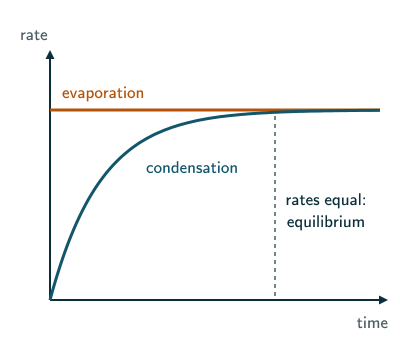
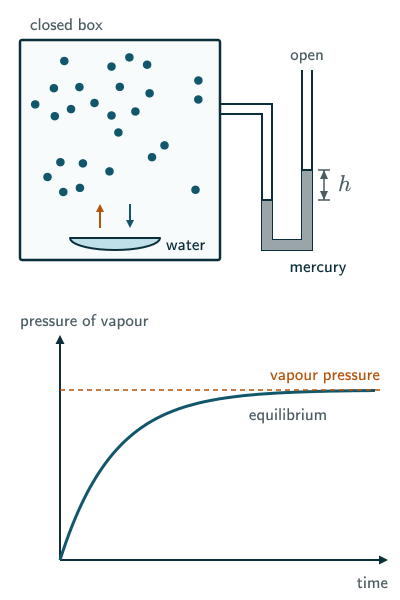
The steady pressure of the water vapour (the extra pressure the manometer shows; assuming constant temperature and gas-space volume, the unchanged dry air adds the same pressure before and after) is the equilibrium vapour pressure (or just vapour pressure). It increases with temperature, and different liquids have different vapour pressures at the same temperature: a liquid with a higher vapour pressure is more volatile at that temperature. A lower normal boiling point often accompanies this, but cannot be proved from one pressure value alone because vapour-pressure curves may cross (page 170).
In an ordinary unsaturated room, vapour escapes from an open dish faster than it returns, so the liquid evaporates. An open dish in an atmosphere saturated with its vapour at the same temperature can instead be in phase equilibrium; “closed system” is the laboratory way to prevent net loss, not a universal thermodynamic requirement.
For any pure liquid at one atmospheric pressure (1.013 bar), the temperature at which the liquid and vapours are at equilibrium is called normal boiling point of the liquid.
NCERT Chemistry Part I (Class 11), Section 6.1.2, page 170
For water this is 100 °C. A liquid boils when its vapour pressure equals the pressure above it, so at high altitude, where the air pressure is lower, water boils below 100 °C.
Solid–vapour equilibrium
Some solids pass straight into vapour (they sublime). Solid iodine in a closed vessel fills it with violet vapour whose colour deepens and then stays constant: I2(s) ⇌ I2(vapour) (NCERT Section 6.1.3, page 170). Camphor behaves the same way, which is why such solids can be purified by sublimation.
NCERT also lists NH4Cl(s) ⇌ NH4Cl(vapour). That is not a true solid–vapour equilibrium: on heating, ammonium chloride splits into ammonia and hydrogen chloride, NH4Cl(s) ⇌ NH3(g) + HCl(g), which recombine to the solid on a cooler surface. It looks like sublimation, but the vapour is almost entirely NH3 and HCl, not NH4Cl molecules, so this is really a chemical equilibrium. A question that follows NCERT’s list may still expect NH4Cl as a solid–vapour example, so know both.
Dissolving solids and gases in liquids
Solids in liquids. Only a limited amount of sugar or salt dissolves in a given amount of water at a given temperature; the solution is then saturated (NCERT Section 6.1.4, page 171). In a saturated solution in contact with solid sugar, dissolving and crystallising balance: Sugar(solution) ⇌ Sugar(solid). NCERT’s evidence: drop some radioactive sugar into a saturated solution of ordinary sugar, and after a while radioactivity is found both in the solution and in the solid. The radioactive molecules could only have got there by exchange between the two phases, so the equilibrium is dynamic.
Gases in liquids. Soda water holds carbon dioxide dissolved under pressure: CO2(gas) ⇌ CO2(in solution).
Henry’s law
Henry’s law
mass of gas dissolved in a fixed amount of solvent ∝ its partial pressure (fixed temperature; dilute Henry-law regime)
NCERT states Henry’s law in terms of mass (Section 6.1.4, page 171): at a given temperature, the mass of a gas dissolved in a given mass of a solvent is proportional to the pressure of the gas above the solvent; for a gas in a mixture, such as CO2 in air, that is its partial pressure. For many gases in water near room temperature, dissolution is exothermic and solubility decreases on heating; this temperature trend is not universal.
A soda bottle is sealed under a high pressure of carbon dioxide, so a lot of gas is dissolved. When it is opened, the pressure of CO2 above the liquid falls to its small partial pressure in air; gas comes out of solution (the fizz) until a new equilibrium is reached, and the drink left open goes flat.
General characteristics
What stays constant at equilibrium (after NCERT Table 6.1, page 171):
| Equilibrium | Fixed quantity (at a given temperature unless stated) |
|---|---|
| H2O(l) ⇌ H2O(g) | vapour pressure of water |
| H2O(s) ⇌ H2O(l) | melting point (at fixed pressure) |
| Sugar(s) ⇌ Sugar(solution) | concentration of sugar in solution |
| CO2(g) ⇌ CO2(aq) | [CO2(aq)]/[CO2(g)] |
Equilibrium is possible only in a closed system at a given temperature.
NCERT Chemistry Part I (Class 11), Section 6.1.5, page 172
Here NCERT is describing closed laboratory vessels that retain both phases. More generally an open subsystem can equilibrate with a matching reservoir; constant properties maintained by a sustained external flow are a different, nonequilibrium steady state.
The other characteristics NCERT lists (page 172): the two opposing processes occur at the same rate, so the state is dynamic but stable; all measurable properties stay constant; the equilibrium is marked by a constant value of one quantity at a given temperature (the table above); and the size of that quantity at any stage shows how far the process has gone before reaching equilibrium.
Solved examples
Example 1: What is fixed at equilibrium?
For each system, name the quantity that has a fixed value at a given temperature: (a) water and its vapour in a sealed flask; (b) a saturated solution of sugar with undissolved sugar; (c) soda water in a sealed bottle.
All three are rows of NCERT Table 6.1; (c) is Henry’s law.
Answer: (a) the vapour pressure of water; (b) the concentration of sugar in the solution (its solubility); (c) the ratio [CO2(aq)]/[CO2(g)], so the dissolved CO2 is fixed for the CO2 pressure in the bottle.
Example 2: Henry’s law and an opened soda
At a certain temperature 1.45 g of CO2 dissolves in 1 L of water when the CO2 pressure is 1.00 atm. How much dissolves (a) at a CO2 pressure of 2.50 atm, (b) when the drink stands open to air in which the partial pressure of CO2 is 4.2 × 10⁻⁴ atm?
The mass dissolved is proportional to the pressure: (a) 1.45 × 2.50; (b) 1.45 × 4.2 × 10−4.
Answer: (a) 3.63 g per litre; (b) 6.1 × 10⁻⁴ g per litre, so almost all of the gas escapes and the drink goes flat.
Example 3: Does a bigger volume change the vapour pressure?
Some water is sealed in a cylinder with a piston at 25 °C and left to reach equilibrium. The piston is then pulled out to double the vapour-space volume at the same temperature, and some liquid is still left at the end. What happens to the vapour pressure?
An idealised rapid isothermal doubling of the vapour-space volume initially halves the vapour pressure, before appreciable evaporation responds, so condensation slows while evaporation goes on at the same rate. More water evaporates until the condensation rate again equals the evaporation rate, which happens at the same pressure as before.
Answer: the vapour pressure returns to its old value (it depends only on the temperature, as long as some liquid remains); only the amount of vapour, and of liquid evaporated, is larger.
Example 4: Why the radioactive sugar spreads
In NCERT’s experiment, radioactive sugar dropped into a saturated sugar solution shows up later in the solution. The amount of solid sugar does not change. What does this prove?
If the equilibrium were static, nothing would cross between solid and solution once it was saturated. The radioactive molecules can only reach the solution by dissolving. The solution was already saturated and the mass of solid does not change, so sugar must crystallise out just as fast as it dissolves.
Answer: dissolving and crystallising go on all the time at equal rates: the equilibrium is dynamic.
Common mistakes to avoid
Common mistake
Calling equilibrium static
Nothing measurable changes, but both processes continue at equal rates. NCERT calls the state dynamic but stable.
Common mistake
Expecting equilibrium in an open dish
In the ordinary unsaturated surroundings assumed here, vapour escapes faster than it returns and the liquid evaporates. Closing the vessel allows saturation if enough liquid remains; matching a saturated external reservoir is another route to equilibrium.
Common mistake
Thinking vapour pressure depends on the amount of liquid
At a given temperature the vapour pressure is the same whether there is a drop or a litre of liquid, and whatever the size of the container, as long as some liquid is left.
Quick revision summary
- Physical equilibrium: opposing physical changes at equal rates under matched equilibrium conditions; a closed vessel retains phases in the laboratory examples.
- Solid ⇌ liquid: one temperature (the melting point) at a given pressure.
- Liquid ⇌ vapour: vapour pressure fixed at a given temperature; boiling point is where it equals the outside pressure (100 °C for water at 1.013 bar).
- Solid ⇌ vapour: sublimation of iodine or camphor (NH4Cl really decomposes into NH3 and HCl).
- Saturated solution: solubility fixed at a given temperature; dissolving and crystallising continue.
- Henry’s law: mass of gas dissolved ∝ its partial pressure above the liquid; many gases in water dissolve less at higher temperature.
Formula sheet
- Rate of evaporation = rate of condensation (liquid–vapour equilibrium)
- Henry’s law: dissolved mass ∝ gas partial pressure (fixed solvent amount and temperature; dilute regime)
Questions students ask
What is the difference between physical and chemical equilibrium?
A physical equilibrium is a balance between two opposite physical changes, such as H2O(l) ⇌ H2O(g) or a solid dissolving and crystallising in its saturated solution, so no new substance forms; a chemical equilibrium balances the forward and reverse reactions of a reversible reaction, such as N2(g) + 3H2(g) ⇌ 2NH3(g), in which bonds break and new substances form. Both are dynamic and require matched equilibrium conditions; a closed vessel prevents net matter loss in the laboratory examples, and in both one quantity is fixed: the vapour pressure or the solubility in a physical equilibrium, the equilibrium constant in a chemical one.
What is Henry’s law constant, and what is its unit?
Henry’s law constant KH is the constant in the mole-fraction form of the law used in the Class 12 chapter Solutions, p = KHx, where p is the partial pressure of the gas above the solution and x its mole fraction in the solution, so KH has the unit of pressure (Pa, bar or kbar). For CO2 in water at 298 K, KH = 1.67 kbar, that is 1.67 × 10 Pa (NCERT Class 12 Chemistry Part I, Table 1.2, page 8). In this form a larger KH means a less soluble gas, and for the common gases in water over this temperature range KH rises on heating. Other constant conventions, such as concentration divided by pressure, have different units and the reciprocal trend.
What is the difference between Henry’s law and Raoult’s law?
Henry’s law describes a dissolved gas, or any volatile solute in a very dilute solution: its partial pressure above the solution is proportional to its mole fraction, p = KHx, where KH is a constant for that solute and solvent at a given temperature. Raoult’s law describes a volatile component of a solution: its partial vapour pressure equals its mole fraction times the vapour pressure of the pure liquid, p = xp. Raoult’s law is thus the special case of Henry’s law with KH = p, which holds for every component of an ideal solution and for the solvent of a dilute one; both laws return in the Class 12 chapter Solutions.
What are the limitations of Henry’s law?
Henry’s law is a dilute-limit relation for a specified dissolved molecular species and gas fugacity (approximately partial pressure for an ideal gas) at fixed temperature and solvent composition. A reaction in solution can increase the total absorbed amount, so one must distinguish molecular NH3, for example, from NH3 plus NH4+. Likewise molecular CO2 obeys its own partition relation while bicarbonate and carbonate contribute to total dissolved inorganic carbon. High pressures, nonideal gases and concentrated solutions need activity/fugacity corrections (IUPAC, Henry’s law constants recommendations).
What are the applications of Henry’s law in daily life?
Henry’s law explains several everyday effects besides fizzy drinks, which are sealed under a high pressure of CO2. A scuba diver breathing compressed air under water dissolves more nitrogen in the blood; if the diver rises too fast, the pressure falls and the nitrogen forms bubbles in the blood (the bends), so divers come up slowly, and tanks may hold mixtures in which less soluble helium replaces part of the nitrogen (NCERT Class 12 Chemistry Part I, pages 8–9). At high altitudes the partial pressure of oxygen is low, so less oxygen dissolves in the blood and climbers become weak and unable to think clearly, which NCERT calls anoxia (beyond the NCERT text, strictly hypoxia).
Is physical equilibrium in the NEET (UG) 2026 and JEE Main 2027 syllabuses?
Yes, physical equilibrium is in Unit 6, Equilibrium, of both the NEET (UG) 2026 syllabus (NMC) and the JEE Main 2027 syllabus (NTA): solid–liquid, liquid–gas and solid–gas equilibria, Henry’s law and the general characteristics of equilibria in physical processes, with JEE Main also naming gas–gas equilibria. Henry’s law is met twice, in its mass form here in Class 11 and as p = KHx in the Class 12 chapter Solutions.
Practice questions
Try each question first, then open the answer to check your working.
-
Q1. Two identical beakers, one holding 50 mL of water and the other 50 mL of acetone, are left open in a warm room. Why does neither reach equilibrium, and which disappears first?
Show answerHide answer
In an open beaker the vapour spreads into the room, so condensation stays far slower than evaporation and there is no equilibrium. Acetone has the higher vapour pressure (it is more volatile), so it evaporates faster and disappears first.
-
Q2. At a certain temperature 0.80 g of a gas dissolves in 1 L of water at 2.0 bar. What mass dissolves in 1 L at 5.0 bar and the same temperature?
Show answerHide answer
Mass dissolved ∝ pressure, so 0.80 × 5.0/2.0 = 2.0 g.
-
Q3. Why does food cook faster in a pressure cooker than in an open pan?
Show answerHide answer
Water boils when its vapour pressure equals the pressure above it. The cooker traps the steam, so the pressure above the water rises above the local atmospheric pressure, and water reaches that pressure at a higher boiling temperature than in an open pan at the same location (above 100 °C when the cooker pressure exceeds 1 atm). The water boils hotter, so food cooks faster.