Solubility product and the common ion effect
NCERT Class 11 Chemistry Chapter 6 Section 6.13
Quick answer
The solubility product is the equilibrium activity product of free ions in a saturated solution in contact with a specified solid. Dilute problems approximate activities by concentrations, but converting this product into total solubility requires accounting for stoichiometry, common ions and side reactions. An ionic product above the equilibrium value favours precipitation, which may be delayed by nucleation.
With your textbook
NCERT Chemistry Part I (Class 11), Chapter 6 “Equilibrium”, Section 6.13 “Solubility Equilibria of Sparingly Soluble Salts”, pages 204–206.
Open the official NCERT chapter (PDF, 5.7 MB, ncert.nic.in) (opens in a new tab)
Checked against the 2026-27 reprint on .
What is the solubility product?
Solubility product
For a sparingly soluble salt in contact with its saturated solution, the solid and its dissolved ions are in equilibrium, and the product of the ion concentrations, each raised to its coefficient, is a constant, the solubility product Ksp (NCERT Section 6.13, pages 204–206):
- BaSO4(s) ⇌ Ba2+(aq) + SO42−(aq): Ksp = [Ba2+][SO42−] = 1.1 × 10⁻¹⁰ at 298 K;
- for MxXy with molar solubility S: Ksp = (xS)x(yS)y = xxyySx+y;
- if the ionic product Qsp exceeds Ksp, precipitation is favoured; if it is smaller, more can dissolve if solid is available;
- a common ion lowers the solubility, and salts of weak acids dissolve better at lower pH.
In plain words: shake a pinch of barium sulphate with water and a tiny amount dissolves until the solution is saturated. From then on ions leave the solid and rejoin it at equal rates. The solid’s own concentration is constant, so only the ion concentrations appear in the equilibrium constant, and exceeding Ksp favours precipitation. Supersaturated solutions can persist temporarily when nucleation is slow.
The thermodynamic Ksp is a dimensionless product of free-ion activities; this lesson uses the introductory dilute concentration approximation. The relation between Ksp and S additionally assumes that the salt is the only ion source and there is no important hydrolysis, protonation, ion pairing or complex formation. Where these processes occur, free-ion concentration and total dissolved amount differ.
Solubility of ionic salts
Solubility varies a great deal: calcium chloride is so soluble that it absorbs water vapour from the air, while lithium fluoride is so slightly soluble that it is usually called insoluble (NCERT page 204). It depends mainly on the lattice enthalpy of the salt and the solvation enthalpy of its ions: the more the energy released by solvation makes up for the lattice enthalpy, the more soluble the salt tends to be. NCERT gives this as a rule, but it is only a guide: for NaCl, hydration gives back 784 kJ mol−1 against a lattice enthalpy of 788 kJ mol−1, yet it dissolves readily, because dissolving also increases entropy (see lattice and hydration enthalpies). Many simple inorganic salts dissolve poorly in non-polar solvents because ion solvation is weak; this is not a rule for every salt. Each salt’s solubility depends on temperature.
NCERT sorts salts into three groups:
| Category | Solubility |
|---|---|
| I, soluble | above 0.1 M |
| II, slightly soluble | 0.01 M to 0.1 M |
| III, sparingly soluble | below 0.01 M |
The solubility product constant
For barium sulphate, the pure solid has unit activity in its standard state, so it is omitted from the thermodynamic dissolution constant. NCERT’s equivalent school-level concentration bookkeeping absorbs the constant solid concentration into Ksp (Section 6.13.1, page 204):
Solubility product of barium sulphate
Ksp = K[BaSO4] = [Ba2+][SO42−]
= 1.1 × 10⁻¹⁰ (298 K)
If the molar solubility is S, both ion concentrations equal S, so S2 = 1.1 × 10⁻¹⁰ and S = 1.05 × 10⁻⁵ mol L−1.
For a salt with ions of different charges (NCERT Eqs. 6.44–6.45, page 205), MxXy(s) ⇌ xMp+(aq) + yXq−(aq):
Molar solubility from K<sub>sp</sub>
Ksp = xxyySx+y
S = (Ksp/(xxyy))1/(x+y)
As a formal stoichiometric exercise, ignoring the substantial hydrolysis/protonation of its ions, for zirconium phosphate, (Zr4+)3(PO43−)4, [Zr4+] = 3S and [PO43−] = 4S, so Ksp = (3S)3(4S)4 = 6912S7 (page 204).
Precipitation or dissolution. The same product written with the concentrations at any moment is the ionic product Qsp (compare the reaction quotient). At equilibrium Qsp = Ksp; if Qsp > Ksp precipitation is favoured (possibly delayed by nucleation), and if Qsp < Ksp more can dissolve if solid is available (page 205).
Some Ksp values at 298 K (NCERT Table 6.9, page 205): AgCl 1.8 × 10⁻¹⁰, AgBr 5.0 × 10⁻¹³, AgI 8.3 × 10⁻¹⁷, Ag2CrO4 1.1 × 10⁻¹², BaSO4 1.1 × 10⁻¹⁰, CaCO3 2.8 × 10⁻⁹, CaF2 5.3 × 10⁻⁹, Ca(OH)2 5.5 × 10⁻⁶, PbCl2 1.6 × 10⁻⁵, Ni(OH)2 2.0 × 10⁻¹⁵, Fe(OH)3 1.0 × 10−38, HgS 4.0 × 10−53. One entry looks wrong: nickel sulphide, NiS, is listed at 4.7 × 10⁻⁵, which is unsuitable as a physical reference value. Nickel sulphide constants depend on solid phase and speciation: a primary sulfide-analysis study (ISIJ International, 2020, volume 60) tabulates 1.3 × 10⁻²⁵ for β-NiS. NCERT’s CaF2 value is also an exercise value; the UC Davis CHE 2B laboratory manual (2025, Solubility Products) uses 3.9 × 10⁻¹¹. Use a problem’s supplied value for its calculation, and a consistent reference dataset for physical predictions.
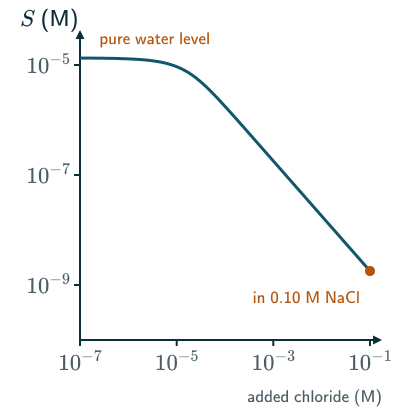
Common ion effect on solubility
By Le Chatelier’s principle, raising a free-ion activity in an already saturated solution favours precipitation until Qsp = Ksp again; lowering it permits more solid to dissolve (NCERT Section 6.13.2, page 206).
- Even a soluble salt obeys this, using activities: passing HCl gas into saturated sodium chloride solution precipitates very pure NaCl, leaving impurities such as sodium and magnesium sulphates in solution.
- In gravimetric analysis, an ion is precipitated almost completely by adding excess of the other ion: silver as silver chloride, iron(III) as its hydroxide, barium as its sulphate.
Effect of pH.
The solubility of salts of weak acids like phosphates increases at lower pH.
NCERT Chemistry Part I (Class 11), Section 6.13.2, page 206
For a simple 1:1 salt MX at externally fixed pH, with no common cation or other complexes, this is because H+ converts the anion X− into the weak acid HX and lowers its free concentration. Let f be the fraction of the dissolved anion left as X−: f = [X−]/([X−] + [HX]) = Ka/(Ka + [H+]) (from Ka = [H+][X−]/[HX]). (In NCERT’s working on page 206, the numerator of the second fraction is misprinted with H− where X− belongs; it should be [HX] + [X−].) Then [M+] = S and [X−] = fS, so Ksp = fS2, which gives
Solubility of a salt MX of a weak acid
S = {Ksp([H+] + Ka)/Ka}1/2
so S increases as [H+] increases, that is, as the pH falls (NCERT Eq. 6.46).
Solved examples
Example 1: Solubility of A<sub>2</sub>X<sub>3</sub> (NCERT Problem 6.26, page 205)
Ksp of A2X3 is 1.1 × 10⁻²³. Find its solubility in pure water, assuming neither ion reacts with water.
A2X3 → 2A3+ + 3X2−, so [A3+] = 2S and [X2−] = 3S: Ksp = (2S)2(3S)3 = 108S5 = 1.1 × 10⁻²³, so S5 = 1.0 × 10⁻²⁵.
Answer: S = 1.0 × 10⁻⁵ mol L−1.
Example 2: Which is more soluble? (NCERT Problem 6.27, pages 205–206)
Ksp of Ni(OH)2 is 2.0 × 10⁻¹⁵ and of AgCN 6 × 10⁻¹⁷ (NCERT misprints the second as “6 × 0–17”). Within the textbook model that neglects CN− protonation, metal complexes and activity effects, which salt has the larger calculated solubility?
AgCN: S12 = 6 × 10⁻¹⁷, S1 = 7.7 × 10⁻⁹ M (NCERT prints 7.8 × 10⁻⁹). Ni(OH)2: S2(2S2)2 = 4S23 = 2.0 × 10⁻¹⁵, so S23 = 5.0 × 10⁻¹⁶ and S2 = 7.9 × 10⁻⁶ M.
Answer: Ni(OH)2 is more soluble, about 1000 times in this model, not a full aqueous speciation prediction. NCERT prints S2 = 0.58 × 10⁻⁴; that does not satisfy 4S23 = 2.0 × 10⁻¹⁵ (it gives 7.8 × 10⁻¹³), though the conclusion stands.
Example 3: Ni(OH)<sub>2</sub> in sodium hydroxide (NCERT Problem 6.28, page 206)
In the ideal free-ion model with no hydroxo complexes, find the molar solubility of Ni(OH)2 (Ksp = 2.0 × 10⁻¹⁵) in 0.10 M NaOH. (NCERT calls this value the “ionic product”; it is Ksp, since the ionic product is Qsp.)
[Ni2+] = S and [OH−] = 0.10 + 2S ≈ 0.10, since 2S ≪ 0.10. So 2.0 × 10−15 = S(0.10)2.
Answer: S = 2.0 × 10⁻¹³ M, about 40 million times less than in pure water (7.9 × 10⁻⁶ M, Example 2): the common ion OH− suppresses it.
Example 4: Will a precipitate form?
Equal volumes of 2.0 × 10⁻⁵ M AgNO3 and 2.0 × 10⁻⁵ M NaCl are mixed. Does AgCl (Ksp = 1.8 × 10⁻¹⁰) precipitate?
Mixing halves each concentration: [Ag+] = [Cl−] = 1.0 × 10⁻⁵ M, so Qsp = (1.0 × 10⁻⁵)2 = 1.0 × 10⁻¹⁰.
Answer: Qsp < Ksp, so no precipitate forms; the solution is not yet saturated.
Common mistakes to avoid
Common mistake
Comparing K<sub>sp</sub> of different formula types
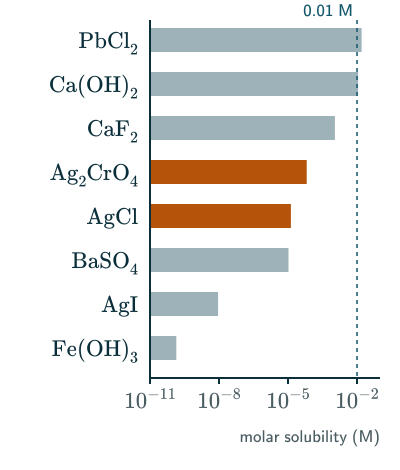
Ag2CrO4 has a smaller Ksp (1.1 × 10⁻¹²) than AgCl (1.8 × 10⁻¹⁰) but is about five times more soluble. Work out S before comparing.
Common mistake
Forgetting the stoichiometric factors
For PbCl2, [Cl−] = 2S, so Ksp = S(2S)2 = 4S3, not S2.
Common mistake
Forgetting to dilute on mixing
When two solutions are mixed, each concentration falls in proportion to the new volume before Qsp is worked out.
Common mistake
Ignoring the OH<sup>−</sup> already in water
For Fe(OH)3 at externally fixed pH 7, the ideal free-ion concentration is [Fe3+] = Ksp/[OH−] = 10/10 ≈ 10 M. This is not total dissolved iron, because hydrolysed iron species also occur. The formal result 1.4 × 10 M from 27S = Ksp neglects both water ionisation and iron hydrolysis and is not a physical total-solubility prediction.
Quick revision summary
- Saturated solution of a sparingly soluble salt: solid ⇌ ions; Ksp = product of ion concentrations, each to the power of its coefficient.
- MxXy: Ksp = xxyySx+y; BaSO4: S = √Ksp = 1.05 × 10⁻⁵ M.
- Qsp > Ksp: precipitation favoured; Qsp < Ksp: dissolution possible if solid is present.
- Common-ion suppression applies in the simple model; complex formation can instead increase total solubility.
- Salts of weak acids dissolve better at lower pH.
Formula sheet
- Ksp = xx yy Sx+y for MxXy, with no added ions or side reactions
- S = (Ksp/(xx yy))1/(x+y)
- Qsp > Ksp: precipitation favoured; Qsp < Ksp: dissolution possible if solid is present
Questions students ask
What is the difference between solubility and solubility product?
Solubility is how much of a salt dissolves to give a saturated solution, in mol L (the molar solubility S) or g L, while the solubility product Ksp is the equilibrium constant of the dissolving, the product of the ion concentrations in that saturated solution. For AgBr, Ksp = 5.0 × 10 at 298 K, so S = √(5.0 × 10) = 7.1 × 10 mol L, about 1.3 × 10 g L. Ksp depends only on temperature, but the solubility also depends on what else is in the solution: a common ion suppresses free-ion dissolution in the simple model, while complex formation can raise total dissolved concentration. The thermodynamic constant is unchanged at fixed temperature and standard states.
What is the difference between the solubility product and the ionic product?
The ionic product Qsp has the same form as the solubility product Ksp but is worked out for whatever solution is present, while Ksp is its value in a saturated solution and is constant at a given temperature. If Qsp > Ksp precipitation is favoured, though nucleation may delay it, if they are equal the solution is just saturated, and if Qsp < Ksp more solid can dissolve. With [Ba2+] = [SO42−] = 1.0 × 10 M, Qsp = 1.0 × 10, far above 1.1 × 10, so BaSO4 precipitates. The ‘ionic product of water’, Kw, is by contrast a true equilibrium constant.
How are the common ion effect and the solubility product used in salt analysis?
In qualitative salt analysis the common ion effect sets which ions reach their Ksp. Group II cations such as Cu2+ are precipitated as sulphides by H2S in dilute HCl: the H+ holds back the ionisation of H2S, so [S2−] is too low for ZnS or NiS, which come down later, in group IV, from ammoniacal solution. In group III, NH4Cl suppresses OH− production from NH3 + H2O ⇌ NH4+ + OH−, so [OH−] is enough to precipitate Fe(OH)3 and Al(OH)3 while the controlled pH and, for some ions such as zinc, ammonia complexation help retain other ions in solution. Salt analysis is in Unit 20 of the JEE Main 2027 and NEET (UG) 2026 syllabuses.
Does the solubility product have a unit?
Yes, written with concentrations in mol L the solubility product of a salt MxXy has the unit (mol L)x+y: mol L for AgCl or BaSO4, mol L for CaF2 and mol L for Fe(OH)3. Tables usually quote Ksp as a pure number, because each concentration is then taken relative to the standard 1 mol L. When a unit is asked for, count the ions in the formula: for Ca3(PO4)2, 3 + 2 = 5, so mol L.
Practice questions
Try each question first, then open the answer to check your working.
-
Q1. Find the molar solubility of CaF2 (Ksp = 5.3 × 10⁻⁹, NCERT Table 6.9).
Show answerHide answer
4S3 = 5.3 × 10⁻⁹, so S3 = 1.33 × 10⁻⁹ and S ≈ 1.1 × 10⁻³ M.
-
Q2. Neglecting chloride complexes and activity effects, find the solubility of AgCl (Ksp = 1.8 × 10⁻¹⁰) in 0.010 M NaCl.
Show answerHide answer
[Cl−] ≈ 0.010 M, so S = 1.8 × 10⁻¹⁰/0.010 = 1.8 × 10⁻⁸ M, about 750 times less than in pure water (1.34 × 10⁻⁵ M).
-
Q3. Arrange AgCl, AgBr and AgI in order of increasing solubility in water.
Show answerHide answer
They are all 1:1 salts, so their Ksp values can be compared directly: AgI (8.3 × 10⁻¹⁷) < AgBr (5.0 × 10⁻¹³) < AgCl (1.8 × 10⁻¹⁰).