Enthalpies of combustion, atomisation, bond, lattice and solution
NCERT Class 11 Chemistry Chapter 5 Section 5.5
Quick answer
Named enthalpies specify the process and molar basis: combustion, atomisation, gas-phase bond dissociation, lattice separation, solution and dilution. A Born–Haber cycle combines known steps to find lattice enthalpy. For an ionic solid dissolving in water, lattice separation and hydration contributions add to the solution enthalpy at a specified final concentration.
With your textbook
NCERT Chemistry Part I (Class 11), Chapter 5 “Thermodynamics”, Section 5.5 “Enthalpies for Different Types of Reactions”, pages 152–157.
Open the official NCERT chapter (PDF, 5.1 MB, ncert.nic.in) (opens in a new tab)
Checked against the 2026-27 reprint on .
Enthalpies for different types of reactions
Named enthalpy changes
Some reaction enthalpies are used so often that they have their own names and symbols (NCERT Section 5.5, pages 152–157):
- combustion, ΔcH⊖: one mole of a substance burnt completely, everything in its standard state;
- atomisation, ΔaH⊖: one mole of a substance broken completely into gaseous atoms;
- bond enthalpy, ΔbondH⊖: one mole of a particular bond broken in the gas phase (a bond dissociation enthalpy, or a mean value over several bonds);
- lattice enthalpy, ΔlatticeH⊖: one mole of an ionic solid separated into its gaseous ions, found with a Born–Haber cycle;
- solution and dilution enthalpies: dissolving one mole of a substance in a solvent, and adding more solvent to a solution.
In plain words: these are all reaction enthalpies with nicknames. Each one names a particular kind of change, so tables can list them and Hess’s law can combine them. Once you know what each name means, “one mole of what, going to what”, the arithmetic is the same products-minus-reactants bookkeeping as before.
Enthalpy of combustion
Combustion reactions are exothermic and matter in industry, rocketry and daily life (NCERT Section 5.5(a), page 152).
Standard enthalpy of combustion is defined as the enthalpy change per mole (or per unit amount) of a substance, when it undergoes combustion and all the reactants and products being in their standard states at the specified temperature.
NCERT Chemistry Part I (Class 11), Section 5.5, page 152
LPG cooking gas contains propane and butane in proportions that vary; take butane as the fuel for this example. NCERT writes C4H10(g) + 13/2 O2(g) → 4CO2(g) + 5H2O(l); ΔcH⊖ = −2658.0 kJ mol−1, but 2658 kJ is the heat released when the water forms as vapour. With liquid water, NCERT’s own Table 5.2 gives 4(−393.51) + 5(−285.83) + 126.15 = −2877 kJ mol−1, the accepted value (NCERT’s Unit 9, with liquid water, gives a close −2875.84 kJ mol−1 for the combustion of butane). Glucose burns with ΔcH⊖ = −2802.0 kJ mol−1; our bodies get energy from food by the same overall change, through a series of enzyme-controlled steps (page 152). Because enthalpies of combustion are easy to measure (a bomb calorimeter gives ΔcU, converted with ΔngRT), they are often combined by Hess’s law to find enthalpies of formation that cannot be measured directly (Example 1).
Enthalpy of atomisation
The enthalpy of atomisation, ΔaH⊖, is the enthalpy change on breaking one mole of a substance completely into atoms in the gas phase (NCERT Section 5.5(b), page 153):
- H2(g) → 2H(g); ΔaH⊖ = 435.0 kJ mol−1. For a diatomic molecule, this is also the bond dissociation enthalpy.
- CH4(g) → C(g) + 4H(g); ΔaH⊖ = 1665 kJ mol−1. The products are only gaseous atoms.
- Na(s) → Na(g); ΔaH⊖ = 108.4 kJ mol−1. For a metal, atomisation is the same as sublimation.
Bond enthalpy
Breaking a bond needs energy and forming one releases it, so a reaction enthalpy can be related to the bonds broken and made (NCERT Section 5.5(c), pages 153–155). Two terms are used: the bond dissociation enthalpy and the mean bond enthalpy. They are introduced, with their link to bond order, on bond parameters.
Diatomic molecules.
The bond dissociation enthalpy is the change in enthalpy when one mole of covalent bonds of a gaseous covalent compound is broken to form products in the gas phase.
NCERT Chemistry Part I (Class 11), Section 5.5, page 153
For a diatomic molecule this equals the enthalpy of atomisation: H–H 435.0, Cl–Cl 242 kJ mol−1 (page 153). NCERT also gives O=O as 428 kJ mol−1 on page 153, but its own Table 5.3(b) on page 154 gives 498 kJ mol−1, the accepted value; 428 is a slip.
Polyatomic molecules. In CH4 all four C–H bonds are identical, yet breaking them one after another takes different amounts of energy (page 154):
| Step | ΔbondH (kJ mol−1) |
|---|---|
| CH4(g) → CH3(g) + H(g) | +427 |
| CH3(g) → CH2(g) + H(g) | +439 |
| CH2(g) → CH(g) + H(g) | +452 |
| CH(g) → C(g) + H(g) | +347 |
| total, CH4(g) → C(g) + 4H(g) | +1665 |
So a mean bond enthalpy is used: ΔC–HH⊖ = ¼ × 1665, about 416 kJ mol−1. NCERT describes mean C–H values as differing slightly between compounds, but the chemical environment can cause substantial differences; use a compound-specific value when supplied. NCERT Table 5.3 lists mean bond enthalpies; a few of them, in kJ mol−1: H–H 435.8, C–H 414, C–C 347, O–H 464, Cl–Cl 243, H–Cl 431, C=C 611, O=O 498, C=O 741, N≡N 946. Mean values for polyatomic molecules are averages over bonds or environments; diatomic H–H and Cl–Cl values are not averages over different bonds. Rounding and data choices account for the small differences from page 153 (H–H 435.8 against 435.0, Cl–Cl 243 against 242).
Reaction enthalpies from bond enthalpies. For a reaction in the gas phase (NCERT Eq. 5.17, page 154):
From bond enthalpies (gases only)
ΔrH⊖ = Σ bond enthalpiesreactants − Σ bond enthalpiesproducts
Energy goes in to break every bond in the reactants and comes out as every bond in the products forms. The relation is approximate (mean values are used) and holds only when all reactants and products are gases; it is most useful when enthalpies of formation are not available (pages 154–155).
Lattice enthalpy and the Born–Haber cycle
The lattice enthalpy of an ionic compound is the enthalpy change which occurs when one mole of an ionic compound dissociates into its ions in gaseous state.
NCERT Chemistry Part I (Class 11), Section 5.5, page 155
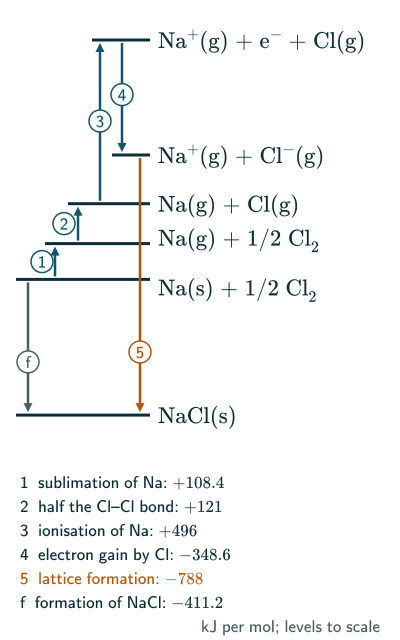
For Na+Cl−(s) → Na+(g) + Cl−(g), ΔlatticeH⊖ = +788 kJ mol−1. It cannot be measured directly, so it is found from a Born–Haber cycle, an enthalpy diagram built from measurable steps (NCERT Fig. 5.9, pages 155–156):
- Na(s) → Na(g), sublimation: +108.4 kJ mol−1
- ½Cl2(g) → Cl(g), half the bond dissociation enthalpy: +121 kJ mol−1
- Na(g) → Na+(g) + e−, ionisation enthalpy: +496 kJ mol−1
- Cl(g) + e− → Cl−(g), electron gain enthalpy: −348.6 kJ mol−1
- Na+(g) + Cl−(g) → Na+Cl−(s), the reverse of the lattice enthalpy.
(NCERT numbers ionisation as step 2 and the chlorine dissociation as step 3; the order does not change the sum.)
The enthalpy changes round a closed cycle add up to zero (Hess’s law). With ΔfH⊖(NaCl) = −411.2 kJ mol−1, this gives ΔlatticeH⊖ = 411.2 + 108.4 + 121 + 496 − 348.6 = +788 kJ mol−1. Because Δng = 2 for NaCl(s) → Na+(g) + Cl−(g), the lattice internal energy is smaller by 2RT: +783 kJ mol−1 (page 156). How lattice enthalpy decides whether an ionic solid forms is discussed on the ionic bond.
NCERT’s box on page 155 relates zero-temperature atomic ionisation/electron-affinity energies to finite-temperature enthalpies. The 5/2 RT translational term is an ideal monatomic-gas approximation; its sign follows the gaseous particle-count change and the convention for the energy quoted. It is not a universal positive correction to both processes.
Enthalpy of solution and dilution
Enthalpy of solution of a substance is the enthalpy change when one mole of it dissolves in a specified amount of solvent.
NCERT Chemistry Part I (Class 11), Section 5.5, page 156
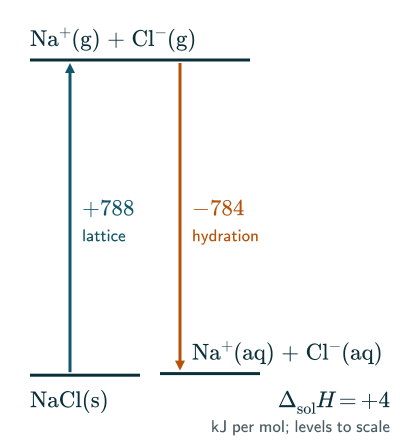
At infinite dilution the solvent is so plentiful that interactions between solute particles become negligible in the limiting sense; interactions with the solvent remain. When an ionic compound dissolves, its ions leave the lattice (lattice enthalpy, positive) and are surrounded by solvent molecules (hydration enthalpy, negative, for water). The hydration enthalpy, ΔhydH⊖, is the enthalpy change when one mole of gaseous ions is surrounded by water to give an infinitely dilute solution; it is always negative, most of all for small, highly charged ions. So (page 156):
Enthalpy of solution
ΔsolH⊖ = ΔlatticeH⊖ + ΔhydH⊖
For NaCl, +788 + (−784) = +4 kJ mol−1: dissolving common salt involves very little heat. NCERT notes that many ionic dissolutions are endothermic. Heating favours an endothermic dissolution equilibrium, provided the relevant solid phase remains the same. Solubility depends on Gibbs energy, including entropy and solution nonideality; lattice enthalpy alone cannot decide it (page 156).
Enthalpy of dilution. The enthalpy of solution depends on how much solvent is used (NCERT Section 5.5(f), pages 156–157). For HCl(g) dissolving in water (written aq):
| Process | ΔH (kJ mol−1) |
|---|---|
| HCl(g) + 10 aq → HCl·10 aq | −69.01 |
| HCl(g) + 25 aq → HCl·25 aq | −72.03 |
| HCl(g) + 40 aq → HCl·40 aq | −72.79 |
| HCl(g) + ∞ aq → HCl·∞ aq | −74.85 |
As more solvent is used, ΔH approaches a limiting value, the value at infinite dilution. Subtracting the 25 aq line from the 40 aq line gives HCl·25 aq + 15 aq → HCl·40 aq; ΔH = −72.79 − (−72.03) = −0.76 kJ mol−1, the enthalpy of dilution. It depends on the starting concentration and the amount of solvent added (page 157). NCERT calls it “the heat withdrawn from the surroundings” when solvent is added; read with its sign, withdrawing −0.76 kJ means 0.76 kJ is given to the surroundings, so diluting hydrochloric acid is exothermic.
Solved examples
Example 1: Δ<sub>f</sub>*H*<sup>⊖</sup> of benzene from its combustion (NCERT Problem 5.9, pages 152–153)
Burning one mole of benzene at 298 K and 1 atm gives CO2(g) and H2O(l) and releases 3267.0 kJ. Find ΔfH⊖ of benzene, given ΔfH⊖ = −393.5 kJ mol−1 for CO2(g) and −285.83 kJ mol−1 for H2O(l).
Target: 6C(graphite) + 3H2(g) → C6H6(l). Six moles of CO2: 6 × (−393.5) = −2361 kJ; three moles of H2O: 3 × (−285.83) = −857.49 kJ; together −3218.49 kJ. The combustion C6H6(l) + 15/2 O2 → 6CO2 + 3H2O(l) has ΔcH⊖ = −3267.0 kJ mol−1; reversed, +3267.0 kJ mol−1. Adding: −3218.49 + 3267.0.
Answer: ΔfH⊖(C6H6, l) = +48.51 kJ mol−1, close to the +49.0 in NCERT Table 5.2. NCERT’s working keeps −3267.0 for the reversed equation and prints the result as −48.51 kJ mol−1: both signs are slips, since reversing an equation changes the sign of its ΔH.
Example 2: The C–Cl bond in CCl<sub>4</sub> (NCERT Exercise 5.15, page 166)
Calculate ΔH for CCl4(g) → C(g) + 4Cl(g) and the C–Cl bond enthalpy in CCl4(g), given ΔvapH(CCl4) = 30.5, ΔfH(CCl4) = −135.5, ΔaH(C) = 715.0 and ΔaH(Cl2) = 242 kJ mol−1.
ΔfH = −135.5 is for liquid CCl4; adding vaporisation, ΔfH(CCl4, g) = −135.5 + 30.5 = −105.0 kJ mol−1. Route: CCl4(g) → C(graphite) + 2Cl2(g), +105.0; C(graphite) → C(g), +715.0; 2Cl2(g) → 4Cl(g), 2 × 242 = +484. Sum: 105.0 + 715.0 + 484 = 1304 kJ mol−1.
Answer: ΔH = 1304 kJ mol−1; four C–Cl bonds, so the C–Cl bond enthalpy is 1304/4 = 326 kJ mol−1.
Example 3: A reaction enthalpy from bond enthalpies
Estimate ΔrH⊖ for H2(g) + Cl2(g) → 2HCl(g) from the bond enthalpies H–H 435.8, Cl–Cl 243 and H–Cl 431 kJ mol−1 (NCERT Table 5.3).
Bonds broken: 435.8 + 243 = 678.8. Bonds formed: 2 × 431 = 862. ΔrH⊖ = 678.8 − 862.
Answer: about −183 kJ mol−1, close to 2 × ΔfH⊖(HCl) = 2 × (−92.31) = −184.6 kJ mol−1 from NCERT Table 5.2.
Example 4: Diluting hydrochloric acid
Using NCERT’s data, find ΔH for diluting HCl·25 aq to infinite dilution.
HCl·25 aq + ∞ aq → HCl·∞ aq: ΔH = −74.85 − (−72.03).
Answer: ΔH = −2.82 kJ mol−1; heat is released as the acid is diluted further.
Common mistakes to avoid
Common mistake
Using bond enthalpies for liquids or solids
ΔrH = Σ(bonds broken) − Σ(bonds formed) holds only when everything is a gas. If a substance is liquid, take it through the gas: liquid water as a reactant needs +ΔvapH (+44.0 kJ mol−1 at 298 K, from NCERT Table 5.2) per mole; as a product it adds −44.0 kJ mol−1 per mole.
Common mistake
Getting the bond-enthalpy subtraction backwards
It is reactants minus products for bond enthalpies (energy in to break, out to form), but products minus reactants for enthalpies of formation. If enthalpies of bond formation (negative, NCERT footnote on page 154) are given, the order flips: products minus reactants.
Common mistake
Mixing the sign of the lattice enthalpy
In NCERT’s sense the lattice enthalpy is for breaking up the solid, so it is positive (+788 kJ mol−1 for NaCl). Forming the lattice from gaseous ions releases the same amount.
Common mistake
Using the whole bond enthalpy of Cl<sub>2</sub> for one mole of NaCl
One mole of NaCl needs only half a mole of Cl2, so the Born–Haber step is ½ × 242 = 121 kJ mol−1. “Enthalpy of atomisation of chlorine” may mean per mole of Cl2 (242, as in NCERT Exercise 5.15) or per mole of Cl atoms (121).
Quick revision summary
- ΔcH⊖: one mole burnt completely; always negative (butane −2877 kJ mol−1, −2658 if the water stays as vapour; glucose −2802 kJ mol−1).
- ΔaH⊖: one mole into gaseous atoms; for diatomic molecules it equals the bond dissociation enthalpy; for metals, the sublimation enthalpy.
- Mean bond enthalpy: average over equivalent bonds (C–H in CH4 = 1665/4 = 416 kJ mol−1).
- Gas-phase ΔrH ≈ Σ bonds broken − Σ bonds formed.
- Lattice enthalpy (NaCl +788 kJ mol−1) from the Born–Haber cycle; ΔsolH = ΔlatticeH + ΔhydH.
- Enthalpy of dilution: the change on adding more solvent; it tends to a limit at infinite dilution.
Formula sheet
- ΔrH = Σ bond enthalpies (reactants) − Σ bond enthalpies (products), gases only
- Mean bond enthalpy = ΔaH ÷ number of equivalent bonds
- Born–Haber (NaCl): ΔlatticeH = −ΔfH + ΔsubH + ½ΔbondH + ΔiH + ΔegH
- ΔsolH = ΔlatticeH + ΔhydH
Questions students ask
What is the difference between enthalpy of atomisation and bond enthalpy?
The enthalpy of atomisation is for breaking one mole of a substance completely into gaseous atoms, while a bond enthalpy is for breaking one mole of one particular bond in the gas phase; the two are equal only for a diatomic gas such as H2. For a polyatomic molecule the atomisation enthalpy is the sum of all its bond enthalpies: CO2(g) → C(g) + 2O(g) takes 393.5 + 715.0 + 498 ≈ 1607 kJ mol (undoing its formation, then atomising graphite and O2), so the mean C=O bond enthalpy in CO2 is about 803 kJ mol; its successive dissociation steps need not have that value. That is well above the mean C=O value, 741 kJ mol in NCERT Table 5.3, which is why bond-enthalpy estimates are only approximate.
Is bond energy the same as bond enthalpy?
Bond energy and bond enthalpy are used for the same quantity in most books, the energy needed to break one mole of a given bond in gaseous molecules into gaseous fragments (atoms for a diatomic molecule). Where the two are distinguished, the bond enthalpy is the enthalpy change, ΔH, of A–B(g) → A(g) + B(g) at 298 K and the bond energy the internal energy change, ΔU; one mole of gas becomes two, so Δng = +1 and ΔH = ΔU + RT. At 298 K, RT is only 2.48 kJ mol, under 1% of a typical bond enthalpy such as 435.8 kJ mol for H–H.
What is the difference between enthalpy of combustion and enthalpy of formation?
The enthalpy of combustion is for burning one mole of a substance completely, and it is always negative, while the enthalpy of formation is for making one mole of a compound from its elements in their reference states, and it can have either sign. The two are linked by Hess’s law: ΔcH⊖ = ΣΔfH⊖(products) − ΔfH⊖(substance burnt), with O2 counting zero. Ethene, C2H4(g), forms endothermically, ΔfH⊖ = +52.3 kJ mol, yet burns to 2CO2(g) + 2H2O(l) with ΔcH⊖ = 2(−393.5) + 2(−285.8) − 52.3 ≈ −1411 kJ mol.
Why is the enthalpy of combustion always negative?
The enthalpy of combustion is always negative because burning a substance in oxygen turns it into products, chiefly CO2 and H2O, that lie far lower in enthalpy: their enthalpies of formation are strongly negative, −393.5 and −285.8 kJ mol. Forming their strong C=O and O–H bonds releases more energy than breaking the bonds of the fuel and of O2 takes, so heat is always given out. Substances that combine with oxygen only endothermically do not burn: nitrogen forms NO with ΔfH⊖ = +90.25 kJ mol, which is why the nitrogen in air is not a fuel.
How do you find a reaction enthalpy from enthalpies of combustion?
To find a reaction enthalpy from enthalpies of combustion, take reactants minus products, ΔrH = ΣΔcH(reactants) − ΣΔcH(products), each multiplied by its coefficient and using the same final combustion products and states: the opposite order to enthalpies of formation, because a combustion enthalpy measures how far a substance lies above its burnt products. Oxygen, CO2 and H2O(l) count as zero, since they do not burn further. For C(graphite) → C(diamond), with ΔcH⊖ = −393.5 kJ mol for graphite and −395.4 kJ mol for diamond, ΔrH⊖ = −393.5 − (−395.4) = +1.9 kJ mol, the enthalpy of formation of diamond.
Practice questions
Try each question first, then open the answer to check your working.
-
Q1. A cooking-gas cylinder holds 14.2 kg of butane (M = 58.1 g mol−1). On a stove the water leaves as vapour: C4H10(g) + 13/2 O2(g) → 4CO2(g) + 5H2O(g); ΔH = −2658 kJ mol−1. How much heat does the cylinder give?
Show answerHide answer
n = 14 200/58.1 = 244.4 mol. Heat = 244.4 × 2658, about 6.50 × 10⁵ kJ (650 MJ); per gram, 2658/58.1 = 45.7 kJ g−1, the fuel’s calorific value.
-
Q2. The enthalpy of atomisation of NH3(g) is 1173 kJ mol−1. Find the mean N–H bond enthalpy.
Show answerHide answer
NH3(g) → N(g) + 3H(g) breaks three equivalent N–H bonds: 1173/3, about 391 kJ mol−1 (NCERT Table 5.3 lists 389).
-
Q3. Estimate ΔrH⊖ for C2H4(g) + H2(g) → C2H6(g) from the bond enthalpies C=C 611, H–H 435.8, C–C 347 and C–H 414 kJ mol−1.
Show answerHide answer
Broken: one C=C and one H–H, 611 + 435.8 = 1046.8. Formed: one C–C and two new C–H, 347 + 2 × 414 = 1175. ΔrH⊖ ≈ 1046.8 − 1175, about −128 kJ mol−1. (The four C–H entries cancel in this mean-bond estimate; the actual C–H bonds have different environments in ethene and ethane.)