Experiment: enthalpy of solution of copper sulphate
Beyond NCERT In the JEE Main and NEET syllabus; the Class 11 book has no section for it.
Quick answer
Dissolving weighed CuSO·5HO crystals in an insulated beaker cools the water slightly; anhydrous CuSO instead warms it. Estimate q(solution and vessel) from their heat capacity and temperature change, then divide its negative by the moles of salt to get the molar solution enthalpy. Specify the salt form and final concentration, calibrate the vessel at a comparable fill, and account for heat leakage because the crystals produce a very small temperature fall.
What is this experiment?
The quantity measured, in NCERT’s words
Enthalpy of solution of a substance is the enthalpy change when one mole of it dissolves in a specified amount of solvent.
NCERT Chemistry Part I (Class 11), Section 5.5, page 156
- A weighed amount of copper sulphate crystals, CuSO4·5H2O, is dissolved in 100 mL of water in an insulated beaker calorimeter, and the temperature change is read.
- For the blue crystals the temperature falls slightly: dissolving them absorbs heat, so ΔsolH is positive.
- The heat comes from the temperature change, the heat capacity of the solution and the calorimeter constant; dividing the heat taken in by the moles dissolved gives ΔsolH in kJ mol−1.
In plain words: drop the crystals in water, stir, and watch the thermometer. If it goes down, the dissolving took heat from the water and the beaker. Work out how much heat that was, and scale it to one mole of the salt.
The NCERT textbook gives the theory of enthalpy of solution (Section 5.5, page 156) but not the method; the JEE Main and NEET (UG) syllabuses list this experiment among the practical chemistry experiments of Unit 20. The method below follows the NCERT Laboratory Manual Chemistry for Class 12, Unit 3 (Thermochemical Measurement), Experiment 3.1, pages 20–23.
Theory
When an ionic solid dissolves, its ions leave the crystal (this absorbs energy) and are surrounded by water molecules (this releases energy); ΔsolH is the balance of the two (NCERT page 156). For an endothermic dissolution equilibrium, heating generally favours dissolving while the same solid phase persists. Solubility ultimately depends on Gibbs energy; hydration, entropy, concentration and possible changes of hydrate phase also matter.
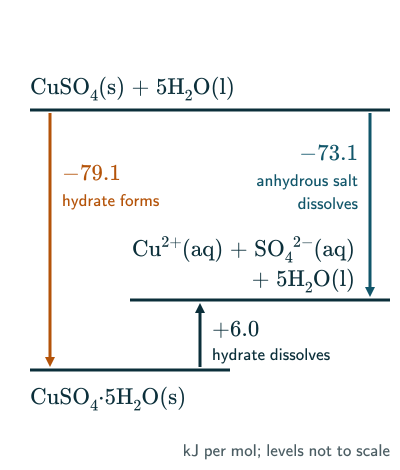
Why the blue crystals cool the water but the white powder warms it. In blue CuSO4·5H2O each Cu2+ ion already holds water molecules, so dissolving it releases little extra energy, while the crystal still has to be broken up: the change is slightly endothermic. White anhydrous CuSO4 has no water; its ions gain all of their hydration on dissolving, and that releases much more energy than breaking the crystal takes. From standard data (dilute solutions, 298 K):
- CuSO4·5H2O(s) → Cu2+(aq) + SO42−(aq) + 5H2O(l): about +6.0 kJ mol−1;
- CuSO4(s) → Cu2+(aq) + SO42−(aq): about −73.1 kJ mol−1.
By Hess’s law, the enthalpy change for turning the white powder into blue crystals, CuSO4(s) + 5H2O(l) → CuSO4·5H2O(s), is the difference: −73.1 − 6.0 = −79.1 kJ mol−1. Problem books and JEE/NEET questions call this the “enthalpy of hydration of copper sulphate”; it is not the same as NCERT’s hydration enthalpy of gaseous ions.
The heat is found with the method of mixtures:
Heat gained by the solution and beaker
q = (msoln × 4.184 + W) × Δt
where msoln is the mass of water plus salt in grams (100 g of water, taking 1 g mL−1), 4.184 J g−1 K−1 is taken as the specific heat of the dilute solution, W is the calorimeter constant in J K−1 and Δt = t2 − t1. Assuming negligible heat exchange with the room, constant approximate heat capacity and only pressure–volume work, the heat taken in by dissolving is −q, so:
Enthalpy of solution
ΔsolH = −q × M/msalt
with msalt the mass dissolved and M its molar mass: 249.7 g mol−1 for CuSO4·5H2O (the Laboratory Manual uses 249.5, from rounded atomic masses). When the temperature falls, Δt and q are negative and ΔsolH is positive.
Apparatus
- Three 250 mL beakers and one 500 mL beaker, a small wooden block, cotton wool and a piece of cardboard: the inner 250 mL beaker stands on the block inside the 500 mL beaker, packed round with cotton wool, with the cardboard as a lid.
- A thermometer with 0.1 °C divisions (a digital one reading 0.01 °C is better here), a stirrer and a glass rod.
- About 2 g of well-powdered copper sulphate, weighed accurately.
Procedure
A. Calorimeter constant. Following the method of mixtures, put 50 mL of water in the inner beaker and record its temperature, tc; add 50 mL of water at 50–60 °C whose exact temperature, th, is read just before mixing; stir and record the mixed temperature, tm. Then W = 4.184 [Vh(th − tm) − Vc(tm − tc)]/
B. Enthalpy of solution.
- Put 100 mL of distilled water in the same (dry) beaker inside the insulated set-up; allow the beaker and salt to reach the same initial temperature as the water and record it, t1.
- Add the weighed copper sulphate, msalt g, and stir until it has all dissolved.
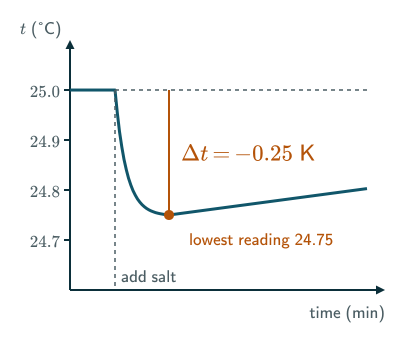
- Record the temperature reached, t2 (for the crystals, the lowest reading).
- Work out q with msoln = 100 + msalt, then ΔsolH.
Precautions (Laboratory Manual, page 23): use a thermometer with 0.1 °C divisions; read the hot water’s temperature just before mixing; do not use very large amounts of salt; stir until it dissolves but not so much that friction warms the liquid; weigh the copper sulphate carefully; insulate the two beakers with cotton wool.
Slips in the Laboratory Manual. Five points in the manual’s working need correcting:
- page 23 takes the density of water as 1 g L−1; it should be 1 g mL−1, which is what makes 100 mL weigh 100 g;
- page 23 multiplies the calorimeter term W(t2 − t1) by 4.184 as well. W is already in J K−1, so only the solution term takes the 4.184;
- page 23 rightly calls the heat gained by the solution and beaker the heat liberated on dissolution, but then sets ΔsolH = +249.5 × (heat liberated per gram). ΔsolH is minus the heat liberated per mole; without the minus sign the expression gives a negative ΔsolH for crystals whose dissolving absorbs heat;
- page 20 drops the minus sign in the formula for W (Eqs. 4 and 5) and calls the heat needed to warm 1 g of a substance by 1 K its heat capacity (that is the specific heat capacity).
Solved examples
Example 1: Enthalpy of solution of the crystals
5.00 g of CuSO4·5H2O is dissolved in 100 mL of water at 25.00 °C in a calorimeter with W = 34.9 J K−1. A digital thermometer shows a lowest reading of 24.75 °C. Find ΔsolH.
msoln = 105.00 g. Heat capacity of solution and beaker = 105 × 4.184 + 34.9 = 439.3 + 34.9 = 474.2 J K−1. Δt = −0.25 K, so q = 474.2 × (−0.25), about −118.6 J: the dissolving took in 118.6 J. Moles = 5.00/249.7, about 0.02002 mol.
Answer: ΔsolH = +118.6/0.02002 J mol−1, about +5.9 kJ mol−1.
Example 2: How big is the change with 2 g?
Taking ΔsolH = +6.0 kJ mol−1, predict the temperature change when the Laboratory Manual’s 2.00 g of crystals dissolves in 100 mL of water (W = 34.9 J K−1).
Moles = 2.00/249.7, about 0.00801 mol, so the heat taken in is about 0.00801 × 6000, or 48 J. Heat capacity = 102 × 4.184 + 34.9, about 461.7 J K−1. Δt = −48/461.7.
Answer: a fall of only about 0.10 °C, one division of the 0.1 °C thermometer the manual asks for. That is why a finer thermometer, or somewhat more salt (the manual warns against very large amounts), gives a better result.
Example 3: The anhydrous salt
Using −73.1 kJ mol−1, predict the temperature change when 2.00 g of anhydrous CuSO4 (M = 159.6 g mol−1) dissolves in 100 mL of water in the same calorimeter.
Moles = 2.00/159.6, about 0.01253 mol. Heat given out = 0.01253 × 73 100, about 916 J. Δt = 916/461.7.
Answer: the temperature rises by about 2.0 °C, about twenty times the change for the same mass of crystals, and in the opposite direction.
Example 4: Finding the enthalpy of forming the hydrate
Use the two enthalpies of solution, +6.0 and −73.1 kJ mol−1, to find ΔH for CuSO4(s) + 5H2O(l) → CuSO4·5H2O(s).
Both salts must end as the same solution, with the hydrate’s water accounted for (or the infinite-dilution limit used). Going anhydrous → solution directly (−73.1) equals going anhydrous → crystals (ΔH) and then crystals → solution (+6.0). So ΔH + 6.0 = −73.1.
Answer: ΔH = −79.1 kJ mol−1. It is hard to measure directly (the powder would have to take up exactly five water molecules per CuSO4 and no more), which is why it is found through Hess’s law.
Common mistakes to avoid
Common mistake
Getting the sign backwards
A fall in temperature means the dissolving absorbed heat: ΔsolH is positive. A rise means it is negative.
Common mistake
Using the wrong molar mass
The blue crystals are CuSO4·5H2O, 249.7 g mol−1; the anhydrous salt is 159.6 g mol−1. Use the one that was weighed.
Common mistake
Multiplying W by 4.184
The calorimeter constant is already a heat per kelvin. Only the mass of solution is multiplied by 4.184.
Quick revision summary
- ΔsolH: enthalpy change when one mole of a substance dissolves in a specified amount of solvent (NCERT page 156).
- CuSO4·5H2O dissolves with a small absorption of heat (about +6 kJ mol−1); anhydrous CuSO4 gives out heat (about −73 kJ mol−1).
- Method: calorimeter constant first, then dissolve a weighed amount in 100 mL of water and read the temperature change.
- q = (msoln × 4.184 + W)Δt; ΔsolH = −q × M/msalt.
- Hess’s law: ΔH(forming the hydrate) = ΔsolH(anhydrous) − ΔsolH(hydrate), about −79 kJ mol−1.
Formula sheet
- q = (msoln × 4.184 + W) × Δt
- ΔsolH = −q × M/msalt
- W = 4.184[Vh(th − tm) − Vc(tm − tc)]/
(tm − tc) - ΔH(hydrate formation) = ΔsolH(anhydrous) − ΔsolH(hydrate)
Questions students ask
Is dissolving copper sulphate in water a physical or a chemical change?
Dissolving copper sulphate crystals in water is usually classed as a physical change at school level because the salt can be recovered by suitable crystallisation. Dissolution still changes coordination and interactions as the crystal gives hydrated ions; gentle evaporation under appropriate conditions gives back blue crystals, CuSO4·5H2O. The blue colour, in the crystals and in the solution, comes from Cu2+ ions bonded to water molecules. White anhydrous CuSO4 is a less clear case: it binds water, giving out heat, and turns blue, which is why it is used as a test for water, and that hydration step is often described as a chemical change.
How is the enthalpy of hydration of copper sulphate found in the laboratory?
The enthalpy of hydration of copper sulphate, ΔH for CuSO4(s) + 5H2O(l) → CuSO4·5H2O(s), is found from two runs in the same calorimeter: measure ΔsolH of the white anhydrous salt and of the blue crystals, then by Hess’s law ΔH = ΔsolH(anhydrous) − ΔsolH(crystals). Use equal amounts, such as 0.0100 mol (1.60 g of CuSO4 or 2.50 g of crystals), so that both runs end with nearly the same solution. For an exact Hess cycle, match final temperature and composition, accounting for the five waters supplied by each mole of hydrate; otherwise include a dilution correction. Dry the anhydrous salt freshly and weigh it quickly: it takes up moisture from the air and would then give out too little heat.
Can potassium nitrate be used instead of copper sulphate in this experiment?
Yes, potassium nitrate can be used instead: the CBSE 2026–27 Class 12 practical syllabus lists ‘enthalpy of dissolution of copper sulphate or potassium nitrate’, while the JEE Main 2027 and NEET (UG) 2026 syllabuses name only CuSO4. The method and the calculation are the same, with M = 101.1 g mol for KNO3. Potassium nitrate dissolves far more endothermically, about +35 kJ mol, so 2.00 g in 100 mL of water in a calorimeter with W = 34.9 J K cools it by about 1.5 °C, a fall much easier to read accurately than that of the copper sulphate crystals.
Practice questions
Try each question first, then open the answer to check your working.
-
Q1. 4.00 g of CuSO4·5H2O is dissolved in 100 mL of water at 26.00 °C in a calorimeter with W = 40.0 J K−1; the lowest temperature is 25.82 °C. Find ΔsolH.
Show answerHide answer
Heat capacity = 104 × 4.184 + 40.0, about 475.1 J K−1. q = 475.1 × (−0.18), about −85.5 J. Moles = 4.00/249.7, about 0.01602 mol. ΔsolH = +85.5/0.01602 J mol−1, about +5.3 kJ mol−1.
-
Q2. Some problem books quote ΔsolH = −66.5 kJ mol−1 (anhydrous CuSO4) and +11.7 kJ mol−1 (CuSO4·5H2O), measured in a finite amount of water. What do they give for CuSO4(s) + 5H2O(l) → CuSO4·5H2O(s)?
Show answerHide answer
ΔH = −66.5 − (+11.7) = −78.2 kJ mol−1, close to the −79.1 from standard data. The subtraction gives the hydrate-formation enthalpy only if both measurements refer to the same final solution and temperature, including water released by the hydrate. Dilution contributions cancel only under that condition; without full experimental conditions, the 0.9 kJ mol−1 difference cannot be assigned uniquely to data-set differences.
-
Q3. A student applies the Laboratory Manual’s expression to the readings of Example 1. The expression multiplies W(t2 − t1) + (100 + msalt)(t2 − t1) by 249.5 × 4.184/msalt. What does she get, and what two things are wrong?
Show answerHide answer
Here W(t2 − t1) + (100 + msalt)(t2 − t1) = (34.9 + 105) × (−0.25) = −34.975, and −34.975 × 249.5 × 4.184/5.00 ≈ −7302 J mol−1, about −7.3 kJ mol−1. The sign is wrong (the temperature fell, so ΔsolH is positive), and W, already in J K−1, has been multiplied by 4.184, which makes the size too large. The correct result is about +5.9 kJ mol−1.