Thermodynamic terms: system, state and internal energy
NCERT Class 11 Chemistry Chapter 5 Section 5.1
Quick answer
An open system can exchange matter and energy, a closed system can exchange energy but not matter, and an isolated system exchanges neither. State functions depend on the current state, while heat and work depend on the path. For a closed system with negligible changes in bulk kinetic and potential energy, the first law is ΔU = q + w, with heat and work positive into the system.
With your textbook
NCERT Chemistry Part I (Class 11), Chapter 5 “Thermodynamics”, Section 5.1 “Thermodynamic Terms”, pages 137–140.
Open the official NCERT chapter (PDF, 5.1 MB, ncert.nic.in) (opens in a new tab)
Checked against the 2026-27 reprint on .
The language of thermodynamics
Thermodynamic terms
Thermodynamics studies energy changes in macroscopic systems, describing states and energy transfers; state-function changes depend only on the initial and final states (NCERT Unit 5 introduction, page 136, and Section 5.1, pages 137–140):
- the system is the part of the universe we observe; the surroundings are everything else that can interact with it; the boundary separates them;
- an open system can exchange matter and energy with its surroundings, a closed one can exchange energy but not matter, an isolated one neither;
- the state of a system is fixed by state functions such as p, V, T and amount n, whose values depend only on the state, not on how it was reached;
- the internal energy U is a state function; it changes when heat q flows, work w is done or matter crosses the boundary; for a closed system ΔU = q + w, the first law of thermodynamics.
In plain words: draw an imaginary line round the thing you care about (a beaker of reacting chemicals, say). Inside is the system, outside the surroundings. Energy can cross the line as heat or as work, and sometimes matter can cross too. Thermodynamics keeps the books: whatever energy comes in or goes out shows up as a change in the system’s internal energy.
System, surroundings and boundary
A system is the part of the universe in which observations are made; the rest of the universe forms the surroundings, and together they make up the universe (NCERT Section 5.1.1, page 137):
The universe = the system + the surroundings
In practice only the part of the universe that can interact with the system matters, usually the region round it. If two substances A and B react in a beaker, the beaker and its contents are the system and the room is the surroundings (NCERT Fig. 5.1). The system may be marked off by real walls, like a beaker or test tube, or simply by a chosen volume in space. The wall, real or imaginary, that separates it from the surroundings is the boundary, which lets us keep track of all matter and energy going in or out.
Types of system
Systems are classified by what can cross the boundary (NCERT Section 5.1.2, pages 137–138):
| System | What can cross | Example |
|---|---|---|
| open | matter and energy | reactants in an open beaker |
| closed | energy only | reactants in a sealed copper or steel vessel |
| isolated | neither | reactants in an ideal sealed, insulated flask with no work transfer |
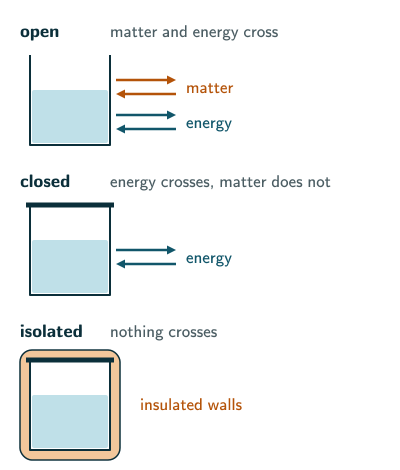
For the open beaker the boundary is an imaginary surface enclosing the beaker and its contents; if only the reactants are taken as the system, the beaker’s walls are the boundary (NCERT footnote, page 137).
The state of a system
To calculate anything we must describe the system before and after a change. In mechanics a state means the position and velocity of every particle; thermodynamics uses a much simpler idea, the average measurable (macroscopic) properties (NCERT Section 5.1.3, page 138). For a gas in equilibrium with fixed composition, pressure p, volume V, temperature T and amount n describe the state (not all are independent). A mixture also requires its composition.
Variables like p, V, T are called state variables or state functions because their values depend only on the state of the system and not on how it is reached.
NCERT Chemistry Part I (Class 11), Section 5.1.3, page 138
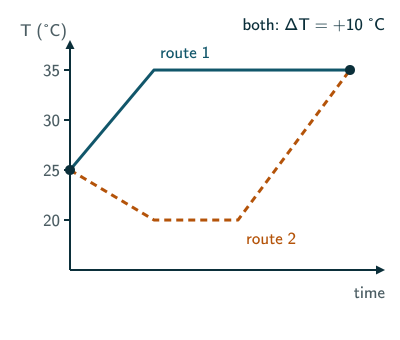
Only a certain number of properties can be varied independently; once these are fixed, the rest have definite values. Path independence is easy to see with temperature: if the system is warmed from 25 °C to 35 °C, the change is +10 °C whether it is heated straight up or first cooled a few degrees and then heated (page 139). The volume of water in a pond is a state function in the same way: it does not matter whether rain or a tubewell filled it. These ideas are the same as the state variables of physics.
Internal energy as a state function
The microscopic energy within a system, including molecular motion and interactions, is its internal energy, U. It excludes the kinetic energy of the system moving as a whole and its external gravitational potential energy. Throughout these lessons, changes of those bulk energies are neglected, so the closed-system first law is ΔU = q + w. It changes when heat passes into or out of the system, when work is done on or by it, or when matter enters or leaves (NCERT Section 5.1.4, page 138).
(a) Work. Put some water in a thermos flask, which allows no heat to cross its walls. Such a system is adiabatic (see also adiabatic processes in physics):
Adiabatic process is a process in which there is no transfer of heat between the system and surroundings.
NCERT Chemistry Part I (Class 11), Section 5.1.4, page 138
An adiabatic wall stops heat only: work can still cross it (paddles, an immersion rod), so once work is done on it this flask is adiabatic, not isolated. NCERT uses a thermos flask for both ideas (Sections 5.1.2 and 5.1.4, page 138). Do 1 kJ of mechanical work on the water by churning it with paddles, and its temperature rises from TA to TB. Do the same 1 kJ as electrical work with an immersion rod, and the temperature change is the same. J. P. Joule did such experiments between 1840 and 1850 and showed that a given amount of work done on a thermally insulated system, however it is done, produces the same change of state (page 139). So the adiabatic work defines a change in a state function, U:
Adiabatic work
ΔU = U2 − U1 = wad
(b) Heat. The same change can be brought about with no work at all, by putting the water in a copper (conducting) vessel inside a large reservoir at TB. The energy that flows because of a temperature difference is heat, q; here the vessel’s volume is fixed and no work is done (w = 0), so ΔU = q (page 139).
(c) The general case. For a closed system (no matter crosses the boundary) changed by both heat and work (page 140):
First law of thermodynamics
ΔU = q + w
q and w separately depend on how the change is carried out, but their sum, ΔU, depends only on the initial and final states. For an isolated system q = 0 and w = 0, so ΔU = 0:
The energy of an isolated system is constant.
NCERT Chemistry Part I (Class 11), Section 5.1.4, page 140
This is the first law of thermodynamics, the law of conservation of energy: energy can be neither created nor destroyed. Unlike volume, internal energy has no measurable absolute value; only changes, ΔU, can be measured (page 140), for example in a bomb calorimeter.
Sign convention
Chemistry follows the IUPAC convention (NCERT Section 5.1.4, page 139):
- w is positive when work is done on the system (its energy rises) and negative when work is done by it;
- q is positive when heat flows into the system and negative when heat flows out.
Many physics books use the alternative convention, in which work done by the system is counted positive (NCERT footnote, page 139); there the first law reads ΔQ = ΔU + ΔW, that is ΔU = ΔQ − ΔW. The physics is the same; only the sign of w differs (see the first law in physics).
Solved examples
Example 1: Walls and systems (NCERT Problem 5.1, page 140)
Express the change in internal energy of a system when (i) no heat is absorbed, but work w is done on the system; (ii) no work is done, but heat q is taken out of the system; (iii) work w is done by the system and heat q is supplied to it. What type of wall or system is it in each case?
Use ΔU = q + w with the IUPAC signs; in the question q and w are sizes, so attach the sign yourself. (i) q = 0, work in: ΔU = +w; no heat crosses, so the wall is adiabatic and w = wad. (ii) w = 0, heat out: ΔU = −q; heat crosses, so the walls conduct heat. (iii) Heat in counts +q, work by the system −w: ΔU = q − w; heat and work cross but no matter, so the system is closed.
Answer: (i) ΔU = wad, an adiabatic wall; (ii) ΔU = −q, thermally conducting walls; (iii) ΔU = q − w, a closed system.
Example 2: Heat in, work out (NCERT Exercise 5.7, page 165)
In a process, 701 J of heat is absorbed by a system and 394 J of work is done by the system. What is the change in internal energy?
Heat absorbed: q = +701 J. Work done by the system: w = −394 J. ΔU = q + w = 701 − 394.
Answer: ΔU = +307 J; the internal energy rises by 307 J.
Example 3: Which kind of system?
Classify: (a) hot tea in a closed thermos flask; (b) water boiling in an open pan; (c) a sealed steel can of soft drink cooling in a refrigerator.
(a) Neither heat nor matter crosses (ideally). (b) Steam escapes and heat enters. (c) Heat leaves, but no matter crosses the sealed can.
Answer: (a) isolated; (b) open; (c) closed.
Example 4: What is a state function? (NCERT Exercise 5.1, page 165)
A thermodynamic state function is a quantity (i) used to determine heat changes; (ii) whose value is independent of path; (iii) used to determine pressure–volume work; (iv) whose value depends on temperature only.
A state function depends only on the state, not on the route taken to reach it.
Answer: (ii).
Common mistakes to avoid
Common mistake
Mixing the chemistry and physics sign conventions
In chemistry ΔU = q + w, with w positive for work done on the system. Work done by a gas in expanding is negative. Do not use ΔU = q − w with chemistry’s signs. NCERT’s Problem 5.1 (iii) answer, ΔU = q − w, is not the physics form: there w is the size of the work done by the system.
Common mistake
Calling heat or work a state function
q and w depend on the path; only their sum, ΔU, does not.
Common mistake
Thinking an isolated system cannot change
An isolated system can change state inside (a reaction in a sealed thermos still happens); its total internal energy simply stays constant.
Quick revision summary
- System + surroundings = universe; the boundary separates them.
- Open: matter and energy can cross. Closed: energy can cross but matter cannot. Isolated: neither.
- State functions (p, V, T, n, U) depend only on the state; q and w depend on the path.
- Adiabatic: no heat crosses; ΔU = wad.
- First law: ΔU = q + w; for an isolated system ΔU = 0.
- IUPAC signs: q and w positive when energy enters the system.
Formula sheet
- ΔU = q + w (first law, IUPAC signs)
- Adiabatic: q = 0, so ΔU = w
- Isolated system: q = 0, w = 0, ΔU = 0
Questions students ask
What is chemical thermodynamics?
Chemical thermodynamics is thermodynamics applied to chemical reactions and phase changes: the first law gives the heat a reaction gives out or takes in (ΔU and ΔH), and the second law predicts whether, and how far, it can go (ΔS, ΔG and K). It uses macroscopic states and energy balances; state-function changes depend only on endpoints, while heat and work can depend on the path. It does not by itself determine reaction rates or mechanisms. In the JEE Main 2027 and NEET (UG) 2026 syllabuses it is Chemistry Unit 4, Chemical Thermodynamics; in NCERT Class 11 Chemistry it is Unit 5.
Is an isolated system a closed system?
An isolated system is a closed system in one sense, since no matter crosses the boundary of either, but it is the stricter case: a closed system can still exchange energy with its surroundings as heat or work, while an isolated system exchanges neither matter nor energy. So a closed system is isolated only if its walls also stop heat and no work can be done on or by it. In exam questions give the strictest description that fits: reactants in a sealed, rigid, insulated vessel form an isolated system if electrical, shaft and other work transfers are also absent.
Is internal energy an extensive or an intensive property?
Internal energy is an extensive property: it depends on the amount of matter, so two moles of a substance in the same state have twice the internal energy of one mole, and the ΔU of a reaction doubles when its equation is doubled. Dividing by the amount gives the molar internal energy, Um = U/n, which is intensive, like every molar quantity. Enthalpy, entropy and Gibbs energy are extensive in the same way, while temperature and pressure are intensive.
Why is the change in internal energy zero in a cyclic process?
The change in internal energy is zero in any cyclic process because internal energy is a state function: at the end of a cycle the system is back in its starting state, so U has its starting value again, whatever happened on the way. Heat and work are not state functions, so neither need be zero over the cycle, but by the first law their sum is: q + w = 0, or q = −w. For example, if a gas taken round a cycle absorbs a net 600 J of heat, then w = −600 J: with chemistry’s signs, it has done a net 600 J of work on its surroundings.
Why can the absolute value of internal energy not be measured?
Ordinary thermodynamic measurements determine differences in internal energy, not a unique absolute zero. Adding the same reference constant to all values of U changes no measured heat or work, so a reference state must be chosen. Experiments measure only the energy that crosses the boundary as heat and work, so only changes, ΔU = q + w, are known. For enthalpy, chemists get round the same problem by a convention: elements in their reference states are given a zero enthalpy of formation.
Practice questions
Try each question first, then open the answer to check your working.
-
Q1. For a process to occur under adiabatic conditions, which is the correct condition: (i) ΔT = 0; (ii) Δp = 0; (iii) q = 0; (iv) w = 0 (NCERT Exercise 5.2, page 165)?
Show answerHide answer
(iii) q = 0: in an adiabatic process no heat crosses the boundary. The temperature can change, as it did when Joule’s paddles churned the water.
-
Q2. A gas is compressed by 250 J of work done on it, and in the process it loses 120 J of heat to the surroundings. Find ΔU.
Show answerHide answer
w = +250 J (work done on the system), q = −120 J (heat lost). ΔU = 250 − 120 = +130 J.
-
Q3. Which are state functions: the volume of water in a tank, the amount of rain that fell into it, the temperature of a cup of tea, the heat the tea has lost, the internal energy of a gas, the work done by the gas in expanding?
Show answerHide answer
Volume, temperature and internal energy. Rain, heat lost and work done describe how the state was reached (the tank could have been filled by a tubewell).