Reaction enthalpy, enthalpy of formation and Hess’s law
NCERT Class 11 Chemistry Chapter 5 Section 5.4
Quick answer
Reaction enthalpy is the coefficient-weighted sum of product molar enthalpies minus that of reactants. Standard formation enthalpies refer to formation from elements in their reference states, whose formation enthalpies are zero by convention. Hess’s law combines reactions by adding their enthalpy changes, with signs reversed for reversed steps and values scaled with coefficients.
With your textbook
NCERT Chemistry Part I (Class 11), Chapter 5 “Thermodynamics”, Section 5.4 “Enthalpy Change, ΔrH of a Reaction – Reaction Enthalpy”, pages 146–152.
Open the official NCERT chapter (PDF, 5.1 MB, ncert.nic.in) (opens in a new tab)
Checked against the 2026-27 reprint on .
What is reaction enthalpy?
Reaction enthalpy
The reaction enthalpy, ΔrH, is the enthalpy change that accompanies a reaction: the sum of molar enthalpies of products minus those of reactants, each multiplied by its coefficient in the balanced equation (NCERT Section 5.4, pages 146–152):
- the standard reaction enthalpy, ΔrH⊖, refers to all substances in their standard states (using a 1 bar standard pressure and specified temperature; solutions require a defined solute standard state);
- phase changes have enthalpies too: fusion, vaporisation and sublimation;
- the standard enthalpy of formation, ΔfH⊖, is for making one mole of a substance from its elements in their reference states; then ΔrH⊖ = ΣaΔfH⊖(products) − ΣbΔfH⊖(reactants);
- Hess’s law: because H is a state function, ΔrH is the same whether a reaction happens in one step or in several.
In plain words: every substance carries a certain enthalpy, like money in an account. When reactants become products, at constant pressure with only pressure–volume work, the difference between the products’ total and the reactants’ total is paid to the surroundings as heat (exothermic, negative) or drawn from them (endothermic, positive). Absolute balances cannot be read, so the standard formation enthalpy of an element in its reference state is zero by convention, and other formation enthalpies are listed relative to those states. This does not mean the actual internal energy or enthalpy of an element is zero. Products minus reactants gives the reaction enthalpy, and the route taken does not matter.
Reaction enthalpy
For a reaction written as reactants → products (NCERT pages 146–147):
Reaction enthalpy
ΔrH = Σ a Hproducts − Σ b Hreactants
Here each H denotes a molar enthalpy (or the appropriate partial molar enthalpy in a mixture), and a and b are the coefficients in the balanced equation. For CH4(g) + 2O2(g) → CO2(g) + 2H2O(l), ΔrH = [Hm(CO2, g) + 2Hm(H2O, l)] − [Hm(CH4, g) + 2Hm(O2, g)], with Hm the molar enthalpy. Engineers need reaction enthalpies to plan the heating or cooling that keeps an industrial reaction at a steady temperature; they are also needed to find how equilibrium constants change with temperature (page 147).
Standard enthalpy of reaction
A reaction enthalpy depends on the conditions, so standard conditions are agreed (NCERT Section 5.4(a), page 147).
The standard enthalpy of reaction is the enthalpy change for a reaction when all the participating substances are in their standard states.
NCERT Chemistry Part I (Class 11), Section 5.4, page 147
The standard state of a substance at a specified temperature is its pure form at 1 bar.
NCERT Chemistry Part I (Class 11), Section 5.4, page 147
For gases the standard state is the hypothetical ideal gas at 1 bar; for solutes it is a specified concentration or molality with ideal dilute behaviour (IUPAC standard-state convention). The NCERT sentence above is the introductory pure-substance shorthand.
The standard state of liquid ethanol at 298 K is pure liquid ethanol at 1 bar; that of solid iron at 500 K is pure iron at 1 bar. Data are usually given at 298 K, and the superscript ⊖ (often printed °) marks standard conditions: ΔH⊖.
Enthalpy changes in phase transformations
Melting, boiling and sublimation also involve enthalpy changes, and an equilibrium transition of a pure substance can occur at constant temperature at its transition pressure (NCERT Section 5.4(b), pages 147–148):
- Fusion: H2O(s) → H2O(l); ΔfusH⊖ = 6.00 kJ mol−1 at 273 K (NCERT’s text value; its Table 5.1 gives 6.01 and Exercise 5.10 uses 6.03 kJ mol−1: use the value a question gives). The standard enthalpy of fusion is the enthalpy change on melting one mole of a solid in its standard state. Melting is endothermic, so ΔfusH⊖ is positive for the ordinary melting transitions considered here; freezing gives the same amount of heat back.
- Vaporisation: H2O(l) → H2O(g); ΔvapH⊖ = +40.79 kJ mol−1 at the boiling point. The standard enthalpy of vaporisation is the heat needed to vaporise one mole of a liquid at constant temperature and 1 bar.
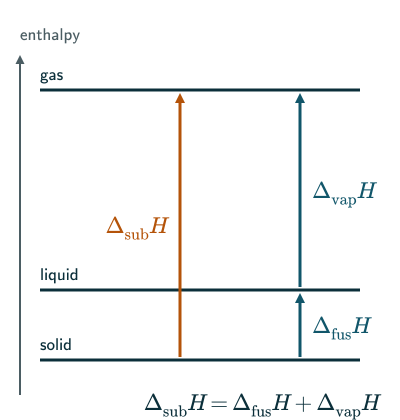
- Sublimation, solid straight to vapour: dry ice (solid CO2) sublimes at 195 K with ΔsubH⊖ = 25.2 kJ mol−1; naphthalene sublimes slowly, ΔsubH⊖ = 73.0 kJ mol−1. The standard enthalpy of sublimation is the enthalpy change when one mole of a solid sublimes at constant temperature and 1 bar. At one temperature, ΔsubH = ΔfusH + ΔvapH (Hess’s law; figure below).
The size of these enthalpies reflects the strength of the forces between the molecules. Strong hydrogen bonds hold water molecules together in the liquid, while the dipole–dipole forces in acetone are much weaker, so it takes less heat to vaporise a mole of acetone than a mole of water (page 148). In physics the same quantities appear, per kilogram, as latent heats.
Some values from NCERT Table 5.1 (page 147), in kJ mol−1, each at the substance’s own melting point (fusion) or boiling point (vaporisation), e.g. 273 K and 373 K for water. At 298 K water’s ΔvapH⊖ is larger, 44.01 kJ mol−1 (NCERT Problem 5.7).
| Substance | ΔfusH⊖ | ΔvapH⊖ |
|---|---|---|
| H2O | 6.01 | 40.79 |
| NH3 | 5.65 | 23.35 |
| CH3COCH3 | 5.72 | 29.1 |
| C6H6 | 9.83 | 30.8 |
| NaCl | 28.8 | 170.0 |
Standard enthalpy of formation
NCERT defines the standard molar enthalpy of formation, ΔfH⊖, as the standard enthalpy change for forming one mole of a substance from its elements in their most stable states of aggregation, also called their reference states (NCERT Section 5.4(c), page 149). The reference states used in these examples at 25 °C and 1 bar are H2(g), O2(g), C(graphite) and S(rhombic) (page 149). By convention, ΔfH⊖ of an element in its reference state is zero (page 150). Examples:
- H2(g) + ½O2(g) → H2O(l); ΔfH⊖ = −285.8 kJ mol−1
- C(graphite, s) + 2H2(g) → CH4(g); ΔfH⊖ = −74.81 kJ mol−1
- 2C(graphite, s) + 3H2(g) + ½O2(g) → C2H5OH(l); ΔfH⊖ = −277.7 kJ mol−1
ΔfH⊖ is a special case of ΔrH⊖. These are not enthalpies of formation (page 150):
- CaO(s) + CO2(g) → CaCO3(s); ΔrH⊖ = −178.3 kJ mol−1, because calcium carbonate is made from compounds, not from its elements;
- H2(g) + Br2(l) → 2HBr(g), because two moles of product form. Halving the equation gives ½H2(g) + ½Br2(l) → HBr(g); ΔfH⊖ = −36.4 kJ mol−1, so the reaction as written has ΔrH⊖ = 2 × (−36.4) = −72.8 kJ mol−1. NCERT prints −178.3 kJ mol−1 for this equation, the value of the CaCO3 line above it; that is a slip.
Some values from NCERT Table 5.2 (page 149), in kJ mol−1 at 298 K:
| Substance | ΔfH⊖ |
|---|---|
| CO2(g) | −393.51 |
| CO(g) | −110.53 |
| H2O(l) | −285.83 |
| H2O(g) | −241.82 |
| CH4(g) | −74.81 |
| NH3(g) | −46.11 |
| CaCO3(s) | −1206.92 |
| CaO(s) | −635.09 |
| Fe2O3(s) | −824.2 |
| NO(g) | +90.25 |
| NO2(g) | +33.18 |
| C(diamond) | +1.89 |
Reaction enthalpies from enthalpies of formation. For any reaction (NCERT Eq. 5.15, page 150):
From enthalpies of formation
ΔrH⊖ = Σ aΔfH⊖(products) − Σ bΔfH⊖(reactants)
For CaCO3(s) → CaO(s) + CO2(g): ΔrH⊖ = (−635.1) + (−393.5) − (−1206.9) = +178.3 kJ mol−1. The decomposition is endothermic, so limestone must be heated to make lime (page 150).
Thermochemical equations
A balanced equation together with its ΔrH is a thermochemical equation; the physical states (and allotropes) must be given (NCERT Section 5.4(d), page 150). For example, C2H5OH(l) + 3O2(g) → 2CO2(g) + 3H2O(l); ΔrH⊖ = −1367 kJ mol−1, the combustion of liquid ethanol. The conventions (pages 150–151):
- For the quoted molar reaction enthalpy, interpret coefficients as molar amounts per mole of reaction. The equation also expresses particle-number ratios, but a kJ mol value is not the heat for a single molecular event.
- ΔrH⊖ refers to the amounts in the equation as written, “per mole of reaction”. For Fe2O3(s) + 3H2(g) → 2Fe(s) + 3H2O(l), ΔrH⊖ = 3(−285.83) − (−824.2) = −33.3 kJ mol−1; written with half these coefficients, it is −16.6 kJ mol−1. Enthalpy is extensive. (NCERT labels these two results ΔfH⊖; they are reaction enthalpies, ΔrH⊖.)
- Reversing an equation reverses the sign: N2(g) + 3H2(g) → 2NH3(g) has ΔrH⊖ = −91.8 kJ mol−1, so 2NH3(g) → N2(g) + 3H2(g) has +91.8 kJ mol−1.
Hess’s law of constant heat summation
Enthalpy is a state function, so the enthalpy change between reactants and products does not depend on the path (NCERT Section 5.4(e), page 151).
If a reaction takes place in several steps then its standard reaction enthalpy is the sum of the standard enthalpies of the intermediate reactions into which the overall reaction may be divided at the same temperature.
NCERT Chemistry Part I (Class 11), Section 5.4, page 151
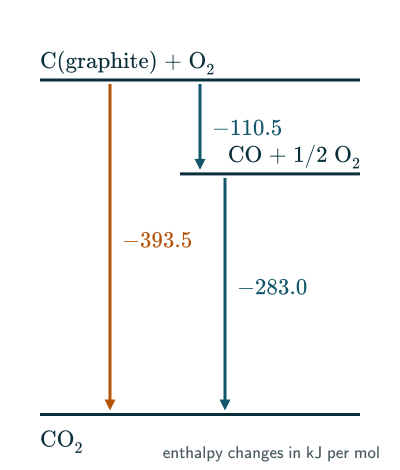
Example: the enthalpy of formation of CO. Partial combustion of carbon can give a mixture of CO and CO2, making a clean direct measurement for C(graphite) + ½O2(g) → CO(g) difficult. Use two reactions that can be (pages 151–152):
-
(i) C(graphite) + O2(g) → CO2(g); ΔrH⊖ = −393.5 kJ mol−1
-
(ii) CO(g) + ½O2(g) → CO2(g); ΔrH⊖ = −283.0 kJ mol−1
-
(iii), which is (ii) reversed: CO2(g) → CO(g) + ½O2(g); ΔrH⊖ = +283.0 kJ mol−1
Add (i) and (iii): CO2 cancels and ½O2 is left on the left: C(graphite) + ½O2(g) → CO(g); ΔrH⊖ = −393.5 + 283.0 = −110.5 kJ mol−1. In general, if A → B in one step has ΔrH, and by another route in steps with ΔrH1, ΔrH2, …, then ΔrH = ΔrH1 + ΔrH2 + … (NCERT Eq. 5.16).
Solved examples
Example 1: Δ<sub>r</sub>*H* from enthalpies of formation (NCERT Exercise 5.12, page 166)
The enthalpies of formation of CO(g), CO2(g), N2O(g) and N2O4(g) are −110, −393, 81 and 9.7 kJ mol−1. Find ΔrH for N2O4(g) + 3CO(g) → N2O(g) + 3CO2(g).
Products: 81 + 3(−393) = −1098. Reactants: 9.7 + 3(−110) = −320.3. ΔrH = −1098 − (−320.3).
Answer: −777.7 before rounding, about −778 kJ mol−1 with the supplied data.
Example 2: Δ<sub>f</sub>*H*<sup>⊖</sup> of methanol by Hess’s law (NCERT Exercise 5.14, page 166)
Given CH3OH(l) + 3/2 O2(g) → CO2(g) + 2H2O(l), ΔrH⊖ = −726 kJ mol−1; C(graphite) + O2(g) → CO2(g), ΔcH⊖ = −393 kJ mol−1; H2(g) + ½O2(g) → H2O(l), ΔfH⊖ = −286 kJ mol−1. Find ΔfH⊖ of CH3OH(l).
ΔcH⊖ is the enthalpy of combustion, for burning one mole of a substance completely in oxygen (NCERT Section 5.5). The carbon and hydrogen equations are also formation reactions, so ΔcH⊖(graphite) = ΔfH⊖(CO2) and ΔcH⊖(H2) = ΔfH⊖(H2O, l). The target is C(graphite) + 2H2(g) + ½O2(g) → CH3OH(l). Take the carbon equation once, the hydrogen equation twice, and the methanol equation reversed: ΔfH⊖ = −393 + 2(−286) − (−726) = −393 − 572 + 726.
Answer: ΔfH⊖(CH3OH, l) = −239 kJ mol−1 (NCERT Table 5.2 gives −238.86).
Example 3: Evaporating a swimmer’s water (NCERT Problem 5.7, page 148)
A swimmer coming out of a pool carries about 18 g of water. How much heat is needed to evaporate it at 298 K, and what is the internal energy of vaporisation? ΔvapH⊖ of water at 298 K = 44.01 kJ mol−1.
18 g is 1 mol, so the heat needed is 1 × 44.01 = 44.01 kJ. Taking steam as an ideal gas, H2O(l) → H2O(g) has Δng = 1: ΔvapU = ΔvapH − ΔngRT = 44.01 − 8.314 × 10−3 × 298 = 44.01 − 2.48.
Answer: about 44 kJ of heat for about 18 g; ΔvapU = 41.53 kJ mol−1.
Example 4: Water at 10 °C to ice at −10 °C (NCERT Exercise 5.10, page 166)
Find the enthalpy change on freezing 1.0 mol of water at 10.0 °C to ice at −10.0 °C. ΔfusH = 6.03 kJ mol−1 at 0 °C; Cp(H2O, l) = 75.3 J mol−1 K−1; Cp(H2O, s) = 36.8 J mol−1 K−1.
Because H is a state function, use three steps. Cool the water from 10 °C to 0 °C: 75.3 × (−10) = −753 J. Freeze it at 0 °C: −6030 J. Cool the ice from 0 °C to −10 °C: 36.8 × (−10) = −368 J. Total: −753 − 6030 − 368 = −7151 J.
Answer: molar change ≈ −7.15 kJ mol−1; for the specified 1.0 mol sample, ΔH ≈ −7.2 kJ to two significant figures.
NCERT Problem 5.8 (pages 148–149) cools 1 mol of liquid water from 100 °C and freezes it at 0 °C: ΔH = −7.56 − 6.00 = −13.56 kJ mol−1. No gas takes part (Δng = 0) and the volume hardly changes, so ΔU ≈ ΔH. Its opening words, “Assuming the water vapour to be a perfect gas”, do not apply: no vapour is involved.
Common mistakes to avoid
Common mistake
Forgetting the coefficients
Multiply each ΔfH⊖ by its coefficient. In N2O4 + 3CO → N2O + 3CO2, CO and CO2 each count three times.
Common mistake
Giving elements a non-zero enthalpy of formation, or the wrong form
ΔfH⊖ = 0 only for the reference state: graphite (not diamond, +1.89 kJ mol−1), O2 (not O3), liquid Br2 (not gaseous, +30.91 kJ mol−1).
Common mistake
Forgetting to change the sign when reversing a step
In Hess’s law, a reaction used backwards contributes −ΔrH. That is how −283.0 became +283.0 in the CO example.
Common mistake
Mixing H<sub>2</sub>O(l) and H<sub>2</sub>O(g)
ΔfH⊖ is −285.83 kJ mol−1 for liquid water and −241.82 kJ mol−1 for steam; the difference, 44.01 kJ mol−1, is the enthalpy of vaporisation of water at 298 K. Use the state given in the equation.
Quick revision summary
- ΔrH = Σ(coefficient × H)products − Σ(coefficient × H)reactants.
- Standard state: a defined reference at specified temperature and usually 1 bar; pure condensed phases, ideal-gas reference, or specified ideal-dilute solute reference; written ⊖.
- Fusion, vaporisation and sublimation enthalpies are positive; ΔsubH = ΔfusH + ΔvapH at the same temperature.
- ΔfH⊖: one mole of substance from elements in reference states; zero for elements in their reference states.
- ΔrH⊖ = ΣaΔfH⊖(products) − ΣbΔfH⊖(reactants).
- Thermochemical equations: states given; ΔH scales with the coefficients; reversing changes the sign.
- Hess’s law: ΔrH is the same by any route.
Formula sheet
- ΔrH⊖ = Σ a ΔfH⊖(products) − Σ b ΔfH⊖(reactants)
- ΔfH⊖ = 0 for an element in its reference state
- ΔsubH = ΔfusH + ΔvapH (same temperature)
- Hess’s law: ΔH(overall) = ΔH1 + ΔH2 + ΔH3 + …
Questions students ask
What is the difference between enthalpy of formation and enthalpy of reaction?
The enthalpy of formation is the reaction enthalpy of one particular reaction, forming one mole of a substance from its elements in their reference states, while an enthalpy of reaction, ΔrH, belongs to any balanced equation, for the amounts as written. So every ΔfH⊖ is a ΔrH⊖, but not the reverse: NH3(g) + HCl(g) → NH4Cl(s) starts from compounds, so its ΔrH⊖ is not an enthalpy of formation. It follows from enthalpies of formation (standard data), −314.4 − (−46.1) − (−92.3) = −176.0 kJ mol, which is why tables list ΔfH⊖ values rather than every reaction.
Is the standard enthalpy of formation always negative?
No, the standard enthalpy of formation is negative for most compounds but positive for some substances: ethyne, C2H2(g), has ΔfH⊖ = +226.7 kJ mol and ozone, O3(g), +142.7 kJ mol (standard data), and NO(g) +90.25 kJ mol (NCERT Table 5.2). A positive value means the substance lies above its elements in enthalpy, so it forms endothermically and is energy-rich: ethyne gives out a great deal of heat when it burns, which is why it is used in welding torches. Such substances need not decompose in practice, since the change can be very slow, and thermodynamic stability at constant temperature and pressure requires the Gibbs energy of the relevant reaction at the actual composition. Standard formation Gibbs energy tests the specified formation reaction under standard conditions, not every possible decomposition.
What are the applications of Hess’s law?
Hess’s law lets you find an enthalpy change that cannot easily be measured by combining reactions whose ΔH values are known, since enthalpy is a state function. Its main uses are enthalpies of formation from enthalpies of combustion; lattice enthalpies from a Born–Haber cycle; mean bond enthalpies from enthalpies of atomisation; enthalpies of phase and allotropic changes; and the enthalpy of forming a hydrate, as for copper sulphate. Each time, known equations are added, reversed or multiplied until they give the target equation.
Does the enthalpy of a reaction depend on temperature or on a catalyst?
The enthalpy of a reaction changes with temperature but not with a catalyst: a catalyst only provides a faster route, lowering the activation energy both ways, and since H is a state function the route does not change ΔrH. Temperature acts through the heat capacities: ΔrH(T2) ≈ ΔrH(T1) + ΔrCp(T2 − T1), Kirchhoff’s relation with ΔrCp taken constant and no intervening phase changes (beyond NCERT). For H2(g) + ½O2(g) → H2O(l), ΔrCp = 75.3 − 28.8 − ½ × 29.4 = +31.8 J K mol, so ΔrH goes from −285.8 kJ mol at 298 K to about −284.2 kJ mol at 348 K.
Is Hess’s law in the JEE Main and NEET syllabus?
Yes, Hess’s law of constant heat summation is named in Chemistry Unit 4, Chemical Thermodynamics, of both the JEE Main 2027 syllabus (NTA) and the NEET (UG) 2026 syllabus (NMC), next to the enthalpies of bond dissociation, combustion, formation, atomisation, sublimation, phase transition, hydration, ionisation and solution. With Hess’s law, thermochemical equations, or enthalpies of formation or combustion, are combined to find a reaction enthalpy, as in the solved examples on this page.
Practice questions
Try each question first, then open the answer to check your working.
-
Q1. The enthalpies of combustion of methane, graphite and dihydrogen at 298 K are −890.3, −393.5 and −285.8 kJ mol−1. Is ΔfH of CH4(g) (i) −74.8; (ii) −52.27; (iii) +74.8; (iv) +52.26 kJ mol−1 (NCERT Exercise 5.5, page 165)? Decide by calculation from the combustion data.
Show answerHide answer
C + 2H2 → CH4: ΔfH = −393.5 + 2(−285.8) − (−890.3) = −74.8 kJ mol−1. Answer (i).
-
Q2. Given N2(g) + 3H2(g) → 2NH3(g); ΔrH⊖ = −92.4 kJ mol−1, what is the standard enthalpy of formation of NH3 gas (NCERT Exercise 5.13, page 166)?
Show answerHide answer
The equation forms 2 mol of NH3, so ΔfH⊖ = −92.4/2 = −46.2 kJ mol−1. (NCERT Table 5.2 lists −46.11 kJ mol−1, and page 151 uses −91.8 kJ mol−1 for this equation; NCERT’s data differ slightly, so use the value given.)
-
Q3. The enthalpy of combustion of carbon to CO2 is −393.5 kJ mol−1. Calculate the heat released on forming 35.2 g of CO2 from carbon and dioxygen (NCERT Exercise 5.11, page 166).
Show answerHide answer
n(CO2) = 35.2/44.0 = 0.800 mol. Heat released = 0.800 × 393.5, about 315 kJ.