Spontaneity, entropy and Gibbs energy
NCERT Class 11 Chemistry Chapter 5 Section 5.6
Quick answer
A spontaneous process has a thermodynamic driving force, but may be slow; it increases the total entropy of system and surroundings. For a closed system at constant temperature and pressure with only pressure–volume work, Gibbs energy falls during spontaneous change. Reaction direction depends on the reaction Gibbs energy at the actual composition; its standard value describes standard states, and its actual value is zero at reaction equilibrium.
With your textbook
NCERT Chemistry Part I (Class 11), Chapter 5 “Thermodynamics”, Section 5.6 “Spontaneity”, pages 157–162.
Open the official NCERT chapter (PDF, 5.1 MB, ncert.nic.in) (opens in a new tab)
Checked against the 2026-27 reprint on .
What decides whether a change is spontaneous?
Spontaneity, entropy and Gibbs energy
A spontaneous process is one that has the potential to proceed on its own, without outside help; it says nothing about how fast (NCERT Section 5.6, pages 157–162):
- a fall in enthalpy (exothermic change) helps, but it is not a sufficient criterion: some endothermic changes happen on their own;
- entropy, S, is related to the number of microscopic arrangements compatible with the macroscopic state; “randomness” is a useful introductory picture, not a precise definition; for a spontaneous change the total entropy of system plus surroundings increases, ΔStotal > 0;
- at constant temperature and pressure the Gibbs energy, G = H − TS, combines both: ΔG = ΔH − TΔS, and a change is spontaneous when ΔG < 0;
- third law: the entropy of a perfect, ideally ordered crystal with a unique ground state approaches zero as the temperature approaches absolute zero.
For the Gibbs criterion below, assume a closed system at fixed temperature and pressure with no externally supplied non-expansion work. Reaction direction means the sign of the reaction Gibbs energy at the actual composition; ΔG° refers specifically to standard states.
In plain words: things happen by themselves when they spread energy and matter out. A hot cup cools, a gas fills its container, a crystal dissolves. Losing energy as heat to the surroundings is one way of spreading it; becoming more disordered is another. Gibbs energy weighs the two against each other at a given temperature, and if the balance is negative, the change can go.
Spontaneous processes
The first law relates heat and work but says nothing about direction. Yet heat flows only from hot to cold, a gas expands to fill its container, and carbon burns in oxygen to give carbon dioxide; none of these reverses by itself (NCERT Section 5.6, page 157). A spontaneous reaction need not be fast: hydrogen and oxygen can stand mixed for years without visible change, yet their reaction is spontaneous. So spontaneity means “having the potential to proceed without the assistance of external agency”, and it says nothing about rate (page 157).
A spontaneous process is an irreversible process and may only be reversed by some external agency.
NCERT Chemistry Part I (Class 11), Section 5.6, page 157
Is a decrease in enthalpy the criterion?
Water flows downhill and a stone falls, losing potential energy, so we might expect reactions to go in the direction in which enthalpy falls (NCERT Section 5.6(a), pages 157–158). Many spontaneous reactions are indeed exothermic:
- ½N2(g) + 3/2 H2(g) → NH3(g); ΔrH⊖ = −46.1 kJ mol−1
- ½H2(g) + ½Cl2(g) → HCl(g); ΔrH⊖ = −92.32 kJ mol−1
- H2(g) + ½O2(g) → H2O(l); ΔrH⊖ = −285.8 kJ mol−1
(NCERT’s first equation, on page 157, prints an empty fraction where the 3/2 in front of H2 belongs.) But some endothermic changes are also spontaneous, so a decrease in enthalpy may help without being the whole story (page 158). Good examples are ammonium nitrate dissolving in water, which absorbs about 26 kJ mol−1 and makes the water cold, and ice melting above 0 °C.
NCERT’s own two examples, which it says “though endothermic, are spontaneous” (page 158), are in fact not spontaneous under standard conditions. For the formation of NO2, ½N2(g) + O2(g) → NO2(g) (+33.2 kJ mol−1), and of CS2 from graphite and rhombic sulfur at 298 K (NCERT instead writes liquid S and +128.5 kJ mol−1; NIST data give about +89 kJ mol−1 for formation of liquid CS2 from the reference elements), standard data give ΔG⊖ of about +51 and +65 kJ mol−1 at 298 K, so the forward standard-state changes are unfavourable at 298 K. Formation of NO2 also has ΔS° ≈ −61 J K−1 mol−1. If those signs persist, ΔG° remains positive; this does not mean that no NO2 can form in a nonstandard mixture, and constant 298 K data should not be extrapolated to every temperature.
Entropy and spontaneity
Consider two gases, A and B, in an isolated container, separated by a partition. Remove the partition and they diffuse into each other, although ΔH = 0 for ideal gases initially at the same temperature (NCERT Fig. 5.11, page 158). Before, a molecule picked from the left was surely A; after mixing, it could be either. The system has become less predictable, more random, and in an isolated system there is always a tendency towards this.
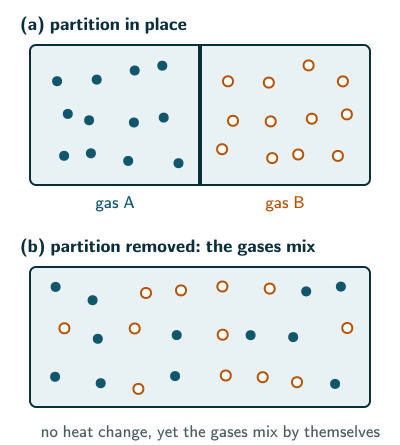
The thermodynamic quantity behind this introductory randomness picture is entropy, S, a state function (pages 158–159). For a substance under comparable ordinary conditions, a gas usually has more accessible microscopic arrangements and higher molar entropy than a liquid or crystal. Entropy also depends on temperature, pressure and composition, so visual disorder alone cannot rank arbitrary systems. Reversible heat input produces a larger entropy change per joule at lower temperature, so (NCERT Eq. 5.18, page 159):
Entropy change
ΔS = qrev/T
Here qrev is the heat absorbed when the change is carried out reversibly at constant temperature T. If temperature varies, use ΔS = ∫δqrev/T rather than dividing total heat by one temperature. For a real, irreversible change, ΔS is found along a reversible path between the same two states, because S is a state function (page 159).
For a spontaneous process the total entropy change of system and surroundings (also called the entropy change of the universe, ΔSuniverse) is positive (NCERT Eq. 5.19):
Total entropy change
ΔStotal = ΔSsystem + ΔSsurroundings > 0
For an isolated system subject to fixed constraints, a spontaneous change increases entropy towards a maximum. At equilibrium there is no further spontaneous change; a reversible limiting change has zero total entropy production. The system’s own entropy can still change: when ice melts at 0 °C, an equilibrium, the water gains entropy and the surroundings lose exactly as much. For the isothermal expansion of an ideal gas ΔU = 0 whether it is done reversibly or not, but ΔStotal is zero only for the reversible case: entropy, not energy, tells reversible and irreversible processes apart (page 159).
Gibbs energy and spontaneity
Most reactions take place in closed or open systems, where both enthalpy and entropy change, and neither alone decides the direction. So the Gibbs energy (Gibbs function) is defined (NCERT Section 5.6(c), pages 160–161):
Gibbs energy
G = H − TS; at constant T: ΔG = ΔH − TΔS
G is an extensive state function, and ΔG has units of energy. Why it decides spontaneity: for a closed system with only pressure–volume work at constant pressure the heat the system gives out is −ΔHsys; if the surroundings are at the same temperature T, they gain exactly this heat, so ΔSsurr = −ΔHsys/T. Substituting and multiplying by T:
From total entropy to Gibbs energy
ΔStotal = ΔSsys − ΔHsys/T
TΔStotal = TΔSsys − ΔHsys
TΔStotal = −ΔG
So at constant T and p, ΔStotal > 0 exactly when ΔG < 0 (NCERT Eq. 5.22, page 161):
- if ΔG < 0, the process is spontaneous;
- if ΔG > 0, it is non-spontaneous;
- at equilibrium ΔG = 0.
At constant temperature and pressure, −ΔG is the maximum useful non-expansion work obtainable in a reversible process. The sign matters: a favourable process has ΔG < 0 and positive available work; actual irreversible work output is smaller (page 161). For a specified change, the signs of ΔH and ΔS fix how temperature matters while those signs and phases remain applicable (NCERT Table 5.4, page 162):
| ΔrH | ΔrS | Spontaneous? |
|---|---|---|
| − | + | at all temperatures |
| − | − | at low T only |
| + | + | at high T only |
| + | − | at no temperature |
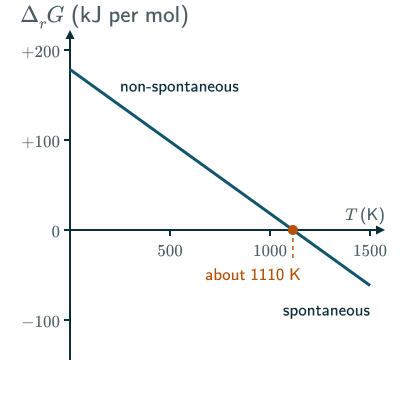
“Low” and “high” are relative: for a given reaction a high temperature may even be room temperature. When ΔH and ΔS are both positive, the reaction becomes spontaneous once TΔS outweighs ΔH, which is one reason reactions are often run hot. The decomposition of limestone is an example.
The second and third laws
Second law. For an isolated system the energy stays constant, so the natural direction of spontaneous change is the one in which entropy increases; this is the second law of thermodynamics (NCERT Section 5.6(d), page 161; compare the second law in physics). It explains why spontaneous exothermic reactions are so common: the heat they release increases the entropy of the surroundings, making ΔStotal positive.
Third law. Molecules move from place to place, spin and vibrate (translational, rotational and vibrational motion); these motions grow with temperature, and so does entropy (NCERT Section 5.6(e), page 161).
The entropy of any pure crystalline substance approaches zero as the temperature approaches absolute zero.
NCERT Chemistry Part I (Class 11), Section 5.6, page 161
The precise condition is an ideally ordered crystal with a unique ground state. Frozen disorder can give residual entropy; zero entropy does not mean zero internal energy or no quantum motion. The third law allows absolute entropies to be found from heat data alone, by adding the qrev/T increments from 0 K to 298 K; standard entropy changes are then found by a Hess’s-law type calculation (pages 161–162):
Standard entropy of reaction
ΔrS⊖ = Σ S⊖(products) − Σ S⊖(reactants)
each multiplied by its coefficient. Unlike enthalpies of formation, standard entropies of elements are not zero (H2(g): 130.7 J K−1 mol−1). For CaCO3(s) → CaO(s) + CO2(g), data tables give (38.1 + 213.8) − 91.7, about +160 J K−1 mol−1, the value used in the graph above.
Solved examples
Example 1: Does entropy rise or fall? (NCERT Problem 5.10, pages 159–160)
Predict whether entropy increases or decreases: (i) a liquid crystallises into a solid; (ii) a crystalline solid is warmed from 0 K to 115 K; (iii) 2NaHCO3(s) → Na2CO3(s) + CO2(g) + H2O(g); (iv) H2(g) → 2H(g).
(i) The molecules become ordered. (ii) Warming populates additional vibrational states and increases entropy. Particles are not literally static at 0 K: quantum zero-point motion can remain. (iii) One solid gives a solid and two gases. (iv) One molecule gives two atoms.
Answer: (i) decreases; (ii), (iii) and (iv) increase.
Example 2: Rusting despite a fall in entropy (NCERT Problem 5.11, page 160)
For 4Fe(s) + 3O2(g) → 2Fe2O3(s), ΔrS⊖ = −549.4 J K−1 mol−1 and ΔrH⊖ = −1648 × 103 J mol−1 at 298 K. Why is the reaction spontaneous?
The surroundings absorb −ΔrH = +1648 × 103 J mol−1, so ΔSsurr = 1648 × 103/298, about 5530 J K−1 mol−1. ΔStotal = 5530 + (−549.4).
Answer: using unrounded values, ΔStotal ≈ +4.98 × 10³ J K−1 mol−1, positive, so the reaction is spontaneous: the large release of heat increases the entropy of the surroundings far more than the system’s entropy falls.
Example 3: When does it become spontaneous? (NCERT Exercise 5.17, page 166)
For 2A + B → C at 298 K, ΔH = 400 kJ mol−1 and ΔS = 0.2 kJ K−1 mol−1. Taking both as constant, at what temperature does the reaction become spontaneous?
ΔG = ΔH − TΔS < 0 when T > ΔH/ΔS = 400/0.2.
Answer: above 2000 K.
Example 4: From ΔU to ΔG (NCERT Exercise 5.19, page 166)
For 2A(g) + B(g) → 2D(g), ΔU⊖ = −10.5 kJ and ΔS⊖ = −44.1 J K−1. Find ΔG⊖ and say whether the reaction may occur spontaneously. (NCERT gives no temperature; take 298 K.)
Δng = 2 − 3 = −1, so ΔH = ΔU + ΔngRT = −10.5 + (−1)(8.314 × 10−3 × 298) = −12.98 kJ. ΔG = ΔH − TΔS = −12.98 − 298 × (−0.0441) = −12.98 + 13.14.
Answer: ΔG⊖ = +0.164 kJ before rounding (about +0.2 kJ at the precision of ΔU), positive, so the reaction is not spontaneous under standard conditions at 298 K.
Common mistakes to avoid
Common mistake
Equating spontaneous with fast
Spontaneity is about direction, not speed. Diamond turning into graphite is spontaneous at room temperature but immeasurably slow.
Common mistake
Looking only at the system’s entropy
A process can be spontaneous even if ΔSsystem is negative, as in rusting. It is the total, system plus surroundings, that must increase.
Common mistake
Mixing kJ and J in ΔH − TΔS
ΔH is usually in kJ and ΔS in J K−1. Convert one before subtracting: 298 K × (−44.1 J K−1) = −13.14 kJ, not −13 142 kJ.
Quick revision summary
- Spontaneous: can proceed by itself (irreversible); says nothing about rate.
- Exothermic changes are often, but not always, spontaneous.
- Entropy measures accessible microscopic arrangements; the usual same-substance trend is solid < liquid < gas. At constant temperature, ΔS = qrev/T; spontaneous change: ΔStotal > 0.
- G = H − TS; ΔG = ΔH − TΔS; ΔG < 0 spontaneous, > 0 non-spontaneous, = 0 at equilibrium.
- Signs of ΔH and ΔS decide how temperature matters; reactions with ΔH > 0 and ΔS > 0 go at high T.
- Second law: in an isolated system entropy increases. Third law: S → 0 for a perfect crystal at 0 K.
Formula sheet
- ΔS = qrev/T (constant T)
- ΔStotal = ΔSsystem + ΔSsurroundings > 0 (spontaneous)
- ΔSsurr = −ΔHsys/T (constant p; only pV work; reservoir T)
- G = H − TS; ΔG = ΔH − TΔS (constant T)
- ΔG < 0 spontaneous; ΔG = 0 at equilibrium
- Crossover: T = ΔH/ΔS (ΔG changes sign)
- ΔrS⊖ = ΣS⊖(products) − ΣS⊖(reactants)
Questions students ask
What is the difference between enthalpy and entropy?
Enthalpy, H, is a measure of energy, and its change, ΔH, is the heat taken in at constant pressure with only pressure–volume work, usually quoted in kJ mol, while entropy, S, measures how spread out (random) the energy and matter of a system are, and its isothermal change is ΔS = qrev/T, usually quoted in J K mol. Both are extensive state functions, and they meet in the Gibbs energy, ΔG = ΔH − TΔS. At a boiling point the two balance: for water at 373 K, ΔvapH = +40.79 kJ mol and ΔvapS = 40 790/373 ≈ +109 J K mol, so TΔS equals ΔH, ΔG = 0, and liquid and vapour are in equilibrium.
What is the difference between a spontaneous and a non-spontaneous process?
A spontaneous process can go on by itself, without continued help from outside, while a non-spontaneous process happens only as long as energy, usually work, is supplied to drive it. At constant temperature and pressure a spontaneous change has ΔG < 0, so the total entropy of system and surroundings rises, and a non-spontaneous one has ΔG > 0; the reverse of a non-spontaneous change is spontaneous. Splitting water, 2H2O(l) → 2H2(g) + O2(g), has ΔrG⊖ = +474.3 kJ mol at 298 K, so it goes only while electrical work is supplied in electrolysis, while the reverse, hydrogen burning, is spontaneous.
What is the unit of entropy?
The SI unit of entropy is the joule per kelvin, J K, since ΔS = qrev/T is a heat divided by a temperature; molar and standard entropies, such as S⊖ = 69.9 J K mol for liquid water at 298 K, are in J K mol. Its dimensional formula is [M L T K], the same as that of heat capacity and of Boltzmann’s constant. Older books use the entropy unit, e.u., which is 1 cal K mol = 4.184 J K mol.
What is the difference between Gibbs free energy and Helmholtz free energy?
For a closed system with no applied non-expansion work, Gibbs free energy, G = H − TS, decides spontaneity at constant temperature and pressure, the conditions of most chemistry in open vessels, while Helmholtz free energy, A = U − TS, plays the same part at constant temperature and volume, as in a sealed rigid container; a change is spontaneous when ΔG < 0 or ΔA < 0 respectively. The two differ by pV, G = A + pV, just as enthalpy differs from internal energy. IUPAC recommends the names Gibbs energy and Helmholtz energy, without ‘free’; NCERT uses Gibbs energy and also calls it free energy, and Helmholtz energy is beyond the Class 11 text.
Is the third law of thermodynamics in the JEE Main and NEET syllabus?
The third law of thermodynamics is not named in the JEE Main 2027 (NTA) or NEET (UG) 2026 (NMC) syllabus: Chemistry Unit 4, Chemical Thermodynamics, names ΔS of the universe and ΔG of the system as criteria for spontaneity and ΔG⊖ with the equilibrium constant (the JEE list also names entropy), and Physics Unit 8 stops at the second law. The third law is in NCERT Class 11 Chemistry, Section 5.6, where it explains how absolute entropies are found, and those standard entropies are what every ΔrS⊖ calculation uses.
Practice questions
Try each question first, then open the answer to check your working.
-
Q1. A reaction A + B → C + D + q has a positive entropy change. Is it (i) possible at high temperature; (ii) possible only at low temperature; (iii) not possible at any temperature; (iv) possible at any temperature (NCERT Exercise 5.6, page 165; NCERT numbers the last option (v))?
Show answerHide answer
Heat q is released, so ΔH < 0, and ΔS > 0. Then ΔG = ΔH − TΔS is negative at every temperature: possible at any temperature.
-
Q2. For an isolated system ΔU = 0. What will ΔS be for a spontaneous change (NCERT Exercise 5.16, page 166)?
Show answerHide answer
Positive. With no heat or work exchanged, energy cannot decide the direction; the system can change only towards higher entropy, ΔS > 0 (ΔS = 0 once it reaches equilibrium).
-
Q3. For 2Cl(g) → Cl2(g), what are the signs of ΔH and ΔS (NCERT Exercise 5.18, page 166)?
Show answerHide answer
ΔH is negative: a bond forms and energy is released. ΔS is negative: two gaseous atoms become one molecule, so the system becomes more ordered.