Work, enthalpy and heat capacity
NCERT Class 11 Chemistry Chapter 5 Section 5.2
Quick answer
Enthalpy is H = U + pV; for a closed system with only pressure–volume work, ΔH = qp at constant pressure and ΔU = qV at constant volume. For ideal-gas reactions at the same temperature, neglecting condensed-phase pV changes, ΔH = ΔU + Δng RT. Work against constant external pressure is −pex ΔV, while q = C ΔT applies for a specified path with approximately constant heat capacity and no phase change.
With your textbook
NCERT Chemistry Part I (Class 11), Chapter 5 “Thermodynamics”, Section 5.2 “Applications”, pages 140–145.
Open the official NCERT chapter (PDF, 5.1 MB, ncert.nic.in) (opens in a new tab)
Checked against the 2026-27 reprint on .
Work, enthalpy and heat capacity
Work, enthalpy and heat capacity
Assume a closed system with negligible changes in bulk kinetic and potential energy and only pressure–volume work, unless stated otherwise. Heat-capacity calculations below assume no phase change or reaction and approximately constant heat capacity over the interval.
For chemical systems the first law, ΔU = q + w, is applied through three ideas (NCERT Section 5.2, pages 140–145):
- pressure–volume work: a gas compressed or expanded against a constant external pressure pex has work w = −pexΔV done on it; for a reversible isothermal change of an ideal gas, w = −2.303 nRT log(Vf/Vi);
- enthalpy, H = U + pV, a state function whose change equals the heat absorbed at constant pressure: ΔH = qp, while ΔU = qV; for reactions of gases ΔH = ΔU + ΔngRT;
- heat capacity, C, in q = CΔT; for one mole of an ideal gas Cp − CV = R.
In plain words: most reactions happen in open flasks at the pressure of the air, not in sealed boxes. If a reaction makes gas, some of its energy goes into pushing the air back. Enthalpy is the bookkeeping quantity that already includes that push, so, under these assumptions, the heat measured at constant pressure is the enthalpy change. Escaping matter or electrical work requires extra terms in the energy balance.
Pressure–volume work
Consider one mole of an ideal gas in a cylinder with a frictionless piston, compressed by a constant external pressure pex from volume Vi to Vf in a single step (NCERT Section 5.2.1, pages 140–141). If the piston of area A moves in a distance l, the volume falls by Al, so ΔV = −Al, and the work done on the gas is force × distance:
Work against a constant external pressure
w = pexAl = −pexΔV
= −pex(Vf − Vi)
The minus sign gives the IUPAC sign: on compression Vf − Vi is negative, so w is positive (work done on the system); on expansion w is negative. If the pressure changes in a number of finite steps, the work is the sum, −ΣpΔV, over the steps. Physics books count work done by the gas as positive (W = +pΔV, ΔU = Q − W); the physics pages linked here use that sign.
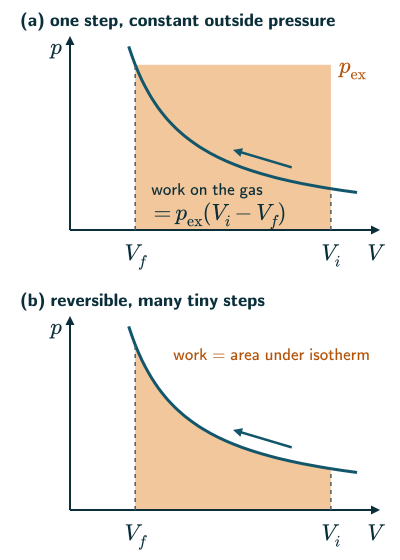
Reversible processes. If the external pressure is always only infinitesimally greater than the gas pressure (on compression) or smaller (on expansion), the volume changes by tiny steps dV and the work is −∫pexdV (NCERT Eq. 5.3, page 141).
A process or change is said to be reversible, if a change is brought out in such a way that the process could, at any moment, be reversed by an infinitesimal change.
NCERT Chemistry Part I (Class 11), Section 5.2.1, page 141
A reversible process follows equilibrium states in the limiting case, with no friction or other dissipative effects and no finite temperature difference for heat transfer; being slow alone is insufficient. Processes that fail these conditions are irreversible (pages 141–142; see also reversible processes in physics). Under reversible conditions pex can be replaced by the gas pressure p = nRT/V, and at constant temperature (NCERT Eqs. 5.4–5.5, page 142):
Reversible isothermal work, ideal gas
wrev = −nRT ln(Vf/Vi)
= −2.303 nRT log(Vf/Vi)
Between the same two volumes at the same temperature, the reversible path gives the most work in expansion and needs the least work on the gas in compression (compare the two shaded areas in the figure, and Examples 1 and 2).
Isothermal, free and adiabatic changes of an ideal gas. For a fixed amount and composition of ideal gas, U depends only on T. At constant T, ΔU = 0 and q = −w; ΔH = 0 too. In Joule’s insulated free-expansion experiment, w = 0 and q = 0, so temperature stays constant. Adiabatic means q = 0: temperature changes if work changes U, but not in this insulated free expansion (page 142):
| Change | Work and heat |
|---|---|
| insulated free expansion (pex = 0) | w = 0, q = 0 |
| isothermal, irreversible | q = −w = pex(Vf − Vi) |
| isothermal, reversible | q = −w = 2.303 nRT log(Vf/Vi) |
| adiabatic | q = 0, ΔU = wad |
No work is done in a free expansion, because pex = 0 (NCERT adds “whether the process is reversible or irreversible”, but a free expansion is always irreversible). With w = −pexΔV, the first law becomes ΔU = q − pexΔV; at constant volume (ΔV = 0) it reduces to ΔU = qV, the heat absorbed at constant volume (page 142).
Enthalpy
Most reactions are carried out not at constant volume but in open vessels at constant (atmospheric) pressure, so a second state function is needed (NCERT Section 5.2.2, page 143). At constant pressure, ΔU = qp − pΔV, which rearranges to qp = (U2 + pV2) − (U1 + pV1). Defining the enthalpy:
Enthalpy
H = U + pV, ΔH = qp
Heat in general depends on the path, but H depends only on U, p and V, all state functions, so ΔH, and therefore qp, is independent of path.
It is important to note that when heat is absorbed by the system at constant pressure, we are actually measuring changes in the enthalpy.
NCERT Chemistry Part I (Class 11), Section 5.2.2, page 143
At constant pressure ΔH = ΔU + pΔV (NCERT Eq. 5.8). ΔH is negative for exothermic reactions, which give out heat, and positive for endothermic ones, which absorb it. At constant volume ΔU = qV, but ΔH = ΔU + VΔp, which equals ΔU only if Δp = 0. For ideal gases at fixed volume and temperature, this corresponds to unchanged total gas amount; unchanged amount alone is insufficient if temperature changes. NCERT writes ΔH = ΔU = qV here (page 143); a bomb calorimeter works at constant volume, yet Example 4 has ΔH ≠ ΔU.
ΔH and ΔU for reactions of gases. For solids and liquids the volume hardly changes, so ΔH and ΔU differ very little. With gases, if nA mol of gaseous reactants (volume VA) give nB mol of gaseous products (volume VB) at the same p and T, the ideal gas law gives pΔV = (nB − nA)RT (page 143):
ΔH and ΔU
ΔH = ΔU + ΔngRT
where Δng is the moles of gaseous products minus the moles of gaseous reactants (NCERT Eq. 5.10). This form assumes ideal gases at the same temperature before and after reaction and neglects the small pV contribution of condensed phases.
Extensive and intensive properties
An extensive property is a property whose value depends on the quantity or size of matter present in the system.
NCERT Chemistry Part I (Class 11), Section 5.2.2, page 144
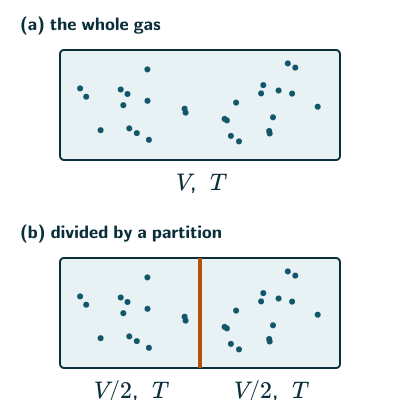
Mass, volume, internal energy, enthalpy and heat capacity are extensive. Properties that do not depend on the amount of matter, such as temperature, density and pressure, are intensive. A molar property, an extensive property divided by the amount n (molar volume Vm, molar heat capacity Cm), is intensive (page 144). If a partition halves a gas at volume V and temperature T, each part has volume V/2 but the same T: volume is extensive, temperature intensive (NCERT Fig. 5.6; see also extensive and intensive variables in physics).
Heat capacity
For a specified heating path and approximately constant heat capacity, q = CΔT; if C varies with temperature, use q = ∫C dT. In the constant-C approximation, the coefficient C, which depends on the size, composition and nature of the system, is its heat capacity (NCERT pages 144–145). A large C, as for water, means a small temperature rise for a given heat.
- Molar heat capacity, Cm = C/n: the heat needed to raise the temperature of one mole by one kelvin (or one degree Celsius).
- Specific heat (capacity), c: the heat needed to raise the temperature of unit mass by one kelvin, so q = c × m × ΔT = CΔT (NCERT Eq. 5.11).
Cp and CV for an ideal gas. At constant volume qV = CVΔT = ΔU; at constant pressure qp = CpΔT = ΔH. For one mole of an ideal gas ΔH = ΔU + Δ(pV) = ΔU + RΔT, so CpΔT = CVΔT + RΔT (NCERT Eqs. 5.12–5.13, page 145):
Mayer’s relation
Cp − CV = R
This is the same relation as in the heat capacities of gases in physics.
Solved examples
Example 1: Into a vacuum, and against 1 atm (NCERT Problems 5.2 and 5.3, page 142)
Two litres of an ideal gas at 10 atm expand isothermally at 25 °C to a total volume of 10 litres, (a) into a vacuum; (b) against a constant external pressure of 1 atm, with a mechanical stop at 10 L. Find the heat absorbed and the work done. The stop is necessary: the final gas pressure is 10 × 2/10 = 2 atm, so without it the gas would continue towards 20 L at equilibrium with 1 atm.
For an isothermal change of an ideal gas, q = −w = pex(Vf − Vi). (a) pex = 0, so q = −w = 0 × 8 = 0. (b) q = −w = 1 × (10 − 2) = 8 L atm, or 8 × 101.3 J, about 810 J.
Answer: (a) no work, no heat; (b) w = −8 L atm (about −810 J), q = +8 L atm.
Example 2: The same expansion done reversibly (NCERT Problem 5.4, pages 142–143)
Repeat the expansion from 2 L to 10 L at 298 K reversibly, for 1 mol of an ideal gas.
q = −w = 2.303 nRT log(Vf/Vi) = 2.303 × 1 × 0.08206 × 298 × log 5 = 2.303 × 0.08206 × 298 × 0.6990, about 39.37 L atm.
Answer: q = +39.37 L atm, w = −39.37 L atm, much more than the 8 L atm of the one-step expansion. NCERT calls this “the expansion given in problem 5.2, for 1 mol”, but the gas of Problem 5.2 (2 L at 10 atm and 298 K) is only 0.818 mol (1 mol at 298 K in 2 L would be at 12.2 atm, not 10 atm); for that gas q = pV ln 5 = 20 × 1.609, about 32.2 L atm. (NCERT’s working also prints Vs for Vi.)
Example 3: Δ*U* of vaporisation (NCERT Problem 5.5, pages 143–144)
Taking water vapour as an ideal gas, the molar enthalpy of vaporisation of water at 1 bar and 100 °C is 41 kJ mol−1. Find ΔU for vaporising 1 mol of water at 1 bar and 100 °C.
H2O(l) → H2O(g): Δng = 1. ΔU = ΔH − ΔngRT = 41 − 1 × 8.3 × 10−3 × 373 = 41 − 3.096.
Answer: the calculation gives 37.9 kJ mol−1, about 38 kJ mol−1 at the precision of the supplied 41; the rest of ΔH goes into pushing back the atmosphere.
Example 4: Burning cyanamide (NCERT Exercise 5.8, page 165)
Cyanamide, NH2CN(s), burns in a bomb calorimeter with ΔU = −742.7 kJ mol−1 at 298 K: NH2CN(s) + 3/2 O2(g) → N2(g) + CO2(g) + H2O(l). Find ΔH.
Gases: products N2 + CO2 = 2 mol, reactants 3/2 mol O2, so Δng = +0.5. ΔH = −742.7 + 0.5 × 8.314 × 10−3 × 298 = −742.7 + 1.24.
Answer: ΔH ≈ −741.5 kJ mol−1. NCERT’s question calls cyanamide a solid, NH2CN(s), but its equation writes NH2CN(g); the solid is right, and with (g) Δng would be −0.5.
Example 5: Warming aluminium (NCERT Exercise 5.9, page 166)
How much heat raises the temperature of 60.0 g of aluminium from 35 °C to 55 °C? Molar heat capacity of Al = 24 J mol−1 K−1.
n = 60.0/27.0 = 2.22 mol. q = nCmΔT = 2.22 × 24 × 20.
Answer: the unrounded result is 1067 J, or about 1.1 kJ to two significant figures.
Common mistakes to avoid
Common mistake
Counting liquids and solids in Δ*n*<sub>g</sub>
Only gases count. In NH2CN(s) + 3/2 O2 → N2 + CO2 + H2O(l), Δng = 2 − 1.5 = +0.5; the solid and the liquid water are left out.
Common mistake
Using kJ for Δ*H* and J for *RT*
R = 8.314 J mol−1 K−1, so ΔngRT comes out in joules. Convert to kJ (× 10−3) before adding it to a ΔH in kJ.
Common mistake
Using −*p*<sub>ex</sub>Δ*V* for a reversible change
−pexΔV holds for a constant external pressure. For a reversible isothermal change of an ideal gas use −2.303 nRT log(Vf/Vi).
Common mistake
Calling temperature extensive because it changes when you add heat
Extensive means “depends on how much matter there is”. Two equal cups of water at 30 °C mixed together are still at 30 °C: temperature is intensive.
Quick revision summary
- Work on a gas: w = −pexΔV at constant pex (positive on compression); reversible isothermal: w = −2.303 nRT log(Vf/Vi); free expansion: w = 0.
- Isothermal ideal gas: ΔU = 0, so q = −w.
- ΔU = qV; H = U + pV; ΔH = qp; ΔH = ΔU + ΔngRT.
- ΔH < 0 exothermic, ΔH > 0 endothermic.
- Extensive: mass, V, U, H, C. Intensive: T, p, density, molar quantities.
- q = CΔT = mcΔT; ideal gas Cp − CV = R.
Formula sheet
- w = −pex ΔV (constant external pressure)
- wrev = −2.303 nRT log(Vf/Vi) (isothermal, ideal gas)
- H = U + pV; ΔH = qp; ΔU = qV
- ΔH = ΔU + Δng RT
- q = C ΔT = m c ΔT; Cp − CV = R (per mole)
Questions students ask
What is the difference between enthalpy and internal energy?
Internal energy, U, is the microscopic energy within a system, while enthalpy, H = U + pV, adds the energy needed to make room for the system against the pressure of its surroundings; so, for a closed system with only pressure–volume work, ΔU is the heat absorbed at constant volume and ΔH the heat absorbed at constant pressure. For reactions of gases they differ by ΔngRT. Burning propane, C3H8(g) + 5O2(g) → 3CO2(g) + 4H2O(l), has Δng = 3 − 6 = −3, so at 298 K ΔH − ΔU = −3 × 8.314 × 298 J mol ≈ −7.43 kJ mol: ΔH is the more negative, because the surroundings do work on the shrinking gas.
Is enthalpy the same as heat?
No, enthalpy is not the same as heat: enthalpy, H = U + pV, is a property of the system and a state function, while heat is energy in transit whose amount depends on the path. The two are linked only through the enthalpy change of a process at constant pressure with no work other than pressure–volume work, ΔH = qp; at constant volume the heat absorbed equals ΔU instead. An isothermal expansion shows the difference: 1 mol of an ideal gas expanding reversibly to four times its volume at 300 K absorbs q = nRT ln 4 ≈ 3.46 kJ of heat, yet its ΔH = 0, because U and pV = nRT of an ideal gas depend only on temperature.
Is the free expansion of a gas reversible or irreversible?
The free expansion of a gas into a vacuum is always irreversible: the gas rushes through states that are not in equilibrium. No work is done, because pex = 0, and in an insulated apparatus no heat flows either (Joule’s experiment), so ΔU = 0 and the temperature stays the same: this insulated free expansion of an ideal gas is adiabatic and isothermal at once. Free expansion alone specifies zero external pressure, not thermal insulation. Its entropy still rises, by ΔS = nR ln(Vf/Vi), which is +5.76 J K for 1 mol doubling its volume, while the surroundings are unchanged, so the total entropy increases, the mark of an irreversible, spontaneous change.
What is the SI unit of enthalpy?
The SI unit of enthalpy is the joule (J), the unit of energy, since H = U + pV and pV has the unit Pa m = N m = J. Enthalpy is extensive, so tables give molar values in J mol or, more often, kJ mol, and a reaction enthalpy such as ΔrH⊖ in kJ mol is per mole of reaction, that is, for the amounts in the equation as written (see thermochemical equations). Engineering steam tables use the specific enthalpy, in kJ kg.
Practice questions
Try each question first, then open the answer to check your working.
-
Q1. ΔU⊖ of combustion of methane is −X kJ mol−1. Is ΔH⊖ (i) = ΔU⊖; (ii) > ΔU⊖; (iii) < ΔU⊖; (iv) = 0 (NCERT Exercise 5.4, page 165)?
Show answerHide answer
CH4(g) + 2O2(g) → CO2(g) + 2H2O(l): Δng = 1 − 3 = −2, so ΔH = ΔU − 2RT, more negative than ΔU. Answer (iii): ΔH⊖ < ΔU⊖.
-
Q2. One mole of an ideal gas expands isothermally and reversibly at 300 K from 10 L to 20 L. Find w and q.
Show answerHide answer
w = −2.303 × 1 × 8.314 × 300 × log 2 = −2.303 × 8.314 × 300 × 0.3010, about −1.73 × 10³ J. Since ΔU = 0, q = +1.73 kJ.
-
Q3. Sort into extensive and intensive: amount of substance, weight, specific heat capacity, boiling point, molarity, refractive index.
Show answerHide answer
Extensive: amount of substance, weight. Intensive: specific heat capacity (heat capacity per unit mass, a ratio of two extensive quantities), boiling point, molarity, refractive index.