Calorimetry: measuring ΔU and ΔH
NCERT Class 11 Chemistry Chapter 5 Section 5.3
Quick answer
Calorimetry uses a measured temperature change and known heat capacity to find heat: ideally q(reaction) = −C ΔT for the complete calorimeter. A sealed, rigid bomb gives ΔU after corrections for other energy inputs, while a constant-pressure solution experiment gives ΔH when matter loss and non-expansion work are negligible. Heat leakage and the vessel’s heat capacity must be accounted for.
With your textbook
NCERT Chemistry Part I (Class 11), Chapter 5 “Thermodynamics”, Section 5.3 “Measurement of ΔU and ΔH: Calorimetry”, pages 145–146.
Open the official NCERT chapter (PDF, 5.1 MB, ncert.nic.in) (opens in a new tab)
Checked against the 2026-27 reprint on .
What is calorimetry?
Calorimetry
Assume negligible heat leakage, approximately constant total heat capacity and no unaccounted work or material loss. Ignition, stirring and side-reaction corrections are neglected in the elementary examples.
Calorimetry measures the heat of a chemical or physical change from the temperature change it causes in a calorimeter of known heat capacity (NCERT Section 5.3, pages 145–146):
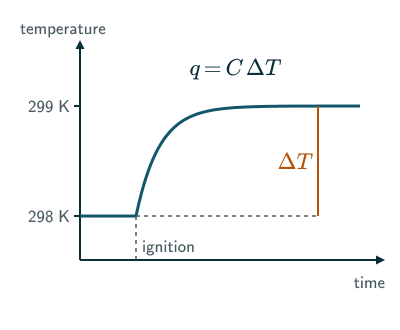
- the heat taken up by the calorimeter is q = CΔT; the reaction gives out the same amount, so its heat is −CΔT;
- in a sealed, rigid bomb calorimeter the volume is constant, no pressure–volume work is done and the heat measured is qV = ΔU;
- in a calorimeter open to the atmosphere the pressure is constant and the heat measured is qp = ΔH, the heat (enthalpy) of reaction.
In plain words: you cannot see heat, but you can see what it does to a thermometer. Let the reaction warm (or cool) a well-insulated container of water whose heat capacity you know. Multiply the temperature change by the heat capacity and you have the heat; then flip the sign, because whatever the water gained, the reaction lost.
We can measure energy changes associated with chemical or physical processes by an experimental technique called calorimetry.
NCERT Chemistry Part I (Class 11), Section 5.3, page 145
The process is carried out in a vessel, the calorimeter, immersed in a known volume of liquid. Knowing the heat capacities of the liquid and of the calorimeter, the heat evolved is found from the temperature change (page 145). The C in q = CΔT is the heat capacity of everything that warms, the liquid plus the vessel: C = mwatercwater + Cvessel. Some problems give the vessel as a ‘water equivalent’, the mass of water with the same heat capacity. The same idea, heat lost by one body equals heat gained by another, is the method of mixtures in physics. Measurements are made under two conditions: constant volume and constant pressure.
ΔU: the bomb calorimeter
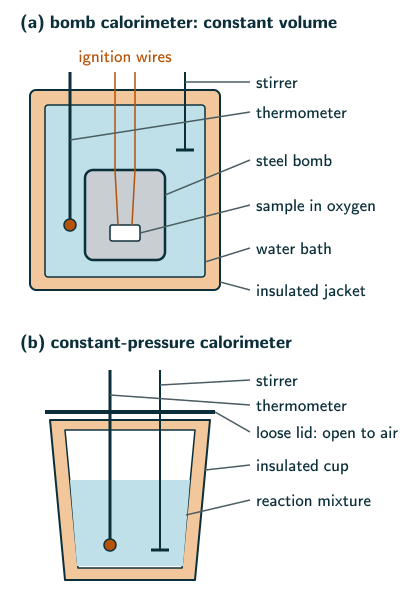
For combustion reactions, the heat absorbed at constant volume is measured in a bomb calorimeter (NCERT Fig. 5.7, page 145). A steel vessel, the bomb, is immersed in a water bath inside an insulated jacket to minimise heat loss to the surroundings. The combustible substance is burnt in pure oxygen inside the bomb, and the heat evolved passes into the water, whose temperature is monitored.
Since the bomb calorimeter is sealed, its volume does not change i.e., the energy changes associated with reactions are measured at constant volume.
NCERT Chemistry Part I (Class 11), Section 5.3, page 145
The bomb is both sealed and rigid: sealing alone does not fix volume. Because ΔV = 0, no pressure–volume work is done, even when gases are formed or used up. The temperature change of the calorimeter is converted to qV = ΔU using its known heat capacity (NCERT Eq. 5.11).
ΔH: constant-pressure calorimetry
Heat changes at constant (usually atmospheric) pressure are measured in a calorimeter open to the air (NCERT Fig. 5.8, page 146). For a closed reacting system with only pressure–volume work, ΔH = qp, so the heat absorbed or evolved at constant pressure is also called the heat of reaction or enthalpy of reaction, ΔrH (page 146).
- In an exothermic reaction heat is evolved: the system loses heat, so qp and ΔrH are negative, and the calorimeter warms.
- In an endothermic reaction heat is absorbed: qp and ΔrH are positive, and the calorimeter cools.
A simple version, often called a coffee-cup calorimeter, is two nested polystyrene cups with a loose lid, a thermometer and a stirrer; the cups keep heat in while the lid lets the pressure stay at that of the air.
Solved examples
Example 1: Burning graphite (NCERT Problem 5.6, page 146)
1 g of graphite is burnt in excess oxygen in a bomb calorimeter at 298 K and 1 atm: C(graphite) + O2(g) → CO2(g). The temperature rises from 298 K to 299 K, and the heat capacity of the calorimeter is 20.7 kJ K−1. Find the enthalpy change at 298 K and 1 atm.
Heat gained by the calorimeter = CΔT (NCERT writes CV) = 20.7 × (299 − 298) = 20.7 kJ. The reaction lost the same amount: q = −20.7 kJ, so ΔU = −20.7 kJ for 1 g. For 1 mol (12.0 g): ΔU = −20.7 × 12.0 = −2.48 × 10² kJ mol−1. Gases: 1 mol CO2 formed, 1 mol O2 used, so Δng = 0 and ΔH = ΔU.
Answer: ΔH = −2.48 × 10² kJ mol−1. Two notes on NCERT’s working: it gives ΔU for 1 g as “−20.7 kJK−1”, but the unit is kJ; and its numbers do not fit real graphite, which gives −393.5 kJ mol−1, the value NCERT itself uses in Exercises 5.5 and 5.11, so 1 g would warm this calorimeter by about 1.6 K, not 1 K.
Example 2: A reaction in a constant-pressure calorimeter
A reaction in solution is carried out in an insulated cup. The cup and its contents have a total heat capacity of 1.50 kJ K−1, and the temperature rises by 2.40 K when 0.0500 mol of the limiting reactant reacts. Find ΔrH per mole of that reactant.
Heat gained by the cup and solution = 1.50 × 2.40 = 3.60 kJ, so qp = −3.60 kJ for 0.0500 mol. Per mole: −3.60/0.0500.
Answer: ΔrH = −72.0 kJ mol−1 (exothermic).
Example 3: Calibrating a bomb calorimeter (beyond the NCERT text)
Burning 1.00 g of benzoic acid, whose energy of combustion is 26.4 kJ g−1, raises the temperature of a bomb calorimeter by 2.64 K. Find the calorimeter’s heat capacity.
The heat released, 26.4 kJ, is all taken up by the calorimeter: C = 26.4/2.64.
Answer: C = 10.0 kJ K−1. Benzoic acid is the usual standard because it burns cleanly and its energy of combustion is accurately known.
Example 4: An endothermic dissolution
When a salt dissolves in water in an insulated cup, 100 g of solution (c = 4.18 J g−1 K−1) cools by 2.0 K (ignore the heat capacity of the cup). What is the heat of the dissolution?
The solution lost m c ΔT = 100 × 4.18 × 2.0 = 836 J of heat to the dissolving salt. So the process absorbed 836 J.
Answer: qp ≈ +8.4 × 10² J (836 J before rounding): endothermic, ΔH positive.
Common mistakes to avoid
Common mistake
Forgetting to change the sign
The calorimeter gains what the reaction loses. If the calorimeter warms, the reaction is exothermic and its q is negative.
Common mistake
Reading a bomb calorimeter result as ΔH
A bomb calorimeter gives ΔU (constant volume). Convert with ΔH = ΔU + ΔngRT unless Δng = 0, as for graphite burning to CO2.
Common mistake
Using the mass of the sample in q = mcΔT
In q = mcΔT for a coffee-cup calorimeter, m and c are those of the solution that changes temperature (plus the cup’s heat capacity, if given), not the mass of the reacting solid.
Quick revision summary
- Calorimetry: heat of a process = −(heat capacity of calorimeter) × ΔT.
- Bomb calorimeter: sealed and rigid, constant volume, no pressure–volume work: measures ΔU = qV.
- Open (constant-pressure) calorimeter: measures ΔH = qp, the enthalpy of reaction ΔrH.
- Exothermic: ΔrH < 0, calorimeter warms. Endothermic: ΔrH > 0, calorimeter cools.
- Bomb results are converted with ΔH = ΔU + ΔngRT.
Formula sheet
- q(calorimeter) = C ΔT; q(reaction) = −C ΔT
- Bomb calorimeter: qV = ΔU
- Constant-pressure calorimeter: qp = ΔH
- ΔH = ΔU + Δng RT
Questions students ask
What is the difference between a bomb calorimeter and a coffee-cup calorimeter?
A bomb calorimeter is a sealed steel vessel in which a sample is burnt in oxygen at constant volume, so it measures ΔU, while a coffee-cup calorimeter is a pair of insulated cups with a loose lid in which a reaction in solution runs at the constant pressure of the air, so it measures ΔH. The bomb, built to hold oxygen under pressure and the burning sample, is used for the combustion of fuels and foods, and its heat capacity must be found accurately by calibration; the cup is used for neutralisation, dissolving and other reactions in water, and most of its heat capacity is that of the solution, mc.
Is a coffee-cup calorimeter an open or a closed system?
A coffee-cup calorimeter is, strictly, an open system: its loose lid lets air, and any gas the reaction gives off, pass in or out, and that keeps the pressure equal to atmospheric pressure. For the usual nonvolatile solution experiment the reacting material is approximately closed, with only pressure–volume work, so its heat is ΔH. Significant evaporation or escaping reaction gases requires accounting for energy carried by matter. Its insulated walls let almost no heat through, so for the energy balance it is treated as adiabatic: the heat of the reaction stays in the solution and the cups. A bomb calorimeter is different: the steel bomb is a closed system, sealed against matter but passing heat to the water around it, and the whole assembly inside its insulated jacket is treated as isolated.
How do you find the heat capacity of a calorimeter?
The heat capacity of a calorimeter is found by calibration: supply a known amount of heat, measure the temperature rise and divide, C = q/ΔT. The heat can come from burning a weighed standard whose energy of combustion is accurately known, such as benzoic acid, or from an electric heater, whose electrical work input is E = VIt (the calibration heat equivalent): a heater working at 12.0 V and 2.50 A for 120 s supplies 3600 J, and if the temperature rises by 0.450 K, C = 3600/0.450 = 8.00 × 10 J K, or 8.00 kJ K. For a simple beaker calorimeter, mixing hot and cold water gives the calorimeter constant in the same way.
Is the bomb calorimeter in the JEE Main 2027 and NEET (UG) 2026 syllabuses?
The bomb calorimeter is not named in the JEE Main 2027 (NTA) or NEET (UG) 2026 (NMC) Chemistry syllabus: Unit 4, Chemical Thermodynamics, lists work, heat, internal energy and enthalpy, heat capacity and molar heat capacity, but not calorimetry. Measuring ΔU at constant volume and ΔH at constant pressure is how those quantities are found, and NCERT Class 11 Chemistry covers it in Section 5.3, so questions that give a heat measured at constant volume and ask for ΔH belong to that unit. Calorimetry itself is named in Physics Unit 7 of both syllabuses, for the method of mixtures.
How does a bomb calorimeter measure the calories in food?
A bomb calorimeter measures the energy in food by burning a dried, weighed sample completely in oxygen and finding the heat released from the calorimeter’s temperature rise, q = CΔT; dividing by the mass gives the energy per gram, which labels give in kcal (the food Calorie) or kJ. The body does not get all of this energy: some fibre is not metabolised, while fermentable fibre can supply some energy; protein is only partly oxidised, its nitrogen leaving as urea. So nutrition labels use average factors of about 17 kJ g (4 kcal g) for carbohydrate and protein and 37 kJ g (9 kcal g) for fat, rather than the raw bomb values.
Practice questions
Try each question first, then open the answer to check your working.
-
Q1. Glucose burns as C6H12O6(s) + 6O2(g) → 6CO2(g) + 6H2O(l). Is the enthalpy of combustion different from the ΔU measured in a bomb calorimeter?
Show answerHide answer
Approximately equal: 6 mol of gas is used and 6 mol formed, so Δng = 0 and ΔH ≈ ΔU when condensed-phase pV changes are neglected.
-
Q2. 1.00 g of a fuel burnt in a bomb calorimeter of heat capacity 8.50 kJ K−1 raises the temperature by 3.20 K. Find ΔU of combustion per gram.
Show answerHide answer
Heat gained by the calorimeter = 8.50 × 3.20 = 27.2 kJ. So ΔU = −27.2 kJ g−1.
-
Q3. Which calorimeter measures an enthalpy change directly, and why?
Show answerHide answer
The constant-pressure (open) calorimeter, because at constant pressure the heat absorbed equals ΔH for the closed reacting material when only pressure–volume work occurs. A sealed, rigid bomb keeps the volume constant, so it measures ΔU.