Gibbs energy change and the equilibrium constant
NCERT Class 11 Chemistry Chapter 5 Section 5.7
Quick answer
For a closed system at fixed temperature and pressure, reaction equilibrium occurs at a minimum of total Gibbs energy, with zero reaction Gibbs energy. The standard reaction Gibbs energy equals minus RT times the natural logarithm of the dimensionless equilibrium constant. Actual direction also depends on the reaction quotient, so a positive standard value does not prevent forward reaction when Q is less than K.
With your textbook
NCERT Chemistry Part I (Class 11), Chapter 5 “Thermodynamics”, Section 5.7 “Gibbs Energy Change and Equilibrium”, pages 162–163.
Open the official NCERT chapter (PDF, 5.1 MB, ncert.nic.in) (opens in a new tab)
Checked against the 2026-27 reprint on .
Gibbs energy and equilibrium
Gibbs energy change and equilibrium
For a closed system at constant temperature and pressure with no imposed non-expansion work, a reacting mixture moves towards lower Gibbs energy and comes to equilibrium where its Gibbs energy is a minimum, so that the Gibbs energy change of the reaction is zero (NCERT Section 5.7, pages 162–163):
- at equilibrium, ΔrG = 0;
- the standard Gibbs energy change fixes the equilibrium constant: ΔrG⊖ = −RT ln K = −2.303 RT log K;
- a negative ΔrG⊖ means K > 1 (products favoured); a positive one means K < 1;
- since ΔrG⊖ = ΔrH⊖ − TΔrS⊖, enthalpy and entropy data give an estimate of K at other temperatures (taking ΔrH⊖ and ΔrS⊖ as roughly constant).
In plain words: Gibbs energy is like height on a hillside, with the reaction mixture rolling downhill. For a typical gas or solution reaction, the equilibrium mixture sits at the bottom of a valley in Gibbs energy. This schematic does not apply unchanged to pure-solid transformations, where one phase can disappear entirely. The lower pure products sit compared with pure reactants (the more negative ΔrG⊖), the further towards products the bottom lies, and the larger K.
The criterion for equilibrium
The sign and size of the Gibbs energy change let us predict whether a reaction is spontaneous and how much useful work it could give (NCERT Section 5.7, page 162). In the strict thermodynamic sense, “reversible” means carried out so that the system is at every moment in equilibrium with its surroundings (see reversible processes); a chemically reversible reaction can proceed in both directions, but this is not the same as a thermodynamically reversible path. At dynamic equilibrium the forward and reverse rates are equal, with no net driving force: neither direction requires a negative reaction Gibbs energy there.
It is possible only if at equilibrium the free energy of the system is minimum.
NCERT Chemistry Part I (Class 11), Section 5.7, page 162
If the system is not at the minimum, it changes spontaneously towards it. So, for A + B ⇌ C + D, the criterion for equilibrium is ΔrG = 0.
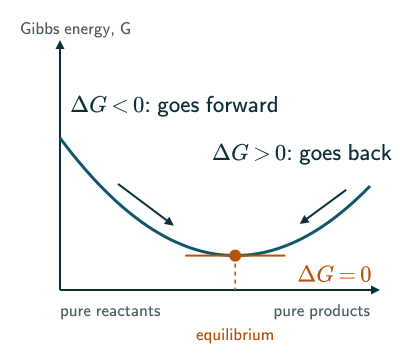
Standard Gibbs energy and the equilibrium constant
ΔrG⊖ is the Gibbs energy change with reactants and products all in their standard states. The reaction Gibbs energy is the change in total G per infinitesimal advance of reaction, at the current composition; it is not the total finite change between pure endpoints. In any mixture ΔrG = ΔrG⊖ + RT ln Q, where Q is the reaction quotient (see K, Q and Gibbs energy in Unit 6). At equilibrium ΔrG = 0 and Q = K, so 0 = ΔrG⊖ + RT ln K (NCERT Eqs. 5.23–5.24, page 162):
Gibbs energy and K
ΔrG⊖ = −RT ln K = −2.303 RT log K
With enthalpy and entropy
ΔrG⊖ = ΔrH⊖ − TΔrS⊖ = −RT ln K
At 298 K, 2.303 RT = 5.71 kJ mol−1, so each 5.71 kJ mol−1 by which ΔrG⊖ is more negative makes K ten times larger.
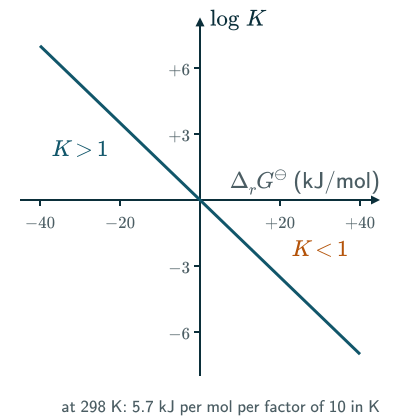
What this tells us (NCERT page 162):
- For an endothermic reaction, a positive ΔrH⊖ tends to reduce K, but a sufficiently favourable entropy term can outweigh it. Enthalpy alone cannot determine K.
- For an exothermic reaction, negative ΔrH⊖ tends to increase K. A large K follows only when the full ΔrG⊖ is sufficiently negative at that temperature.
We may expect strongly exothermic reactions to have a large K, and hence can go to near completion.
NCERT Chemistry Part I (Class 11), Section 5.7, page 162
- ΔrS⊖ also matters: depending on its sign, it raises or lowers K.
- Two practical uses (page 163): ΔrG⊖ estimated from measured ΔH⊖ and ΔS⊖ gives an estimate of K at other temperatures, to choose conditions for economic yields; and if K is measured in the laboratory, ΔrG⊖ follows, at that temperature. Extrapolating to other temperatures also requires enthalpy/entropy data (or the temperature dependence of K); one K measurement alone is insufficient.
Equilibrium constants themselves, and how concentrations shift, are the subject of the next unit, Equilibrium.
Solved examples
Example 1: Oxygen to ozone (NCERT Problem 5.12, page 163)
Calculate ΔrG⊖ for 3/2 O2(g) → O3(g) at 298 K if Kp = 2.47 × 10⁻²⁹.
ΔrG⊖ = −2.303 RT log Kp = −2.303 × 8.314 × 298 × log(2.47 × 10⁻²⁹) = −5706 × (−28.61).
Answer: ΔrG⊖ ≈ +163 000 J mol−1 = +163 kJ mol−1: the equilibrium lies almost entirely on the oxygen side.
Example 2: Making urea (NCERT Problem 5.13, page 163)
Find K at 298 K for 2NH3(g) + CO2(g) ⇌ NH2CONH2(aq) + H2O(l), given ΔrG⊖ = −13.6 kJ mol−1.
log K = −ΔrG⊖/(2.303 RT) = 13 600/
Answer: K = 102.38, about 2.4 × 10². (NCERT’s working shows the numerator as (−13.6 × 10³ J mol−1) without the leading minus of −ΔrG⊖; taken literally that gives −2.38, though NCERT’s result, 2.38, is right.)
Example 3: Dinitrogen tetroxide at 60 °C (NCERT Problem 5.14, page 163)
At 60 °C, N2O4 is 50% dissociated. Find the standard free energy change at this temperature and 1 atm.
T = 60 + 273 = 333 K. N2O4(g) ⇌ 2NO2(g). Starting from 1 mol, 0.5 mol remains and 1 mol of NO2 forms: 1.5 mol in all. Partial pressures: p(N2O4) = 0.5/1.5 atm, p(NO2) = 1/1.5 atm. Kp = (1/1.5)2/(0.5/1.5) = 1.33 (pressures in atm divided by the 1 atm standard, so Kp is a pure number). This explicitly uses the older 1 atm standard; with the modern 1 bar standard at the same total pressure, K = (4/3) × 1.01325 ≈ 1.351 and ΔG° ≈ −0.83 kJ mol−1. Returning to the stated 1 atm reference, ΔrG⊖ = −RT ln Kp = −8.314 × 333 × ln 1.333 = −8.314 × 333 × 0.2877.
Answer: ΔrG⊖ ≈ −796 J mol−1, about −0.80 kJ mol−1. NCERT prints −763.8 kJ mol−1. Its own working, −8.314 × 333 × 2.303 × 0.1239 (log 1.33 = 0.1239 is right), comes to about −790, and that is in joules, not kilojoules. The small gap from −796 is only because NCERT rounds Kp to 1.33.
Example 4: From K to Δ<sub>r</sub>G<sup>⊖</sup> (NCERT Exercise 5.20, page 167)
The equilibrium constant for a reaction is 10. What is ΔrG⊖? R = 8.314 J K−1 mol−1, T = 300 K.
ΔrG⊖ = −2.303 RT log K = −2.303 × 8.314 × 300 × log 10 = −2.303 × 8.314 × 300 × 1.
Answer: ΔrG⊖ ≈ −5744 J mol−1, about −5.74 kJ mol−1.
Common mistakes to avoid
Common mistake
Confusing ΔG with ΔG<sup>⊖</sup>
At equilibrium ΔrG = 0, but ΔrG⊖ is usually not zero; it is −RT ln K. ΔrG⊖ = 0 only when K = 1.
Common mistake
Using kJ with R in J
R = 8.314 J K−1 mol−1, so −RT ln K comes out in joules. Convert ΔG⊖ to J (or R to kJ) first; this is exactly the slip in NCERT Problem 5.14.
Common mistake
Mixing ln and log
ΔrG⊖ = −RT ln K = −2.303 RT log K. Use the factor 2.303 only with log (base 10).
Quick revision summary
- Equilibrium: Gibbs energy of the system is a minimum; ΔrG = 0.
- ΔrG⊖ = −RT ln K = −2.303 RT log K.
- ΔrG⊖ < 0: K > 1, products favoured; ΔrG⊖ > 0: K < 1.
- At 298 K, 5.71 kJ mol−1 in ΔrG⊖ corresponds to a factor of 10 in K.
- ΔrG⊖ = ΔrH⊖ − TΔrS⊖ lets K be estimated at other temperatures (ΔrH⊖, ΔrS⊖ taken as constant).
Formula sheet
- ΔrG = 0 at reaction equilibrium (constant T, p)
- ΔrG⊖ = −RT ln K = −2.303 RT log K
- ΔrG⊖ = ΔrH⊖ − TΔrS⊖
- At 298 K: 2.303 RT = 5.71 kJ mol
Questions students ask
How is the standard Gibbs energy change related to the cell potential?
The standard Gibbs energy change of a cell reaction is ΔrG⊖ = −nFE⊖cell, where n is the moles of electrons transferred and F = 96 485 C mol, so a positive standard cell potential means a negative ΔrG⊖ : the cell reaction is spontaneous under standard conditions. With ΔrG⊖ = −RT ln K it links all three: for the Daniell cell, Zn(s) + Cu2+(aq) → Zn2+(aq) + Cu(s), with E⊖ = 1.10 V and n = 2, ΔrG⊖ = −2 × 96 485 × 1.10 J mol ≈ −212 kJ mol and K ≈ 1.6 × 10 at 298 K. This is Class 12 Electrochemistry.
Should Kp or Kc be used in ΔrG⊖ = −RT ln K?
In ΔrG⊖ = −RT ln K, K is the thermodynamic equilibrium constant: it is built from dimensionless activities. For ideal gases these reduce to partial pressures divided by 1 bar, and for ideal dilute solutes to concentration divided by the specified standard concentration, often 1 mol L; nonideal systems need activity or fugacity corrections. Thus K has no unit; in the ideal-gas case it is numerically the Kp expression formed using pressures in bar. Using Kc for a gas reaction gives ΔrG⊖ for a different standard state, 1 mol L, unless Δng = 0, as for H2(g) + I2(g) ⇌ 2HI(g). Pure solids and pure liquids present as separate phases have unit activity and do not appear explicitly in K.
Can a reaction with a positive standard Gibbs energy change still take place?
Yes, a reaction with a positive ΔrG⊖ still takes place to some extent: it only means K < 1, so that reactants are favoured at equilibrium, not that no products form. At 298 K a reaction with ΔrG⊖ = +20.0 kJ mol has log K = −20 000/5706 ≈ −3.51, so K ≈ 3.1 × 10. Whether a given mixture reacts forward depends on ΔrG = ΔrG⊖ + RT ln Q, negative whenever Q < K, as when the products are removed as fast as they form.
What is the standard Gibbs energy change for diamond turning into graphite?
For C(diamond) → C(graphite) at 298 K, ΔrG⊖ ≈ −2.9 kJ mol (standard data), so graphite is the stable form at 1 bar and diamond can turn into it spontaneously. In practice the change is immeasurably slow at room temperature, because the strong C–C bonds of diamond would have to break first, so diamonds last: spontaneity gives the direction, not the rate. Both forms are pure solids, so there is no equilibrium mixture for K to describe: whichever form has the lower Gibbs energy is the stable one, and diamond becomes the stable form only above about 1.5 × 10 bar at room temperature.
Practice questions
Try each question first, then open the answer to check your working.
-
Q1. For 3/2 O2(g) → O3(g), Kp = 2.47 × 10⁻²⁹ and ΔrG⊖ = +163 kJ mol−1 at 298 K (NCERT Problem 5.12). What are ΔrG⊖ and K for 3O2(g) → 2O3(g)?
Show answerHide answer
Doubling the equation doubles ΔrG⊖ to +326 kJ mol−1 and squares K: (2.47 × 10⁻²⁹)2, about 6.1 × 10−58.
-
Q2. A reaction has ΔrG⊖ = +10.0 kJ mol−1 at 298 K. Find K.
Show answerHide answer
log K = −10 000/
(2.303 × 8.314 × 298) = −10 000/5706, about −1.75. K = 10−1.75, about 0.018. -
Q3. Two reactions at 298 K have equilibrium constants 104 and 10−2. By how much do their ΔrG⊖ values differ?
Show answerHide answer
A factor of 106 in K is 6 × 5.71 = 34.2 kJ mol−1 in ΔrG⊖. The first is −22.8 kJ mol−1, the second +11.4 kJ mol−1.