Applications of equilibrium constants
NCERT Class 11 Chemistry Chapter 6 Section 6.6
Quick answer
An equilibrium constant helps predict a reaction’s favoured direction and calculate its equilibrium composition. Compare the current reaction quotient with the matching constant for direction, then combine the equilibrium expression with mass balance for amounts. A large or small constant alone does not specify percentage conversion or reaction speed.
With your textbook
NCERT Chemistry Part I (Class 11), Chapter 6 “Equilibrium”, Section 6.6 “Applications of Equilibrium Constants”, pages 181–184.
Open the official NCERT chapter (PDF, 5.7 MB, ncert.nic.in) (opens in a new tab)
Checked against the 2026-27 reprint on .
What can the equilibrium constant tell us?
Three uses of K
Once K is known for a reaction at a given temperature, it can be used to (NCERT Section 6.6, pages 181–184):
- predict the extent of the reaction: a large K favours products in the equilibrium expression, a small K reactants; actual conversion also needs stoichiometry and starting amounts;
- predict the direction a mixture will move: compare K with the reaction quotient Q, worked out from the concentrations at that moment;
- calculate equilibrium concentrations from the starting ones, using a table of initial, change and equilibrium amounts.
In plain words: K is the target ratio of products to reactants. If you know where a mixture is now (Q) and where it must end up (K), you know which way it will go and, with a little algebra, exactly where it stops. What K cannot tell you is how fast it gets there.
NCERT first lists the main features of K (page 181): the reaction quotient equals K at equilibrium (constant concentrations alone could also describe a kinetically frozen or driven steady state); K does not depend on the starting concentrations; it depends on temperature, with one value at each temperature for a reaction written as a particular balanced equation; reversing the equation inverts it; and multiplying or dividing the equation by a small integer changes it in a related way (multiplying by n raises K to the power n; dividing by n gives K1/n).
Predicting the extent of a reaction
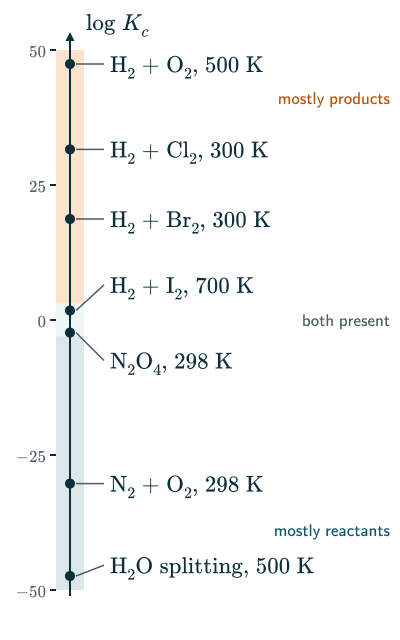
The numerical value of the equilibrium constant for a reaction indicates the extent of the reaction.
NCERT Chemistry Part I (Class 11), Section 6.6.1, page 181
These thresholds are a textbook guide, not universal percentage-conversion rules. For A ⇌ 2B starting at concentration c, Kc = 4cα/(1 − α): even a small Kc can give α near 1 if c is sufficiently small. Use the equilibrium expression together with mass balance. K says nothing about the rate at which equilibrium is reached.
- Kc > 103: products are strongly favoured in the usual textbook mixtures. Examples: 2H2(g) + O2(g) ⇌ 2H2O(g) at 500 K, Kc = 2.4 × 1047; H2(g) + Cl2(g) ⇌ 2HCl(g) at 300 K, Kc = 4.0 × 1031; H2(g) + Br2(g) ⇌ 2HBr(g) at 300 K, Kc = 5.4 × 10¹⁸.
- Kc < 10−3: reactants are strongly favoured in the usual textbook mixtures. Examples: decomposition of H2O into H2 and O2 at 500 K, Kc = 4.1 × 10−48 (the same reaction reversed: 1/(2.4 × 1047)); N2(g) + O2(g) ⇌ 2NO(g) at 298 K, Kc = 4.8 × 10⁻³¹.
- Kc between 10−3 and 103: both may be appreciable, depending on loading and stoichiometry. Examples: H2 + I2 ⇌ 2HI, Kc = 57.0 at 700 K; N2O4 ⇌ 2NO2, Kc = 4.64 × 10⁻³ at 25 °C.
The value NCERT gives for HCl looks low: standard data (ΔfH⊖(HCl) = −92.3 kJ mol−1 and standard entropies) give about 1.6 × 1033 at 300 K. Either value predicts very high conversion in a stoichiometric textbook mixture; finite equilibrium constants do not mean mathematically complete conversion.
Predicting the direction of a reaction
The reaction quotient Q is written exactly like K, but with the concentrations (Qc) or partial pressures (Qp) at any moment, not necessarily at equilibrium (NCERT Section 6.6.2, page 182). For aA + bB ⇌ cC + dD:
Reaction quotient
Qc = [C]c[D]d/([A]a[B]b) (any moment)
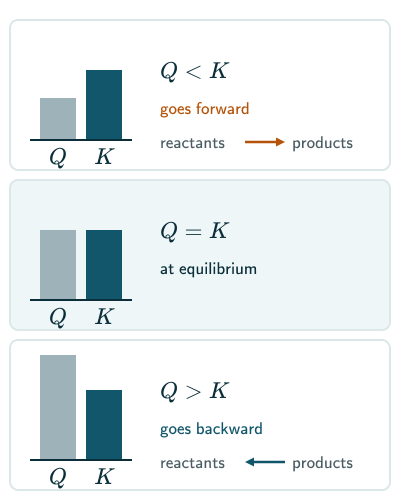
For the same reaction, temperature and concentration/pressure convention, comparing Q with K gives the thermodynamically favoured direction. These concentration expressions assume an ideal gas or dilute ideal solution; real systems use activities. They do not predict the rate:
- Q < K: too few products; net reaction goes forward (left to right);
- Q > K: too many products; net reaction goes backward (right to left);
- Q = K: the mixture is already at equilibrium; no net reaction.
NCERT’s example (page 182): for H2(g) + I2(g) ⇌ 2HI(g), Kc = 57.0 at 700 K. A mixture with [H2] = 0.10 M, [I2] = 0.20 M and [HI] = 0.40 M has Qc = (0.40)2/(0.10 × 0.20) = 8.0. Since 8.0 < 57.0, more H2 and I2 react to form HI until Qc = Kc. The same comparison has a thermodynamic meaning: ΔrG = ΔrG⊖ + RT ln Q, which is negative while Q < K (see K, Q and Gibbs energy and Gibbs energy and equilibrium).
Calculating equilibrium concentrations
When only the starting amounts are known, NCERT’s method is (Section 6.6.3, page 183):
- Write the balanced equation.
- At fixed volume, make a table of the initial concentration, the change on going to equilibrium, and the equilibrium concentration of each substance. Call the change in one substance x and use the coefficients to write the others in terms of x.
- Put the equilibrium concentrations into the K expression and solve for x; if it is a quadratic, keep the root that makes chemical sense.
- Work out the equilibrium concentrations from x.
- Check the answer by putting it back into the K expression.
If the volume changes, first tabulate amounts in moles and then divide each equilibrium amount by the final volume.
Shortcut: if both sides of the equation in x are perfect squares (equal starting amounts in A + B ⇌ C + D, for example), take square roots first instead of solving a quadratic.
Solved examples
Example 1: Which way? (NCERT Problem 6.7, pages 182–183)
For 2A ⇌ B + C, Kc = 2 × 10⁻³. At some moment [A] = [B] = [C] = 3 × 10⁻⁴ M. In which direction will the reaction go?
Qc = [B][C]/[A]2 = (3 × 10⁻⁴)(3 × 10⁻⁴)/
Answer: Qc = 1 > Kc = 2 × 10⁻³, so the reaction goes in the reverse direction, forming A.
Example 2: N<sub>2</sub>O<sub>4</sub> in a 1 L flask (NCERT Problem 6.8, page 183)
13.8 g of N2O4 is placed in a 1 L vessel at 400 K. At equilibrium, N2O4(g) ⇌ 2NO2(g), the total pressure is 9.15 bar. Find the partial pressures, Kp and Kc.
n = 13.8/92 = 0.15 mol, so the starting pressure is p = nRT/V = 0.15 × 0.083 × 400/1 = 4.98 bar (R = 0.083 bar L mol−1 K−1, as NCERT uses). If N2O4 falls by x bar, NO2 rises by 2x: total = (4.98 − x) + 2x = 9.15, so x = 4.17 bar. Then pN2O4 = 0.81 bar and pNO2 = 8.34 bar.
Answer: Kp = (8.34)2/0.81 ≈ 85.9 bar, and Kc = Kp/(RT) = 85.9/(0.083 × 400) ≈ 2.6 mol L−1. (These data do not fit the real reaction: NCERT’s own Table 6.5 gives Kp = 47.9 at 400 K, which would give about 8.76 bar in total, not 9.15 bar. In exams, use the problem’s numbers.)
Example 3: PCl<sub>5</sub> in a closed vessel (NCERT Problem 6.9, pages 183–184)
3.00 mol of PCl5 in a 1 L vessel reaches equilibrium at 380 K; Kc = 1.80 for PCl5 ⇌ PCl3 + Cl2. Find the composition.
If x mol L−1 of PCl5 dissociates: [PCl5] = 3.00 − x, [PCl3] = [Cl2] = x. So x2/(3.00 − x) = 1.80, that is x2 + 1.80x − 5.40 = 0, and x = [−1.80 + √(3.24 + 21.6)]/2 = (−1.80 + 4.98)/2 = 1.59 (the other root is negative).
Answer: [PCl3] = [Cl2] ≈ 1.59 M, [PCl5] ≈ 1.41 M. Check: (1.59)2/1.41 ≈ 1.79. (NCERT Problem 6.3 gives these same concentrations, so the same Kc ≈ 1.8, at 500 K; these are stipulated exercise datasets, not a consistent reference dataset for the temperature dependence of this endothermic dissociation.)
Example 4: Following the HI mixture to equilibrium
Take NCERT’s mixture at 700 K, [H2] = 0.10 M, [I2] = 0.20 M, [HI] = 0.40 M (Qc = 8.0, Kc = 57.0). Find the equilibrium concentrations.
Q < K, so the reaction goes forward: [H2] = 0.10 − x, [I2] = 0.20 − x, [HI] = 0.40 + 2x. Then (0.40 + 2x)2/
Answer: [H2] ≈ 0.036 M, [I2] ≈ 0.136 M, [HI] ≈ 0.528 M. Check: (0.528)2/(0.036 × 0.136) ≈ 57.
Common mistakes to avoid
Common mistake
Assuming current concentrations are equilibrium concentrations
Q uses the concentrations at the moment in question, including equilibrium if that is the state specified. Do not set Q = K before establishing equilibrium.
Common mistake
Reading a large K as a fast reaction
K tells how far a reaction goes, not how fast. H2 and O2 have an enormous K yet react negligibly slowly in a clean uncatalysed mixture at room temperature; ignition or a suitable catalyst can accelerate reaction.
Common mistake
Comparing unlike quantities
Compare Qc with Kc and Qp with Kp, never across (they differ by (RT)Δn). Write Q from the same balanced equation, in the same direction, as the given K, and leave pure solids and liquids out of both.
Common mistake
Keeping the wrong root
A root that makes any concentration negative, or uses up more than was present, has no chemical meaning.
Quick revision summary
- Large K favours products and small K reactants in the equilibrium expression; conversion also depends on stoichiometry and starting amounts.
- Q has the form of K with the concentrations at any moment.
- Q < K: forward; Q > K: backward; Q = K: at equilibrium.
- Equilibrium amounts: table of initial, change (in terms of x) and equilibrium; solve, keep the sensible root, check.
Formula sheet
- Qc = Cc Dd/(Aa Bb) for aA + bB ⇌ cC + dD, where A, B, C, D stand for the concentrations at any moment
- Q < K: forward; Q > K: backward; Q = K: equilibrium
- K alone does not determine percentage conversion; combine it with mass balance
Questions students ask
What is the difference between the reaction quotient Q and the equilibrium constant K?
The reaction quotient Q and the equilibrium constant K have the same expression, but K uses the equilibrium concentrations and has one value at a given temperature, while Q uses the concentrations at any moment and changes as the reaction proceeds. The thermodynamically favoured reaction brings Q towards K, provided a reaction pathway is accessible: a flask of pure N2O4 has Q = 0 for N2O4 ⇌ 2NO2, so some of it must dissociate. Because the two are built the same way, Q has the same unit as K for that equation, or none when concentrations are taken relative to 1 mol L.
How is the degree of dissociation found from vapour density?
For an initially pure ideal gas undergoing only A ⇌ nB, with densities compared at the same temperature and pressure, the degree of dissociation α follows from its vapour density: the moles of gas rise from 1 to 1 + (n − 1)α, so the observed vapour density d is smaller than the vapour density D of the undissociated gas, and α = (D − d)/[(n − 1)d]. For N2O4 ⇌ 2NO2, D = 92.0/2 = 46.0 (relative to hydrogen, using its approximate molar mass 2) and n = 2; if the equilibrium mixture has a vapour density of 35.0, α = (46.0 − 35.0)/35.0 ≈ 0.31, so 31% of the N2O4 has dissociated. Molar masses can be used in place of vapour densities, and α then gives Kp or Kc.
What is an ICE table in chemical equilibrium?
At fixed volume, an ICE table lists, under the balanced equation, the Initial concentration of each substance, its Change on reaching equilibrium written in terms of one unknown x, and its Equilibrium concentration; it is NCERT’s method for calculating equilibrium concentrations under another name. For A ⇌ B with Kc = 3.0 and 0.80 mol L of A at the start, the rows are: initial 0.80 and 0; change −x and +x; equilibrium 0.80 − x and x. Then x/(0.80 − x) = 3.0 gives x = 0.60, so at equilibrium [B] = 0.60 mol L and [A] = 0.20 mol L.
Practice questions
Try each question first, then open the answer to check your working.
-
Q1. For N2(g) + 3H2(g) ⇌ 2NH3(g), Kc = 0.50 at a certain temperature. A mixture has [N2] = 1.0 M, [H2] = 1.0 M and [NH3] = 1.0 M. Which way will it react?
Show answerHide answer
Qc = (1.0)2/{(1.0)(1.0)3} = 1.0 > 0.50, so the reaction goes backward: some ammonia decomposes.
-
Q2. Kc = 4.0 for A + B ⇌ C + D. Starting with 1.0 M each of A and B only, find [C] at equilibrium.
Show answerHide answer
x2/(1.0 − x)2 = 4.0, so x/(1.0 − x) = 2.0 and x = 2/3 ≈ 0.67 M. [C] = [D] ≈ 0.67 M; [A] = [B] ≈ 0.33 M.
-
Q3. For ideal A ⇌ B starting with A only, which of these values gives nearly complete conversion at the stated temperature: (a) Kc = 5 × 10⁸; (b) Kc = 0.2; (c) Kc = 3 × 10⁻¹²?
Show answerHide answer
For this specified stoichiometry the converted fraction is K/(1 + K). Thus (a) is almost 100%; (b) is 0.2/1.2 ≈ 16.7%; (c) is about 3 × 10⁻¹². Only (a) is nearly complete. The same conversion formula does not apply to different stoichiometries.