Experiment: acid-base titration with an indicator
Beyond NCERT In the JEE Main and NEET syllabus; the Class 11 book has no section for it.
Quick answer
An acid–base titration determines an unknown concentration from a measured volume and an accurately known standard solution, which may be in the flask or burette. The balanced reaction gives the stoichiometric equivalence point; a suitable indicator provides a nearby observed end point. Molarity times molar mass gives strength in grams per litre.
What is an acid–base titration?
Acid–base titration
A titration finds the concentration of a solution by measuring the volume of a solution of accurately known concentration, the standard solution, needed to react with it completely:
- the standard solution is often added from a burette, but in both experiments below the standard is pipetted into the conical flask and the solution under test goes in the burette (the manual notes this on page 65);
- an indicator gives an observed colour-change end point, chosen to be close to the stoichiometric equivalence point;
- at the equivalence point (approximately at a well-chosen end point), a1M1V1 = a2M2V2, where a is the basicity of the acid or the acidity of the base, M the molarity and V the volume;
- phenolphthalein suits a weak acid against a strong base, methyl orange a strong acid against a weak base; for a strong acid against a strong base either will do.
In plain words: you know exactly how strong one solution is. Run one solution from a burette into a measured portion of the other until the indicator just changes colour. From the volume used and the balanced equation you can work back to how strong the unknown solution is.
The NCERT Class 11 textbook gives the theory behind this experiment (ionisation of acids and bases, indicators, NCERT Section 6.11) but not the method. The JEE Main and NEET (UG) syllabuses list acid–base titrations among the practical chemistry experiments of Unit 20. The method here follows the NCERT Laboratory Manual Chemistry for Class 11, Unit 6 (Titrimetric Analysis), pages 65–78: Experiment 6.1, sodium hydroxide against oxalic acid, and Experiment 6.3, hydrochloric acid against sodium carbonate.
Standard solutions
A solution of accurately known concentration is a standard solution (Lab Manual page 66). It can be made by weighing directly only if the substance is a primary standard: available pure and dry (impurities not above 0.01–0.02%), unchanged in air (not hygroscopic, not oxidised, not affected by carbon dioxide, not losing water of crystallisation), easy to test for impurities, of high molar mass so that weighing errors are small, readily soluble, and reacting instantly and stoichiometrically.
- Primary standards in practice (page 67): sodium carbonate, sodium tetraborate, potassium hydrogenphthalate, oxalic acid, ferrous ammonium sulphate.
- Secondary standards, such as sodium hydroxide and potassium permanganate, cannot be weighed straight into a standard solution; their exact concentration is found by titrating them against a primary standard.
Concentration is expressed as molarity, moles of solute per litre of solution (see reactions in solutions), and the result as strength in g L−1 = molarity × molar mass.
Indicators and the end point
The point at which the reaction is just complete is the equivalence point (stoichiometric end point); the point at which the indicator actually changes is the end point. Any small difference between them is the titration error, and the indicator is chosen to keep it small (Lab Manual page 65); so a1M1V1 = a2M2V2, exact at the equivalence point, is applied approximately to the end-point reading.
- Phenolphthalein is represented in the manual by the simplified indicator equilibrium HPh ⇌ H+ + Ph−, colourless on the acid side and pink on the alkaline side. Its actual structural/ionisation changes are more complex than this one-proton notation. In alkali, OH− removes H+, the equilibrium shifts right, and the solution turns pink (pages 67–68).
- Methyl orange has a yellow anionic base form and a red protonated form; calling the yellow sodium-salt form “un-ionised” is misleading. On accepting a proton the indicator’s anion (from its sodium salt) changes from the yellow benzenoid form to the pinkish-red quinonoid form (page 68).
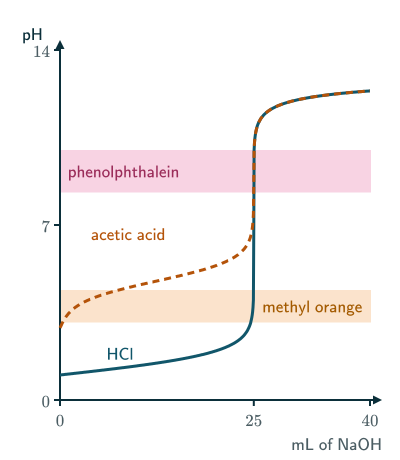
Choice of indicator (pages 68–69): methyl orange for a strong acid against a weak base; phenolphthalein for a weak acid against a strong base; either for a strong acid against a strong base; and for a weak acid against a weak base no indicator is suitable. The reason is in the titration curves: the indicator must change colour within the steep jump in pH at the equivalence point.
Apparatus
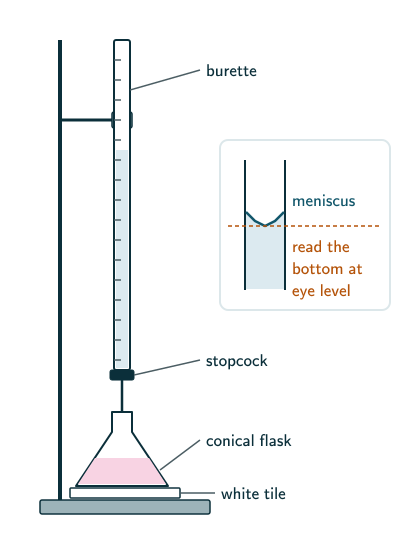
From the Laboratory Manual (pages 70 and 76): a 50 mL burette and burette stand, a 10 mL pipette, a 100 mL conical flask, a 100 mL measuring flask, a funnel, a white glazed tile; oxalic acid or sodium carbonate, the solution to be tested, and the indicator.
Procedure
Experiment 6.1: NaOH against standard oxalic acid (Lab Manual pages 69–72).
- Make 0.1 M oxalic acid, (COOH)2·2H2O (126 g mol−1), by weighing it accurately and making it up in a measuring flask.
- Wash the burette, rinse it with the NaOH solution, clamp it vertically and fill it above the zero mark through a funnel. Run some out to clear the air from the nozzle, remove the funnel, and note the initial reading with the eye level with the meniscus.
- Pipette 10 mL of oxalic acid into a clean conical flask (rinse the pipette with the acid first) and add 1–2 drops of phenolphthalein.
- Stand the flask on the white tile and add NaOH in small amounts at first and then drop by drop, swirling, until a very faint pink persists for about 30 seconds of swirling. Note the final reading.
- Repeat until three concordant titres are obtained, using the laboratory’s specified tolerance (often within 0.1 mL). Record final minus initial burette readings and average the concordant titres.
Experiment 6.3: HCl against standard sodium carbonate (pages 75–77). Make 0.1 M Na2CO3 (1.0600 g in 100 mL, molar mass 106 g mol−1; Experiment 6.2, page 74). Here HCl goes in the burette and Na2CO3 in the flask with methyl orange; the end point is yellow to pinkish-red:
Na2CO3 + 2HCl → 2NaCl + CO2 + H2O
Why the alkali goes in the burette with phenolphthalein (pages 68–69): the colour change colourless → pink is easy to see; pink → colourless, with the alkali in the flask, is harder to judge.
Precautions (pages 72 and 77): rinse the burette and pipette with the solution they will hold; remove the air gap from the nozzle; remove the funnel and any hanging drop before reading; read the lower meniscus for clear solutions and the upper for dark ones, eye level with it; never mouth-pipette any solution (use a pipette bulb); for the usual calibrated delivery pipette, let it drain and do not blow out the retained tip liquid. The manual requests four decimal places for strength, but this formatting does not imply that the measured data support four-decimal-place accuracy.
The Laboratory Manual has three slips worth knowing. In its box on page 73 it calls N1 and N2 in N1V1 = N2V2 “equivalent masses … dissolved in per litre”; they are normalities, gram equivalents per litre, with N = aM. On page 74 it calls M1 and M2 in a1M1V1 = a2M2V2 “molar masses”; they are molarities. On page 78 it gives potassium hydrogenphthalate as C6H5O4K; it is KHC8H4O4 (C8H5KO4, 204.2 g mol−1).
Solved examples
Example 1: Making the standard solution
How much oxalic acid, (COOH)2·2H2O, is needed for 100 mL of 0.1 M solution?
Moles = 0.1 mol L−1 × 0.100 L = 0.0100 mol; mass = 0.0100 × 126.
Answer: 1.2600 g, dissolved and made up to exactly 100 mL in a measuring flask.
Example 2: Strength of NaOH (Experiment 6.1)
10.0 mL of 0.1 M oxalic acid needs 20.4 mL of NaOH (concordant reading). Find the molarity and strength of the NaOH.
(COOH)2 + 2NaOH → (COONa)2 + 2H2O, so a1 = 2 (basicity of oxalic acid) and a2 = 1. Then 2 × 0.1 × 10.0 = 1 × M2 × 20.4, so M2 = 2.0/20.4.
Answer: M2 = 0.098039 ≈ 0.0980 M; strength = 0.098039 × 40 = 3.9216 g L−1 (to four decimal places, as the manual asks).
Example 3: Strength of HCl (Experiment 6.3)
10.0 mL of 0.1 M Na2CO3 needs 19.2 mL of HCl with methyl orange. Find the molarity and strength of the HCl.
Here a1 = 2 (Na2CO3 takes two H+) and a2 = 1: 2 × 0.1 × 10.0 = 1 × M2 × 19.2.
Answer: M2 = 2.0/19.2 ≈ 0.1042 M; strength = 0.104167 × 36.5 ≈ 3.8021 g L−1.
Example 4: Choosing the indicator
Which indicator would you use for: (a) HCl against NaOH; (b) acetic acid against NaOH; (c) HCl against ammonia solution; (d) acetic acid against ammonia solution?
Match the indicator’s colour-change range to the pH jump at the equivalence point: the equivalence point of a weak acid with a strong base is above pH 7, that of a strong acid with a weak base below 7.
Answer: (a) either; (b) phenolphthalein; (c) methyl orange; (d) none gives a sharp end point.
Common mistakes to avoid
Common mistake
Forgetting basicity and acidity
One mole of oxalic acid reacts with two moles of OH−, and one mole of sodium carbonate with two moles of H+; leaving out a = 2 halves the answer. For sodium carbonate, a = 2 holds only with methyl orange (end point near pH 4, carbonate to CO2). With phenolphthalein the colour goes near pH 8.3, when CO32− has only become HCO3−, so a = 1. This is the basis for titrating a Na2CO3–NaHCO3 mixture (a Laboratory Manual discussion question, page 78).
Common mistake
Rinsing the burette with water only
Water left inside dilutes the titrant, so more is needed and the result is wrong. Rinse with the solution the burette will hold. (The conical flask is rinsed with water only.)
Common mistake
Taking the first rough reading as the answer
The first titration only shows roughly where the end point is. Use concordant readings, which agree with each other.
Quick revision summary
- Standard solution: accurately known concentration; made by weighing a primary standard (oxalic acid, Na2CO3), or found by titration for a secondary one (NaOH).
- a1M1V1 = a2M2V2 at equivalence (approximately at the end point); strength (g L−1) = molarity × molar mass.
- Phenolphthalein: colourless → pink, for weak acid against strong base; methyl orange: yellow → pinkish-red, for strong acid against weak base; either for strong against strong.
- Rinse the burette and pipette with their own solutions; read the meniscus at eye level; take concordant readings.
Formula sheet
- a1M1V1 = a2M2V2 (at equivalence; approximate at the indicator end point)
- Strength (g/L) = molarity × molar mass
- Dilution: M1V1 = M2V2
Questions students ask
What are the pH ranges and colours of phenolphthalein and methyl orange?
Phenolphthalein changes from colourless to pink over about pH 8.3 to 10.0, and methyl orange from red to yellow over about pH 3.1 to 4.4, being orange in between. Each indicator is a weak acid or base whose two forms have different colours, and the eye sees the change over 1 to 2 pH units around its pKIn, about 9.3 for phenolphthalein and 3.5 for methyl orange, where both forms are present in comparable amounts. These ranges are standard data, beyond the NCERT text.
What is a back titration, and how is it different from an ordinary titration?
In an ordinary (direct) titration the titrant reacts with the substance being measured, while in a back titration a known excess of a standard reagent is added first and the part left over is titrated with a second standard solution; it is used when the substance is insoluble or reacts slowly. For example, 0.500 g of impure CaCO3 is warmed with 50.0 mL of 0.200 M HCl, and the excess acid then needs 10.0 mL of 0.200 M NaOH: the carbonate used 10.0 − 2.00 = 8.00 mmol of HCl, so it is 4.00 mmol of CaCO3 (100.1 g mol), 0.400 g, and the sample is about 80% pure. The NCERT Class 11 Laboratory Manual’s acid–base Experiments 6.1 and 6.3 are direct titrations.
What is the difference between an acid–base titration and a redox titration?
An acid–base titration is based on proton transfer, H+ + OH− → H2O, and uses a pH indicator such as phenolphthalein or methyl orange, while a redox titration is based on electron transfer between an oxidant and a reductant. In the redox titrations of the JEE and NEET practical syllabus, oxalic acid or Mohr’s salt against KMnO4, KMnO4 is its own indicator: the end point is the first lasting pale pink. Both use a1M1V1 = a2M2V2, with a counting H+ or OH− in one case and electrons in the other.
What is the difference between titrant and titrand?
The titrant is the solution run in from the burette, and the titrand (or analyte) is the solution it is added to in the conical flask, usually a volume measured with a pipette. Either one may be the standard solution: in Experiment 6.1 of the NCERT Laboratory Manual the standard oxalic acid is the titrand and the sodium hydroxide being tested is the titrant. The point at which exactly enough titrant has been added to react with all the titrand is the equivalence point.
Is acid–base titration in the JEE Main 2027 and NEET (UG) 2026 syllabuses?
Yes, both the JEE Main 2027 (NTA) and the NEET (UG) 2026 (NMC) chemistry syllabuses include, in Unit 20, Principles Related to Practical Chemistry, ‘the chemistry involved in the titrimetric exercises – acids, bases and the use of indicators’, together with the redox titrations of oxalic acid and Mohr’s salt against KMnO4. The questions test the chemistry rather than bench skill: the choice of indicator, a1M1V1 = a2M2V2, primary standards and the shapes of titration curves.
Practice questions
Try each question first, then open the answer to check your working.
-
Q1. How would you prepare 250 mL of 0.05 M sodium carbonate (106 g mol−1)? (A discussion question in the NCERT Laboratory Manual.)
Show answerHide answer
Moles = 0.05 × 0.250 = 0.0125 mol; mass = 0.0125 × 106 = 1.3250 g. Weigh it accurately, dissolve in a little water, transfer to a 250 mL measuring flask and make up to the mark.
-
Q2. 20.0 mL of an H2SO4 solution needs 25.0 mL of 0.10 M NaOH. Find the molarity of the acid.
Show answerHide answer
a1 = 2 for H2SO4, a2 = 1 for NaOH: 2 × M1 × 20.0 = 1 × 0.10 × 25.0, so M1 = 0.0625 M.
-
Q3. Why can a standard solution of HCl not be made by weighing? (A Laboratory Manual discussion question, page 78.)
Show answerHide answer
HCl is a volatile gas at ordinary conditions and is not a convenient stable solid primary standard for routine direct weighing. Concentrated hydrochloric acid is a solution of it whose concentration is not accurately known and changes as the gas escapes, so it is not a primary standard. Its exact concentration has to be found by titration, for example against sodium carbonate.