Factors affecting equilibria: Le Chatelier’s principle
NCERT Class 11 Chemistry Chapter 6 Section 6.8
Quick answer
Le Chatelier’s principle describes how an equilibrium responds to a disturbance, with the reaction quotient providing the reliable direction test. Under the ideal-gas assumptions, isothermal compression favours fewer gas moles, while inert gas has no effect at fixed temperature and volume. Temperature changes the equilibrium constant; a catalyst accelerates equilibration without changing it.
With your textbook
NCERT Chemistry Part I (Class 11), Chapter 6 “Equilibrium”, Section 6.8 “Factors Affecting Equilibria”, pages 184–188.
Open the official NCERT chapter (PDF, 5.7 MB, ncert.nic.in) (opens in a new tab)
Checked against the 2026-27 reprint on .
What changes an equilibrium?
Le Chatelier’s principle
If a system at equilibrium is disturbed, it shifts so as to reduce, or counteract, the effect of the change (NCERT Section 6.8, pages 184–188):
- concentration: adding a substance shifts the equilibrium in the direction that uses it up; removing one shifts it in the direction that replaces it;
- pressure (changed by changing the volume): a rise shifts a gas reaction towards the side with fewer moles of gas;
- inert gas added at constant volume: no change;
- temperature: a rise favours the endothermic direction, and it is the only one of these changes that alters the value of K;
- catalyst: no change in the equilibrium; it is only reached faster.
The rules below assume ideal gases or dilute ideal solutions, a fixed reaction and standard states, and constant temperature except when temperature is deliberately changed. Selective concentration changes hold the other activities fixed; gas compression/expansion is isothermal. For coupled changes, calculate Q rather than applying a slogan.
In plain words: an equilibrium mixture behaves like a stubborn balance. Push it one way and it pushes back. Add a reactant and some of it gets used up; squeeze a gas mixture and it reacts in the direction that makes fewer molecules; heat it and it absorbs heat by running the endothermic way. Concentration, pressure and inert-gas changes only move the mixture until Q again equals the same K; a temperature change gives a new K.
NCERT states the principle this way (page 185): a change in any of the factors that determine the equilibrium conditions of a system will cause the system to change in such a manner as to reduce or to counteract the effect of the change. It applies to all physical and chemical equilibria. The aim in industry is the largest yield at mild temperature and pressure; NCERT’s example is the Haber process (NCERT gives annual world production of ammonia as about a hundred million tonnes, mainly for fertilisers; page 185).
Effect of concentration change
When the concentration of any of the reactants or products in a reaction at equilibrium is changed, the composition of the equilibrium mixture changes so as to minimize the effect of concentration changes
NCERT Chemistry Part I (Class 11), Section 6.8.1, page 185
Take H2(g) + I2(g) ⇌ 2HI(g). Adding H2 makes the reaction quotient Qc = [HI]2/[H2][I2] smaller than Kc, so more H2 and I2 react to form HI. At the new equilibrium [H2] is less than just after the addition but more than in the original mixture (NCERT Fig. 6.8, page 185).
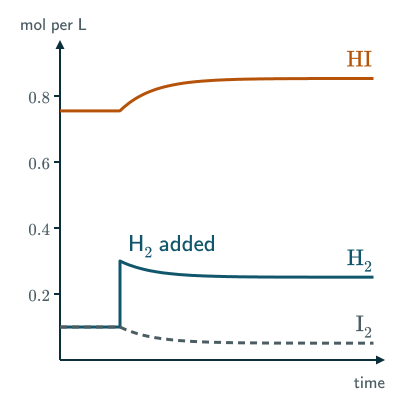
Removing a product does the same: it keeps Qc below Kc, so the reaction keeps going forward (page 186). In the manufacture of ammonia, NH3 is liquefied and removed; in making quicklime, CaO, from CaCO3, CO2 is constantly removed from the kiln, which promotes decomposition when the kiln is hot enough and supplies the required heat.
An experiment (page 186). Two drops of 0.002 M potassium thiocyanate added to 1 mL of 0.2 M iron(III) nitrate give a red colour, from the equilibrium
Fe3+(aq) + SCN−(aq) ⇌ [Fe(SCN)]2+(aq) (yellow, colourless, deep red)
- oxalic acid removes Fe3+ as [Fe(C2O4)3]3−, so [Fe(SCN)]2+ dissociates and the red fades;
- aqueous HgCl2 removes SCN− as [Hg(SCN)4]2−, and the red fades;
- adding potassium thiocyanate shifts the equilibrium to the right, and the red deepens.
Effect of pressure change
Changing the pressure by changing the volume affects a gas reaction only if the moles of gaseous reactants and products differ (NCERT Section 6.8.2, pages 186–187). For these gas-dominated equilibria the pressure dependence of pure solid/liquid activities is neglected. Pressure can affect condensed-phase equilibria when reaction volume changes matter.
For the methanation reaction, CO(g) + 3H2(g) ⇌ CH4(g) + H2O(g), 4 mol of gas become 2 mol. If the equilibrium mixture is compressed to half its volume at constant temperature, every concentration doubles:
Methanation after halving the volume
Qc = (2[CH4])(2[H2O]) / {(2[CO])(2[H2])3}
= (4/16)Kc = Kc/4
NCERT’s printed expression on page 187 leaves out the factors of 2; with them, Qc = Kc/4.
Since Qc < Kc, the reaction goes forward, the direction with fewer moles of gas, which lowers the pressure. In general, halving the volume multiplies Qc by 2Δng, where Δng = (moles of gaseous products) − (moles of gaseous reactants); here Δng = 2 − 4 = −2. For C(s) + CO2(g) ⇌ 2CO(g), a rise in pressure sends the reaction backward, because the forward reaction makes more gas (page 187).
Effect of adding an inert gas
If an inert gas such as argon is added at constant volume, the equilibrium is undisturbed: the partial pressures and concentrations of the reacting gases do not change (NCERT Section 6.8.3, page 187). This no-shift result assumes fixed temperature and ideal gases; at constant pressure the result differs, as follows.
Beyond the NCERT text (reasoned): if the inert gas is added at constant pressure, the volume must increase, so the partial pressures of the reacting gases fall, just as if the mixture had been expanded. The equilibrium then shifts towards the side with more moles of gas; there is no shift only when Δng = 0.
Effect of temperature change
Changes of concentration, pressure or volume move the mixture because Qc no longer equals Kc. A change of temperature is different: it changes the equilibrium constant (NCERT Section 6.8.4, page 187). For the thermodynamic constant K (the pressure-standard constant for ideal gases), the van ’t Hoff rule uses ΔrH⊖:
- for an exothermic reaction (ΔH negative), K decreases as the temperature rises;
- for an endothermic reaction (ΔH positive), K increases as the temperature rises.
For an ideal gas concentration constant, Kp = Kc(RT)Δng implies d ln Kc/dT = (ΔrH⊖ − ΔngRT)/(RT). Thus the enthalpy sign rule must not be applied blindly to Kc when Δng ≠ 0; the familiar strongly exothermic/endothermic examples here retain their stated trend.
For N2(g) + 3H2(g) ⇌ 2NH3(g), ΔH = −92.38 kJ mol−1: raising the temperature shifts the equilibrium to the left, so a low temperature favours a high yield of ammonia, but at very low temperatures the reaction is too slow, so a catalyst is used. NCERT Table 6.5 (page 178) shows the effect: Kp = 6.8 × 10⁵ at 298 K, 41 at 400 K and 3.6 × 10⁻² at 500 K. The link between K and temperature comes from ΔrG⊖ = ΔrH⊖ − TΔrS⊖ = −RT ln K (see Gibbs energy and equilibrium).
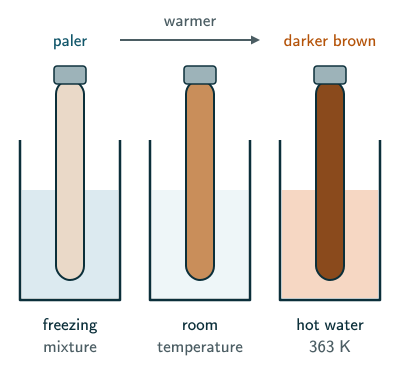
An experiment (pages 187–188). Brown NO2 dimerises to colourless N2O4:
2NO2(g) ⇌ N2O4(g); ΔH = −57.2 kJ mol−1
Two sealed 5 mL tubes of NO2 of equal colour are first kept in water at room temperature for 8–10 minutes; then one is put in a freezing mixture and the other in hot water at 363 K. In the cold tube the exothermic forward reaction is favoured and the brown colour fades; in the hot tube the reverse reaction is favoured and the brown deepens (NCERT Fig. 6.9).
A second example is endothermic (page 188): [Co(H2O)6]2+(aq) + 4Cl−(aq) ⇌ [CoCl4]2−(aq) + 6H2O(l), pink to blue. NCERT reports the mixture blue at room temperature, turning pink when cooled in a freezing mixture (page 188); the blue needs a high chloride concentration (reasoned).
NCERT slip (page 188): NCERT prints the pink ion as [Co(H2O)6]3+; it is the cobalt(II) ion, [Co(H2O)6]2+, as the charges in the equation require. In an exam, write 2+.
Effect of a catalyst
A catalyst increases the rate of the reaction by making available a new, low-energy pathway. It speeds up the forward and reverse reactions that pass through the same transition state, and it lowers the activation energy for both by exactly the same amount, so it does not affect the equilibrium composition; it appears neither in the balanced equation nor in the equilibrium constant expression (NCERT Section 6.8.5, page 188). Strictly, the deeper reason is that a catalyst changes neither the reactants’ nor the products’ Gibbs energies, so K stays the same; real catalytic mechanisms can have several intermediates and barriers (reasoned). In an exam, give NCERT’s reason: the same lowering of both activation energies.
- Ammonia. The reaction is highly exothermic and reduces the moles of gas. K falls as the temperature rises, but at low temperatures the reaction is too slow. Fritz Haber found an iron catalyst that gives a satisfactory rate at temperatures where the yield is still reasonable; high pressure improves the yield. NCERT gives the optimum conditions with a catalyst as around 500 °C and 200 atm (page 188); a real plant’s optimum also depends on its design (reasoned).
- Sulphuric acid (contact process). For 2SO2(g) + O2(g) ⇌ 2SO3(g), NCERT gives Kc = 1.7 × 1026 (no temperature is stated; it is of the same order as a room-temperature estimate, since NCERT Table 6.5’s 298 K Kp, 4.0 × 1024, gives the same order, about 1 × 1026). The reaction is very slow, so platinum or V2O5 is used as catalyst.
If K is exceedingly small, a catalyst is of little help: it cannot make more product than the equilibrium allows.
Solved examples
Example 1: Adding hydrogen to the HI equilibrium
At 700 K, Kc = 57.0 for H2(g) + I2(g) ⇌ 2HI(g). An equilibrium mixture has [H2] = [I2] = 0.100 M and [HI] = 0.755 M. H2 is added until [H2] = 0.300 M. Find the new equilibrium concentrations.
Just after the addition Qc = (0.755)2/(0.300 × 0.100) = 19.0 < 57.0, so the reaction goes forward. If x M of H2 reacts: (0.755 + 2x)2/
Answer: [H2] ≈ 0.251 M, [I2] ≈ 0.051 M, [HI] ≈ 0.853 M. [H2] ends below 0.300 but above 0.100, as Le Chatelier’s principle says.
Example 2: Squeezing the methanation mixture
Explain, using Qc, what happens when the equilibrium mixture for CO(g) + 3H2(g) ⇌ CH4(g) + H2O(g) is compressed to half its volume at constant temperature (NCERT page 187).
Every concentration doubles. The top of Qc has two concentrations (factor 2 × 2 = 4), the bottom four (factor 2 × 23 = 16), so Qc = Kc × 4/16.
Answer: Qc = Kc/4 < Kc, so the reaction moves forward, to the side with fewer moles of gas, until Qc = Kc again.
Example 3: Ammonia under five changes
For N2(g) + 3H2(g) ⇌ 2NH3(g); ΔH = −92.38 kJ mol−1, predict the shift or change in NH3 formation under: (a) raising the temperature; (b) compressing the mixture; (c) adding argon at constant volume; (d) adding an iron catalyst; (e) removing NH3.
(a) Exothermic forward reaction: K falls. (b) 4 mol of gas become 2: forward shift. (c) Partial pressures unchanged. (d) Same K, reached faster. (e) Q < K: forward shift.
Answer: (a) less NH3; (b) more; (c) no change; (d) no change, only reached sooner; (e) some NH3 is regenerated after removal; this does not mean that the amount left in the vessel exceeds the original amount.
Example 4: Doubling the pressure over hot graphite
In NCERT Problem 6.6, CO2(g) + C(s) ⇌ 2CO(g) at 1000 K (Kp = 3.0) reached pCO = 0.665 bar and pCO2 = 0.147 bar (NCERT rounds these to 0.66 and 0.15 bar). The volume is now halved at 1000 K. Find the new partial pressures.
Just after halving, pCO = 1.33 bar and pCO2 = 0.295 bar, so Qp = (1.33)2/0.295 ≈ 6.0 > 3.0: the reaction goes backward. If CO2 rises by y: (1.33 − 2y)2/(0.295 + y) = 3.0, which rearranges to 4y2 − 8.32y + 0.884 = 0 and gives y ≈ 0.112 bar.
Answer: pCO ≈ 1.11 bar and pCO2 ≈ 0.407 bar; the total, about 1.51 bar, is less than the 1.63 bar just after compression, as the principle predicts.
Common mistakes to avoid
Common mistake
Thinking a concentration or pressure change alters K
Only temperature changes K. The other changes move the mixture until Q returns to the same K.
Common mistake
Thinking an inert gas always has no effect
At constant volume it has none. At constant pressure the volume grows, and a reaction with Δng ≠ 0 shifts towards more moles of gas.
Common mistake
Thinking a catalyst increases the yield
A catalyst speeds up the forward and reverse reactions equally, lowering both activation energies by exactly the same amount (NCERT page 188). It shortens the time to reach equilibrium but leaves the equilibrium amounts unchanged.
Quick revision summary
- Le Chatelier: a disturbed equilibrium shifts to counteract the change.
- Add a reactant or remove a product: forward. Add a product or remove a reactant: backward.
- Compress a gas mixture: shift to fewer moles of gas; no effect if Δng = 0.
- Inert gas at constant volume: no effect; at constant pressure: shift to more moles of gas (none if Δng = 0).
- Temperature: K falls with rising T for exothermic reactions, rises for endothermic ones.
- Catalyst: equilibrium reached faster; K and the composition unchanged.
Formula sheet
- Halving the volume multiplies every gas concentration by 2, so Qc = Kc × 2Δng
- Exothermic (ΔH < 0): K falls as T rises; endothermic (ΔH > 0): K rises as T rises
- ΔrG⊖ = ΔrH⊖ − TΔrS⊖ = −RT ln K
Questions students ask
What are some examples of Le Chatelier’s principle in daily life?
Oxygen binding in blood can be understood through a local binding-equilibrium model: higher oxygen partial pressure favours oxygenated haemoglobin, while lower pressure favours release. Circulating blood is an open, regulated system, not a single closed equilibrium flask. Clinicians use oxygen in treating carbon monoxide poisoning; displacement of CO from haemoglobin illustrates part of the chemistry, but CO also disrupts cellular oxygen use (CDC, Clinical Guidance for Carbon Monoxide Poisoning, 2026). In tooth decay, acids remove OH− and protonate PO43−, promoting dissolution of enamel in the simplified equilibrium Ca5(PO4)3OH(s) ⇌ 5Ca2+ + 3PO43− + OH−.
What are the limitations of Le Chatelier’s principle?
Le Chatelier’s principle is a qualitative summary of the equilibrium law: it gives the direction of a shift but not its size, it applies only to a system already at equilibrium, and it can mislead when one change alters several concentrations at once, where comparing Q with K is the reliable test. A known case is adding N2 to the ammonia equilibrium at constant total pressure and temperature: the extra gas also dilutes H2 and NH3, and for a small addition when the initial mole fraction of N2 is above 0.5 the net reaction goes backward, the opposite of the simple prediction. It also says nothing about how fast the new equilibrium is reached.
What is the van ’t Hoff equation for the effect of temperature on K?
For the thermodynamic equilibrium constant, the van ’t Hoff equation gives how K changes with temperature: log(K2/K1) = [ΔrH⊖/(2.303R)](1/T1 − 1/T2), taking ΔrH⊖ and ΔrS⊖ as constant; it follows from ΔrG⊖ = ΔrH⊖ − TΔrS⊖ = −RT ln K written at two temperatures. For an endothermic reaction with ΔrH⊖ = +50.0 kJ mol and K = 2.0 at 300 K, 50 000/19.15 = 2611 and 1/300 − 1/350 = 4.76 × 10, whose product is log(K2/K1) ≈ 1.24, so K ≈ 35 at 350 K. The equation is beyond NCERT.
Who gave Le Chatelier’s principle?
Le Chatelier’s principle was stated in 1884 by the French chemist Henri Louis Le Chatelier (1850–1936), who generalised van ’t Hoff’s rule of the same year for the effect of temperature on equilibrium into a rule for any change of conditions. The German physicist Karl Ferdinand Braun reached the same idea independently in 1887, so it is also called the Le Chatelier–Braun principle. Le Chatelier also worked on cements, metals and the measurement of high temperatures.
Practice questions
Try each question first, then open the answer to check your working.
-
Q1. An equilibrium mixture of Fe3+(aq) + SCN−(aq) ⇌ [Fe(SCN)]2+(aq) is diluted with an equal volume of water. Using Qc, say which way it shifts.
Show answerHide answer
Every concentration halves, so Qc = (½[Fe(SCN)2+])/
{(½[Fe3+])(½[SCN−])} = 2Kc. Since Qc > Kc, some [Fe(SCN)]2+ dissociates: the shift is to the left, towards more particles in solution. -
Q2. For which of these does compressing the mixture have no effect on the equilibrium amounts: (a) N2(g) + O2(g) ⇌ 2NO(g); (b) PCl5(g) ⇌ PCl3(g) + Cl2(g); (c) CaCO3(s) ⇌ CaO(s) + CO2(g)?
Show answerHide answer
Only (a), where Δng = 0. In (b) compression shifts the equilibrium backward (fewer moles of gas); in (c) it also shifts backward, since the only gas is a product and pCO2 must return to its fixed value.
-
Q3. NCERT’s blue [CoCl4]2− mixture turns pink when cooled. Show from this observation alone that the forward reaction must be endothermic, and predict the colour and the change in K on heating.
Show answerHide answer
Cooling favours the exothermic direction; here cooling makes the pink [Co(H2O)6]2+, so the reverse reaction is exothermic and the forward reaction is endothermic. On heating, K for the forward reaction increases and the mixture turns bluer.