Ionization of acids and bases: pH, Ka and Kb
NCERT Class 11 Chemistry Chapter 6 Section 6.11
Quick answer
Acid and base ionisation constants determine equilibrium composition and acidity; conjugate acid and base constants multiply to the ionic product of water. pH is defined using hydrogen-ion activity, approximated by concentration in dilute ideal solutions. At 298 K neutral water has pH about seven, while common ions and salt hydrolysis can change solution pH.
With your textbook
NCERT Chemistry Part I (Class 11), Chapter 6 “Equilibrium”, Section 6.11 “Ionization of Acids and Bases”, pages 192–202.
Open the official NCERT chapter (PDF, 5.7 MB, ncert.nic.in) (opens in a new tab)
Checked against the 2026-27 reprint on .
How far do acids and bases ionise?
Ionisation of acids and bases
Strong acids and bases ionise almost completely in water; weak ones only partly, and their ionisation is an equilibrium described by an ionisation constant (NCERT Section 6.11, pages 192–202):
- water itself ionises slightly: Kw = [H+][OH−] = 1.0 × 10⁻¹⁴ at 298 K;
- pH = −log [H+]; at 298 K, pH + pOH = 14, and a neutral solution has pH 7;
- a weak acid HX has Ka = [H+][X−]/[HX], a weak base Kb = [BH+][OH−]/[B], and for a conjugate pair Ka × Kb = Kw;
- adding a common ion holds ionisation back, and salts of weak acids or bases change the pH of water by hydrolysis.
Unless stated otherwise, calculations below use dilute ideal aqueous solutions at 298 K, with activities approximated by concentrations relative to 1 mol L−1. Concentration expressions are approximations; neutral pH is pKw/2 at the temperature in question.
In plain words: this is the arithmetic of acidity. Strong acids such as HCl give up their proton completely, so [H+] equals their concentration (unless the acid is extremely dilute). Weak acids give up only a fraction, set by Ka, so you need a small equilibrium calculation. Water is always there in the background, keeping [H+][OH−] fixed, and the pH scale turns these tiny concentrations into everyday numbers.
Strong and weak acids and bases
Perchloric (HClO4), hydrochloric, hydrobromic, hydriodic, nitric and sulphuric acid’s first ionisation are strong: almost complete in water. The second ionisation of sulphuric acid is weaker and need not be complete. LiOH, NaOH, KOH, CsOH and Ba(OH)2 are strong bases (NCERT pages 192–193). In Brönsted–Lowry terms, a strong acid is a good proton donor, and in HA + H2O ⇌ H3O+ + A− the equilibrium moves towards the weaker acid and weaker base.
So strong acids have very weak conjugate bases: ClO4−, Cl−, Br−, I−, NO3− and HSO4− are much weaker bases than water. Weak acids such as nitrous acid, hydrofluoric acid and acetic acid have stronger conjugate bases, and NH2−, O2− and H−, the conjugate bases of extremely weak acids, are very good proton acceptors (page 193).
Indicators. Some water-soluble organic compounds, such as phenolphthalein and bromothymol blue, are weak acids whose acid form, HIn, and conjugate base, In−, have different colours: HIn(aq) + H2O(l) ⇌ H3O+(aq) + In−(aq). Shifting this equilibrium with acid or base changes the colour, which is why they are used in acid–base titrations and to estimate [H+] (page 193).
The ionic product of water
Water acts as an acid and a base at once (NCERT Section 6.11.1, page 193): H2O(l) + H2O(l) ⇌ H3O+(aq) + OH−(aq). Since [H2O] is constant, it is taken into a new constant, the ionic product of water:
Ionic product of water
Kw = [H+][OH−] = (1.0 × 10⁻⁷)2 = 1.0 × 10⁻¹⁴ at 298 K
[H+] in pure water at 298 K has been measured as 1.0 × 10⁻⁷ M, and [OH−] is equal to it. Kw depends on temperature, like any equilibrium constant. Pure water is 1000/18.0 = 55.56 M (NCERT writes 55.55), so there are about 2 hydronium–hydroxide ion pairs per 109 water molecules. Each pair contains two water-derived ions, so this is not a count of only two participating water molecules. A solution is acidic if [H3O+] > [OH−], neutral if they are equal and basic if [H3O+] < [OH−].
The pH scale
NCERT defines the pH of a solution as the negative logarithm to base 10 of the activity of the hydrogen ion (Section 6.11.2, pages 193–194). In dilute solutions (below about 0.01 M) the activity is approximately the molarity divided by 1 mol L−1 (the accuracy depends on ionic strength), so pH = −log [H+] (page 194). For example, 10−2 M HCl has pH 2, and NaOH with [OH−] = 10−4 M has [H3O+] = 10−10 M and pH 10. Taking −log of Kw:
pH and pOH
pKw = pH + pOH = 14 (298 K)
At 298 K a neutral solution has pH 7, an acidic one pH < 7 and a basic one pH > 7. One pH unit means a factor of 10 in [H+]; two units, a factor of 100. pH paper with four strips gives the pH to about 0.5; some pH meters display increments of 0.001 (page 194), but display resolution is not guaranteed accuracy; calibration, temperature and electrode behaviour matter.
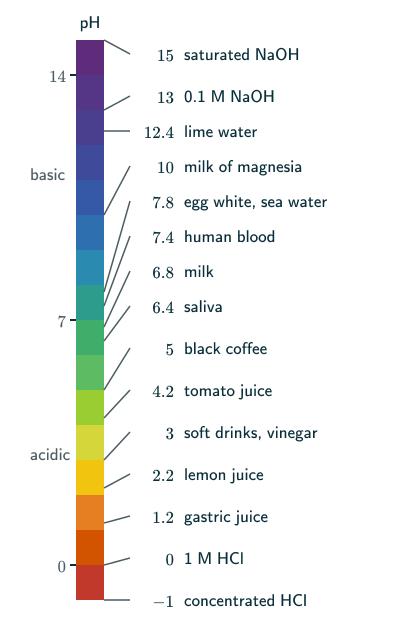
NCERT slip (page 195): NCERT’s Table 6.5 of common pH values lists lime water as 10.5. Beyond the NCERT text: lime water is a saturated solution of calcium hydroxide, of which about 1.73 g L−1 dissolves at 20 °C (Wikipedia, “Calcium hydroxide”), and calcium hydroxide saturated at 25 °C has pH 12.4 (Hazardous Substances Data Bank, via PubChem), so 10.5 is far too low. From the solubility, [OH−] is about 0.047 M and the ideal pH about 12.7; the measured 12.4 is lower because at this strength activity is below concentration (reasoned). In an exam that asks for NCERT’s table value, give 10.5. If an exercise supplies a concentration or solubility product, calculate from those data with its stated approximation; a measured pH also depends on temperature and on CO2 absorbed from the air (reasoned).
Ionisation constants of weak acids
For a monoprotic weak acid HX with no added common ion and negligible water ionisation, of initial concentration c with degree of ionisation α (NCERT Section 6.11.3, pages 195–196): HX(aq) + H2O(l) ⇌ H3O+(aq) + X−(aq), with c(1 − α), cα and cα at equilibrium.
Ionisation constant of a weak acid
Ka = [H+][X−]/[HX] = cα2/(1 − α)
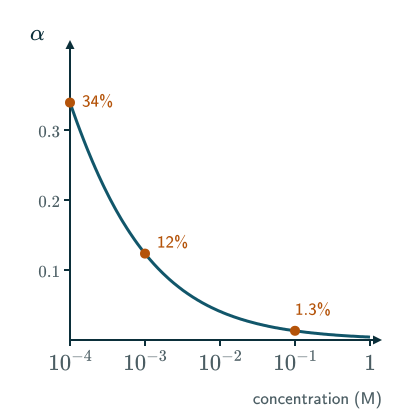
The larger Ka, the stronger the acid; pKa = −log Ka. If α is small, Ka ≈ cα2, so α ≈ √(Ka/c): a weak acid ionises more when it is diluted. Dilution raises α but still lowers [H+] = cα: 0.1 M acetic acid has 1.3 × 10⁻³ M H+, 0.001 M only 1.2 × 10⁻⁴ M.
Ka values at 298 K (NCERT Table 6.6, page 195): HF 3.5 × 10⁻⁴, HNO2 4.5 × 10⁻⁴, HCOOH 1.8 × 10⁻⁴, benzoic acid 6.5 × 10⁻⁵, acetic acid 1.74 × 10⁻⁵, niacin 1.5 × 10⁻⁵, HClO 3.0 × 10⁻⁸, HCN 4.9 × 10⁻¹⁰, phenol 1.3 × 10⁻¹⁰.
NCERT’s two books differ on phenol. Table 6.6 gives its Ka as 1.3 × 10⁻¹⁰ (pKa 9.89), while NCERT Class 12 Chemistry, Unit 7, Table 7.3 (page 207) gives pKa 10.0, that is Ka = 1.0 × 10⁻¹⁰, the value the Class 11 book’s own Exercise 6.44 (page 213) uses. In a problem, use the value the question gives.
NCERT’s method for the pH of a weak electrolyte (page 196): identify the Brönsted acids and bases present; write all the proton-transfer reactions; take the one with the larger K as the primary reaction; tabulate initial, change (in terms of α) and equilibrium concentrations; solve for α; find the concentrations; and finally pH = −log [H3O+]. The percent dissociation is ([HA] dissociated/[HA] initial) × 100 (NCERT Eq. 6.32).
Ionisation of weak bases
For a weak base MOH ⇌ M+ + OH− (NCERT Section 6.11.4, pages 197–198), Kb = [M+][OH−]/[MOH] = cα2/(1 − α), and pKb = −log Kb. Amines, derivatives of ammonia, are weak bases; ammonia gives OH− by NH3(aq) + H2O(l) ⇌ NH4+(aq) + OH−(aq).
Kb values at 298 K (NCERT Table 6.7, page 197): dimethylamine 5.4 × 10⁻⁴, triethylamine 6.45 × 10⁻⁵, ammonia 1.77 × 10⁻⁵, quinine 1.10 × 10⁻⁶, pyridine 1.77 × 10⁻⁹, aniline 4.27 × 10⁻¹⁰, urea 1.3 × 10⁻¹⁴.
NCERT’s two books differ on triethylamine. Table 6.7 gives its Kb as 6.45 × 10⁻⁵ (pKb 4.19), while NCERT Class 12 Chemistry, Unit 9, Table 9.3 (page 267) gives pKb 3.25, that is Kb = 5.6 × 10⁻⁴. The other amines in Table 6.7 agree with Table 9.3 (dimethylamine pKb 3.27, ammonia 4.75), so only triethylamine differs. In a problem, use the value the question gives.
Relation between Ka and Kb
For NH4+ (acid, Ka = 5.6 × 10⁻¹⁰) and NH3 (base, Kb = 1.8 × 10⁻⁵), adding the two ionisation equations gives 2H2O ⇌ H3O+ + OH−, and the constants multiply (NCERT Section 6.11.5, pages 198–199):
Conjugate acid–base pair
Ka × Kb = Kw; pKa + pKb = 14 (298 K)
This is a case of a general rule: the constant for a net reaction obtained by adding reactions is the product of their constants, Knet = K1 × K2 × … (NCERT Eq. 6.35). Knowing one of Ka and Kb gives the other, and a strong acid has a weak conjugate base.
Polybasic acids and polyacidic bases
Oxalic, sulphuric and phosphoric acids have more than one ionisable proton (NCERT Section 6.11.6, pages 199–200). A dibasic acid H2X ionises in two steps, H2X ⇌ H+ + HX− (Ka1) and HX− ⇌ H+ + X2− (Ka2).
| Acid | Ka1 | Ka2 | Ka3 |
|---|---|---|---|
| Oxalic | 5.9 × 10⁻² | 6.4 × 10⁻⁵ | |
| Ascorbic | about 6.8 × 10⁻⁵ | 1.6 × 10⁻¹² | |
| Sulphurous | 1.7 × 10⁻² | 6.4 × 10⁻⁸ | |
| Sulphuric | very large | 1.2 × 10⁻² | |
| Carbonic | 4.3 × 10⁻⁷ | 5.6 × 10⁻¹¹ | |
| Citric | 7.4 × 10⁻⁴ | 1.7 × 10⁻⁵ | 4.0 × 10⁻⁷ |
| Phosphoric | 7.5 × 10⁻³ | 6.2 × 10⁻⁸ | 4.2 × 10⁻¹³ |
(NCERT Table 6.8, page 200, 298 K, with the ascorbic first constant corrected.) The printed ascorbic value 7.4 × 10⁻⁴ is inconsistent with pKa1 ≈ 4.17, reported in a primary structural study by Xu and colleagues (Journal of Biological Inorganic Chemistry, 2020, 25:875–885), which gives Ka1 ≈ 6.8 × 10⁻⁵. The carbonic first constant is the conventional apparent constant counting dissolved CO2 with H2CO3, not the intrinsic constant of molecular H2CO3 alone. For the listed acids, successive constants decrease, because a positive proton is harder to pull away from a negative ion: from HCO3− than from H2CO3, from HPO42− than from H2PO4−. When successive constants are well separated and the solution is not extremely dilute, almost all the H3O+ comes from the first step. (NCERT gives the reason as “H2A being a strong acid”; H2A need not be strong, only much stronger than HA−, Ka1 ≫ Ka2, as weak carbonic acid shows.)
Bases can likewise accept protons in steps: CO32− takes one to give HCO3− (Kb1 = Kw/Ka2 = 1.8 × 10⁻⁴), then a second to give H2CO3 (Kb2 = Kw/Ka1 = 2.3 × 10⁻⁸).
Factors affecting acid strength
The extent of dissociation of HA depends on the strength and the polarity of the H–A bond (NCERT Section 6.11.7, page 200). For related hydrides, a weaker H–A bond (lower bond enthalpy) and a more polar one both make HA a stronger acid.
- Down a group of related hydrides, weakening bonds are a major factor: as A grows, the H–A bond weakens and acid strength increases, HF << HCl << HBr << HI; H2S is a stronger acid than H2O.
- Across a period of related hydrides, bond polarity and conjugate-base stability are major factors: as the electronegativity of A increases, so does acid strength, CH4 < NH3 < H2O < HF.
Solvation and conjugate-base stability also contribute to acid strength. HCl, HBr and HI are all essentially fully ionised in water, so their intrinsic strength order is not distinguished by simply comparing ionisation percentages in water.
Common ion effect
Adding acetate ions to acetic acid, CH3COOH ⇌ H+ + CH3COO−, lowers [H+]; adding H+ pushes the equilibrium back towards un-ionised acid (NCERT Section 6.11.8, pages 200–201).
It can be defined as a shift in equilibrium on adding a substance that provides more of an ionic species already present in the dissociation equilibrium.
NCERT Chemistry Part I (Class 11), Section 6.11.8, page 201
It is Le Chatelier’s principle at work. With 0.05 M acetate in 0.05 M acetic acid (Ka = 1.8 × 10⁻⁵), [H+] = Ka × 0.05/0.05 = 1.8 × 10⁻⁵ M and pH = 4.74, far less acidic than 0.05 M acetic acid alone (work that out in Q4).
Hydrolysis of salts
Salt ions either stay simply hydrated or react with water to re-form the weak acid or base, which is hydrolysis (NCERT Section 6.11.9, pages 201–202). Ions of strong acids and bases (Na+, K+, Ca2+, Ba2+, Cl−, Br−, NO3−, ClO4−) hydrolyse negligibly in this introductory model, so their salts are approximately neutral at 298 K. The following rules cover simple salts with the stated conjugate partners; amphiprotic ions need their competing acid/base equilibria:
- weak acid, strong base (CH3COONa): CH3COO− + H2O ⇌ CH3COOH + OH−, so pH > 7;
- strong acid, weak base (NH4Cl): NH4+ + H2O ⇌ NH3 + H3O+, so pH < 7;
- weak acid, weak base (CH3COONH4): both ions hydrolyse; neglecting water ionisation and activity effects, the usual hydrolysis approximation is independent of concentration and
Salt of a weak acid and a weak base
pH = 7 + ½(pKa − pKb)
Solved examples
Example 1: A soft drink (NCERT Problem 6.16, page 194)
[H+] in a soft drink is 3.8 × 10⁻³ M. What is its pH?
pH = −log(3.8 × 10⁻³) = −(0.58 − 3.0).
Answer: pH = 2.42: acidic.
Example 2: Very dilute HCl (NCERT Problem 6.17, pages 194–195)
Calculate the pH of 1.0 × 10⁻⁸ M HCl.
The acid alone would suggest pH 8, which is impossible for an acid. Water’s own ions must be counted: if x = [OH−] from water, then [H3O+] = 10−8 + x and (10−8 + x)x = 10−14, that is x2 + 10−8x − 10−14 = 0, so x = 9.5 × 10⁻⁸.
Answer: pOH = 7.02 and pH = 6.98: very slightly acidic.
Example 3: Hydrofluoric acid (NCERT Problem 6.18, page 196)
Ka of HF is 3.2 × 10⁻⁴. Find α, the concentrations of H3O+, F− and HF, and the pH of 0.02 M HF.
The estimated acid-generated [H+] is much greater than √Kw, so water ionisation is negligible here and HF + H2O ⇌ H3O+ + F− is the primary reaction. 0.02α2/(1 − α) = 3.2 × 10⁻⁴ gives α2 + 0.016α − 0.016 = 0, so α = 0.12 (the other root, −0.135, is impossible; NCERT prints it as −0.12).
Answer: α ≈ 0.12; [H3O+] = [F−] = 2.4 × 10⁻³ M; [HF] = 1.76 × 10⁻² M; pH = 2.62. (NCERT’s Table 6.6 gives 3.5 × 10⁻⁴ for HF; the problem uses 3.2 × 10⁻⁴.)
Example 4: K<sub>a</sub> from a pH (NCERT Problem 6.19, pages 196–197)
The pH of 0.1 M monobasic acid HA is 4.50. Find [H+], [A−], [HA], Ka and pKa.
[H+] = 10−4.50 = 3.16 × 10⁻⁵ M = [A−], and [HA] = 0.1 − 3.16 × 10⁻⁵ ≈ 0.1 M.
Answer: Ka = (3.16 × 10⁻⁵)2/0.1 = 1.0 × 10⁻⁸; pKa = 8.
Example 5: Hypochlorous acid (NCERT Problem 6.20, page 197)
Find the pH and percent dissociation of 0.08 M HOCl, taking Ka = 2.5 × 10⁻⁵.
x2/0.08 = 2.5 × 10⁻⁵ (x ≪ 0.08), so x = [H+] = 1.41 × 10⁻³ M.
Answer: pH = 2.85; dissociation = 1.41 × 10⁻³/0.08 × 100 = 1.76%. NCERT’s own Table 6.6 gives Ka = 3.0 × 10⁻⁸ for HClO, close to the accepted value, so the problem’s 2.5 × 10⁻⁵ is a slip; with 3.0 × 10⁻⁸ the pH is about 4.31 and only 0.061% is dissociated.
Example 6: Hydrazine (NCERT Problem 6.21, page 198)
The pH of 0.004 M hydrazine, NH2NH2 + H2O ⇌ NH2NH3+ + OH−, is 9.7. Find Kb and pKb.
[H+] = 10−9.7 = 2.0 × 10⁻¹⁰ M, so [OH−] = 10−14/(2.0 × 10−10) = 5.0 × 10⁻⁵ M = [NH2NH3+], and [NH2NH2] ≈ 0.004 M.
Answer: Kb = (5.0 × 10⁻⁵)2/0.004 ≈ 6.3 × 10⁻⁷; pKb ≈ 6.2. NCERT takes antilog(−9.7) as 1.67 × 10⁻¹⁰ (it is 2.0 × 10⁻¹⁰) and so prints 8.96 × 10⁻⁷ and 6.04.
Example 7: Ammonia with ammonium chloride (NCERT Problem 6.22, page 198)
Find the pH of a solution 0.2 M in NH4Cl and 0.1 M in NH3 (pKb = 4.75).
Kb = 10−4.75 = 1.78 × 10⁻⁵ (NCERT writes 1.77 × 10⁻⁵ and so gets 0.88 × 10⁻⁵; the pH is 8.95 either way). With x small, (0.20)(x)/0.10 = Kb, so x = [OH−] ≈ 0.89 × 10⁻⁵ M and [H+] ≈ 1.12 × 10⁻⁹ M.
Answer: pH ≈ 8.95.
Example 8: Ammonia solution (NCERT Problem 6.23, page 199)
Find α and the pH of 0.05 M ammonia (Kb = 1.77 × 10⁻⁵), and Ka of NH4+.
α ≈ √(1.77 × 10⁻⁵/0.05) = 0.0188, so [OH−] = 0.05 × 0.0188 = 9.4 × 10⁻⁴ M and [H+] = 1.06 × 10⁻¹¹ M.
Answer: α ≈ 0.019 and pH ≈ 10.97; Ka(NH4+) = 10−14/(1.77 × 10−5) = 5.65 × 10⁻¹⁰ (NCERT prints 5.64 × 10⁻¹⁰).
Example 9: Ammonia partly neutralised (NCERT Problem 6.24, page 201)
Find the pH of 0.10 M ammonia (Kb = 1.77 × 10⁻⁵), and the pH after 50.0 mL of it is mixed with 25.0 mL of 0.10 M HCl.
Before: x2/0.10 = 1.77 × 10⁻⁵, x = [OH−] = 1.33 × 10⁻³ M, pH = 11.12. After: 2.5 mmol of HCl turns 2.5 of the 5.0 mmol of NH3 into NH4+; in 75 mL both are 0.033 M, so [OH−] = Kb × 0.033/0.033 = 1.77 × 10⁻⁵ M.
Answer: pH 11.12 before; after, [H+] = 5.65 × 10⁻¹⁰ M and pH = 9.25 (NCERT prints 9.24).
Example 10: Ammonium acetate (NCERT Problem 6.25, page 202)
pKa of acetic acid is 4.76 and pKb of ammonium hydroxide 4.75. Find the pH of ammonium acetate solution.
pH = 7 + ½(4.76 − 4.75) = 7 + 0.005.
Answer: pH ≈ 7.005, practically neutral, because the acid and the base are almost equally weak.
Common mistakes to avoid
Common mistake
Forgetting water in very dilute solutions
Below about 10−6 M the H+ from water starts to matter, and at 10−8 M it is 90% of the total. 10−8 M HCl has pH 6.98, not 8.
Common mistake
Using K<sub>b</sub> for [H] directly
A base calculation gives [OH−] first. Convert with pH = 14 − pOH (298 K) or [H+] = Kw/[OH−].
Common mistake
Applying α ≈ √(K/c) when α is not small
The shortcut needs α below about 5%. For 0.02 M HF, α = 0.12, so solve the quadratic.
Quick revision summary
- Kw = [H+][OH−] = 10−14 at 298 K; pH + pOH = 14.
- Weak acid: Ka = cα2/(1 − α) ≈ cα2; weak base: Kb likewise; pK = −log K.
- Conjugate pair: Ka × Kb = Kw, pKa + pKb = 14.
- For the listed polybasic acids the constants decrease; first-step dominance requires well-separated constants and suitable concentration.
- Acid strength: down a group, bond strength decides (HF < HI); across a period, electronegativity decides (CH4 < HF).
- Common ion holds back ionisation; salts of weak acids are basic, of weak bases acidic; weak–weak salts: pH = 7 + ½(pKa − pKb).
Formula sheet
- Ionic product of water: [H][OH] = 1.0 × 10 at 298 K
- pH = −log [H]; pH + pOH = 14 at 298 K
- Ka = cα2/(1 − α); α ≈ √(Ka/c) when α is small
- Ka × Kb = Kw; pKa + pKb = 14 at 298 K
- At 298 K, pH ≈ 7 + (pKa − pKb)/2 for a simple weak-acid/weak-base salt when water ionisation is negligible
Questions students ask
Does the ionic product of water change with temperature?
Yes, the ionic product of water, Kw = [H+][OH−], increases with temperature, because the ionisation of water, 2H2O(l) ⇌ H3O+(aq) + OH−(aq), absorbs heat: it is the reverse of neutralisation. Kw is about 1.1 × 10 at 0 °C, 1.0 × 10 at 25 °C and 5 × 10 at 100 °C, so the pH of pure, neutral water falls from about 7.5 to 7.0 to 6.1. Written with concentrations, Kw has the unit mol L, though it is usually quoted as a pure number.
What is the difference between the ionisation constant and the ionic product of water?
In NCERT’s concentration bookkeeping, writing H2O ⇌ H+ + OH− gives Kc = [H+][OH−]/[H2O] ≈ 10/55.5 = 1.8 × 10 mol L at 298 K. Absorbing the nearly constant water concentration gives the concentration product Kw ≈ 10 mol L. This is a concentration-standard convention; thermodynamic water autoionisation uses activities with solvent-water activity approximately 1, and its dimensionless constant is not obtained by treating 55.5 M as a pure-water activity.
What are the pH formulas for the hydrolysis of salts?
For a simple salt sufficiently concentrated that water autoionisation is negligible, with small hydrolysis and ideal behaviour, the usual approximation is as follows. For a weak-acid/strong-base salt such as sodium acetate, the anion hydrolyses with hydrolysis constant Kh = Kw/Ka and degree of hydrolysis h ≈ √(Kh/c), which gives pH = 7 + ½pKa + ½log c at 298 K, where c is the salt concentration in mol L. For 0.010 M sodium benzoate (Ka = 6.5 × 10, pKa = 4.19), pH = 7 + 2.09 − 1.00 ≈ 8.09. For a salt of a strong acid and a weak base, such as NH4Cl, Kh = Kw/Kb and pH = 7 − ½pKb − ½log c.
Can pH be negative or more than 14?
Yes, pH can be below 0 or above 14, because the scale has no fixed ends: pH = −log [H+] is negative whenever [H+] is more than 1 mol L. On this simple definition 2.0 M HCl has pH = −log 2.0 = −0.30, and at 298 K 2.0 M NaOH has pOH = −0.30 and pH = 14.30. In such concentrated solutions the activity of H+ differs a lot from its molarity, so these values are only approximate; the familiar 0 to 14 range simply covers solutions up to 1 M.
Practice questions
Try each question first, then open the answer to check your working.
-
Q1. Find the pH of 0.010 M NaOH at 298 K.
Show answerHide answer
NaOH is a strong base, so [OH−] = 0.010 M, pOH = 2 and pH = 14 − 2 = 12.
-
Q2. Find [H+] and the pH of 0.10 M HCN (Ka = 4.9 × 10⁻¹⁰, NCERT Table 6.6).
Show answerHide answer
[H+] ≈ √(4.9 × 10−10 × 0.10) = √(4.9 × 10⁻¹¹) = 7.0 × 10⁻⁶ M, so pH ≈ 5.15. α = 7.0 × 10⁻⁵, tiny, so the shortcut is safe.
-
Q3. Kb of pyridine is 1.77 × 10⁻⁹. Find Ka and pKa of the pyridinium ion, its conjugate acid.
Show answerHide answer
Ka = Kw/Kb = 10−14/1.77 × 10−9 = 5.65 × 10⁻⁶; pKa = 5.25 (and pKa + pKb = 5.25 + 8.75 = 14).