Alcohols and phenols: preparation and reactions
NCERT Class 12 Chemistry Chapter 7 Section 7.4
Quick answer
Alcohols are made by hydrating alkenes, reducing aldehydes, ketones and acids, or adding Grignard reagents to carbonyl compounds; phenol comes from chlorobenzene, benzenesulphonic acid, diazonium salts or cumene. Phenol is a stronger acid than water and alcohols because its phenoxide ion is stabilised by resonance; alcohols also break the C–O bond in the Lucas test and dehydration (3° > 2° > 1°) and are oxidised to carbonyls. The –OH group activates phenol’s ring, so bromine water gives 2,4,6-tribromophenol, and Kolbe’s and Reimer–Tiemann reactions put –COOH or –CHO at the ortho position.
With your textbook
NCERT Chemistry Part II (Class 12), Chapter 7 “Alcohols, Phenols and Ethers”, Section 7.4 “Alcohols and Phenols”, pages 199–213.
Open the official NCERT chapter (PDF, 4.6 MB, ncert.nic.in) (opens in a new tab)
Checked against the 2026-27 reprint on .
How are alcohols and phenols made, and how do they react?
Alcohols and phenols
Alcohols are made from alkenes, from aldehydes, ketones, acids and esters, and from Grignard reagents; phenols from haloarenes, benzenesulphonic acid, diazonium salts and cumene. Both owe their properties chiefly to the –OH group, which can lose its H (acidity, esters) or, in alcohols, its whole –OH (halides, dehydration); oxidation removes the H of the –OH and an H from the carbon (NCERT Section 7.4, pages 199–213). NCERT sums up their double role:
Alcohols are versatile compounds. They react both as nucleophiles and electrophiles.
NCERT Chemistry Part II (Class 12), Section 7.4.4, page 204
In plain words: the O–H bond makes these compounds weak acids and lets them hydrogen bond, which raises boiling points and solubility. In alcohols the C–O bond can also break, so the –OH can be swapped for a halogen or removed with an H as water. In phenols the ring holds the C–O bond firmly, but the –OH makes the ring very reactive towards electrophiles.
Preparation of alcohols
1. From alkenes (NCERT pages 199–200)
- Acid catalysed hydration. Alkenes add water with an acid catalyst; with unsymmetrical alkenes the addition follows Markovnikov’s rule: CH3CH=CH2 + H2O → CH3CH(OH)CH3. NCERT’s three steps: (1) the alkene is protonated by H3O+ to a carbocation; (2) water attacks the carbocation; (3) loss of a proton gives the alcohol.
- Hydroboration–oxidation. Diborane, (BH3)2, adds to the alkene to give a trialkylborane, which H2O2 in aqueous NaOH oxidises to the alcohol. Boron goes to the sp2 carbon with more hydrogens, so the product looks like water added against Markovnikov’s rule; the yield is excellent. H. C. Brown first reported it in 1959 and shared the 1979 Nobel Prize in Chemistry with G. Wittig.
2. From carbonyl compounds (NCERT page 200)
- Aldehydes and ketones are reduced by H2 over finely divided Pt, Pd or Ni, or by NaBH4 or LiAlH4: aldehydes give primary alcohols, ketones secondary alcohols.
- Carboxylic acids are reduced to primary alcohols in excellent yield by LiAlH4, followed by water. LiAlH4 is expensive, so commercially acids are first made into esters, which are reduced by H2 with a catalyst.
3. From Grignard reagents (NCERT page 201). A Grignard reagent, RMgX (NCERT Unit 6 prepares it from a haloalkane and magnesium), adds to the C=O group; hydrolysis of the adduct gives the alcohol. Methanal gives a primary alcohol, other aldehydes secondary alcohols, and ketones tertiary alcohols. NCERT Example 7.2 (page 201): butanal on catalytic reduction gives butan-1-ol; propene with dilute H2SO4 gives propan-2-ol; propanone with CH3MgBr and hydrolysis gives 2-methylpropan-2-ol.
Preparation of phenols
Phenol, also called carbolic acid, was first isolated from coal tar in the early nineteenth century; today it is made synthetically (NCERT page 201). Laboratory routes (NCERT page 202):
- From haloarenes. Chlorobenzene fused with NaOH at 623 K and 320 atm gives sodium phenoxide, and acidification gives phenol.
- From benzenesulphonic acid. Benzene is sulphonated with oleum; the benzenesulphonic acid, heated with molten NaOH, gives sodium phenoxide, and acidification gives phenol.
- From diazonium salts. An aromatic primary amine with nitrous acid (NaNO2 + HCl) at 273–278 K gives a diazonium salt, which is hydrolysed to phenol by warming with water or dilute acid.
- NCERT slip (pages 182 and 202): for chlorobenzene and NaOH at 623 K, the text of page 202 says 320 atmospheres, but the equation printed just below it says 300 atm, as Unit 6 does in both its text and its equation (page 182). Unit 6 also heats chlorobenzene in aqueous NaOH solution, where page 202 says “fused”. In an exam, use the pressure the question gives; otherwise write “NaOH, 623 K, 300 atm, then H+”, as both NCERT equations do.
Phenol from cumene
Most of the world’s phenol comes from cumene, isopropylbenzene (NCERT page 202):
- Cumene is oxidised by air to cumene hydroperoxide.
- Dilute acid converts this to phenol and acetone. Acetone, the by-product, is also obtained in large quantities this way.
- C6H5CH(CH3)2 + O2 → C6H5C(CH3)2OOH, then C6H5C(CH3)2OOH → C6H5OH + CH3COCH3 (H+) (reasoned from NCERT page 202).
Physical properties
- Boiling points rise with the number of carbon atoms (stronger van der Waals forces) and, for alcohols, fall with branching (smaller surface area) (NCERT page 203).
- The –OH group forms intermolecular hydrogen bonds, so alcohols and phenols boil higher than hydrocarbons, ethers, haloalkanes and haloarenes of comparable molecular mass (NCERT pages 203–204). NCERT’s comparison (page 204): ethanol (46, 351 K), methoxymethane (46, 248 K) and propane (44, 231 K).
- Solubility in water comes from hydrogen bonds with water; it falls as the hydrophobic alkyl or aryl part grows, and several lower alcohols mix with water in all proportions (NCERT page 204).
Chemical reactions
- As nucleophiles alcohols react through the O–H bond: the oxygen’s lone pair attacks an electron-poor carbon, and H+ is lost. As electrophiles, once protonated (R–OH2+), they react through the C–O bond, which breaks as a nucleophile attacks: Br− + RCH2–OH2+ → RCH2Br + H2O (NCERT page 204).
- So the reactions fall into two groups: those that break O–H (acidity, esterification) and those that break C–O (with HX and PX3, dehydration), which happen only in alcohols; phenols break the C–O bond only with zinc (NCERT pages 204–208). Oxidation forms a C=O bond by breaking O–H and C–H bonds (NCERT page 209).
- Esterification. Alcohols and phenols give esters with carboxylic acids or anhydrides (with a little concentrated H2SO4; with an acid the reaction is reversible, so the water is removed as it forms) and with acid chlorides (with pyridine to neutralise the HCl). Introducing an acetyl group, CH3CO, is acetylation; acetylation of salicylic acid gives aspirin (NCERT pages 207–208).
Acidity of alcohols and phenols
- With metals. Alcohols and phenols react with sodium, potassium and aluminium to give alkoxides or phenoxides and hydrogen: 2R–OH + 2Na → 2R–ONa + H2. Phenols also react with aqueous NaOH: C6H5OH + NaOH → C6H5ONa + H2O. Both are Brönsted acids, proton donors (NCERT page 205).
- Alcohols. The O–H bond is polar; electron-releasing alkyl groups increase the electron density on oxygen and lower the polarity, so the acid strength falls: primary > secondary ≫ tertiary (NCERT page 205). Alcohols are weaker acids than water: an alkoxide takes a proton from water, R–O− + H2O → R–OH + OH−, so alkoxides are stronger bases than hydroxide (sodium ethoxide is a stronger base than NaOH). With the lone pairs on oxygen, alcohols are also Brönsted bases (NCERT page 206).
- Phenols are more acidic, as their reaction with NaOH shows: the sp2 carbon withdraws electron density from oxygen, raising the O–H polarity, and the negative charge of the phenoxide ion is delocalised over the ring, which stabilises it; the phenol molecule’s own resonance structures separate charge and stabilise it less (NCERT pages 206–207; see resonance).
- Substituents. Electron-withdrawing groups such as –NO2 raise the acidity, most at ortho and para; electron-releasing alkyl groups lower it, so cresols are less acidic than phenol (NCERT page 207).
NCERT Table 7.3 (page 207) gives these pKa values; the greater the pKa, the weaker the acid:
| Compound | pKa |
|---|---|
| p-nitrophenol | 7.1 |
| o-nitrophenol | 7.2 |
| m-nitrophenol | 8.3 |
| phenol | 10.0 |
| m-cresol | 10.1 |
| o-cresol | 10.2 |
| p-cresol | 10.2 |
| ethanol | 15.9 |
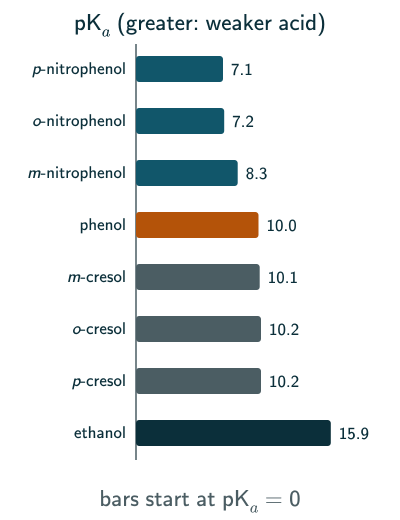
- “A million times”. NCERT says phenol is a million times more acidic than ethanol (page 207). The pKa values differ by 15.9 − 10.0 = 5.9, so the ratio of Ka values is 105.9 ≈ 8 × 10⁵: close to a million, as NCERT’s round figure says (reasoned).
- NCERT’s two books differ on phenol. Table 7.3 gives its pKa as 10.0 (Ka = 1.0 × 10⁻¹⁰), but NCERT Class 11 Chemistry, Unit 6, Table 6.6 (page 195) gives Ka = 1.3 × 10⁻¹⁰, a pKa of 9.89. In a problem, use the value the question gives.
Lucas test for primary, secondary and tertiary alcohols
- Alcohols react with hydrogen halides: ROH + HX → R–X + H2O, and with PBr3 to give alkyl bromides (NCERT page 208, as in NCERT Unit 6).
- The three classes react with HCl at very different rates, which is the Lucas test. Alcohols dissolve in Lucas reagent (concentrated HCl and ZnCl2), but their chlorides do not and make the solution turbid. A tertiary alcohol gives turbidity immediately, as it forms the halide easily; a primary alcohol gives no turbidity at room temperature (NCERT page 208). A secondary alcohol comes in between: NCERT Unit 6 (page 164) gives the order of reactivity of alcohols with a haloacid as 3° > 2° > 1°.
Mechanism of dehydration of alcohols
- Alcohols lose water to give alkenes with a protic acid (concentrated H2SO4 or H3PO4) or a catalyst such as anhydrous ZnCl2 or alumina. Ethanol needs concentrated H2SO4 at 443 K; secondary and tertiary alcohols react under milder conditions: propan-2-ol with 85% H3PO4 at 440 K gives propene, and 2-methylpropan-2-ol with 20% H3PO4 at 358 K gives 2-methylpropene (NCERT pages 208–209).
- Ease of dehydration: tertiary > secondary > primary, because tertiary carbocations are the most stable and easiest to form (NCERT page 209).
- NCERT’s mechanism for ethanol (page 209): (1) fast protonation gives the ethyl oxonium ion, CH3CH2OH2+; (2) loss of water gives the carbocation, CH3CH2+, the slowest, rate-determining step; (3) loss of a proton gives ethene. The acid used in step 1 is released in step 3, and ethene is removed as it forms to drive the equilibrium.
Oxidation of alcohols
- Oxidation makes a C=O bond by breaking an O–H and a C–H bond: it is also called dehydrogenation (NCERT page 209).
- NCERT slip (pages 208–209): NCERT lists oxidation as item 4 under “Reactions involving cleavage of carbon – oxygen (C–O) bond in alcohols”, yet its own first sentence on oxidation says that an O–H and a C–H bond break while the C–O bond becomes C=O. In an exam, for the bonds broken in oxidation, write O–H and C–H.
- Primary alcohols give aldehydes, which can be oxidised further to carboxylic acids. Acidified KMnO4 goes straight to the acid; CrO3 in an anhydrous medium, or better pyridinium chlorochromate (PCC), stops at the aldehyde (NCERT pages 209–210).
- Secondary alcohols give ketones with CrO3. Tertiary alcohols are not oxidised; under strong conditions (KMnO4, heat) C–C bonds break and a mixture of acids with fewer carbons forms (NCERT page 210).
- Over heated copper at 573 K, primary and secondary alcohols are dehydrogenated to an aldehyde or ketone, while tertiary alcohols are dehydrated to alkenes (NCERT page 210).
- In the body, methanol and ethanol are oxidised to the aldehyde and then the acid. Methanol gives methanal and then methanoic acid, which can cause blindness and death; a patient is treated with intravenous dilute ethanol, which keeps the enzyme busy while the kidneys excrete the methanol (NCERT page 210).
- NCERT slip (page 210): NCERT says the ethanol swamps the enzyme that oxidises the aldehyde (HCHO) to the acid. Beyond the NCERT text, the ethanol competes for alcohol dehydrogenase, the enzyme of the first step, methanol to methanal, so little methanol is turned into the toxic products and the kidneys can excrete it (Wikipedia, “Methanol toxicity”). In a written answer, “ethanol slows the oxidation of methanol, giving the kidneys time to excrete it” is safe, and if you name the enzyme, name alcohol dehydrogenase; in an objective question that repeats NCERT’s sentence, recognise it as NCERT’s wording.
Nitration, sulphonation and halogenation of phenol
The –OH group activates the ring towards electrophilic substitution and directs to ortho and para, which resonance makes electron-rich (NCERT page 211; directive influence, Class 11).
- Nitration. Dilute HNO3 at 298 K gives o- and p-nitrophenol, separated by steam distillation: o-nitrophenol is steam volatile because of intramolecular hydrogen bonding, while p-nitrophenol is held by intermolecular hydrogen bonds. Concentrated HNO3 gives 2,4,6-trinitrophenol (picric acid), but in poor yield (NCERT page 211).
- Sulphonation then nitration. Picric acid is now made by treating phenol with concentrated H2SO4, which gives phenol-2,4-disulphonic acid, and then with concentrated HNO3 (NCERT page 211). Picric acid is a strong acid because of its three electron-withdrawing –NO2 groups.
- Halogenation. Br2 in a solvent of low polarity (CS2 or CHCl3) at 273 K gives monobromophenols, mainly p-bromophenol with some o-bromophenol; no Lewis acid is needed, because –OH is so strongly activating. Bromine water gives a white precipitate of 2,4,6-tribromophenol: C6H5OH + 3Br2 → C6H2Br3OH + 3HBr (NCERT page 212).
- NCERT slip (page 212): Example 7.5 (c) asks for the mononitration of “phenyl methanoate”, but the answer drawn has an –OCOCH3 group, which is phenyl ethanoate (phenyl acetate); the product shown is 4-nitrophenyl ethanoate. In an exam, answer for the ester the question names: phenyl methanoate, HCOOC6H5, gives 4-nitrophenyl methanoate, and phenyl ethanoate gives 4-nitrophenyl ethanoate; in both, the ring O directs the –NO2 mainly to the para position (reasoned from NCERT’s answer).
Kolbe’s and Reimer–Tiemann reactions
- Kolbe’s reaction. Phenol with NaOH gives the phenoxide ion, which is even more reactive than phenol and is substituted even by the weak electrophile CO2; acidification gives ortho-hydroxybenzoic acid, salicylic acid (NCERT pages 212–213).
- Reimer–Tiemann reaction. Phenol with chloroform and aqueous NaOH puts a –CHO group at the ortho position: the intermediate substituted benzal chloride is hydrolysed by the alkali, and acidification gives salicylaldehyde (NCERT page 213).
- With zinc dust, phenol is reduced to benzene: C6H5OH + Zn → C6H6 + ZnO. With chromic acid (Na2Cr2O7 and H2SO4) it gives benzoquinone, a conjugated diketone; in air, phenols slowly darken to mixtures containing quinones (NCERT page 213).
Solved examples
Example 1: Choosing the Grignard route
Which carbonyl compound would you treat with CH3CH2MgBr, followed by hydrolysis, to make (i) propan-1-ol, (ii) butan-2-ol and (iii) 2-methylbutan-2-ol?
Answer: (i) Methanal, HCHO: a primary alcohol, CH3CH2CH2OH. (ii) Ethanal, CH3CHO: a secondary alcohol, CH3CH(OH)CH2CH3. (iii) Propanone, (CH3)2CO: a tertiary alcohol, (CH3)2C(OH)CH2CH3 (NCERT page 201; reasoned).
Example 2: Phenol and acetone from cumene
How much phenol and acetone can be made from 240 g of cumene, C9H12? (C = 12.0, H = 1.0, O = 16.0.)
Answer: M(C9H12) = 120 g mol−1, so 240 g is 2.00 mol. Each mole gives 1 mol of phenol, C6H5OH (94 g mol−1), and 1 mol of acetone, CH3COCH3 (58 g mol−1): at most 188 g of phenol and 116 g of acetone (reasoned from NCERT page 202).
Example 3: How much stronger an acid?
Using NCERT Table 7.3, how many times larger is Ka for p-nitrophenol than for phenol?
Answer: pKa 7.1 against 10.0, a difference of 2.9; Ka ratio = 102.9 ≈ 790. The –NO2 group at the para position delocalises the phenoxide’s charge (NCERT page 207; reasoned).
Example 4: Bromine water
0.94 g of phenol (94 g mol−1) is treated with excess bromine water. What mass of 2,4,6-tribromophenol (331 g mol−1) forms, and how many moles of Br2 are used?
Answer: 0.94/94 = 0.010 mol of phenol gives 0.010 mol of C6H2Br3OH: 0.010 × 331 = 3.31 g. It uses 3 × 0.010 = 0.030 mol of Br2 (NCERT page 212; reasoned).
Example 5: Oxidise or dehydrate?
What do (i) propan-1-ol with PCC, (ii) propan-2-ol with CrO3, and (iii) 2-methylpropan-2-ol over copper at 573 K give?
Answer: (i) Propanal, CH3CH2CHO (PCC stops at the aldehyde). (ii) Propanone, CH3COCH3. (iii) A tertiary alcohol is not dehydrogenated but dehydrated: 2-methylpropene, (CH3)2C=CH2 (NCERT pages 209–210).
Common mistakes to avoid
Common mistake
Reading hydroboration–oxidation as Markovnikov addition
It gives the alcohol on the less substituted carbon: propene gives propan-1-ol, not propan-2-ol.
Common mistake
Ranking tertiary alcohols as the strongest acids
Alkyl groups release electrons and lower the acidity: primary > secondary ≫ tertiary. Tertiary alcohols are the fastest in the Lucas test and in dehydration, not the most acidic.
Common mistake
Expecting alcohols to react with aqueous NaOH like phenol
Phenol forms sodium phenoxide with NaOH; alcohols are weaker acids than water and need sodium metal.
Common mistake
Thinking *o*-nitrophenol is held by intermolecular hydrogen bonds
In o-nitrophenol the hydrogen bond is within the molecule, which makes it steam volatile; p-nitrophenol forms bonds between molecules.
Common mistake
Using KMnO<sub>4</sub> to make an aldehyde
Acidified KMnO4 takes a primary alcohol to the acid; use PCC or CrO3 in an anhydrous medium to stop at the aldehyde.
Quick revision summary
- Alcohols from alkenes (HO/H, Markovnikov; hydroboration–oxidation, anti-Markovnikov-looking), from aldehydes (1°) and ketones (2°) by reduction, from acids by LiAlH, and from Grignard reagents (HCHO 1°, other aldehydes 2°, ketones 3°).
- Phenol from chlorobenzene (NaOH, 623 K, high pressure), benzenesulphonic acid, diazonium salts, and cumene (with acetone as by-product).
- Hydrogen bonding raises boiling points and solubility; branching lowers boiling points.
- Acidity: 1° > 2° ≫ 3° alcohols; alcohols < water < phenol; –NO raises and –CH lowers the acidity of phenol.
- Lucas test (conc. HCl + ZnCl): 3° turbid at once, 1° not at room temperature. Dehydration: 3° > 2° > 1°, via a carbocation.
- Oxidation: 1° to aldehyde (PCC) or acid (KMnO); 2° to ketone; 3° resists; Cu at 573 K dehydrogenates 1° and 2°, dehydrates 3°.
- Phenol: o,p-directing and activating; bromine water gives 2,4,6-tribromophenol; Kolbe gives salicylic acid, Reimer–Tiemann salicylaldehyde.
Formula sheet
- 2R–OH + 2Na → 2R–ONa + H
- CHOH + NaOH → CHONa + HO
- Acid strength: 1° > 2° ≫ 3° alcohol; ethanol < water < phenol
- Cumene → cumene hydroperoxide → phenol + acetone
- CHOH + 3Br → CHBrOH + 3HBr
- Dehydration ease: 3° > 2° > 1°
- Lucas reagent: conc. HCl + ZnCl
- CHOH + Zn → CH + ZnO
Questions students ask
Is phenol a strong acid or a weak acid?
Phenol is a weak acid: its pKa is 10.0 (NCERT Table 7.3, page 207), and NCERT Unit 8 calls acids with pKa between 5 and 15 weak, keeping “strong” for pKa below 1 (NCERT page 250). It is far weaker than ethanoic acid, pKa 4.76 (NCERT page 250), so it reacts with sodium hydroxide to give sodium phenoxide but, unlike carboxylic acids, gives no carbon dioxide with sodium hydrogencarbonate (NCERT pages 205 and 249). Three –NO2 groups change that: 2,4,6-trinitrophenol, picric acid, is a strong acid (NCERT page 211).
Why are cresols less acidic than phenol, and which cresol is the most acidic?
Cresols are slightly weaker acids than phenol because the electron-releasing methyl group makes the phenoxide ion less stable (NCERT page 207); in NCERT Table 7.3 m-cresol is the most acidic, pKa 10.1, against 10.2 for the other two and 10.0 for phenol. Beyond the NCERT text, finer values agree, 10.09 (m), 10.26 (p) and 10.29 (o) against 9.99 for phenol, with o and p too close to rank (PubChem, Hazardous Substances Data Bank). The reason (reasoned from NCERT page 206): the phenoxide ion’s negative charge spreads onto the ortho and para carbons, so a methyl group there destabilises the ion most, while a meta methyl sits on a carbon with none of that charge.
Is the dehydration of alcohols E1 or E2?
Acid-catalysed dehydration of secondary and tertiary alcohols follows the E1 path, a name beyond the NCERT text: the protonated alcohol slowly loses water to a carbocation, which then loses a proton, so the ease is 3° > 2° > 1° (NCERT page 209). Primary alcohols are often given an E2 path, a base removing a β-hydrogen as water leaves, in one step, since a primary carbocation is so unstable (Ian Hunt, University of Calgary course notes). NCERT, though, draws even ethanol’s dehydration through a carbocation (page 209), so in JEE and NEET answers write its three steps.
Why do tertiary alcohols resist oxidation?
Tertiary alcohols resist oxidation because the carbon carrying their –OH has no hydrogen: oxidation forms the C=O bond by removing the H of the O–H and an H from that carbon (NCERT page 209), and R3C–OH has none to lose. A C=O bond could form there only by breaking a C–C bond (reasoned), so under the usual conditions tertiary alcohols are not oxidised, while strong agents such as KMnO4 at high temperature break C–C bonds and give a mixture of acids with fewer carbons (NCERT page 210). Primary and secondary alcohols, which have that hydrogen, give aldehydes and ketones.
What is the electrophile in the Reimer–Tiemann reaction?
The electrophile in the Reimer–Tiemann reaction is dichlorocarbene, :CCl2, a point beyond the NCERT text: the hydroxide ion takes a proton from chloroform, the CCl3− ion left behind loses a chloride ion, and the electron-poor carbene is attacked by the electron-rich phenoxide ion, mainly at the ortho position (Wikipedia, “Reimer–Tiemann reaction”). The –CHCl2 group this puts on the ring is the substituted benzal chloride that NCERT names as the intermediate, and the alkali hydrolyses it to –CHO, giving salicylaldehyde after acidification (NCERT page 213). So chloroform supplies one carbon, which ends up as the aldehyde group (reasoned).
Why is the cumene process preferred for making phenol?
The cumene process is preferred because one process gives two bulk products, phenol and acetone: NCERT notes that most of the world’s phenol comes from cumene and that acetone, the by-product, is also obtained in large quantities this way (NCERT page 202). Beyond the NCERT text, cumene is made from benzene and propene by Friedel–Crafts alkylation, and the route pays only while acetone is wanted as well as phenol (Wikipedia, “Cumene process”). The chlorobenzene route needs fused NaOH at 623 K and very high pressure and gives no such by-product (NCERT page 202; reasoned).
Are Kolbe’s and Reimer–Tiemann reactions in the JEE Main 2027 and NEET (UG) 2026 syllabuses?
The Reimer–Tiemann reaction is named in Unit 17, Organic Compounds Containing Oxygen, of both JEE Main 2027 and NEET (UG) 2026, but Kolbe’s reaction is not named separately: it falls under the unit’s opening line, “General methods of preparation, properties, reactions and uses” (JEE Main 2027 wording). In JEE Main 2027’s words, the same unit names, for alcohols, the “Identification of primary, secondary and tertiary alcohols” and the “mechanism of dehydration”, and, for phenols, their “Acidic nature” and their halogenation, nitration and sulphonation. Read with its opening line, Unit 17 covers the whole of NCERT Section 7.4 (pages 199–213), Kolbe’s reaction included (reasoned).
Practice questions
Try each question first, then open the answer to check your working.
-
Q1. Arrange water, ethanol and phenol in order of increasing acid strength, and give one reaction that shows phenol is the strongest.
Show answerHide answer
Ethanol < water < phenol. Phenol dissolves in aqueous NaOH to give sodium phenoxide, C6H5OH + NaOH → C6H5ONa + H2O, which alcohols do not (NCERT pages 205–206).
-
Q2. How would you distinguish pentan-1-ol from 2-methylbutan-2-ol by the Lucas test?
Show answerHide answer
With Lucas reagent (conc. HCl + ZnCl2), the tertiary 2-methylbutan-2-ol turns turbid at once, as its chloride forms easily; the primary pentan-1-ol gives no turbidity at room temperature (NCERT page 208).
-
Q3. o-Nitrophenol and p-nitrophenol have the same molar mass. Which has the higher boiling point, and why?
Show answerHide answer
p-Nitrophenol. Its molecules are joined by intermolecular hydrogen bonds, which must be broken before it boils; in o-nitrophenol the hydrogen bond lies within each molecule, so the molecules are not associated (NCERT page 211; reasoned).
-
Q4. Name the products of (i) phenol with CHCl3 and aqueous NaOH, then acid; (ii) sodium phenoxide with CO2, then acid.
Show answerHide answer
(i) Salicylaldehyde, 2-hydroxybenzaldehyde (Reimer–Tiemann). (ii) Salicylic acid, 2-hydroxybenzoic acid (Kolbe) (NCERT pages 212–213).