Commercially important alcohols: methanol and ethanol
NCERT Class 12 Chemistry Chapter 7 Section 7.5
Quick answer
Methanol, once called wood spirit, is made by hydrogenating carbon monoxide over a ZnO–CrO catalyst at 200–300 atm and 573–673 K; it boils at 337 K, is highly poisonous (even a little can cause blindness) and is used chiefly to make formaldehyde. Ethanol is made by fermentation: invertase splits the sugar into glucose and fructose, and zymase in yeast turns them into ethanol and carbon dioxide without air, stopping above 14 percent alcohol; large amounts also come from hydration of ethene. Commercial ethanol is denatured with copper sulphate and pyridine so that it is unfit to drink.
With your textbook
NCERT Chemistry Part II (Class 12), Chapter 7 “Alcohols, Phenols and Ethers”, Section 7.5 “Some Commercially Important Alcohols”, page 214.
Open the official NCERT chapter (PDF, 4.6 MB, ncert.nic.in) (opens in a new tab)
Checked against the 2026-27 reprint on .
What are the commercially important alcohols?
Methanol and ethanol
NCERT names two commercially important alcohols: methanol, CH3OH, and ethanol, C2H5OH (NCERT page 214). Methanol is made from carbon monoxide and hydrogen over a catalyst; ethanol by fermentation of sugars and, in large quantities, by hydration of ethene. Ethanol sold for industry is made undrinkable on purpose. NCERT says:
The commercial alcohol is made unfit for drinking by mixing in it some copper sulphate (to give it a colour) and pyridine (a foul smelling liquid). It is known as denaturation of alcohol.
NCERT Chemistry Part II (Class 12), Section 7.5, page 214
In plain words: methanol, once “wood spirit”, now comes from a gas reaction at high pressure, and even a little of it can blind; ethanol comes from yeast working on sugar, or from ethene. Industrial ethanol gets a colour and a foul smell so that no one drinks it.
Methanol
- Name and old source. Methanol is also called wood spirit: it was produced by destructive distillation of wood (NCERT page 214).
- Manufacture today. Most methanol is made by catalytic hydrogenation of carbon monoxide at high pressure and temperature, over a ZnO–Cr2O3 catalyst (NCERT page 214):
Methanol from carbon monoxide
CO + 2H2 → CH3OH (ZnO–Cr2O3, 200–300 atm, 573–673 K)
- Why high pressure? At 573–673 K all three substances are gases, and 3 mol of gas give 1 mol, so Δng = 1 − 3 = −2. By Le Chatelier’s principle, raising the pressure shifts the equilibrium towards methanol (reasoned from NCERT Class 11 Chemistry, Unit 6, Section 6.8.2).
- Beyond the NCERT text: ZnO–Cr2O3 at a few hundred atmospheres is the original process, first run in Germany in 1923. Today the most widely used catalyst is a mixture of copper and zinc oxides on alumina, first used in 1966, at about 50–100 atm and 523 K (Wikipedia, “Methanol”). In exams, give NCERT’s catalyst and conditions.
- Properties. A colourless liquid, boiling at 337 K. It is highly poisonous: even small quantities can cause blindness, and large quantities cause death (NCERT page 214). In the body it is oxidised to methanal and then methanoic acid; a poisoned patient is given dilute ethanol intravenously (NCERT page 210).
- Uses. A solvent in paints and varnishes, and chiefly for making formaldehyde (methanal) (NCERT page 214).
Ethanol
Fermentation
Ethanol is obtained commercially by fermentation, and the oldest method starts from sugars, in molasses, sugarcane or fruits such as grapes (NCERT page 214). It goes in two steps, each needing an enzyme:
- Invertase converts the sugar into glucose and fructose, both C6H12O6.
- Zymase, found in yeast, ferments glucose and fructose into ethanol and carbon dioxide.
The two steps of fermentation
C12H22O11 + H2O → C6H12O6 (glucose) + C6H12O6 (fructose) (invertase)
C6H12O6 → 2C2H5OH + 2CO2 (zymase)
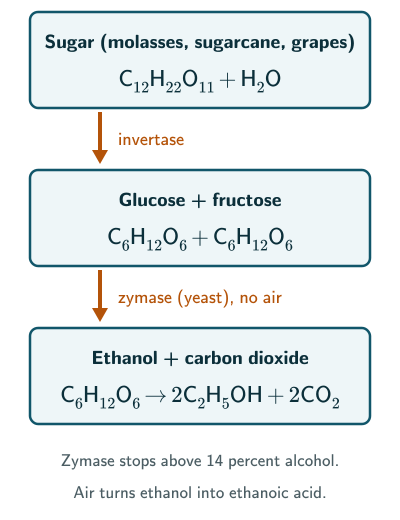
Three conditions matter (NCERT page 214):
- No air. Fermentation takes place in anaerobic conditions, and carbon dioxide is released. If air gets in, its oxygen oxidises ethanol to ethanoic acid, which spoils the taste of alcoholic drinks.
- A ceiling of about 14 percent. The action of zymase is inhibited once the alcohol formed exceeds 14 percent, so fermentation alone cannot give stronger alcohol.
- Wine making. Grapes supply both the sugar and the yeast: sugar builds up as grapes ripen, yeast grows on the outer skin, and crushing brings the two together.
Properties, uses and denaturation
- Ethanol is a colourless liquid, boiling at 351 K. It is used as a solvent in the paint industry and to prepare many carbon compounds (NCERT page 214).
- Denaturation: commercial alcohol is made unfit for drinking with copper sulphate, for colour, and pyridine, for a foul smell (NCERT page 214).
- NCERT page 210 calls ethanol mixed with methanol “denatured alcohol” too. The two descriptions do not clash: page 214 names a colouring agent and a foul-smelling one, page 210 a poisonous one. Beyond the NCERT text, the main additive is usually about 10 percent methanol, hence the name “methylated spirits”; pyridine is another typical denaturant, and a dye is often added for colour (Wikipedia, “Denatured alcohol”). If asked what denaturation is, give page 214’s answer: copper sulphate and pyridine.
- Nowadays large quantities of ethanol come from the hydration of ethene (NCERT page 214).
- In the body: ethanol acts on the central nervous system. Moderate amounts affect judgement and lower inhibitions; higher amounts cause nausea and loss of consciousness; still higher amounts interfere with breathing and can be fatal (NCERT page 214, margin note).
| Property | Methanol | Ethanol |
|---|---|---|
| Formula | CH3OH | C2H5OH |
| Boiling point | 337 K | 351 K |
| Made by | CO + 2H2, ZnO–Cr2O3 | fermentation; hydration of ethene |
| Main use | making formaldehyde | solvent; carbon compounds |
| Danger | blindness, death | acts on the nervous system |
Solved examples
Example 1: Ethanol from sucrose
What mass of ethanol, at most, can 342 g of sucrose give by fermentation, and what mass of carbon dioxide is released? (C = 12, H = 1, O = 16.)
Answer: M(C12H22O11) = 144 + 22 + 176 = 342 g mol−1, so 342 g is 1.00 mol. By the balanced equations, 1 mol of sucrose gives 2 mol of hexose, and each hexose gives 2 mol of ethanol and 2 mol of CO2: 4 mol of each. Ethanol: 4 × 46 = 184 g; CO2: 4 × 44 = 176 g. Check: 342 + 18 (water) = 360 g = 184 + 176 (NCERT page 214; reasoned).
Example 2: Carbon monoxide and hydrogen for methanol
What masses of carbon monoxide and hydrogen are needed to make 1.00 kg of methanol?
Answer: M(CH3OH) = 32 g mol−1, so 1000/32 = 31.25 mol. CO + 2H2 → CH3OH needs 31.25 mol of CO, 31.25 × 28 = 875 g, and 62.5 mol of H2, 62.5 × 2 = 125 g. Check: 875 + 125 = 1000 g (reasoned from NCERT page 214).
Common mistakes to avoid
Common mistake
Saying invertase ferments the sugar
Invertase only splits the sugar into glucose and fructose. Zymase, from yeast, does the fermentation to ethanol and carbon dioxide.
Common mistake
Letting air into a fermentation
Fermentation is anaerobic. Air does not help it: oxygen oxidises the ethanol to ethanoic acid.
Common mistake
Calling denatured alcohol purified alcohol
Denatured alcohol is ethanol made unfit to drink on purpose, with copper sulphate for colour and pyridine for smell.
Quick revision summary
- Methanol (wood spirit): CO + 2H2 → CH3OH over ZnO–Cr2O3 at 200–300 atm and 573–673 K; b.p. 337 K; highly poisonous (blindness, death); solvent; chiefly for formaldehyde.
- Ethanol: fermentation of sugars (invertase, then zymase in yeast), anaerobic; stops above 14 percent alcohol; air turns it into ethanoic acid; also from hydration of ethene; b.p. 351 K.
- Denaturation: copper sulphate (colour) and pyridine (foul smell) make commercial alcohol unfit for drinking.
Formula sheet
- Methanol: CO + 2H → CHOH (ZnO–CrO, 200–300 atm, 573–673 K)
- Invertase: CHO + HO → CHO + CHO
- Zymase: CHO → 2CHOH + 2CO
- Boiling points: methanol 337 K, ethanol 351 K
Questions students ask
Why is methanol called wood spirit?
Methanol is called wood spirit because it was once made by the destructive distillation of wood (NCERT page 214), that is, by heating wood strongly out of contact with air. Beyond the NCERT text, Robert Boyle obtained pure methanol from boxwood in 1661, and in 1834 Dumas and Péligot coined the word “methylène” from the Greek methy, an alcoholic drink, and hȳlē, wood; “methyl” was formed from it around 1840, and the -yl of ethyl, propyl and every other alkyl group comes from methyl (Wikipedia, “Methanol”). Today most methanol is made from carbon monoxide and hydrogen instead (NCERT page 214).
How is methanol made from water gas?
Methanol is made from water gas, a route beyond the NCERT text, by turning part of its carbon monoxide into extra hydrogen and then hydrogenating the rest over a ZnO–Cr2O3 catalyst, CO + 2H2 → CH3OH, the step NCERT gives (page 214). Steam over red-hot coke gives water gas, C + H2O → CO + H2, a 1 : 1 mixture, and the water–gas shift, CO + H2O ⇌ CO2 + H2, makes up the hydrogen (Wikipedia, “Water gas”): shifting 1 mol of CO in every 3 leaves 2 mol of CO with 4 mol of H2, the 1 : 2 that methanol needs (reasoned).
What is the difference between methanol and ethanol?
Methanol, CH3OH, and ethanol, C2H5OH, are the first two members of the alcohol homologous series, one CH2 apart (reasoned), and they differ most in source and danger: methanol is made from carbon monoxide and hydrogen and even a little can cause blindness, while ethanol comes from fermenting sugars or hydrating ethene and is the alcohol in drinks (NCERT page 214). Beyond the NCERT text, the two look and smell so alike that they are hard to tell apart without a chemical test, which is how methanol-tainted liquor poisons people (Wikipedia, “Methanol toxicity”).
Why is methanol so much more poisonous than ethanol?
Methanol is far more poisonous than ethanol because of what the body makes of it, methanal and then methanoic acid (NCERT page 210), whose formate ion, beyond the NCERT text, builds up, stops cells using oxygen, acidifies the blood and can destroy the optic nerve (Wikipedia, “Methanol toxicity”; NIOSH). Ethanol gives ethanal and then ethanoate, which the body turns into carbon dioxide and water in the citric acid cycle (Wikipedia, “Pharmacology of ethanol”). Symptoms may take 1 to 72 hours to show, and the antidote is fomepizole or ethanol (NIOSH).
Why is methanol added to ethanol?
Methanol is added to ethanol to make it poisonous and so unfit to drink: NCERT calls ethanol mixed with methanol denatured alcohol (page 210), and even a little methanol can cause blindness (page 214). Beyond the NCERT text, methanol is the usual choice because it is toxic and boils close to ethanol, 337 K against 351 K (NCERT page 214), so the two are hard to separate by simple distillation (Wikipedia, “Denatured alcohol”). Denaturing lets industry use ethanol as a solvent or fuel without paying the heavy taxes that many countries put on drinkable alcohol (Wikipedia, “Denatured alcohol”).
Practice questions
Try each question first, then open the answer to check your working.
-
Q1. Name the two enzymes in the fermentation of cane sugar and say what each does.
Show answerHide answer
Invertase converts the sugar into glucose and fructose; zymase, found in yeast, converts them into ethanol and carbon dioxide (NCERT page 214).
-
Q2. What is denaturation of alcohol, and why is it done?
Show answerHide answer
Mixing commercial alcohol with some copper sulphate, to give it a colour, and pyridine, a foul-smelling liquid, so that it is unfit for drinking (NCERT page 214).