Ethers: preparation, properties and reactions
NCERT Class 12 Chemistry Chapter 7 Section 7.6
Quick answer
Ethers are made by dehydrating primary alcohols with sulphuric acid (ethanol gives ethoxyethane at 413 K), or by Williamson synthesis, in which a sodium alkoxide attacks a primary alkyl halide by SN2; a tertiary halide gives only an alkene. Ethers boil close to alkanes of similar mass, far below alcohols, because their molecules cannot hydrogen bond to each other, yet dissolve in water about as well as alcohols. Hot concentrated HI cleaves them: the lower alkyl group, or a tertiary one, becomes the iodide, and anisole gives phenol and iodomethane.
With your textbook
NCERT Chemistry Part II (Class 12), Chapter 7 “Alcohols, Phenols and Ethers”, Section 7.6 “Ethers”, pages 215–221.
Open the official NCERT chapter (PDF, 4.6 MB, ncert.nic.in) (opens in a new tab)
Checked against the 2026-27 reprint on .
What do you need to know about ethers?
Ethers: preparation and reactions
Ethers, R–O–R′, are made by dehydrating primary alcohols or by Williamson synthesis, NCERT’s important laboratory method, from an alkyl halide and a sodium alkoxide. They boil about as low as alkanes of similar molar mass but dissolve in water about as well as alcohols. Their C–O bond breaks only under drastic conditions; NCERT says:
Ethers are the least reactive of the functional groups. The cleavage of C-O bond in ethers takes place under drastic conditions with excess of hydrogen halides.
NCERT Chemistry Part II (Class 12), Section 7.6.3, page 217
In plain words: to make an ether, let an alkoxide ion push a halide off a primary carbon. To break one, protonate the oxygen with hot concentrated HI or HBr and let the halide ion attack. In anisole the –OCH3 group activates the ring, much as –OH does in phenol.
Preparation of ethers
By dehydration of alcohols
- Alcohols are dehydrated by protic acids (H2SO4, H3PO4), and the conditions decide the product. With sulphuric acid, ethanol gives ethene at 443 K but mainly ethoxyethane at 413 K (NCERT page 215).
Ethanol and sulphuric acid
C2H5OH → CH2=CH2 + H2O (H2SO4, 443 K)
2C2H5OH → C2H5OC2H5 + H2O (H2SO4, 413 K)
- Mechanism (SN2), in three steps (NCERT page 215): (i) the alcohol is protonated, CH3CH2OH2+; (ii) a second alcohol molecule attacks it as a nucleophile, and water leaves; (iii) the protonated ether loses H+.
- Only for primary alkyl groups. The alkyl group must be unhindered and the temperature kept low, or the alkene wins. Secondary and tertiary alcohols react by SN1, and their dehydration to ethers fails because elimination competes over substitution (NCERT page 215).
Williamson synthesis
Williamson synthesis is an important laboratory method for both symmetrical and unsymmetrical ethers: an alkyl halide reacts with a sodium alkoxide (NCERT page 215). Alexander William Williamson (1824–1904) became Professor of Chemistry at University College, London, in 1849 (NCERT page 215, margin note).
Williamson synthesis
R–X + R′–O−Na+ → R–O–R′ + NaX
- The alkoxide attacks a primary halide by SN2. The alkoxide may carry a secondary or tertiary group: (CH3)3C–O−Na+ + CH3Br → (CH3)3C–O–CH3 + NaBr (NCERT pages 215–216).
- Not with a tertiary halide. Alkoxides are strong bases as well as nucleophiles. With secondary halides elimination competes; with a tertiary halide the alkene is the only product: CH3ONa + (CH3)3C–Br gives exclusively 2-methylpropene (NCERT page 216).
- So put the bulky group on the alkoxide and keep the halide primary. NCERT Example 7.6 (page 216) makes tert-butyl ethyl ether from sodium tert-butoxide and CH3CH2Cl; sodium ethoxide with tert-butyl chloride gives mainly 2-methylprop-1-ene.
- Phenols react the same way, as the phenoxide ion: C6H5OH + NaOH → C6H5O−Na+ + H2O, then C6H5O−Na+ + R–X → C6H5–O–R + NaX (NCERT page 216).
- Diethyl ether was once widely used as an inhalation anaesthetic, but its slow effect and unpleasant recovery period led to its replacement by other compounds (NCERT page 215, margin note).
Physical properties
- The C–O bonds are polar, so ethers have a net dipole moment, but this weak polarity hardly affects their boiling points: they are close to those of alkanes of comparable molecular mass and much lower than those of alcohols (NCERT page 217).
| Compound | b.p./K |
|---|---|
| n-pentane, CH3(CH2)3CH3 | 309.1 |
| ethoxyethane, C2H5–O–C2H5 | 307.6 |
| butan-1-ol, CH3(CH2)3–OH | 390 |
- The large gap between alcohols and ethers is due to hydrogen bonding in alcohols (NCERT page 217); ether molecules have no O–H to bond with each other.
- Solubility. Ethers mix with water about as well as alcohols of the same molecular mass: ethoxyethane 7.5 g and butan-1-ol 9 g per 100 mL of water, while pentane is essentially immiscible. The ether’s oxygen forms hydrogen bonds with water molecules (NCERT page 217).
Cleavage of the C–O bond
- Ethers are cleaved by excess hydrogen halide under drastic conditions, with concentrated HI or HBr at high temperature; the order of reactivity is HI > HBr > HCl (NCERT page 217).
- A dialkyl ether gives an alkyl halide and an alcohol, which excess HX turns into a second alkyl halide (NCERT page 217):
Cleavage by HX
R–O–R + HX → RX + R–OH
R–OH + HX → R–X + H2O
Mechanism with HI (NCERT page 218):
- Protonation. HI or HBr is acidic enough to protonate the oxygen, giving an oxonium ion.
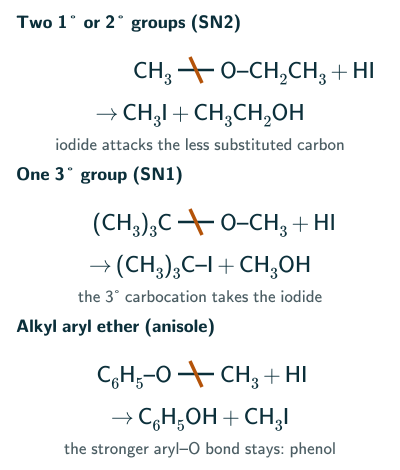
- Iodide attacks the least substituted carbon of the oxonium ion and displaces an alcohol molecule by SN2. With primary or secondary groups, the lower alkyl group becomes the alkyl iodide: CH3–O–CH2CH3 + HI → CH3I + CH3CH2OH.
- With excess HI at high temperature, the ethanol is also converted to ethyl iodide.
- NCERT slip (page 218): in step 2, NCERT draws the transition state as [I···CH3···O(H)···CH2CH3] with a + on the oxygen and a − outside the bracket, and with the O–CH2CH3 bond dotted. The reactants, I− and the oxonium ion, carry no net charge, so the transition state is neutral overall, with a partial negative charge on iodine and a partial positive charge on the oxygen; only the I···C and C···O bonds to the methyl carbon are partial, and the O–CH2CH3 bond stays whole. Draw it that way in an exam.
- With a tertiary group, it is the tertiary group that becomes the iodide: (CH3)3C–O–CH3 + HI → CH3OH + (CH3)3C–I. CH3OH leaves the protonated ether to give the stable (CH3)3C+, which takes the iodide, so this step follows SN1 (NCERT page 218).
- Alkyl aryl ethers break at the alkyl–oxygen bond: anisole gives phenol and CH3I. The O–C6H5 bond is stronger, because that carbon is sp2 hybridised and the bond has partial double bond character. Phenol does not react further, because its sp2 carbon cannot undergo the nucleophilic substitution needed (NCERT pages 217–219).
Electrophilic substitution in anisole
The alkoxy group, –OR, activates the ring and is ortho, para directing, as –OH is in phenol, because its lone pairs feed electron density into the ring by resonance (NCERT page 219; compare directive influence). NCERT’s three reactions of anisole (pages 219–220):
- Bromination with Br2 in ethanoic acid, even without an iron(III) bromide catalyst: p-bromoanisole (90%, major) and o-bromoanisole (minor).
- Friedel–Crafts, with anhydrous AlCl3: with CH3Cl (in CS2), 4-methoxytoluene (major) and 2-methoxytoluene (minor); with CH3COCl, 4-methoxyacetophenone (major) and 2-methoxyacetophenone (minor).
- Nitration with concentrated H2SO4 and HNO3: 4-nitroanisole (major) and 2-nitroanisole (minor).
Solved examples
Example 1: Choosing the Williamson pair
How would you make 2-methoxypropane, (CH3)2CH–O–CH3, by Williamson synthesis?
Answer: Use sodium propan-2-olate (sodium isopropoxide) with bromomethane: (CH3)2CH–O−Na+ + CH3Br → (CH3)2CH–O–CH3 + NaBr. The halide is primary, so SN2 substitution wins. The other pair, CH3ONa with 2-bromopropane, uses a secondary halide, where elimination to propene competes (reasoned from NCERT pages 215–216).
Example 2: Which group becomes the iodide?
Give the products when 2-methoxypropane is heated with excess concentrated HI.
Answer: Both groups are primary or secondary, so iodide attacks the less substituted carbon, the methyl group: (CH3)2CH–O–CH3 + HI → CH3I + (CH3)2CHOH. With excess HI at high temperature, propan-2-ol goes on to 2-iodopropane (reasoned from NCERT page 218).
Example 3: Boiling points of isomeric compounds
Using NCERT’s data, show that n-pentane, ethoxyethane and butan-1-ol have comparable molar masses, and find how much higher butan-1-ol boils than ethoxyethane. (C = 12, H = 1, O = 16.)
Answer: C5H12: 60 + 12 = 72 g mol−1; C4H10O (both ethoxyethane and butan-1-ol): 48 + 10 + 16 = 74 g mol−1. Butan-1-ol boils 390 − 307.6 = 82.4 K higher than ethoxyethane, its isomer, because its molecules hydrogen bond to each other; ethoxyethane and pentane differ by only 309.1 − 307.6 = 1.5 K (NCERT page 217).
Common mistakes to avoid
Common mistake
Using a tertiary halide in Williamson synthesis
The alkoxide acts as a base and removes HX: (CH3)3C–Br with CH3ONa gives only 2-methylpropene. Put the tertiary group on the alkoxide instead.
Common mistake
Expecting iodobenzene from anisole and HI
The O–CH3 bond breaks, not the stronger O–C6H5 bond: the products are phenol and CH3I.
Common mistake
Calling ethers high-boiling because their C–O bonds are polar
Ether molecules cannot hydrogen bond to each other, so ethoxyethane (307.6 K) boils like pentane, not like butan-1-ol (390 K).
Quick revision summary
- Dehydration with H2SO4: ethanol gives ethoxyethane at 413 K and ethene at 443 K; SN2 on the protonated alcohol; primary alkyl groups only.
- Williamson synthesis: R–X + R′ONa → R–O–R′ + NaX, by SN2; the halide should be primary, as tertiary halides give only alkenes; phenoxides work too.
- Boiling points close to alkanes and far below alcohols (no hydrogen bonding between ether molecules); solubility close to alcohols (hydrogen bonds to water).
- Cleavage by concentrated HI or HBr (HI > HBr > HCl): the lower alkyl group becomes the iodide by SN2; a tertiary group becomes the iodide by SN1; anisole gives phenol and CH3I.
- –OR is activating and ortho, para directing: anisole is brominated without a catalyst, and gives mainly para products in bromination, Friedel–Crafts and nitration.
Formula sheet
- 2CHOH → CHOCH + HO (HSO, 413 K)
- R–X + R′–ONa → R–O–R′ + NaX
- R–O–R + HX → RX + R–OH
- CHOCH + HI → CHOH + CHI
- Reactivity: HI > HBr > HCl
- b.p.: n-pentane 309.1 K, ethoxyethane 307.6 K, butan-1-ol 390 K
Questions students ask
Is Williamson ether synthesis SN1 or SN2?
Williamson ether synthesis is an SN2 reaction: the alkoxide ion attacks the carbon carrying the halogen and pushes the halide out in one step, so it works best with a primary alkyl halide (NCERT pages 215–216). An SN1 path would need a carbocation, which forms mainly from tertiary halides, and those give only alkenes (reasoned; NCERT page 216). Being SN2 fixes the stereochemistry (reasoned from NCERT Unit 6, pages 172 and 179): the halide’s carbon is inverted if it is a stereocentre, but the alcohol’s C–O bond never breaks, so a chiral alcohol keeps its configuration.
Why are ethers less reactive than alcohols?
Ethers are less reactive than alcohols because they have no O–H bond, so the alcohol reactions that break it cannot happen: ethers give no hydrogen with sodium, form no esters and are not oxidised to carbonyl compounds, which needs the H of the O–H (NCERT pages 205, 207 and 209); beyond the NCERT text, the C–O bonds that remain are strong (Wikipedia, “Ether”). To break a C–O bond, an acid must first protonate the oxygen and a good nucleophile must attack, so ethers are cleaved only by concentrated HI or HBr at high temperature, HCl acting only slowly (NCERT pages 217–218; Wikipedia, “Ether”). Lacking an O–H, ethers can even be dried with sodium (Wikipedia, “Diethyl ether”).
What is the difference between ethers and esters?
Ethers and esters differ in what sits next to the oxygen: an ether, R–O–R′, has it between two alkyl or aryl groups, while an ester, RCOOR′, such as ethyl ethanoate, CH3COOC2H5, has a C=O group beside it and is made from a carboxylic acid and an alcohol (esterification, NCERT Unit 8, page 251). That C=O lets acid or alkali hydrolyse an ester to the acid, or its salt, and the alcohol (NCERT Unit 8, page 247), while ethers break only with hot concentrated HI or HBr (NCERT page 217). Beyond the NCERT text, many esters have fruity smells (Wikipedia, “Ester”).
What is anisole, and what is it used for?
Anisole is methoxybenzene, C6H5OCH3, or methyl phenyl ether (NCERT Table 7.2, page 197), the simplest alkyl aryl ether (reasoned). Beyond the NCERT text, it is a colourless liquid that smells of aniseed and boils at about 154 °C, 427 K (PubChem), and it is used to make other compounds, among them medicines, perfumes and insect pheromones (Wikipedia, “Anisole”). Unlike phenol, C6H5OH, it has no O–H, so it is not acidic and does not dissolve in aqueous NaOH (reasoned from NCERT page 205).
Why are ethers used as solvents?
Ethers such as ethoxyethane are used as solvents because they dissolve many organic compounds yet react with very few reagents: NCERT calls ethers “the least reactive of the functional groups” (page 217), and Grignard reagents, for one, are made in dry ether. Ethoxyethane boils at only 307.6 K (NCERT page 217), so it is easily evaporated off, and, beyond the NCERT text, it forms a separate layer above water, so it is used to extract organic compounds from water (Wikipedia, “Diethyl ether”). But it is extremely flammable, and ethers left in air and light form explosive peroxides (Wikipedia, “Ether”).
Which chapter has Williamson ether synthesis, and is it in the JEE Main 2027 and NEET (UG) 2026 syllabuses?
Williamson ether synthesis is in NCERT Class 12 Chemistry Part II, Unit 7, Alcohols, Phenols and Ethers, Section 7.6.1 (pages 215–216), which calls it an important laboratory method for both symmetrical and unsymmetrical ethers. Unit 17, Organic Compounds Containing Oxygen, of both JEE Main 2027 and NEET (UG) 2026 does not name it: for ethers it lists only “Ethers: Structure.”, and their preparation and reactions come under the unit’s opening line, “General methods of preparation, properties, reactions and uses” (JEE Main 2027 wording). Read together, these cover all of NCERT Section 7.6 (pages 215–221), Williamson synthesis, dehydration of alcohols and cleavage by HI included (reasoned).
Practice questions
Try each question first, then open the answer to check your working.
-
Q1. Why is acid dehydration of a mixture of methanol and ethanol not a good way to make ethyl methyl ether?
Show answerHide answer
Each alcohol can attack either protonated alcohol, so a mixture of three ethers forms: CH3OCH3, CH3OC2H5 and C2H5OC2H5, which must then be separated (reasoned from NCERT page 215, which asks this question).
-
Q2. Which bond of anisole breaks when it is heated with HI, and why?
Show answerHide answer
The O–CH3 bond, giving phenol and CH3I. The O–C6H5 bond is stronger: the ring carbon is sp2 hybridised and the bond has partial double bond character (NCERT page 218).