Carbonyl group: nomenclature and structure
NCERT Class 12 Chemistry Chapter 8 Section 8.1
Quick answer
Aldehydes, R–CHO, and ketones, R–CO–R′, are named in IUPAC by replacing the alkane’s final -e with -al or -one; a simple open-chain monoaldehyde’s CHO carbon is C1, ketones are numbered from the end nearer C=O, and common names use α, β, γ from the carbon next to the carbonyl group. The carbonyl carbon is sp hybridised, so it and the three atoms on it lie in one plane with bond angles of about 120°. Oxygen is more electronegative, so the C=O bond is polar: the carbon is electrophilic and the oxygen nucleophilic.
With your textbook
NCERT Chemistry Part II (Class 12), Chapter 8 “Aldehydes, Ketones and Carboxylic Acids”, Section 8.1 “Nomenclature and Structure of Carbonyl Group”, pages 228–231.
Open the official NCERT chapter (PDF, 4.4 MB, ncert.nic.in) (opens in a new tab)
Checked against the 2026-27 reprint on .
What is the carbonyl group?
The carbonyl group, >C=O
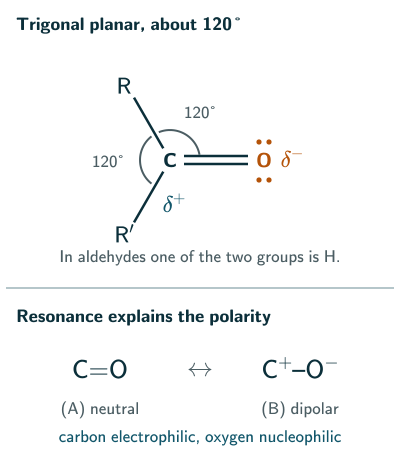
Aldehydes and ketones both contain the carbonyl group, a carbon doubly bonded to oxygen. In an aldehyde the carbonyl carbon carries a hydrogen and a carbon group or another hydrogen, R–CHO (R = alkyl, aryl or H; methanal is HCHO); in a ketone it carries two carbon groups, R–CO–R′ (NCERT page 227). The carbon is sp2 hybridised and the C=O bond is polar; NCERT says:
The carbon-oxygen double bond is polarised due to higher electronegativity of oxygen relative to carbon. Hence, the carbonyl carbon is an electrophilic (Lewis acid), and carbonyl oxygen, a nucleophilic (Lewis base) centre.
NCERT Chemistry Part II (Class 12), Section 8.1.2, page 231
In plain words: the carbonyl carbon and the three atoms on it lie flat, about 120° apart, and oxygen pulls the shared electrons towards itself. The slightly positive carbon is where nucleophiles attack, which is the key to almost every reaction in this chapter.
Common names
- Aldehydes take the common name of the matching carboxylic acid, with the ending –ic acid replaced by aldehyde: formic acid gives formaldehyde, acetic acid gives acetaldehyde. The names reflect the Latin or Greek source of the acid (NCERT page 228).
- Substituent positions are shown by Greek letters: the α-carbon is the one directly linked to the aldehyde group, then β, γ, δ (NCERT page 228). So CH3CH(Br)CH2CHO is β-bromobutyraldehyde; in IUPAC terms the α-carbon is C2, so this is 3-bromobutanal (reasoned).
- Ketones are named by the two alkyl or aryl groups on the carbonyl group, with positions α, α′, β, β′ counted from the carbons next to it. The simplest, dimethyl ketone, keeps its historical name, acetone (NCERT page 229).
- Phenyl ketones commonly add the acyl group’s name to phenone: acetophenone (C6H5COCH3), propiophenone (C6H5COCH2CH3) and benzophenone (C6H5COC6H5) (NCERT page 229).
IUPAC names
The rules (NCERT page 229), which build on the Class 11 functional-group rules:
- Take the alkane name and replace the final –e by –al for an aldehyde or –one for a ketone.
- Simple open-chain monoaldehydes: choose the longest suitable chain containing –CHO and number its carbon C1. Ketones: choose a chain containing the principal C=O group and number it to give that group the lowest locant. Multiple principal groups and ring carbaldehydes need the corresponding suffix rules.
- Prefix the substituents in alphabetical order, with their positions.
- In a cyclic ketone the carbonyl carbon is C1. When –CHO is attached to a ring, add the suffix carbaldehyde to the ring’s name and number from the ring carbon carrying it.
- The simplest aromatic aldehyde is benzenecarbaldehyde, but IUPAC also accepts benzaldehyde, so other aromatic aldehydes are named as substituted benzaldehydes.
NCERT’s examples (pages 229–230):
- CH3CH2CH2CH(Br)CH(CH3)CH2CHO: 4-bromo-3-methylheptanal
- CH3CH2CH=CHCHO: pent-2-enal
- C6H5COCH2CH3: 1-phenylpropan-1-one
- CH3CH2COCH2CHO: 3-oxopentanal (the aldehyde is the principal group, so the ketone oxygen is named “oxo”)
- OHC–CH2–CH(CHO)–CH2–CHO: propane-1,2,3-tricarbaldehyde, which treats all three –CHO groups alike
- cyclopentanone with CH3 two carbons from C=O: 3-methylcyclopentanone; a ring with –CHO: cyclohexanecarbaldehyde
- p-O2NC6H4CHO: 4-nitrobenzenecarbaldehyde, or 4-nitrobenzaldehyde as a substituted benzaldehyde
NCERT Table 8.1 (page 230), common name then IUPAC name:
-
HCHO: formaldehyde, methanal
-
CH3CHO: acetaldehyde, ethanal
-
(CH3)2CHCHO: isobutyraldehyde, 2-methylpropanal
-
a cyclohexane ring carrying –CHO, with CH3 on ring carbon 3 (the carbon carrying –CHO is 1): γ-methylcyclohexanecarbaldehyde, 3-methylcyclohexanecarbaldehyde
-
CH3CH(OCH3)CHO: α-methoxypropionaldehyde, 2-methoxypropanal
-
CH3CH2CH2CH2CHO: valeraldehyde, pentanal
-
CH2=CHCHO: acrolein, prop-2-enal
-
o-C6H4(CHO)2: phthaldehyde, benzene-1,2-dicarbaldehyde
-
m-BrC6H4CHO: m-bromobenzaldehyde, 3-bromobenzaldehyde (3-bromobenzenecarbaldehyde)
-
CH3COCH2CH2CH3: methyl n-propyl ketone, pentan-2-one
-
(CH3)2CHCOCH(CH3)2: diisopropyl ketone, 2,4-dimethylpentan-3-one
-
cyclohexanone with CH3 on the carbon next to C=O: α-methylcyclohexanone, 2-methylcyclohexanone
-
(CH3)2C=CHCOCH3: mesityl oxide, 4-methylpent-3-en-2-one
-
A note on one name (page 231): NCERT’s Intext Question 8.1 (v) prints “Di-sec. butyl ketone”, with “sec.” as an abbreviation, a style NCERT also uses in Unit 6 (“1-Bromo-4-sec. butyl-2-methylbenzene”, page 163). NCERT’s naming lessons write the group sec-butyl (NCERT Class 11 Chemistry, Unit 8, page 263), so the compound is di-sec-butyl ketone, (CH3CH2CH(CH3))2CO, or 3,5-dimethylheptan-4-one. In an exam, write sec-butyl with a hyphen.
Structure of the carbonyl group
- The carbonyl carbon is sp2 hybridised and forms three σ bonds. Its fourth electron, in a p orbital, overlaps a p orbital of oxygen to form the π bond, and oxygen also has two non-bonding electron pairs (NCERT page 231; see hybridisation of carbon).
- So the carbonyl carbon and the three atoms attached to it lie in one plane, with the π electron cloud above and below it; the bond angles are about 120°, as in a trigonal coplanar structure (NCERT page 231 and its Figure 8.1).
- Polarity. Oxygen is more electronegative, so the C=O bond is polarised: the carbon is an electrophilic (Lewis acid) centre and the oxygen a nucleophilic (Lewis base) centre, in the terms of electrophiles and nucleophiles. Simple aldehydes and ketones generally have larger dipole moments than comparable ethers (NCERT page 231).
- The high polarity is explained by resonance represented by a neutral contributor (A), >C=O, and a dipolar contributor (B), >C+–O− (NCERT page 231).
- NCERT slip (page 231): the sentence prints “Carbonyl compounds have substantial dipole moments and are polar than ethers”, with more missing. The intended comparison is “more polar than ethers”, for comparable simple molecules; write it that way in an exam. Resonance contributors are alternative drawings of one delocalised electronic structure, not species rapidly interconverting.
Solved examples
Example 1: Common and IUPAC names of an aldehyde
Give the common and IUPAC names of (CH3)2CHCH2CHO.
Answer: The chain has four carbons counting the CHO carbon, so the parent is butanal (common: butyraldehyde). The methyl group is on the second carbon from the CHO group, the β-carbon, or C3: common name β-methylbutyraldehyde, IUPAC name 3-methylbutanal (reasoned from NCERT pages 228–229; NCERT Exercise 8.3 (i), page 255, asks for the reverse).
Example 2: An alkyl phenyl ketone
Name C6H5COCH2CH2CH3 in both systems.
Answer: The acyl group CH3CH2CH2CO– is butyryl, so the common name is butyrophenone, built like propiophenone. IUPAC: a four-carbon chain with the carbonyl at C1 and a phenyl group on it, 1-phenylbutan-1-one, built like 1-phenylpropan-1-one (reasoned from NCERT page 229).
Common mistakes to avoid
Common mistake
Calling the CHO carbon the α-carbon
In common names the α-carbon is the one next to the aldehyde group. In an -al name that is C2, because the CHO carbon itself is C1. In a -carbaldehyde name the CHO carbon is not numbered, so the ring carbon carrying it is both C1 and α: γ-methylcyclohexanecarbaldehyde is 3-methylcyclohexanecarbaldehyde (NCERT Table 8.1, page 230).
Common mistake
Numbering an aldehyde chain from the other end
For a simple open-chain monoaldehyde named with -al, the CHO carbon is C1 and its locant is omitted: pentanal, not pentan-1-al. This does not replace the separate rules for dialdehydes and carbaldehydes.
Common mistake
Drawing the carbonyl carbon as tetrahedral
It is sp2 and trigonal planar, with angles of about 120°; the π cloud lies above and below that plane.
Quick revision summary
- Aldehydes R–CHO, ketones R–CO–R′; both contain >C=O.
- Common names: aldehydes from acid names (–ic acid → aldehyde), positions α, β, γ from the carbon next to CHO; ketones by their two groups (acetone; acetophenone, benzophenone).
- IUPAC: –e → –al or –one; the CHO carbon is C1 in simple monoaldehydes; ketones numbered from the end nearer C=O; carbaldehyde for –CHO on a ring; benzaldehyde accepted.
- Structure: sp2 carbon, trigonal planar, about 120°; C=O polarised, carbon electrophilic, oxygen nucleophilic; resonance >C=O ↔ >C+–O−.
Formula sheet
- Aldehyde: R–CHO
- Ketone: R–CO–R′
- Open-chain aldehydes: α-carbon = IUPAC C2, β = C3, γ = C4; ring carbaldehydes: α = ring C1
- Carbonyl carbon: sp, trigonal planar, bond angles about 120°
- Resonance: >C=O ↔ >C–O
Questions students ask
What is the difference between aldehydes and ketones?
Aldehydes and ketones differ in what the carbonyl carbon carries: in an aldehyde, R–CHO, it holds a hydrogen plus a carbon group or another hydrogen, so in an open chain the group stands at an end and is named -al, its carbon C1, while in a ketone, R–CO–R′, it holds two carbon groups and is named -one (NCERT pages 227–229). That hydrogen also sets their chemistry apart: aldehydes are oxidised even by mild oxidising agents, which leave ketones unchanged, and are generally more reactive in nucleophilic addition (NCERT pages 236 and 239).
Are aldehydes and ketones isomers?
Aldehydes and ketones with the same molecular formula are functional group isomers: propanal, CH3CH2CHO, and propanone, CH3COCH3, are both C3H6O. A ketone needs a carbon on each side of its C=O, so the pairs start at three carbons, and methanal and ethanal have no ketone isomer (reasoned). The count grows fast: C5H10O has seven structural carbonyl isomers, four aldehydes and three ketones, among them pentanal, pentan-2-one and pentan-3-one (reasoned).
What is the difference between the carbonyl, formyl and acyl groups?
The carbonyl group is the >C=O unit itself, found in aldehydes, ketones and carboxylic acids alike, while an acyl group is R–CO–, a carbonyl carbon with one more group on it, such as acetyl, CH3CO–, or benzoyl, C6H5CO– (reasoned from NCERT pages 227, 229 and 234). The formyl group, –CHO, is the simplest acyl group, the one with R = H, named from formic acid as acetyl is from acetic acid (reasoned from NCERT page 228). So an aldehyde is a formyl group joined to R or H and a ketone an acyl group joined to a second carbon group, and acyl chlorides, RCOCl, carry the acyl group into the Rosenmund reduction and Friedel–Crafts acylation (NCERT pages 232 and 234).
Is the carbonyl group acidic or basic?
The carbonyl group is both in the Lewis sense: its carbon is an electrophilic, Lewis acid centre and its oxygen a nucleophilic, Lewis base centre (NCERT page 231), which an acid can protonate, making the carbon more electrophilic (NCERT pages 237–238). The acidic hydrogens of aldehydes and ketones are not on the group but on the α-carbon next to it (acidity of α-hydrogens, NCERT page 241). Removal of an α-hydrogen gives an enolate whose negative charge is delocalised over oxygen and carbon. This stabilisation explains the acidity and the aldol reaction; numerical pKa comparisons require the same solvent and conditions.
What is the general formula of aldehydes and ketones?
Saturated acyclic aldehydes and ketones with one C=O, no other functional group and no other multiple bond share the general formula CnH2nO: methanal is CH2O, ethanal C2H4O, and propanal and propanone are both C3H6O, each member one CH2 larger than the last (reasoned from NCERT pages 228–230). The formula alone does not prove a carbonyl compound, because unsaturated alcohols such as prop-2-en-1-ol, CH2=CHCH2OH, and cyclic ethers share it (reasoned). The 2,4-DNP test detects aldehydes and ketones under the usual test conditions; carboxylic acids, esters and amides also contain C=O but do not normally give this precipitate (NCERT page 238).
Practice questions
Try each question first, then open the answer to check your working.
-
Q1. Why is the carbonyl carbon attacked by nucleophiles and the carbonyl oxygen by electrophiles?
Show answerHide answer
Oxygen is more electronegative, so the C=O bond is polarised, as the dipolar resonance structure >C+–O− shows: the carbon is an electrophilic centre and the oxygen a nucleophilic one (NCERT page 231).
-
Q2. Give the IUPAC name of CH3CH2CH(Cl)CHO, α-chlorobutyraldehyde.
Show answerHide answer
2-Chlorobutanal: the α-carbon is the one next to the CHO group, C2 in a chain numbered from the aldehyde carbon (NCERT pages 228–229).