Hybridisation: sp, sp², sp³, sp³d and sp³d²
NCERT Class 11 Chemistry Chapter 4 Section 4.6
Quick answer
Hybridisation is a mathematical combination of orbitals on one atom used to describe directional bonding, not a physical mixing event before a bond forms. Ideal sp, sp and sp sets point at 180°, 120° and 109.5° respectively. Traditional spd and spd labels describe main-group geometries in school chemistry, while modern bonding need not involve substantial d-orbital participation.
With your textbook
NCERT Chemistry Part I (Class 11), Chapter 4 “Chemical Bonding and Molecular Structure”, Section 4.6 “Hybridisation”, pages 120–125.
Open the official NCERT chapter (PDF, 4.5 MB, ncert.nic.in) (opens in a new tab)
Checked against the 2026-27 reprint on .
What is hybridisation?
Hybridisation
Hybridisation is a mathematical combination of atomic orbitals on one atom into a new set, the hybrid orbitals, used to describe bonding. Ideal equivalent sp, sp and sp sets have equal s/p composition and the familiar symmetric directions (NCERT Section 4.6, pages 120–125):
- the number of hybrid orbitals equals the number of atomic orbitals mixed;
- the hybrids point in directions that keep the electron pairs as far apart as possible, so the type of hybridisation fixes the geometry;
- sp gives two orbitals at 180° (linear), sp2 three at 120° (trigonal planar), sp3 four at 109.5° (tetrahedral), sp3d five (trigonal bipyramidal) and sp3d2 six (octahedral).
Pauling introduced the idea to explain the shapes of molecules such as CH4, NH3 and H2O.
In plain words: an atom’s s and p orbitals point in awkward directions (the p orbitals are at 90°, the s orbital has no direction at all). We can describe the same orbital space using directional combinations, each with a large lobe pointing one way. This is not a separate physical event that happens before bonding. Mix one s with three p and you get four sp3 orbitals aimed at the corners of a tetrahedron, which is exactly the shape of methane.
Why hybridisation is needed
Simple overlap of pure orbitals puts the bonds made by p orbitals at 90° to one another in CH4, NH3 and H2O (and leaves the direction of methane’s fourth, 2s-based bond undecided), because the three p orbitals are at right angles; the real angles are 109.5°, 107° and 104.5° (NCERT Section 4.5.3, pages 119–120). To explain these characteristic shapes, Pauling proposed that the atomic orbitals combine into a new set of equivalent orbitals, the hybrid orbitals, and that these, unlike pure orbitals, are used in bond formation (NCERT Section 4.6, page 120). For example, when one 2s and three 2p orbitals of carbon hybridise, four new sp3 hybrid orbitals form. The shapes of the s and p orbitals being mixed are shown on the page on shapes of atomic orbitals.
Features and conditions
Salient features (NCERT pages 120–121):
- The number of hybrid orbitals equals the number of atomic orbitals that are hybridised.
- Ideal sp, sp and sp sets are equivalent; actual bond and lone-pair orbitals need not be identical, and axial/equatorial positions in a trigonal bipyramid differ.
- Directional hybrids provide a useful localised picture of effective overlap. Changing the mathematical orbital basis does not itself lower a molecule’s energy.
- They point in preferred directions that minimise repulsion between electron pairs, so the type of hybridisation indicates the geometry of the molecule.
Conditions (NCERT page 121):
- only orbitals of the valence shell are hybridised;
- the orbitals being mixed must have almost equal energy;
- promotion of an electron is not an essential condition before hybridisation;
- not only half-filled orbitals take part: in some cases even filled orbitals of the valence shell are hybridised (as the lone-pair orbitals of N in NH3 and O in H2O are).
Types of hybridisation: sp, sp2, sp3
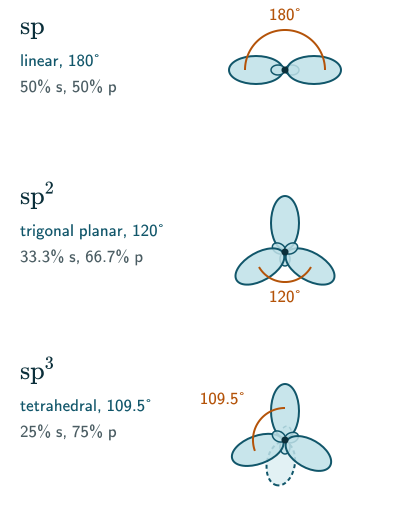
sp hybridisation (NCERT Section 4.6.1, page 121): one s and one p orbital mix to give two equivalent sp orbitals, each with 50% s and 50% p character, pointing in opposite directions along one axis (180°). It is also called diagonal hybridisation. Each sp hybrid has a large positive lobe and a very small negative lobe, which gives more effective overlap and stronger bonds. Example, BeCl2: Be is 1s2 2s2. In the excited state one 2s electron is promoted to a vacant 2p orbital; the 2s and that 2p orbital hybridise to two sp orbitals at 180°, and each overlaps axially with a 3p orbital of chlorine to form two Be–Cl σ bonds. Isolated gaseous BeCl2 is linear; its condensed-phase structures are more complex.
sp2 hybridisation (pages 121–122): one s and two p orbitals give three equivalent sp2 orbitals, each with 33.3% s and 66.7% p character, in a plane at 120°. Example, BCl3: B is 1s2 2s2 2p1. Promoting one 2s electron leaves three unpaired electrons; the 2s and two 2p orbitals hybridise to three sp2 orbitals, which overlap with 3p orbitals of chlorine to form three B–Cl bonds. BCl3 is trigonal planar, Cl–B–Cl 120°. (NCERT’s text on pages 121–122 says 2p here, a slip: chlorine bonds through its half-filled 3p orbital; its 2p subshell is full and lies inside.)
sp3 hybridisation (page 122): one s and three p orbitals give four equivalent sp3 orbitals, each with 25% s and 75% p character, directed to the corners of a tetrahedron at 109.5°.
- CH4: the four sp3 orbitals of carbon each overlap with an H 1s orbital: four C–H σ bonds, tetrahedral, 109.5°.
- NH3: nitrogen (2s2 2p3) forms four sp3 orbitals; three hold one electron each and form N–H σ bonds, the fourth holds the lone pair. Lone pair–bond pair repulsion is greater than bond pair–bond pair repulsion, so the angle shrinks from 109.5° to 107°: pyramidal.
- H2O: oxygen’s four sp3 orbitals hold two single electrons (for the two O–H bonds) and two lone pairs. Two corners of the tetrahedron are taken by H atoms and two by lone pairs; the angle falls to 104.5°: V-shaped (angular).
| Type | Geometry (angle) | Examples |
|---|---|---|
| sp | linear (180°) | BeCl2, C2H2 |
| sp2 | trigonal planar (120°) | BCl3, C2H4 |
| sp3 | tetrahedral (109.5°) | CH4, C2H6 |
Hybridisation of carbon in ethane, ethene and ethyne
In ethane molecule both the carbon atoms assume sp hybrid state.
NCERT Chemistry Part I (Class 11), Section 4.6.2, page 123
Ethane, C2H6 (sp3): one sp3 orbital of each carbon overlaps axially with the other’s to form the sp3–sp3 C–C σ bond; the other three on each carbon form sp3–s σ bonds with H. C–C is 154 pm and C–H 109 pm (NCERT page 123).
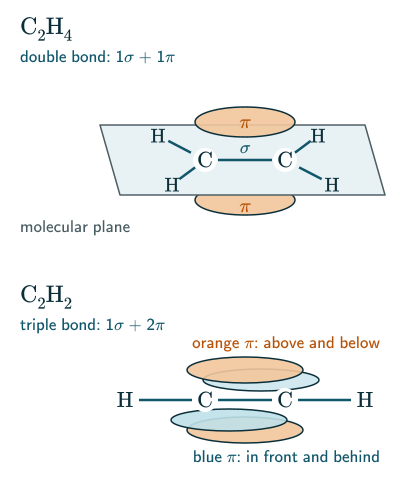
Ethene, C2H4 (sp2): one sp2 orbital of each carbon forms the C–C σ bond; the other two form sp2–s σ bonds with H. The unhybridised 2p orbital on each carbon, perpendicular to the plane of the molecule, overlaps sideways with the other to form a weak π bond, with two equal electron clouds above and below the plane. So the C=C bond is one sp2–sp2 σ bond plus one π bond, 134 pm long; C–H is 108 pm; H–C–H is 117.6° and H–C–C 121° (NCERT page 123).
Ethyne, C2H2 (sp): each carbon is sp hybridised and keeps two unhybridised p orbitals, 2px and 2py. One sp orbital of each carbon forms the C–C σ bond and the other forms a σ bond with H, so the molecule is linear. The two pairs of unhybridised p orbitals overlap sideways to form two π bonds: the triple bond is one σ and two π bonds (NCERT page 124). The C=C of every alkene and the C≡C of every alkyne are built the same way as in ethene and ethyne.
More s character holds the electrons closer to the nucleus, so bonds from sp2 and sp carbons are shorter: C–H is 109 pm from sp3 carbon and 108 pm from sp2 carbon (NCERT page 123); beyond the NCERT text, the C–H bond in ethyne (sp, 50% s) is shorter still, about 106 pm. The C–C bond also shortens, from 154 to 134 to about 120 pm, but mainly because of the extra π bonds.
Hybridisation involving d orbitals
The following is NCERT’s traditional d-hybridisation model for third-period molecules such as PCl5 and SF6. Modern bonding calculations do not require significant 3d participation: these labels are useful school-level geometry labels, not literal proof of electron promotion into 3d orbitals. The 3d orbitals are also comparable to 4s and 4p, which allows 3d, 4s, 4p hybridisation in transition-metal ions such as [Ni(CN)4]2− (NCERT Section 4.6.3, page 124). The important schemes:
| Shape | Type | Examples |
|---|---|---|
| square planar | dsp2 | [Ni(CN)4]2−, [PtCl4]2− |
| trigonal bipyramidal | sp3d | PF5, PCl5 |
| square pyramidal | sp3d2 | BrF5 |
| octahedral | sp3d2 | SF6 |
| octahedral | d2sp3 | [CrF6]3−, [Co(NH3)6]3+ |
Gaseous PCl5, traditional sp3d description: phosphorus (Z = 15) is 3s2 3p3; in the excited state one 3s electron moves to a 3d orbital, leaving five half-filled orbitals (one s, three p, one d). These hybridise to five sp3d orbitals pointing to the corners of a trigonal bipyramid, and each overlaps with a singly occupied 3p orbital of a chlorine atom to form a P–Cl σ bond (NCERT pages 124–125). The bond angles are not all equal: three equatorial bonds lie in one plane at 120° to each other, and two axial bonds, one above and one below, are at 90° to that plane. The axial bond pairs suffer more repulsion from the equatorial bond pairs, so the axial bonds are slightly longer and weaker, which makes PCl5 more reactive (page 125). Beyond the NCERT text: the rule that hybrids are equivalent holds for sp, sp2, sp3 and sp3d2, but not for sp3d. Its three equatorial and two axial orbitals differ, which is one more reason the axial and equatorial bonds are not the same.
NCERT’s orbital-box diagram for PCl5 (page 124) is captioned as sp3d orbitals filled by electron pairs donated by the five Cl atoms. That would describe coordinate bonds, and it is a slip: each P–Cl bond is an ordinary covalent bond, with one electron from a half-filled sp3d orbital of phosphorus and one from the singly occupied orbital of chlorine, as NCERT’s own text on page 125 says.
SF6, traditional sp3d2 description: sulphur is 3s2 3p4; in the excited state one s, three p and two d orbitals are singly occupied. They hybridise to six sp3d2 orbitals towards the corners of a regular octahedron, which overlap with singly occupied orbitals of six fluorine atoms: six S–F σ bonds, octahedral (page 125).
Beyond the NCERT text: modern calculations show that d orbitals contribute little to the bonding in molecules such as PCl5 and SF6. The sp3d and sp3d2 descriptions are still the ones used in NCERT, JEE and NEET, and they give the right shapes.
Finding the hybridisation quickly
A common shortcut (beyond the NCERT text) for an atom in a molecule or ion:
Steric number
Steric number = (number of σ bonds) + (number of lone pairs) on the atom
A steric number of 2, 3, 4, 5 or 6 means sp, sp2, sp3, sp3d or sp3d2. Count every single, double or triple bond as one σ bond; π bonds use unhybridised p orbitals and do not count. Find lone pairs from a complete Lewis structure. For an individual atom, nonbonding electrons = its valence count − its formal charge − the sum of its bond orders; divide by two for lone pairs. Do not assign the overall ion charge to the central atom unless that is its formal charge; for example, S in SO2 has 6 − 4 = 2 electrons left, one lone pair, so it is sp2. For hypervalent main-group species, 5, 6 and 7 domains are traditionally labelled sp3d, sp3d2 and sp3d3 (IF7). Conjugated lone pairs are another limitation: an amide nitrogen is approximately planar/sp because its lone pair occupies a p orbital, despite a naive count of three bonds plus one lone pair. The shortcut does not decide between dsp2 and sp3, or d2sp3 and sp3d2, in complex ions; that needs the d-electron count, covered with coordination compounds in Class 12.
Solved examples
Example 1: Carbon atoms in organic molecules (NCERT Exercise 4.30, page 135)
Which hybrid orbitals do the carbon atoms use in (a) CH3–CH3; (b) CH3–CH=CH2; (c) CH3–CH2–OH; (d) CH3–CHO; (e) CH3COOH?
A carbon with four single bonds has steric number 4 (sp3); a carbon in a double bond has three σ bonds (sp2).
Answer: (a) both sp3; (b) CH3 sp3, CH and CH2 sp2; (c) both sp3; (d) CH3 sp3, CHO carbon sp2; (e) CH3 sp3, COOH carbon sp2.
Example 2: A change of hybridisation (NCERT Exercise 4.25, page 134)
Describe the change in hybridisation, if any, of Al in AlCl3 + Cl− → AlCl4−.
In isolated monomeric AlCl3, aluminium has three σ bonds and no lone pair: steric number 3, sp2, trigonal planar. Its empty 3p orbital accepts a lone pair from Cl−; in AlCl4− it has four σ bonds: steric number 4, sp3.
Answer: sp2 (trigonal planar) changes to sp3 (tetrahedral).
Example 3: PCl<sub>5</sub> (NCERT Exercise 4.38, page 135)
Describe the hybridisation in PCl5. Why are the axial bonds longer than the equatorial bonds?
Phosphorus uses one 3s, three 3p and one 3d orbital: five sp3d hybrids, trigonal bipyramidal. Each axial bond pair is at 90° to three equatorial bond pairs, while each equatorial bond pair is at 90° to only the two axial ones.
Answer: sp3d; the axial bond pairs suffer more repulsion from the equatorial bond pairs, so the axial bonds are slightly longer and weaker.
Example 4: Using the steric number
Find the hybridisation and shape of the central atom in NH3, SF4 and ICl4−.
NH3: 3 σ bonds + 1 lone pair = 4, sp3, pyramidal. SF4: sulphur has 6 valence electrons, 4 used in bonds, so 1 lone pair: 4 + 1 = 5, sp3d, see-saw. ICl4−: iodine has 7 + 1 = 8 electrons, 4 used in bonds, so 2 lone pairs: 4 + 2 = 6, sp3d2, square planar.
Answer: NH3 sp3; SF4 sp3d; ICl4− sp3d2.
Common mistakes to avoid
Common mistake
Thinking hybridisation needs promotion
Promotion of an electron is not an essential condition, and filled orbitals can be hybridised too: in NH3 the lone pair sits in one of the four sp3 orbitals.
Common mistake
Counting π bonds in the steric number
π bonds are made from unhybridised p orbitals. In ethene each carbon has three σ bonds and is sp2, not sp3.
Common mistake
Calling NH<sub>3</sub> or H<sub>2</sub>O tetrahedral
The hybrid orbitals are arranged tetrahedrally, but the shape names only the atoms: NH3 is pyramidal and H2O V-shaped.
Common mistake
Hybridising orbitals of very different energy
Only valence-shell orbitals of nearly equal energy mix. Inner orbitals, such as carbon’s 1s, take no part, and NCERT notes that 3p, 3d and 4s cannot be mixed together because 3p and 4s differ too much in energy.
Quick revision summary
- Hybridisation (Pauling): valence orbitals of nearly equal energy mix into an equal number of directional hybrid orbitals; ideal equivalent sets describe familiar geometries without implying a literal pre-bonding mixing process.
- sp: 2 orbitals, 180°, 50% s (BeCl2, C2H2). sp2: 3, 120° (BCl3, C2H4). sp3: 4, 109.5°, 25% s (CH4, NH3 107°, H2O 104.5°).
- Carbon: ethane sp3 (C–C 154 pm), ethene sp2 (1σ + 1π, 134 pm), ethyne sp (1σ + 2π).
- Traditional main-group d-hybrid labels (modern bonding need not use significant d character): sp3d trigonal bipyramidal (PCl5, axial bonds longer), sp3d2 octahedral (SF6), dsp2 square planar.
- Steric number (σ bonds + lone pairs) 2 to 6 gives sp to sp3d2.
Formula sheet
- Steric number = σ bonds + lone pairs on the atom
- Steric number 2, 3, 4, 5, 6: sp, sp, sp, spd, spd
- s character: sp 50%, sp 33.3%, sp 25%
- Angles: sp 180°, sp 120°, sp 109.5°
Questions students ask
What is the difference between sp2 and sp3 hybridisation?
In sp2 hybridisation one s and two p orbitals mix into three hybrids in a plane at 120°, each with 33.3% s character, while in sp3 hybridisation one s and three p orbitals mix into four hybrids at 109.5°, pointing to the corners of a tetrahedron, each with 25% s character. An sp2 atom keeps one unhybridised p orbital, perpendicular to the plane, which can form a π bond, so sp2 carbon is found in double bonds (C=C in alkenes, C=O in aldehydes); an sp3 atom has no p orbital left over and forms only σ bonds, as carbon does in alkanes.
What is the hybridisation of carbon in CO2?
The carbon atom in CO2 is sp hybridised: it forms two σ bonds, one to each oxygen, and has no lone pair, so its steric number is 2 and the molecule is linear, O=C=O, with a bond angle of 180°. The two perpendicular sets of p orbitals form π systems delocalised over O–C–O. Assigning one p orbital exclusively to one oxygen is only a localised Lewis picture, not the full molecular-orbital description.
What is the hybridisation of XeF4 and XeF6?
In the traditional school model, XeF4 is labelled sp3d2 and XeF6 sp3d3; these labels do not establish substantial d-orbital participation. In XeF4 its 8 valence electrons form 4 Xe–F bonds and leave 2 lone pairs, a steric number of 6, so the six hybrid orbitals point to the corners of an octahedron; the lone pairs take opposite corners, and the molecule is square planar. In XeF6, 6 bonds and 1 lone pair give a steric number of 7, and the molecule is a distorted octahedron.
How does hybridisation affect electronegativity?
The more s character a hybrid orbital has, the more electronegative the atom using it, so carbon’s electronegativity rises in the order sp3 (25% s) < sp2 (33.3% s) < sp (50% s): an s orbital holds its electrons closer to the nucleus than a p orbital does. An sp carbon therefore pulls the electrons of a C–H bond towards itself more strongly, which is why the hydrogen atoms of ethyne are weakly acidic: ethyne reacts with sodium to give sodium ethynide and hydrogen, while ethene and ethane do not.
What is the difference between sp3 and dsp2 hybridisation?
Both sp3 and dsp2 hybridisation give four hybrid orbitals, but sp3 mixes one s and three p orbitals into a tetrahedral set (109.5°), while dsp2 mixes one inner d orbital, of the shell below, with one s and two p orbitals into a square planar set (90°). The difference matters for complexes of nickel(II), studied in Class 12: [NiCl4]2− is sp3, tetrahedral and paramagnetic, with two unpaired electrons, while [Ni(CN)4]2− is dsp2, square planar and diamagnetic.
Practice questions
Try each question first, then open the answer to check your working.
-
Q1. What is meant by hybridisation of atomic orbitals? Describe the shapes of sp, sp2 and sp3 hybrid orbitals (NCERT Exercise 4.24, page 134).
Show answerHide answer
Hybridisation is the intermixing of orbitals of slightly different energies on one atom to give an equal number of new orbitals of equal energy and shape. Each hybrid has one large lobe and a very small one. Two sp hybrids point in opposite directions (linear, 180°); three sp2 hybrids lie in a plane at 120° (trigonal planar); four sp3 hybrids point to the corners of a tetrahedron at 109.5°.
-
Q2. Is there any change in the hybridisation of B and N atoms as a result of the reaction BF3 + NH3 → F3B.NH3 (NCERT Exercise 4.26, page 135)?
Show answerHide answer
Boron in BF3 has three σ bonds (sp2, trigonal planar); after accepting nitrogen’s lone pair it has four σ bonds (sp3, tetrahedral). Nitrogen is sp3 in NH3 (three σ bonds + one lone pair) and stays sp3 in the adduct (four σ bonds). So only boron changes.
-
Q3. Describe how the double bond in C2H4 and the triple bond in C2H2 are formed (based on NCERT Exercise 4.27, page 135).
Show answerHide answer
C2H4: each carbon is sp2; sp2–sp2 overlap gives the C–C σ bond, and the unhybridised 2p orbitals, perpendicular to the molecular plane, overlap sideways to give one π bond (clouds above and below the plane). C2H2: each carbon is sp; sp–sp overlap gives the σ bond, and the two unhybridised p orbitals on each carbon, at right angles, overlap sideways to give two π bonds. The figure above shows both.