Bonding in coordination compounds: VBT and CFT
NCERT Class 12 Chemistry Chapter 5 Section 5.5
Quick answer
Valence bond theory uses hybrid orbitals as a qualitative model of coordination bonding and geometry. Crystal field theory explains how a ligand field splits the metal’s d orbitals and how splitting competes with pairing energy to determine spin. Magnetic moments and colours help test these models, but real spectra can include charge transfer and magnetic moments do not uniquely determine geometry.
With your textbook
NCERT Chemistry Part I (Class 12), Chapter 5 “Coordination Compounds”, Section 5.5 “Bonding in Coordination Compounds”, pages 128–135.
Open the official NCERT chapter (PDF, 3.7 MB, ncert.nic.in) (opens in a new tab)
Checked against the 2026-27 reprint on .
How is bonding in coordination compounds explained?
Bonding in coordination compounds
Werner described what coordination compounds are, but not why certain elements form them, why their bonds are directional, or why they have characteristic magnetic and optical properties (NCERT Section 5.5, page 128). NCERT treats two theories: valence bond theory (VBT), which uses hybrid orbitals, and crystal field theory (CFT), which NCERT introduces as follows:
The crystal field theory (CFT) is an electrostatic model which considers the metal-ligand bond to be ionic arising purely from electrostatic interactions between the metal ion and the ligand.
NCERT Chemistry Part I (Class 12), Section 5.5.4, page 131
In plain words: In the qualitative VBT model, the metal combines selected atomic-orbital functions into a set of equal hybrid orbitals, and each ligand pushes a lone pair into one of them. CFT says the ligands, as negative charges, push some of the metal’s d orbitals up in energy and leave the others lower; whether the d electrons then pair up decides the magnetism, and transitions between the sets can give colour. Charge-transfer and ligand-centred transitions can also contribute to a real spectrum.
Valence bond theory
- The metal atom or ion uses its (n − 1)d, ns, np or ns, np, nd orbitals to form a set of equivalent hybrid orbitals of definite geometry; these overlap with ligand orbitals that donate electron pairs (NCERT Section 5.5.1, page 128).
- NCERT Table 5.2 (page 128):
| Hybridisation (coordination number) | Shape |
|---|---|
| sp3 (4) | tetrahedral |
| dsp2 (4) | square planar |
| sp3d (5) | trigonal bipyramidal |
| sp3d2 (6) | octahedral |
| d2sp3 (6) | octahedral |
- NCERT’s worked cases (pages 129–130), counting the metal’s d electrons from its oxidation state:
- [Co(NH3)6]3+: Co3+ is 3d6; the six electrons pair up in three 3d orbitals, two 3d orbitals join 4s and 4p: d2sp3, octahedral, diamagnetic.
- [CoF6]3−: Co3+, 3d6 as in the free ion, four unpaired; 4s, 4p and two 4d orbitals: sp3d2, octahedral, paramagnetic with four unpaired electrons.
- [NiCl4]2−: Ni2+ is 3d8 with two unpaired electrons; sp3, tetrahedral, paramagnetic.
- [Ni(CO)4]: nickel is 0. The free atom is 3d84s2, with two unpaired 3d electrons (NCERT Class 12 Chemistry, Unit 4, Table 4.2, page 94). In the textbook VBT bookkeeping, the bonded nickel centre is represented as 3d10, leaving 4s and 4p available: sp3, tetrahedral, diamagnetic (NCERT page 129).
- [Ni(CN)4]2−: Ni2+, 3d8, all paired, which frees one 3d orbital: dsp2, square planar, diamagnetic.
- NCERT slip (page 129): the [CoF6]3− diagram labels its six hybrid orbitals “sp3d3 hybrid”. 4s, three 4p and two 4d make sp3d2, as the row label and the text say; write sp3d2.
- Hybrid orbitals are mathematical combinations of atomic-orbital functions, not separately measurable physical objects. NCERT emphasises the mathematical nature of hybridisation (NCERT page 130).
Inner and outer orbital complexes
- A complex that uses inner d orbitals, (n − 1)d, in d2sp3 hybridisation is an inner orbital complex; the d example here is also low spin, like [Co(NH3)6]3+ (NCERT page 129).
- A complex that uses outer d orbitals, nd, in sp3d2 hybridisation is an outer orbital complex; the d example here is also high spin, like [CoF6]3− (NCERT page 129).
- Up to three d electrons (Ti3+ d1, V3+ d2, Cr3+ d3), two 3d orbitals are free anyway. From d4 to d6, a vacant pair of 3d orbitals appears only if the electrons pair up, leaving two (d4), one (d5) or no (d6) unpaired electrons (NCERT page 130).
The inner/outer labels are VBT orbital choices, not universal synonyms for low/high spin. Octahedral d–d and d–d have no alternative high/low-spin filling in the simple CFT model; even low-spin d cannot leave two 3d orbitals vacant. Use CFT for the spin classification.
Magnetic properties of coordination compounds
- The magnetic moment, measured by magnetic susceptibility experiments, gives information about the number of unpaired electrons and hence the structures adopted by metal complexes (NCERT Section 5.5.2, page 130). It does not by itself fix the geometry (reasoned).
- When orbital contributions are sufficiently quenched, the spin-only approximation is μ = √[n(n + 2)] BM for n unpaired electrons, as on the general-properties page (NCERT Class 12 Chemistry, Unit 4, page 102).
- NCERT’s pairs (page 130):
| Complex | Unpaired | Type |
|---|---|---|
| [Mn(CN)6]3− | 2 | inner, d2sp3 |
| [MnCl6]3− | 4 | outer, sp3d2 |
| [Fe(CN)6]3− | 1 | inner, d2sp3 |
| [FeF6]3− | 5 | outer, sp3d2 |
| [Co(C2O4)3]3− | 0 | inner, d2sp3 |
| [CoF6]3− | 4 | outer, sp3d2 |
- The data agree with maximum spin pairing in many cases, especially for d6 ions; d4 and d5 ions give the complications above, which VBT explains with inner and outer orbital complexes (NCERT page 130).
Limitations of valence bond theory
VBT explains formation, structures and magnetic behaviour to a large extent, but (NCERT Section 5.5.3, page 131):
- it involves a number of assumptions;
- it gives no quantitative interpretation of magnetic data;
- it does not explain the colour of coordination compounds;
- it gives no quantitative account of their thermodynamic or kinetic stabilities;
- it makes no exact prediction between tetrahedral and square planar structures for 4-coordinate complexes;
- it does not distinguish between weak and strong ligands.
Crystal field theory
- Ligands are treated as point charges (anions) or point dipoles (neutral molecules) (NCERT page 131).
- The five d orbitals of an isolated metal atom or ion have the same energy (they are degenerate), and they stay degenerate in a spherically symmetrical field of negative charges. The field of real ligands is not spherical, so the degeneracy is lifted: the d orbitals split, in a pattern set by the geometry (NCERT page 131).
Splitting in octahedral and tetrahedral fields
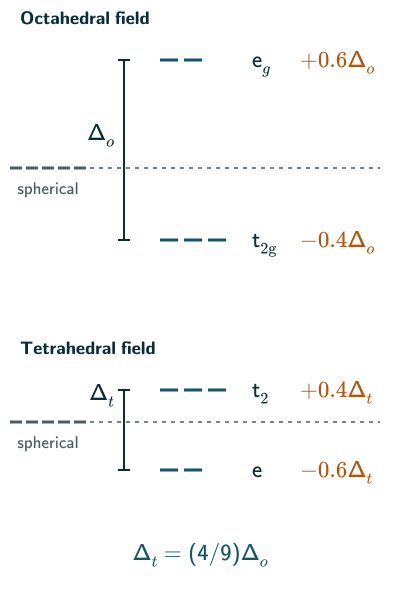
- Octahedral. The ligands approach along the axes. The dx²−y² and dz² orbitals, which point along the axes, are repelled more and lie above the spherical-field average: the eg set. The dxy, dyz and dxz orbitals, which point between the axes, lie below that average: the t2g set (NCERT page 131).
- The gap is the crystal field splitting, Δo. The two eg orbitals rise by (3/5)Δo and the three t2g fall by (2/5)Δo, so the average energy is unchanged: 2 × (3/5) − 3 × (2/5) = 0 (NCERT page 132, Fig. 5.8).
- Filling. d1 to d3 go singly into t2g. For d4, the fourth electron either pairs in t2g or goes into eg, depending on Δo and the pairing energy P (NCERT page 132):
- Δo < P: t2g3 eg1, weak field ligands, high spin;
- Δo > P: t2g4 eg0, strong field ligands, low spin.
- Why P decides (reasoned from NCERT page 132). Count −0.4Δo per t2g electron and +0.6Δo per eg electron. d4 high spin: −1.2Δo + 0.6Δo = −0.6Δo. Low spin: −1.6Δo, plus one pairing energy P. Low spin is lower by Δo − P, so it wins only when Δo > P.
- NCERT links strong-field d–d configurations with greater crystal-field stabilisation (page 132). Overall complex stability also depends on ligand bonding, solvation and entropy; Δ alone cannot rank arbitrary complexes.
- Tetrahedral. The splitting is inverted and smaller: in the ideal point-charge model with the same metal, ligands and metal–ligand distance, Δt ≈ (4/9)Δo. It is rarely large enough to force pairing, so low spin tetrahedral complexes are rare. Ideal octahedral and square planar ligand fields have inversion symmetry and use g labels for the d-orbital levels. Tetrahedral ones lack a centre of symmetry (NCERT says “lack symmetry”, but a tetrahedron is highly symmetrical), so their levels are e and t2: t2 rises by (2/5)Δt and e falls by (3/5)Δt (NCERT page 133, Fig. 5.9).
Spectrochemical series
Ligands arranged in order of increasing field strength, an experimentally determined series based on the light that complexes absorb (NCERT page 132):
I− < Br− < SCN− < Cl− < S2− < F− < OH− < C2O42− < H2O < NCS− < edta4− < NH3 < en < CN− < CO
- Ligands at the left produce small splittings (weak field); those at the right, large splittings (strong field). Thiocyanate appears twice because S-bound SCN− and N-bound NCS− differ (reasoned).
- Δo also depends on the charge on the metal ion (NCERT page 132).
Colour in coordination compounds
- A complex absorbs part of the visible spectrum, and the colour we see is that of the light left over, which is complementary to the colour absorbed: if green light is absorbed, the complex appears red (NCERT Section 5.5.5, page 133).
- [Ti(H2O)6]3+ is violet. Ti3+ is 3d1, with the electron in t2g. Absorbing blue-green light (498 nm) excites it to eg, t2g1 eg0 → t2g0 eg1, a d–d transition (NCERT page 133, with its Fig. 5.10 on page 134).
- NCERT Table 5.3 (page 133), including its printed wavelength/colour labels:
| Entity, light absorbed | Absorbed → seen |
|---|---|
| [CoCl(NH3)5]2+, 535 nm | yellow → violet |
| [Co(NH3)5(H2O)]3+, 500 nm | blue green → red |
| [Co(NH3)6]3+, 475 nm | blue → yellow orange |
| [Co(CN)6]3−, 310 nm | ultraviolet → pale yellow |
| [Cu(H2O)4]2+, 600 nm | red → blue |
| [Ti(H2O)6]3+, 498 nm | blue green → violet |
-
NCERT slip (page 133): two colour labels. For an NCERT question, quote Table 5.3’s labels as printed. Beyond the NCERT text: on the usual band limits of the visible spectrum, green runs from 500 to 565 nm and orange from 590 to 625 nm, so 535 nm is green rather than yellow and 600 nm is orange rather than red (Wikipedia, “Visible spectrum”, table of spectral colours). A 310 nm ultraviolet absorption alone cannot explain a visible pale-yellow colour: visible absorption bands or tails also matter, and the colour seen depends on the full spectrum (reasoned).
-
No ligands, no splitting, no colour (NCERT page 134). NCERT: “in the absence of ligand, crystal field splitting does not occur and hence the substance is colourless”. Its examples: removing the water from [Ti(H2O)6]Cl3 on heating leaves it colourless; anhydrous CuSO4 is white, but CuSO4·5H2O is blue.
-
NCERT slip (page 134): removing water changes the coordination environment; it does not remove every ligand. The titanium example implies that anhydrous TiCl3 is colourless, and it is not. Beyond the NCERT text: TiCl3 remains coordinated by chloride and is violet or brown depending on its crystal form (Wikipedia, “Titanium(III) chloride”), and in anhydrous CuSO4 sulphate oxygens still coordinate copper, whose measured d–d bands lie in the near infrared (Wildner and colleagues, Physics and Chemistry of Minerals, 2014). So the colour change comes from the different environment and absorption spectrum, not from an absence of all ligands (reasoned). In a written answer on NCERT’s rule, give NCERT’s reason (no ligand, so no splitting and no colour) and its examples. Of the two, only the CuSO4 observation is right: anhydrous CuSO4 is white because its changed environment moves the d–d absorption into the near infrared, not because it has no ligands (Wildner and colleagues, 2014).
-
The ligand changes the colour. Adding en to green [Ni(H2O)6]2+ step by step gives pale blue [Ni(H2O)4(en)]2+, blue/purple [Ni(H2O)2(en)2]2+ and violet [Ni(en)3]2+ (NCERT page 134, Fig. 5.11). NCERT Fig. 5.11 labels the third tube [Ni(H2O)4en2]2+; the equation gives the right [Ni(H2O)2(en)2]2+. en is a stronger field ligand than water, so each step absorbs at higher energy (reasoned from the spectrochemical series).
-
Gemstones. Ruby is Al2O3 with about 0.5–1% Cr3+ (d3) in octahedral sites; in emerald, Cr3+ sits in octahedral sites of beryl, Be3Al2Si6O18, where its absorption bands shift to longer wavelength and the stone transmits green light (NCERT pages 134–135).
Limitations of crystal field theory
- If ligands were point charges, anionic ligands should split the d orbitals most, yet many such as halides occur at its weak end while neutral CO is strong; anionic CN is itself strong (NCERT Section 5.5.6, page 135).
- CFT ignores the covalent character of the metal–ligand bond, such as the π back bonding in metal carbonyls (reasoned from NCERT pages 135–136). Ligand field theory and molecular orbital theory deal with these points, beyond NCERT’s scope (NCERT page 135).
Solved examples
Example 1: Geometry from the magnetic moment (NCERT Example 5.7)
The spin-only magnetic moment of [MnBr4]2− is 5.9 BM. Predict its geometry.
Answer: Mn is +2 (x − 4 = −2), so 3d5. 5.9 BM fits five unpaired electrons: √(5 × 7) = √35 = 5.92 BM. Square planar dsp2 would need a vacant 3d orbital, so pairing; five unpaired electrons mean sp3, tetrahedral (NCERT page 131).
Example 2: Inner or outer orbital?
Explain why [Fe(CN)6]3− is weakly paramagnetic but [Fe(H2O)6]3+ strongly paramagnetic. (NCERT Intext Question 5.7.)
Answer: Both contain Fe3+, 3d5. CN− is a strong ligand: the 3d electrons pair up, leaving one unpaired electron, and two 3d orbitals take part in d2sp3, an inner orbital complex (μ = √3 = 1.73 BM). H2O is a weak ligand: the five electrons stay unpaired, and sp3d2 gives an outer orbital complex (μ = √35 = 5.92 BM) (NCERT answer, page 140).
Example 3: High spin or low spin d<sup>6</sup>
Write the t2g/eg configurations of [CoF6]3− and [Co(NH3)6]3+ and count the unpaired electrons.
Answer: Co3+ is d6. F− is a weak field ligand (Δo < P): t2g4 eg2, four unpaired, high spin. NH3 is a strong field ligand for Co3+ (Δo > P): t2g6 eg0, none, low spin and diamagnetic, matching VBT’s d2sp3 (NCERT page 129; reasoned).
Example 4: The size of Δ<sub>t</sub>
If Δo for a metal–ligand pair is 18 000 cm−1, estimate Δt for a tetrahedral complex of the same metal and ligand at the same distance.
Answer: Δt = (4/9)Δo = (4/9) × 18 000 = 8000 cm−1 (NCERT page 133).
Common mistakes to avoid
Common mistake
Calling the hybrid orbitals real
Hybridisation is a mathematical change of orbital basis. The named hybrids are a useful model, not independently observed objects or a complete molecular-orbital description.
Common mistake
Writing g for tetrahedral levels
Tetrahedral complexes have no centre of symmetry, so their levels are e and t2, not eg and t2g, and the order is inverted.
Common mistake
Expecting anions to be the strongest ligands
CFT’s point charges suggest it, but I−, Br− and Cl− are weak field ligands, while neutral CO is the strongest in the series.
Common mistake
Thinking colour needs unpaired electrons
Diamagnetic [Co(NH3)6]3+, t2g6, is yellow orange (NCERT Table 5.3): a d–d jump needs room in eg, not an unpaired electron (reasoned).
Quick revision summary
- VBT: hybrid orbitals take ligand lone pairs; sp tetrahedral, dsp square planar, spd trigonal bipyramidal, dsp (inner) and spd (outer) octahedral.
- Estimate unpaired electrons from a spin-only magnetic moment, μ = √[n(n + 2)] BM; e.g. [Fe(CN)] 1, [FeF] 5.
- CFT: octahedral eg up by 0.6Δo, t2g down by 0.4Δo; tetrahedral inverted, Δt = (4/9)Δo.
- Δo < P high spin (weak field); Δo > P low spin (strong field). Spectrochemical series from I (weakest) to CO (strongest).
- Colour can involve d–d, charge-transfer and ligand transitions; the colour seen depends on the full absorption spectrum.
Formula sheet
- Octahedral: eg = +0.6Δo, t2g = −0.4Δo
- Tetrahedral: Δt = (4/9)Δo
- Spin-only moment: μ = √[n(n + 2)] BM
- d in an octahedral field: t2g eg if Δo < P; t2g eg if Δo > P
Questions students ask
What is the difference between crystal field theory and valence bond theory?
Valence bond theory treats the metal–ligand bond as covalent, with ligand lone pairs in metal hybrid orbitals, while crystal field theory treats it as ionic, with ligands as point charges or dipoles that split the d orbitals (NCERT pages 128 and 131). VBT ties each shape to a hybrid set, chosen by the magnetic moment, but cannot explain colour or predict which ligands pair the d electrons; CFT explains colour by d–d transitions and spin by comparing Δo with P (NCERT pages 132–133). NCERT associates inner-orbital d–d examples with low spin, but the labels are not universally equivalent; the Class 11 valence bond theory page shows VBT at work in complexes.
What is crystal field stabilisation energy, and how is it different from the splitting energy?
Crystal field stabilisation energy (CFSE) is the net lowering in energy of a metal ion’s d electrons in the ligand field, counted as −0.4Δo per t2g and +0.6Δo per eg electron, while the splitting energy Δo is only the gap between the two sets (beyond the NCERT text; Wikipedia, “Crystal field theory”). For high spin d7, t2g5 eg2, CFSE = 5(−0.4Δo) + 2(0.6Δo) = −0.8Δo, while low spin t2g6 eg1 gives −1.8Δo plus one more pairing energy P (reasoned). So low spin wins only if Δo > P.
Why is the tetrahedral crystal field splitting smaller than the octahedral one, and why is it inverted?
The tetrahedral splitting is smaller because a tetrahedron has four ligands instead of six and none points straight at a d orbital (beyond the NCERT text; Wikipedia, “Crystal field theory”); for the same metal, ligands and distance, NCERT gives Δt = (4/9)Δo (page 133). It is inverted because the four ligands lie between the x, y and z axes, nearer the lobes of dxy, dyz and dxz than those of dx²−y² and dz², which point along the axes (reasoned from NCERT page 131). So the t2 set rises and the e set falls (NCERT page 133).
How can you remember the spectrochemical series?
The spectrochemical series is easiest to remember by donor atom: NCERT’s order (page 132) runs halogen and sulphur donors < O donors < N donors < C donors (reasoned). First come I− < Br− < SCN− < Cl− < S2− < F−, then OH− < C2O42− < H2O, then NCS− < edta4− < NH3 < en, bound through N (edta also through O), and last CN− < CO. Thiocyanate is weak through S but stronger through N, and other tables place S2− differently (Wikipedia, “Crystal field theory”), so in an exam use NCERT’s order.
What is the difference between crystal field theory and ligand field theory?
Crystal field theory treats ligands only as point charges or dipoles, while ligand field theory combines it with molecular orbital theory, so the metal–ligand bond becomes partly covalent, with σ and π parts (beyond the NCERT text; Wikipedia, “Crystal field theory”; beyond NCERT’s scope, page 135). The name comes from physics: Hans Bethe (1929) and John van Vleck (1932) worked out how the ions of a crystal split a metal ion’s levels (same source). The π part lets ligand field theory explain what crystal field theory cannot, such as neutral CO at the top of the spectrochemical series (same source).
Is crystal field theory in the JEE Main 2027 and NEET (UG) 2026 syllabus?
Yes, crystal field theory is in both syllabuses, but only its basic ideas: Unit 12 of JEE Main 2027 lists “Bonding: Valence bond approach and basic ideas of Crystal field theory, colour and magnetic properties”, and Unit 12 of NEET (UG) 2026 the same, printed as “Bonding-Valence bond approach and basic ideas of Crystal field theory, colour and magnetic properties”. Neither names ligand field theory, the stabilisation energy or the spectrochemical series. The splitting in octahedral and tetrahedral fields, Δo against P, the spectrochemical series and d–d colour make up NCERT Sections 5.5.4 and 5.5.5 (pages 131–135), the core of those basic ideas (reasoned).
Practice questions
Try each question first, then open the answer to check your working.
-
Q1. Explain on the basis of valence bond theory that [Ni(CN)4]2−, square planar, is diamagnetic and [NiCl4]2−, tetrahedral, is paramagnetic. (NCERT Intext Question 5.5.)
Show answerHide answer
Both contain Ni2+, 3d8. With CN− the eight electrons pair up in four 3d orbitals, freeing one for dsp2: square planar, no unpaired electron. With Cl− they stay as in the free ion, two unpaired, and 4s and 4p give sp3: tetrahedral and paramagnetic (NCERT pages 129–130).
-
Q2. [NiCl4]2− is paramagnetic while [Ni(CO)4] is diamagnetic though both are tetrahedral. Why? (NCERT Intext Question 5.6.)
Show answerHide answer
In [Ni(CO)4] nickel is in the zero oxidation state, and in the presence of the CO ligand the unpaired d electrons of Ni pair up, but in [NiCl4]2−, where it is +2, Cl−, a weak ligand, cannot pair up the two unpaired electrons (NCERT answer, page 140). The textbook VBT model then represents the bonded centre in [Ni(CO)4] as 3d10, leaving 4s and 4p for sp3; this is an orbital model, not a literal transfer sequence (reasoned).
-
Q3. Predict the number of unpaired electrons in the square planar [Pt(CN)4]2− ion. (NCERT Intext Question 5.9.)
Show answerHide answer
Pt2+ is 5d8. Square planar means dsp2, so the 5d electrons pair up to leave one 5d orbital empty: no unpaired electron (NCERT answer, page 140).