Nomenclature of coordination compounds
NCERT Class 12 Chemistry Chapter 5 Section 5.3
Quick answer
Name the cation before the anion, and within a coordination entity name the ligands alphabetically before the metal and its oxidation state. A metal in a complex anion takes an ending such as cobaltate or ferrate. In formulas, alphabetise the ligand formulas or abbreviations; in names, alphabetise the ligand names, so the two written orders can differ.
With your textbook
NCERT Chemistry Part I (Class 12), Chapter 5 “Coordination Compounds”, Section 5.3 “Nomenclature of Coordination Compounds”, pages 122–125.
Open the official NCERT chapter (PDF, 3.7 MB, ncert.nic.in) (opens in a new tab)
Checked against the 2026-27 reprint on .
How are coordination compounds named?
Nomenclature of coordination compounds
Coordination compounds are given formulas and names by IUPAC rules, to describe compounds unambiguously; stereochemical descriptors distinguish isomers when required, and more than one accepted name may be possible (NCERT Section 5.3, page 122). NCERT gives the reason:
Nomenclature is important in Coordination Chemistry because of the need to have an unambiguous method of describing formulas and writing systematic names, particularly when dealing with isomers.
NCERT Chemistry Part I (Class 12), Section 5.3, page 122
In plain words: a formula starts with the metal and then lists the ligands; a name lists the ligands first and ends with the metal. Alphabetise the written ligand formulas in a formula and the ligand names in a name; these can give different orders. The charges must add up.
Formulas of mononuclear coordination entities
A mononuclear coordination entity contains a single central metal atom (NCERT page 123). NCERT’s rules for its formula (Section 5.3.1, page 123):
- The central atom is listed first.
- The ligands follow in alphabetical order; a ligand’s place does not depend on its charge.
- Polydentate ligands are listed alphabetically too; an abbreviated ligand, such as en, is placed by the first letter of its abbreviation.
- The whole entity, charged or not, is enclosed in square brackets. Polyatomic ligands and ligand abbreviations go in parentheses.
- There is no space between the ligands and the metal inside the brackets.
- If a charged entity is written without its counter ion, its charge goes outside the bracket as a right superscript, number before sign: [Co(CN)6]3−, [Cr(H2O)6]3+.
- The charge of the cation(s) is balanced by the charge of the anion(s).
- Alphabetical by what? IUPAC’s Red Book (2005, Sections IR-2.15.3.4 and IR-9.2.3.1) orders ligand formulas or abbreviations in a formula, but ligand names in a name. Thus Cl precedes NH in a formula, while ammine precedes chlorido in a name. NCERT’s worked formulas sometimes use name order instead. These reordered formulas still denote the same composition; do not mistake a change in written order for an isomer. For a formula explicitly requested in IUPAC order, use the formula/abbreviation rule.
- Background. NCERT notes that the 2004 IUPAC draft recommends sorting ligands alphabetically whatever their charge (page 123).
Naming of mononuclear coordination compounds
Names follow additive nomenclature: the groups round the central atom are named as prefixes to the name of the metal, with multipliers where needed (NCERT Section 5.3.2, page 123). The rules (NCERT pages 123–124):
- The cation is named first, whether the complex entity is the cation or the anion.
- The ligands are named in alphabetical order before the central atom, the reverse of the formula.
- Anionic ligands end in -o; NCERT uses the -ido forms of the 2004 IUPAC draft (chlorido, cyanido, hydroxido). Neutral and cationic ligands keep their names, except aqua (H2O), ammine (NH3), carbonyl (CO) and nitrosyl (NO). The anion’s ending changes: chloride → chlorido, nitrite → nitrito, oxalate → oxalato (reasoned from NCERT’s names). Older names such as chloro, cyano and hydroxo name the same ligands; NCERT’s margin note says chloro becomes chlorido (page 123).
- Mono, di, tri and so on give the number of each ligand. If the ligand’s name already contains a number, bis, tris, tetrakis are used, with the ligand in parentheses: [NiCl2(PPh3)2] is dichloridobis(triphenylphosphine)nickel(II).
- The oxidation state of the metal is shown by a Roman numeral in parentheses. Zero is written (0): NCERT names [Fe(CO)5] pentacarbonyliron(0) (Section 5.6, page 135).
- In a complex cation the metal keeps its name (cobalt, platinum); in a complex anion it ends in -ate: cobaltate in [Co(SCN)4]2−. Some metals use their Latin names in anions, such as ferrate for iron.
- A neutral complex is named like a complex cation.
Ligand names used in NCERT’s examples and questions (NCERT pages 123–125 and 138–140):
| Ligand | Charge | Name |
|---|---|---|
| Cl−, Br− | −1 | chlorido, bromido |
| CN−, OH− | −1 | cyanido, hydroxido |
| NO2− | −1 | nitrito-N (–NO2) or nitrito-O (–ONO) |
| SCN− | −1 | thiocyanato-S (–SCN) or thiocyanato-N (–NCS) |
| C2O42−, CO32− | −2 | oxalato, carbonato |
| H2O, NH3 | 0 | aqua, ammine |
| CO | 0 | carbonyl |
| NO | convention-dependent | nitrosyl |
| en | 0 | ethane-1,2-diamine |
| CH3NH2 | 0 | methanamine |
| PPh3 | 0 | triphenylphosphine |
NO is a non-innocent ligand: its formal charge and the metal oxidation state depend on the bonding assignment, so do not treat every nitrosyl as neutral. Follow the stated formulation in an exercise.
- Metals in anions in NCERT’s examples: aluminate, chromate, cobaltate, nickelate, palladate, platinate and zincate, with ferrate for iron, argentate for silver and cuprate for copper (NCERT pages 123–125 and 138).
- Alphabetical order ignores the multipliers. In tetraammineaquachloridocobalt(III), ammine comes before aqua: the tetra does not count (NCERT Example 5.2, page 124).
- Counter-ion numbers are usually unnecessary in the school names. NCERT’s worked example [Co(H2NCH2CH2NH2)3]2(SO4)3 is simply tris(ethane-1,2-diamine)cobalt(III) sulphate: the oxidation states and charges determine the required ratio here; other nomenclature styles can explicitly include multiplicative prefixes (NCERT page 124).
- The oxidation state comes from the charges. In [Cr(NH3)3(H2O)3]Cl3, three chloride ions make the complex ion +3, and all six ligands are neutral, so chromium is +3: triamminetriaquachromium(III) chloride (NCERT page 124).
- NCERT slip (page 124): the explanation of this example says “The amine ligands are named before the aqua ligands”. NH3 as a ligand is ammine, with two m’s, as NCERT’s own rule 3 says (page 123); an amine is an organic compound. In your answers always write ammine for NH3.
- NCERT slip (page 124): [Ag(NH3)2][Ag(CN)2], a salt of two complex ions, is printed “diamminesilver(I)dicyanidoargentate(I)”, run together. As in NCERT’s other salts, the cation and anion are separate words: diamminesilver(I) dicyanidoargentate(I). Leave the space in your answers; a name printed without it is the same compound.
- NCERT slip (page 124): Example 5.3(e) assigns Hg(I) and Co(III) to Hg[Co(SCN)4], though NCERT’s own rule 6 writes this anion as [Co(SCN)4]2− (page 123), which makes cobalt +2. Beyond the NCERT text: the familiar cobalt–mercury thiocyanate contains Hg(II) and Co(II), and the real solid is a bridged coordination network, with N bound to Co and S to Hg, so the printed discrete-ion formula is not a complete structure description (Jeffery and Rose, Acta Crystallographica B, 1968). Within the simplified S-bound formula as printed, the exercise name is mercury(II) tetrathiocyanato-S-cobaltate(II).
Solved examples
Example 1: Naming a complex cation
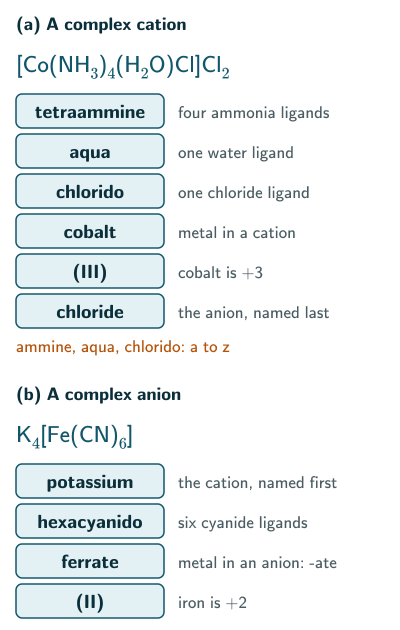
Name [Co(NH3)4(H2O)Cl]Cl2.
Answer: Two Cl− counter ions make the complex ion +2. NH3 and H2O are neutral and the Cl− inside is −1, so x − 1 = +2 and cobalt is +3. Alphabetically: ammine, aqua, chlorido. Name: tetraammineaquachloridocobalt(III) chloride, the compound whose formula NCERT asks for in Example 5.2(a) (page 124).
Example 2: Naming a complex anion
Name K4[Fe(CN)6].
Answer: Four K+ make the complex ion −4. Six CN− give −6, so x − 6 = −4 and iron is +2. The complex is an anion, so iron becomes ferrate, its Latin form (NCERT page 123). Name: potassium hexacyanidoferrate(II).
Example 3: From name to formula
Write the formula of potassium amminepentachloridoplatinate(IV).
Answer: Pt +4, five Cl− (−5) and one NH3 (0) give the anion a charge of 4 − 5 = −1, so one K+ balances it: K[PtCl5(NH3)], with Cl before NH by formula order. NCERT also writes equivalent formulas in ligand-name order (reasoned).
Example 4: Both ions complex
Name [Pt(NH3)4][PtCl4], in which both platinum atoms are +2.
Answer: With neutral NH3, the cation is [Pt(NH3)4]2+; with four Cl−, the anion is [PtCl4]2− (2 − 4 = −2), so the charges balance. Name the cation first, then the anion with -ate: tetraammineplatinum(II) tetrachloridoplatinate(II), named like NCERT’s silver example (page 124), with the space (reasoned).
Example 5: Checking NCERT’s Example 5.3(e)
NCERT names Hg[Co(SCN)4] as “mercury (I) tetrathiocyanato-S-cobaltate(III)” (page 124). Check the charges.
Answer: If the anion is [Co(SCN)], four SCN ligands give cobalt +2, and the balancing mercury is +2. Hg(I)/Co(III) also balances the empirical composition, so charge arithmetic alone cannot decide between the assignments. Nor does one Hg in an empirical formula exclude a doubled formula containing an Hg–Hg pair. The known compound’s structure and chemistry establish Hg(II)/Co(II). For the simplified S-bound formula in the exercise, write mercury(II) tetrathiocyanato-S-cobaltate(II); the real solid has bridging thiocyanates rather than isolated ions (Jeffery and Rose, 1968).
Common mistakes to avoid
Common mistake
Writing amine for ammine
NH3 as a ligand is ammine, with two m’s; amines are organic compounds such as methanamine, CH3NH2.
Common mistake
Alphabetising with the prefixes
[Cr(H2O)4Cl2]+ is tetraaquadichloridochromium(III), not dichloridotetraaquachromium(III): aqua comes before chlorido, whatever the multipliers.
Common mistake
Forgetting -ate in an anion
In K4[Fe(CN)6] the complex is an anion, so the name ends in ferrate(II), not iron(II).
Common mistake
Thinking the counter ions must be counted in the name
K2[PtCl6] is potassium hexachloridoplatinate(IV): once the oxidation state is shown, the number of potassium ions need not be named (NCERT page 124).
Quick revision summary
- Formula: metal first, then ligand formulas or abbreviations in alphabetical order, all in square brackets; charge outside as a right superscript.
- Name: cation first; within a complex, ligands (alphabetical, multipliers ignored), then the metal and its oxidation state in Roman numerals, (0) for zero.
- Anionic ligands end in -o or -ido (chlorido, cyanido, oxalato); aqua, ammine, carbonyl, nitrosyl for HO, NH, CO, NO.
- bis, tris, tetrakis for ligands whose names contain numbers, such as ethane-1,2-diamine.
- Metal in a complex anion: -ate (cobaltate, ferrate, argentate, cuprate).
Formula sheet
- Formula: metal first, then ligand formulas or abbreviations in alphabetical order, all in square brackets; an ion’s charge as a right superscript
- Name: cation, then anion; ligands (alphabetical) + metal (-ate in an anion) + (oxidation state)
- Oxidation state = charge on the entity − sum of ligand charges
Questions students ask
Which metals use their Latin names in complex anions?
Six metals use a Latin root in a complex anion: iron gives ferrate, copper cuprate, silver argentate, gold aurate, lead plumbate and tin stannate, from ferrum, cuprum, argentum, aurum, plumbum and stannum (IUPAC Red Book 2005, Table X; beyond the NCERT text, except ferrate, argentate and cuprate, which NCERT uses on pages 123, 124 and 138). Every other metal builds its -ate name from the English one, as in cobaltate, nickelate, platinate and zincate, and mercury becomes mercurate. So Na2[Sn(OH)6] is sodium hexahydroxidostannate(IV), while in a complex cation the same metal is plain tin (reasoned).
Why are bis, tris and tetrakis used in some names instead of di, tri and tetra?
Bis, tris and tetrakis are used, with the ligand name in parentheses, when the ligand’s name already contains a number, which is why three en ligands are tris(ethane-1,2-diamine) (NCERT pages 123–124). Beyond the NCERT text, the IUPAC Red Book 2005 (Section IR-9.2.2.2, pages 150–151) also uses them wherever di or tri could be misread: two NH3 are diammine, but two methylamine ligands, CH3NH2, are bis(methylamine), because dimethylamine is a different molecule, (CH3)2NH. NCERT’s methanamine is the same ligand, so two of them are likewise bis(methanamine) (reasoned).
How are bridging ligands named, and are they in the JEE Main 2027 and NEET (UG) 2026 syllabus?
A bridging ligand, one bonded to two or more metal atoms, is marked with the Greek letter μ, as μ-chlorido in a name and μ-Cl in a formula such as [Cl2Al(μ-Cl)2AlCl2] for the aluminium chloride dimer, Al2Cl6 (beyond the NCERT text; IUPAC Red Book 2005, Section IR-9.1.2.10, page 148). Naming polynuclear complexes is outside both syllabuses, whose Unit 12 lists only the “IUPAC nomenclature of mononuclear co-ordination compounds”, and NCERT’s naming rules (Section 5.3) are for mononuclear entities. NCERT depicts the bridged form of octacarbonyldicobalt(0), whose Co–Co bond is bridged by two CO groups, but its name does not mark the bridges (NCERT page 135).
What is the common name of K4[Fe(CN)6]?
K4[Fe(CN)6] is commonly called potassium ferrocyanide, the name NCERT Class 11 Chemistry uses in its redox unit (Unit 7, page 236); beyond the NCERT text, an older name is yellow prussiate of potash (Wikipedia, “Potassium ferrocyanide”). The ferro- of the common name is the older way of marking iron(II), as in ferrous, which the IUPAC name, potassium hexacyanidoferrate(II), shows with a Roman numeral instead (Example 2; reasoned). Use the IUPAC name whenever a question asks for it.
Practice questions
Try each question first, then open the answer to check your working.
-
Q1. Write the formulas for (i) tetraamminediaquacobalt(III) chloride, (ii) potassium tetracyanidonickelate(II), (iii) tris(ethane-1,2-diamine)chromium(III) chloride. (NCERT Intext Question 5.1, parts (i)–(iii).)
Show answerHide answer
(i) [Co(NH3)4(H2O)2]Cl3, (ii) K2[Ni(CN)4], (iii) [Cr(en)3]Cl3 (NCERT answers, page 140).
-
Q2. Write the IUPAC names of (i) [Co(NH3)5Cl]Cl2, (ii) K3[Fe(C2O4)3], (iii) K2[PdCl4]. (NCERT Intext Question 5.2, parts (ii), (iv) and (v).)
Show answerHide answer
(i) Pentaamminechloridocobalt(III) chloride, (ii) potassium trioxalatoferrate(III), (iii) potassium tetrachloridopalladate(II) (NCERT answers, page 140).
-
Q3. Write the formulas of (i) pentaamminenitrito-O-cobalt(III) and (ii) pentaamminenitrito-N-cobalt(III). (NCERT Exercise 5.6, parts (v) and (x).)
Show answerHide answer
Both are cations: Co +3, five neutral NH3 and one NO2− give +2. (i) [Co(NH3)5(ONO)]2+, bound through O; (ii) [Co(NH3)5(NO2)]2+, bound through N (reasoned).