Bonding in metal carbonyls
NCERT Class 12 Chemistry Chapter 5 Section 5.6
Quick answer
Metal carbonyls contain carbon monoxide ligands bonded to a metal, usually through carbon. Carbon donates electron density to the metal, while metal orbitals can donate back into antibonding orbitals of carbon monoxide; these interactions reinforce the metal–carbon bond. Nickel tetracarbonyl is tetrahedral, iron pentacarbonyl trigonal bipyramidal and chromium hexacarbonyl octahedral.
With your textbook
NCERT Chemistry Part I (Class 12), Chapter 5 “Coordination Compounds”, Section 5.6 “Bonding in Metal Carbonyls”, pages 135–136.
Open the official NCERT chapter (PDF, 3.7 MB, ncert.nic.in) (opens in a new tab)
Checked against the 2026-27 reprint on .
What are metal carbonyls?
Metal carbonyls
Metal carbonyls are coordination compounds of metals with carbon monoxide, CO, bound through its carbon atom. NCERT describes the simplest kind:
The homoleptic carbonyls (compounds containing carbonyl ligands only) are formed by most of the transition metals.
NCERT Chemistry Part I (Class 12), Section 5.6, page 135
In plain words: CO gives the metal a lone pair, as any ligand does, and the metal gives some of its own d electrons back into an empty orbital of CO. Each gift makes the other stronger, so the metal–carbon bond is stronger than either half alone.
Homoleptic carbonyls
These carbonyls have simple, well-defined structures (NCERT page 135, with its Fig. 5.13 on page 136):
-
[Ni(CO)4], tetracarbonylnickel(0): tetrahedral.
-
[Fe(CO)5], pentacarbonyliron(0): trigonal bipyramidal.
-
[Cr(CO)6], hexacarbonylchromium(0): octahedral.
-
[Mn2(CO)10], decacarbonyldimanganese(0): two square pyramidal Mn(CO)5 units joined by an Mn–Mn bond.
-
[Co2(CO)8], octacarbonyldicobalt(0): in the form drawn by NCERT, a Co–Co bond bridged by two CO groups. Unbridged isomers also exist; the illustrated structure is not its only form (primary carbonyl studies, Inorganic Chemistry, 2001).
-
CO is a neutral ligand, so in neutral carbonyls such as these five the metal is in the zero oxidation state, as the (0) in each name shows (reasoned from the oxidation number rule).
-
Three of the shapes are coordination polyhedra from NCERT Fig. 5.1 (page 122): tetrahedral, trigonal bipyramidal and octahedral.
Synergic bonding between the metal and CO
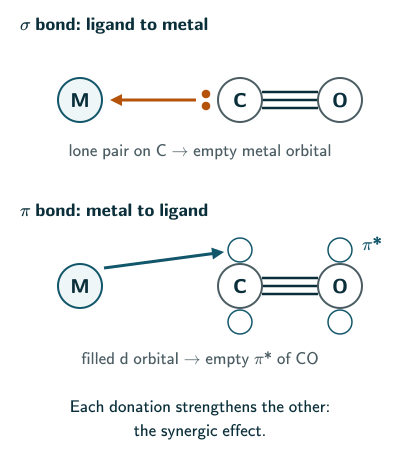
The metal–carbon bond in metal carbonyls has both σ and π character (NCERT page 136):
- σ bond, ligand to metal. The lone pair of electrons on the carbon of CO is donated into a vacant orbital of the metal.
- π bond, metal to ligand. A pair of electrons from a filled d orbital of the metal is donated into the vacant antibonding π* orbital of carbon monoxide. This is often called back donation or back bonding.
- Synergic effect. The metal-to-ligand bonding creates a synergic effect that strengthens the bond between CO and the metal (NCERT page 136, Fig. 5.14). Each donation helps the other: σ donation gives the metal electron density to return by back donation, which in turn lets it accept more (reasoned).
- Why it matters. Electrons placed in an antibonding orbital lower a bond order, so back donation weakens the C–O bond a little while it strengthens the M–C bond (reasoned from the bond order, ½(Nb − Na), of molecular orbital theory, NCERT Class 11 Chemistry, Unit 4, page 129).
- Coordination number. Only the σ bonds count, so [Ni(CO)4] has coordination number 4 although each Ni–C bond also has π character (NCERT pages 122 and 136).
- A strong field ligand. CO is at the strong end of the spectrochemical series (NCERT page 132). For [Ni(CO)4] the textbook VBT model represents nickel as 3d10, with sp3 orbitals for tetrahedral bonding and no unpaired electrons. This is a bonding model rather than a literal 4s-to-3d transfer sequence (NCERT page 129; the 3d10 step is reasoned).
Solved examples
Example 1: Shapes from the number of CO groups
Give the shape of [Fe(CO)5] and [Cr(CO)6], and the oxidation state of the metal in each.
Answer: Five CO groups round iron: trigonal bipyramidal; six round chromium: octahedral (NCERT page 135). CO is neutral, so x + 5(0) = 0 and x + 6(0) = 0: both metals are 0.
Example 2: The two metal–metal carbonyls
How do the structures of [Mn2(CO)10] and [Co2(CO)8] differ?
Answer: In [Mn2(CO)10] each manganese carries five terminal CO groups, two square pyramidal Mn(CO)5 units, joined only by an Mn–Mn bond. In the bridged form of [Co2(CO)8] drawn by NCERT, the Co–Co bond is also bridged by two CO groups, each bonded to both cobalt atoms; the other six CO groups are terminal, three on each cobalt (NCERT page 135, with its Fig. 5.13 on page 136; 8 − 2 = 6).
Common mistakes to avoid
Common mistake
Calling the M–C bond a plain σ bond
The bond has σ character from carbon’s lone pair and π character from back donation into the π* orbital of CO; the two strengthen each other.
Common mistake
Giving the metal a positive oxidation state
CO is neutral, so the metal in [Ni(CO)4], [Fe(CO)5] or [Cr(CO)6] is in the zero oxidation state.
Quick revision summary
- Homoleptic carbonyls contain only CO ligands; in neutral ones, like NCERT’s five, the metal is 0.
- [Ni(CO)] tetrahedral; [Fe(CO)] trigonal bipyramidal; [Cr(CO)] octahedral; [Mn(CO)] two square pyramidal Mn(CO) joined by Mn–Mn; [Co(CO)] has a two-bridge form shown by NCERT and also unbridged isomers.
- M–C bond: σ donation from carbon’s lone pair, plus π back donation from a filled metal d orbital into CO’s π*; the synergic effect strengthens the bond.
Formula sheet
- σ bond: C lone pair → vacant metal orbital
- π bond: filled metal d orbital → vacant antibonding π orbital of CO
- Metal oxidation state in neutral homoleptic carbonyls: 0
Questions students ask
How are metal carbonyls classified?
Metal carbonyls are classified by the number of metal atoms, by their other ligands and charge, and by how each CO is bound (beyond the NCERT text; Wikipedia, “Metal carbonyl”). Mononuclear ones have one metal atom, as in [Ni(CO)4], and polynuclear ones contain two or more metal atoms, often linked by metal–metal bonds or bridging ligands, as in [Mn2(CO)10] and the cluster [Fe3(CO)12]; they may be homoleptic or heteroleptic, and neutral, cationic or anionic (carbonylates). Each CO is terminal, bonded to one metal, or bridging, shared by two or more, as in [Fe2(CO)9] (same source).
What is the difference between back bonding and synergic bonding?
Back bonding, or back donation, is one half of the metal–CO bond, the π donation from a filled metal d orbital into the empty π* orbital of CO, while synergic bonding is the whole two-way bond, σ donation from carbon plus that π back donation, each strengthening the other (NCERT page 136). IUPAC defines back donation as one part of a synergic process (beyond the NCERT text; Wikipedia, “Pi backbonding”). The name is also used for BF3, where π overlap of filled fluorine p orbitals with boron’s empty p orbital may explain its short B–F bonds (Wikipedia, “Boron trifluoride”), a different bonding context from the metal–CO donor/acceptor model (reasoned).
Why is CO a strong field ligand though it is neutral?
CO is a strong field ligand, the strongest in NCERT’s spectrochemical series (page 132), because it is a π acceptor: a filled t2g orbital of the metal donates electrons back into the empty π* orbital of CO, which lowers the t2g set and widens Δo (beyond the NCERT text; Wikipedia, “Crystal field theory” and “18-electron rule”; orbital picture reasoned). Point charges cannot account for this, one of the limitations of crystal field theory (NCERT page 135). Back donation is strongest from electron-rich metals in low oxidation states, as in nickel(0) [Ni(CO)4] (Wikipedia, “Metal carbonyl”).
What is the 18-electron rule, and why are the manganese and cobalt carbonyls dimers?
The 18-electron rule says stable carbonyls usually have 18 valence electrons round each metal, using the neutral counting method, its group number plus 2 per terminal CO: [Cr(CO)6] has 6 + 12, [Fe(CO)5] 8 + 10 and [Ni(CO)4] 10 + 8 (beyond the NCERT text and both syllabuses; Wikipedia, “18-electron rule”). Manganese, in group 7, would have only 7 + 10 = 17 in Mn(CO)5, so two units share an Mn–Mn bond, one more electron each, giving [Mn2(CO)10]; for the bridged Co(CO) structure each Co has 9 + 3 × 2 + 2 × 1 + 1 = 18: two bridging CO ligands contribute one electron each to each metal, and the Co–Co bond contributes one (reasoned). Many familiar odd-group neutral carbonyls are polynuclear, but the 18-electron rule has exceptions; [V(CO)6], a 17-electron monomer, is one exception (Wikipedia, “Metal carbonyl”).
Are metal carbonyls organometallic compounds?
Yes, metal carbonyls are organometallic compounds by NCERT’s test, “compounds containing carbon-metal bonds” (NCERT Class 12 Chemistry Part II, Unit 6, page 180), since every M–CO link is a metal–carbon bond (reasoned from NCERT page 136). Carbon monoxide is not usually counted as an organic molecule, but organometallic chemistry includes the carbonyls, and [Ni(CO)4] is described as a nickel(0) organometallic compound (beyond the NCERT text; Wikipedia, “Nickel tetracarbonyl” and “Organometallic chemistry”). NCERT’s own examples are the Grignard reagents, RMgX, on the haloalkanes page.
Is synergic bonding in the JEE Main 2027 and NEET (UG) 2026 syllabus?
Neither the JEE Main 2027 nor the NEET (UG) 2026 syllabus explicitly names metal carbonyls or synergic bonding: for bonding, Unit 12 of both lists only the “Valence bond approach and basic ideas of Crystal field theory, colour and magnetic properties”. Metal carbonyls are NCERT Section 5.6 (pages 135–136) of the 2026–27 reprint, which also uses [Ni(CO)4] as a valence bond example (page 129) and asks about carbonyl bonding in its Exercise 5.22. So a JEE or NEET student still meets carbonyls inside the named topics, for example [Ni(CO)4] as a diamagnetic sp3 complex (reasoned).
Practice questions
Try each question first, then open the answer to check your working.
-
Q1. Discuss the nature of bonding in metal carbonyls. (NCERT Exercise 5.22.)
Show answerHide answer
The metal–carbon bond has both σ and π character. The σ bond forms when the lone pair on the carbon of CO is donated into a vacant metal orbital; the π bond forms when a filled metal d orbital donates a pair of electrons into the vacant antibonding π* orbital of CO. This synergic effect strengthens the bond between CO and the metal (NCERT page 136).
-
Q2. A homoleptic carbonyl ion is [M(CO)6]−. What is the oxidation state of M?
Show answerHide answer
x + 6(0) = −1, so −1. The metal is 0 only in neutral carbonyls (reasoned from the oxidation number rule).