Chemical reactions of haloalkanes and haloarenes
NCERT Class 12 Chemistry Chapter 6 Section 6.7
Quick answer
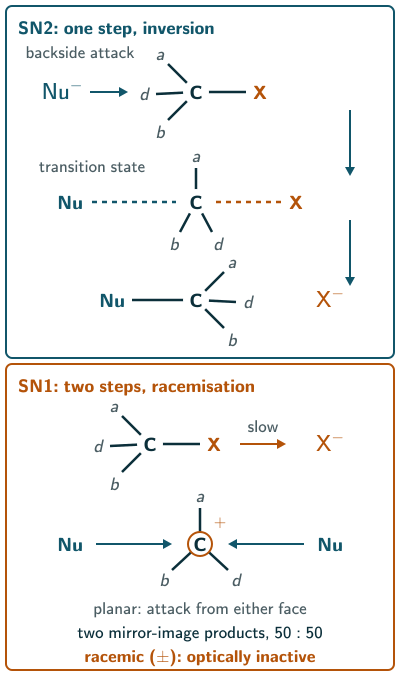
Haloalkanes undergo nucleophilic substitution, elimination and reactions with metals. SN2 is a one-step backside attack whose rate depends on both the halide and the nucleophile, inverts the configuration and is fastest for CHX and primary halides, while SN1 goes through a planar carbocation, depends only on the halide, gives racemisation and is fastest for tertiary, allylic and benzylic halides. Haloarenes resist nucleophilic substitution because of resonance and their sp carbon, and their halogen is ortho and para directing but deactivating in electrophilic substitution.
With your textbook
NCERT Chemistry Part II (Class 12), Chapter 6 “Haloalkanes and Haloarenes”, Section 6.7 “Chemical Reactions”, pages 169–186.
Open the official NCERT chapter (PDF, 4.3 MB, ncert.nic.in) (opens in a new tab)
Checked against the 2026-27 reprint on .
What reactions do haloalkanes and haloarenes undergo?
Reactions of halogen compounds
Haloalkanes undergo nucleophilic substitution, elimination and reactions with metals (NCERT page 169). Haloarenes resist nucleophilic substitution, undergo electrophilic substitution on the ring, and react with sodium. In the key reaction a nucleophile replaces the halogen; NCERT explains the name:
Since the substitution reaction is initiated by a nucleophile, it is called nucleophilic substitution reaction.
NCERT Chemistry Part II (Class 12), Section 6.7.1, page 170
In plain words: the carbon bonded to the halogen is slightly positive, so an electron-rich nucleophile attacks it and the halogen leaves as X−. Whether that happens in one step or two decides the speed and the stereochemistry. A strong base may instead pull off a hydrogen and make an alkene, and metals turn the halide into a carbon–metal compound.
Reactions of haloalkanes
NCERT divides them into three categories (page 169):
- Nucleophilic substitution: Nu− replaces X.
- Elimination: H and X are removed to give an alkene.
- Reaction with metals: Grignard reagents and the Wurtz reaction.
Nucleophilic substitution
- The nucleophile attacks the haloalkane (the substrate) at the carbon with the partial positive charge; the halogen, the leaving group, departs as a halide ion: Nu− + R–X → R–Nu + X− (NCERT page 170).
- It is one of the most useful classes of organic reactions, for halogen bonded to an sp3 carbon (NCERT page 170).
NCERT Table 6.4 (page 170) lists the products with common reagents. Read each line as reagent → product (class):
- NaOH or KOH → ROH (alcohol); H2O → ROH (alcohol)
- NaOR′ → ROR′ (ether)
- NaI → R–I (alkyl iodide)
- NH3 → RNH2 (primary amine); R′NH2 → RNHR′ (secondary); R′R″NH → RNR′R″ (tertiary)
- KCN → RCN (nitrile, cyanide); AgCN → RNC (isonitrile, isocyanide)
- KNO2 → R–O–N=O (alkyl nitrite); AgNO2 → R–NO2 (nitroalkane)
- R′COOAg → R′COOR (ester)
- LiAlH4 → RH (hydrocarbon); R′−M+ → RR′ (alkane)
Ambident nucleophiles. Cyanide and nitrite have two nucleophilic centres (NCERT pages 170–171):
-
Cyanide can bond through C, giving alkyl cyanides, or through N, giving isocyanides. KCN is mainly ionic and gives free CN−, which attacks mainly through carbon, because a C–C bond is more stable than a C–N bond. AgCN is mainly covalent, so the nitrogen is the free donor and the isocyanide is the main product (NCERT Example 6.5, page 171).
-
Nitrite, −O–N=O, bonds through O to give alkyl nitrites or through N to give nitroalkanes (NCERT page 171).
-
NCERT slip (page 170): Table 6.4’s nucleophile column prints two ions without their charge: “H” for LiAlH4, which supplies the hydride ion, H−, and “O=N—O” for KNO2, the nitrite ion, −O–N=O, whose charge NCERT does print on page 171. The products, RH and R–O–N=O, are right. In an exam write H− and the nitrite ion with its charge.
SN2 and SN1 mechanisms
SN2: substitution nucleophilic bimolecular (NCERT pages 171–173)
- CH3Cl + OH− → CH3OH + Cl− follows second order kinetics: the rate depends on the concentration of both reactants, rate = k[CH3Cl][OH−] (reasoned from NCERT page 171 and the order of a reaction).
- One step. The C–O bond forms as the C–Cl bond breaks, with no intermediate. In the transition state the three C–H bonds lie in one plane and carbon is bonded to five atoms at once; such structures cannot be isolated (NCERT pages 171–172).
- Inversion. The nucleophile attacks from the side opposite the halogen, and the three groups flip over, like an umbrella turned inside out in a strong wind: the configuration is inverted (NCERT page 172). Hughes and Ingold proposed this mechanism in 1937 (NCERT page 171). Configuration means the spatial arrangement of the bonds round a carbon (reasoned from NCERT page 178).
- Steric hindrance. Bulky groups on or near the carbon block the nucleophile, so the order is CH3X > primary > secondary > tertiary (NCERT pages 172–173). Even a branch on the next carbon slows SN2: NCERT Example 6.7 (page 175) puts CH3CH2CH2CH2Br ahead of (CH3)2CHCH2Br. NCERT Fig. 6.3 (page 173) gives relative SN2 rates of 30 (methyl), 1 (ethyl, 1°), 0.02 (isopropyl, 2°) and about 0 (tert-butyl, 3°).
SN1: substitution nucleophilic unimolecular (NCERT pages 173–174)
- Usually run in polar protic solvents such as water, alcohol or acetic acid. (CH3)3CBr + OH− → (CH3)3COH + Br− follows first order kinetics: rate = k[(CH3)3CBr] (NCERT page 173; reasoned).
- Two steps. Step I, slow and reversible: the C–Br bond breaks to give a carbocation and Br−; the energy comes from solvation of the halide ion by the protic solvent. Step II, fast: the nucleophile attacks the carbocation. The slow step sets the rate, so the rate does not depend on [OH−] (NCERT pages 173–174; the rate-determining step).
- Carbocation stability. The more stable the carbocation, the faster the reaction, so 3° halides react very fast: the order is 3° > 2° > 1° > CH3X. Allylic and benzylic halides are also very reactive, because their carbocations are stabilised by resonance (NCERT page 174, citing Class 11 Unit 8).
Both mechanisms. For a given alkyl group, R–I > R–Br > R–Cl ≫ R–F (NCERT page 174). Iodide is the best leaving group because of its large size (NCERT Example 6.6, page 174).
| Feature | SN2 | SN1 |
|---|---|---|
| Steps | one | two (carbocation) |
| Rate | k[RX][Nu−] | k[RX] |
| Fastest | CH3X, 1° | 3°, allylic, benzylic |
| Optically active RX | inversion | racemisation |
Optical activity, chirality and enantiomers
- Optical activity. Ordinary light passed through a Nicol prism becomes plane polarised. Solutions of some compounds rotate its plane: they are optically active, and the angle is measured with a polarimeter. Rotation to the right (clockwise) is dextrorotatory, the d- or (+)-form; to the left, laevorotatory, the l- or (−)-form. Such (+) and (−) isomers are optical isomers (NCERT page 175).
- History. Louis Pasteur (1848) found crystals of some compounds as mirror images whose solutions rotated light equally but oppositely. In 1874 van ’t Hoff and Le Bel independently proposed that the four groups round a carbon are arranged tetrahedrally; if all four are different, the mirror image cannot be superimposed (NCERT pages 175–176).
- Chirality. A carbon with four different groups is an asymmetric carbon or stereocentre. An object that cannot be superimposed on its mirror image, like a hand, is chiral; one that can, like a sphere or cube, is achiral. Chiral molecules are optically active (NCERT page 176). NCERT gives “the presence of a single asymmetric carbon atom” as one aid to recognising a chiral molecule (page 176).
- Propan-2-ol, with two CH3 groups on the central carbon, is achiral; butan-2-ol, with H, OH, CH3 and C2H5, is chiral (NCERT Figs. 6.5 and 6.6, pages 176–177). NCERT’s other chiral examples: 2-chlorobutane, 2,3-dihydroxypropanal, bromochloroiodomethane and 2-bromopropanoic acid (page 177).
- Enantiomers are stereoisomers that are non-superimposable mirror images. They have identical melting points, boiling points and refractive indices and differ only in the direction of rotation. The sign of rotation is not necessarily related to the absolute configuration (NCERT page 177).
- Racemic mixture. Equal amounts of two enantiomers give zero rotation: a racemic mixture, written with dl or (±), as in (±)-butan-2-ol. Converting an enantiomer into a racemic mixture is racemisation (NCERT page 177). The same idea of mirror-image isomers appears in optical isomerism of coordination compounds.
Inversion, retention and racemisation
- Retention. If no bond to the stereocentre is broken, the product keeps the same arrangement round it. (−)-2-Methylbutan-1-ol heated with concentrated HCl gives (+)-1-chloro-2-methylbutane (the C–O bond that breaks is on C1; the stereocentre is C2): the configuration is the same, yet the sign of rotation changes, because two different compounds with the same configuration can rotate light in opposite directions (NCERT page 178).
- Three outcomes when a bond to the asymmetric carbon breaks and X is replaced by Y: only the product with the same configuration (retention), only the mirror-image product (inversion), or a 50:50 mixture of the two (racemisation, optically inactive) (NCERT pages 178–179).
- SN2 gives inversion. The nucleophile attaches on the side opposite the halogen: (−)-2-bromooctane with NaOH gives (+)-octan-2-ol, with the –OH on the side opposite to the one the Br had occupied (NCERT page 179).
- SN1 gives racemisation. The carbocation is sp2 and planar (achiral), so the nucleophile attacks from either face; optically active 2-bromobutane gives (±)-butan-2-ol on hydrolysis (NCERT page 179).
- NCERT slip (pages 177–178): three misprints. Page 177 prints “dihyroxypropanal” for dihydroxypropanal; page 178 says “configuration at a symmetric centre” where it means an asymmetric centre, and, under the three outcomes, “configuration has been rotated in A” where it means retained. In an exam, retention means the same configuration, not a rotated one.
Elimination and Saytzeff’s rule
- The carbon bonded to the halogen is the α-carbon; a carbon next to it is a β-carbon (NCERT page 179).
- A haloalkane with a β-hydrogen, heated with alcoholic KOH, loses H from the β-carbon and X from the α-carbon, giving an alkene: β-elimination, or dehydrohalogenation (NCERT pages 179–180).
- Saytzeff (Zaitsev) rule, 1875. NCERT summarises it as “in dehydrohalogenation reactions, the preferred product is that alkene which has the greater number of alkyl groups attached to the doubly bonded carbon atoms” (page 180). So 2-bromopentane gives pent-2-ene (81%) as the major product and pent-1-ene (19%) as the minor one (NCERT page 180).
- Elimination or substitution? A base or nucleophile can do either; the route depends on the halide, the strength and size of the base, and the conditions. A bulky base prefers to remove a proton. A primary halide prefers SN2; a secondary one SN2 or elimination, depending on the base; a tertiary one SN1 or elimination, depending on the carbocation’s stability or the more substituted alkene (NCERT page 180).
Grignard reagents and the Wurtz reaction
- Most organic chlorides, bromides and iodides react with some metals to give organometallic compounds, with carbon–metal bonds (NCERT page 180).
- Grignard reagents, RMgX, discovered by Victor Grignard in 1900, are made from a haloalkane and magnesium in dry ether: CH3CH2Br + Mg → CH3CH2MgBr (NCERT page 180). Grignard shared the 1912 Nobel Prize in Chemistry with Paul Sabatier (NCERT page 181).
- The C–Mg bond is covalent but highly polar, with carbon δ−; the Mg–X bond is essentially ionic (NCERT page 181).
- Grignard reagents react with any source of protons, even water, alcohols and amines, to give hydrocarbons: RMgX + H2O → RH + Mg(OH)X. So even traces of moisture must be kept out, which is why dry ether is used; the reaction is also a way of turning a halide into a hydrocarbon (NCERT page 181).
- Wurtz reaction. Alkyl halides with sodium in dry ether give hydrocarbons with twice as many carbon atoms: 2RX + 2Na → R–R + 2NaX (NCERT page 181).
Reactions of haloarenes
Haloarenes undergo nucleophilic substitution only under drastic conditions, electrophilic substitution on the ring, and reactions with metals (NCERT Section 6.7.2, pages 181–186).
Low reactivity of haloarenes in nucleophilic substitution
Aryl halides are far less reactive than alkyl halides here, for four reasons (NCERT pages 181–182):
- Resonance. The halogen’s lone pairs are in conjugation with the ring’s π electrons, so the C–Cl bond gains partial double bond character and is harder to break.
- sp2 carbon. It has more s-character and is more electronegative than an sp3 carbon, so it holds the bonding pair more tightly: the C–Cl bond is 169 pm in a haloarene against 177 pm in a haloalkane, and the shorter bond is harder to break. (NCERT Table 6.2 on page 164 gives 178 pm for CH3–Cl; use the value a question gives.)
- Unstable phenyl cation. It would not be stabilised by resonance, so SN1 is ruled out.
- Repulsion between the electron-rich nucleophile and the electron-rich ring.
Replacement by –OH. Chlorobenzene gives phenol only on heating with aqueous NaOH at 623 K and 300 atmospheres, then acidifying (NCERT page 182). Nitro groups at the ortho and para positions make it much easier (NCERT pages 182–183):
| Chloroarene | Conditions for –OH |
|---|---|
| chlorobenzene | NaOH, 623 K, 300 atm |
| 1-chloro-4-nitrobenzene | NaOH, 443 K |
| 1-chloro-2,4-dinitrobenzene | NaOH, 368 K |
| 2-chloro-1,3,5-trinitrobenzene | warm water |
- Why only ortho and para. The nitro group withdraws electron density, which helps the nucleophile attack, and the negatively charged intermediate (a carbanion) is stabilised by resonance. With –NO2 at ortho or para, one resonance structure puts the negative charge on the carbon bearing –NO2, which stabilises it; at meta none does. NCERT therefore says a meta nitro group has no effect on reactivity (page 183). Read that as “no resonance help”: a meta –NO2 still pulls electrons by its −I effect, so it helps a little, but far less than an ortho or para one (reasoned from NCERT’s own point that the nitro group withdraws electron density). In an NCERT-style question, answer “no effect”; in a ranking that includes chlorobenzene, put the meta isomer above chlorobenzene but well below the ortho and para isomers.
- NCERT slip (page 183): the explanation box says “in case of meta-nitrobenzene”. Nitrobenzene carries only one group, so it has no meta isomer; NCERT means the chlorobenzene with a meta nitro group, 1-chloro-3-nitrobenzene. The argument is unaffected. In an answer, write 1-chloro-3-nitrobenzene (or m-chloronitrobenzene).
Electrophilic substitution in haloarenes
-
Haloarenes undergo the usual electrophilic substitutions of benzene: halogenation, nitration, sulphonation and Friedel–Crafts reactions (NCERT page 184).
-
o,p-directing but deactivating. Resonance raises the electron density more at the ortho and para positions, so substitution goes there. The halogen’s −I inductive effect withdraws electrons, so the ring is somewhat deactivated and the reactions are slower and need harsher conditions than for benzene (NCERT page 184). Reactivity is controlled by the stronger inductive effect, orientation by resonance (NCERT Example 6.9, page 185). NCERT’s products from chlorobenzene (pages 184–185), with the para product as the major one each time:
-
Halogenation (Cl2, anhydrous FeCl3): 1,4-dichlorobenzene
-
Nitration (HNO3, conc. H2SO4): 1-chloro-4-nitrobenzene
-
Sulphonation (conc. H2SO4, heat): 4-chlorobenzenesulphonic acid
-
Friedel–Crafts alkylation (CH3Cl, anhydrous AlCl3): 1-chloro-4-methylbenzene
-
Friedel–Crafts acylation (CH3COCl, anhydrous AlCl3): 4-chloroacetophenone
The minor products are the 1,2- (ortho) isomers. NCERT spells the sulphonic acids “sulfonic” here (page 184).
Wurtz–Fittig and Fittig reactions
- Wurtz–Fittig. An alkyl halide and an aryl halide with sodium in dry ether give an alkylarene: C6H5X + 2Na + RX → C6H5R + 2NaX (NCERT page 186).
- Fittig. Aryl halides alone with sodium in dry ether join two aryl groups: 2C6H5X + 2Na → C6H5–C6H5 + 2NaX, giving diphenyl (biphenyl) (NCERT page 186).
- NCERT slip (page 186): the Wurtz–Fittig equation is printed with one Na and one NaX, which does not balance: one Na atom is needed for each halogen removed, so it is 2Na and 2NaX, as in the Fittig equation that NCERT prints just below it. In an exam write the balanced form.
Solved examples
Example 1: KCN or AgCN?
What is the main product when bromoethane reacts with (i) KCN, (ii) AgCN? Name both.
Answer: (i) KCN is ionic and gives free CN−, which attacks through carbon: CH3CH2CN, propanenitrile (ethyl cyanide). (ii) AgCN is covalent, so nitrogen is the donor: CH3CH2NC, ethyl isocyanide (NCERT Example 6.5, page 171; names reasoned).
Example 2: Rates and rate laws
An SN2 reaction runs at 3.0 × 10⁻⁴ mol L−1 s−1. What is the new rate if [OH−] is tripled? What would it be for an SN1 reaction with the same starting rate?
Answer: SN2: rate = k[RX][OH−], so tripling [OH−] triples the rate: 9.0 × 10⁻⁴ mol L−1 s−1. SN1: rate = k[RX], independent of [OH−]: it stays 3.0 × 10⁻⁴ mol L−1 s−1 (reasoned from NCERT pages 171 and 174).
Example 3: How much faster is methyl?
Using NCERT Fig. 6.3, how many times faster does a methyl halide react by SN2 than an isopropyl halide?
Answer: 30/0.02 = 1500 times. The two methyl groups on the isopropyl carbon crowd the backside approach (NCERT page 173; reasoned).
Example 4: Mass of the Saytzeff product
15.1 g of 2-bromopentane (151 g mol−1) is heated with alcoholic KOH. Using NCERT’s 81% share, what mass of pent-2-ene (70.1 g mol−1) forms, assuming all the bromide eliminates?
Answer: 15.1/151 = 0.100 mol; 0.81 × 0.100 = 0.081 mol of pent-2-ene; 0.081 × 70.1 = 5.68, about 5.7 g (NCERT page 180; reasoned).
Example 5: Methane from a Grignard reagent
What volume of methane, at 273.15 K and 1 bar, comes from 0.0500 mol of CH3MgBr and excess water? (Molar volume 22.7 L mol−1.)
Answer: CH3MgBr + H2O → CH4 + Mg(OH)Br, one mole of methane per mole of reagent: 0.0500 × 22.7 = 1.135 L, about 1.14 L (reasoned from NCERT page 181).
Example 6: Which is chiral, and what does each mechanism give?
(i) Which of 2-bromobutane and 2-bromopropane is chiral? (ii) What does (+)-2-bromobutane give with OH− by SN2, and by SN1?
Answer: (i) 2-Bromobutane: its C2 carries four different groups (H, Br, CH3, C2H5). 2-Bromopropane carries two CH3 on C2, so it is achiral. (ii) SN2: butan-2-ol with the inverted configuration (one enantiomer). SN1: (±)-butan-2-ol, a racemic mixture (NCERT pages 176–179; reasoned).
Common mistakes to avoid
Common mistake
Swapping the KCN and AgCN products
KCN gives the nitrile (cyanide), RCN; AgCN gives the isocyanide, RNC.
Common mistake
Expecting tertiary halides to react fastest by SN2
SN2 is blocked by bulky groups: CH3X > 1° > 2° > 3°. It is SN1 that runs 3° > 2° > 1°.
Common mistake
Expecting SN1 to invert the configuration
The planar carbocation is attacked from both faces, so SN1 gives racemisation; inversion is the SN2 outcome.
Common mistake
Reading the configuration from the sign of rotation
(+) and (−) tell the direction of rotation only; (−)-2-methylbutan-1-ol gives (+)-1-chloro-2-methylbutane with the same configuration.
Common mistake
Deciding chirality by counting asymmetric carbons
One asymmetric carbon makes a molecule chiral (NCERT page 176). With two or more, the molecule can still be achiral if it has an internal mirror plane, as the meso form of 2,3-dibromobutane does: use NCERT’s test of superimposing the mirror image, not a count (reasoned; meso forms are beyond the NCERT text).
Common mistake
Using aqueous KOH for elimination
Alcoholic KOH gives the alkene; aqueous NaOH or KOH gives the alcohol by substitution.
Common mistake
Calling halogens activating because they are o,p-directing
They direct to ortho and para by resonance but deactivate the ring by their −I effect.
Quick revision summary
- Haloalkanes: nucleophilic substitution, elimination, reactions with metals.
- KCN gives RCN and AgCN gives RNC; KNO2 gives R–O–N=O and AgNO2 gives R–NO2.
- SN2: one step, rate = k[RX][Nu−], inversion, CH3X > 1° > 2° > 3°. SN1: two steps through a planar carbocation, rate = k[RX], racemisation, 3° > 2° > 1° > CH3X; allylic and benzylic halides are fast.
- R–I > R–Br > R–Cl ≫ R–F in both. A molecule with a single asymmetric carbon (four different groups) is chiral; enantiomers differ only in the direction of rotation.
- Alcoholic KOH: β-elimination; the more substituted alkene is major (Saytzeff).
- RMgX in dry ether; with water it gives RH. Wurtz: 2RX + 2Na gives R–R.
- Haloarenes resist nucleophilic substitution (resonance, sp2 carbon, unstable phenyl cation, repulsion); o- and p-NO2 groups help. Halogens are o,p-directing but deactivating.
Formula sheet
- R–X + Nu → R–Nu + X
- SN2 rate = k[RX][Nu]
- SN1 rate = k[RX]
- SN2: CHX > 1° > 2° > 3°; SN1: 3° > 2° > 1° > CHX
- R–I > R–Br > R–Cl ≫ R–F
- RMgX + HO → RH + Mg(OH)X
- 2RX + 2Na → R–R + 2NaX (dry ether)
- CHX + 2Na + RX → CHR + 2NaX (dry ether)
- 2CHX + 2Na → CH–CH + 2NaX (dry ether)
Questions students ask
What do the letters and numbers in SN1 and SN2 stand for?
SN1 and SN2 stand for substitution nucleophilic unimolecular and bimolecular (NCERT pages 171 and 173): the number is the molecularity of the rate-determining step, one species (haloalkane) in SN1 and two (haloalkane and nucleophile) in SN2 (reasoned). So the numbers look back to front: SN2 takes one step and SN1 two. Beyond the NCERT text, these are called Hughes–Ingold symbols, after the chemists whose 1937 SN2 mechanism NCERT mentions (page 171), and E1 and E2 follow the same pattern (Wikipedia, “SN1 reaction” and “Elimination reaction”).
What is the difference between E1 and E2 reactions?
Beyond the NCERT text, E2 and E1 are the two main mechanisms of the β-elimination that NCERT describes with alcoholic KOH (pages 179–180): E2 happens in one step, the base pulling off a β-hydrogen as the halide ion leaves, so its rate depends on both the haloalkane and the base, while E1 happens in two, the same slow ionisation to a carbocation as in SN1 and then loss of a β-hydrogen, so its rate depends on the haloalkane alone (Wikipedia, “Elimination reaction”). E2 needs a strong base and competes with SN2; E1 runs with a weak base or none, mainly for tertiary halides, competes with SN1 and, through its carbocation, can give rearranged alkenes.
What is the difference between Saytzeff’s rule and Hofmann’s rule?
Saytzeff’s (Zaitsev’s) rule predicts that dehydrohalogenation gives mainly the more substituted alkene, with more alkyl groups on the doubly bonded carbons (NCERT page 180), while Hofmann’s rule, beyond the NCERT text, predicts the less substituted alkene in some eliminations (Wikipedia, “Zaytsev’s rule”). Hydroxide or ethoxide gives mainly the Saytzeff alkene, but with a bulky base such as potassium tert-butoxide the Hofmann alkene usually wins, since a big base reaches an outer β-hydrogen more easily than an inner one. The name comes from the Hofmann elimination of quaternary ammonium hydroxides, whose bulky leaving group acts the same way (Wikipedia, “Hofmann elimination”).
How is a racemic mixture separated into its enantiomers?
A racemic mixture cannot usually be separated by crystallisation, because its enantiomers have identical physical properties (NCERT page 177); beyond the NCERT text, it is resolved by combining it with one pure enantiomer of another chiral compound, as when a racemic amine forms salts with (+)-tartaric acid (Wikipedia, “Chiral resolution”). The two salts are diastereomers, not mirror images of each other, so they differ in solubility and can be separated by crystallisation; a base then frees each pure enantiomer. Pasteur’s mirror-image crystals of 1848 (NCERT page 175) were, beyond the NCERT text, a rare case in which the two enantiomers crystallise separately and can be sorted by hand.
Why is ether used as the solvent for Grignard reagents?
Ether is used as the solvent for Grignard reagents because it does not destroy them and it holds them in solution: it has no hydrogen on oxygen or nitrogen to give up as a proton, unlike water, alcohols and amines, which NCERT says turn RMgX into a hydrocarbon (page 181), and, beyond the NCERT text, the lone pairs on its oxygen bond to the magnesium, so that in solution each magnesium carries two ether molecules (Wikipedia, “Grignard reagent”). Tetrahydrofuran, a cyclic ether, is used in the same way. The ether molecules act much as ligands do in a coordination compound (reasoned).
Does an SN1 reaction always give an exact 50:50 racemic mixture?
An SN1 reaction at a stereocentre gives racemisation in NCERT’s account, because the planar carbocation can be attacked from either face (page 179), but beyond the NCERT text, the product is often not an exact 50:50 mixture: it is partly racemised, with an excess of the inverted enantiomer (Wikipedia, “SN1 reaction”). For a moment the carbocation and the halide ion it has lost stay together as an ion pair, the halide on one face, so the nucleophile reaches the other face, as in SN2, a little more often. The main outcome is still racemisation, not the clean inversion of SN2, so in an NCERT-based answer write racemisation.
What is the difference between nucleophilic and electrophilic substitution?
In nucleophilic substitution an electron-rich nucleophile attacks an electron-poor carbon and replaces a group there, while in electrophilic substitution an electron-poor electrophile attacks an electron-rich arene ring and replaces an atom there, usually hydrogen (NCERT pages 170 and 184; nucleophiles and electrophiles, Class 11). Haloalkanes show the first: hydroxide replaces the chlorine of chloromethane. Haloarenes resist it but show the second: nitration puts –NO2 in place of a ring hydrogen of chlorobenzene, mainly para to the chlorine (NCERT pages 171 and 184–185).
Which chapter has SN1 and SN2 reactions, and are they in the JEE Main 2027 and NEET (UG) 2026 syllabuses?
SN1 and SN2 reactions are in NCERT Class 12 Chemistry Part II, Unit 6, Haloalkanes and Haloarenes, Section 6.7.1 (pages 171–179, stereochemistry included); NCERT Class 11 Chemistry, Unit 8, names substitution only as one type of organic reaction. Both exams include them in Unit 16, Organic Compounds Containing Halogens: JEE Main 2027 lists “mechanisms of substitution reactions” and NEET (UG) 2026 “Mechanisms of substitution reactions”. Unit 16 names none of SN1, SN2, optical activity or elimination; stereoisomerism and elimination are in Unit 14, the Grignard reagent in Unit 17 (aldehydes and ketones), and E1 and E2 are not in NCERT.
Practice questions
Try each question first, then open the answer to check your working.
-
Q1. Arrange CH3Br, (CH3)3CBr, (CH3)2CHBr and CH3CH2Br in order of increasing SN2 reactivity.
Show answerHide answer
(CH3)3CBr < (CH3)2CHBr < CH3CH2Br < CH3Br: the more crowded the carbon, the slower the backside attack (NCERT pages 172–173).
-
Q2. Why does chlorobenzene need 623 K and 300 atm to give phenol with NaOH, while chloroethane reacts readily?
Show answerHide answer
In chlorobenzene the C–Cl bond has partial double bond character from resonance, the carbon is sp2 and holds the bond pair more tightly (shorter bond), the phenyl cation is unstable, and the electron-rich ring repels the nucleophile (NCERT pages 181–182).
-
Q3. What is the major product when 2-bromobutane is heated with alcoholic KOH, and which rule decides it?
Show answerHide answer
But-2-ene, CH3CH=CHCH3: by Saytzeff’s rule the alkene with more alkyl groups on the double bond is preferred; but-1-ene is the minor product (reasoned from NCERT page 180).
-
Q4. 1-Bromobutane is turned into its Grignard reagent in dry ether, and the reagent is then shaken with D2O (heavy water). What is the organic product, and why must the first step be dry?
Show answerHide answer
CH3CH2CH2CH2D, butane with one deuterium on C1. D2O is a proton (here deuteron) source just as water is: C4H9MgBr + D2O → C4H9D + Mg(OD)Br. Traces of ordinary water in the first step would destroy the reagent and give plain butane (NCERT page 181; reasoned; NCERT Intext Question 6.9, page 186, uses D2O the same way).