Physical properties of haloalkanes and haloarenes
NCERT Class 12 Chemistry Chapter 6 Section 6.6
Quick answer
Alkyl chlorides, bromides and iodides boil considerably higher than hydrocarbons of comparable molecular mass, because their polar, heavier molecules attract one another more strongly; for the same alkyl group the order is RI > RBr > RCl > RF, and branching lowers the boiling point. Isomeric dihalobenzenes boil at nearly the same temperature, but the symmetrical para isomer melts highest. Bromo, iodo and polychloro compounds are denser than water, and haloalkanes are only very slightly soluble in water but dissolve in organic solvents.
With your textbook
NCERT Chemistry Part II (Class 12), Chapter 6 “Haloalkanes and Haloarenes”, Section 6.6 “Physical Properties”, pages 167–169.
Open the official NCERT chapter (PDF, 4.3 MB, ncert.nic.in) (opens in a new tab)
Checked against the 2026-27 reprint on .
What are the physical properties of haloalkanes and haloarenes?
Physical properties
Chloro-, bromo- and iodoalkanes boil well above hydrocarbons of similar molecular mass; bromo, iodo and polychloro compounds are denser than water; and all are only very slightly soluble in water but dissolve in organic solvents. NCERT opens the section with their look and smell:
Alkyl halides are colourless when pure. However, bromides and iodides develop colour when exposed to light. Many volatile halogen compounds have sweet smell.
NCERT Chemistry Part II (Class 12), Section 6.6, page 167
In plain words: the polar C–X bond and the heavy halogen atom make the molecules stick together more strongly than those of the parent hydrocarbon, so they boil higher and are denser; but the attractions they can form with water are weaker than the hydrogen bonds between water molecules that they would have to break, so they barely dissolve in it.
Melting and boiling points
- State. Methyl chloride, methyl bromide, ethyl chloride and some chlorofluoromethanes are gases at room temperature; higher members are liquids or solids (NCERT page 168).
- Higher than the hydrocarbons. The molecules are polar and heavier than the parent hydrocarbon, so the intermolecular forces (dipole–dipole and van der Waals) are stronger. That is why chlorides, bromides and iodides boil considerably higher than hydrocarbons of comparable molecular mass (NCERT page 168). The polarity comes from the polar C–X bond (NCERT Section 6.3, page 163).
- Down the halogens. The forces grow as the molecules get bigger and have more electrons. For the same alkyl group the order is RI > RBr > RCl > RF, because van der Waals forces increase with the size and mass of the halogen atom (NCERT page 168 and its Figure 6.1, which compares the chlorides, bromides and iodides of methyl, ethyl and propyl).
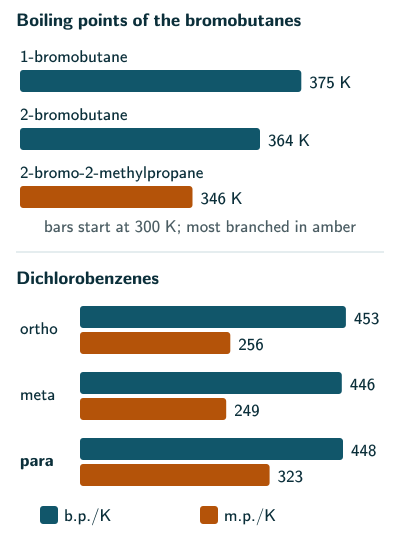
- Branching lowers the boiling point, as it does for the alkanes: among three of the C4H9Br isomers, 1-bromobutane boils at 375 K, 2-bromobutane at 364 K and 2-bromo-2-methylpropane at 346 K (NCERT page 168). A more branched molecule is more compact, with less surface for the molecules to attract one another (reasoned from NCERT Class 11 Chemistry, Unit 9).
- Dihalobenzenes. The three isomers boil at very nearly the same temperature, but the para isomer melts much higher, because its symmetry fits the crystal lattice better (NCERT page 168). For the dichlorobenzenes (NCERT page 169):
| Dichlorobenzene | b.p./K | m.p./K |
|---|---|---|
| ortho (1,2-) | 453 | 256 |
| meta (1,3-) | 446 | 249 |
| para (1,4-) | 448 | 323 |
Density
- Bromo, iodo and polychloro derivatives of hydrocarbons are heavier than water. NCERT adds that density increases with the number of carbon atoms, the number of halogen atoms and the atomic mass of the halogen (page 169); the first of these needs a correction.
- NCERT slip (page 169): NCERT says density increases with the number of carbon atoms. For haloalkanes with one halogen atom it is the other way round: as the alkyl group grows, the heavy halogen makes up a smaller share of the molecule, and the density falls (reasoned). Beyond the NCERT text: iodomethane has a density of 2.28 g/mL, against 1.747 for 1-iodopropane in NCERT’s own Table 6.3; bromoethane (1.46 g/mL) and 1-bromobutane (1.27 g/mL) sit either side of NCERT’s 1.335 for 1-bromopropane (US National Library of Medicine, Hazardous Substances Data Bank, via PubChem; at 20–25 °C). Density does rise with the number of halogen atoms and with the halogen’s atomic mass, as NCERT says. In an exam that quotes NCERT’s sentence, recognise it; when asked which of two haloalkanes with the same halogen is denser, choose the one with fewer carbon atoms.
- NCERT Table 6.3 (page 169), the density of some haloalkanes:
| Compound | Density (g/mL) |
|---|---|
| n-C3H7Cl | 0.89 |
| n-C3H7Br | 1.335 |
| n-C3H7I | 1.747 |
| CH2Cl2 | 1.336 |
| CHCl3 | 1.489 |
| CCl4 | 1.595 |
NCERT’s 1.335 for n-C3H7Br and 1.336 for CH2Cl2 differ slightly from the values in the same data bank (about 1.35 and 1.33 g/mL at 20 °C); neither changes an order on this page, and the examples use NCERT’s numbers.
- Read down the first three rows: the heavier the halogen, the denser the propyl halide. Read down the last three: each extra chlorine adds density. 1-Chloropropane, at 0.89 g/mL, is lighter than water and floats on it (reasoned from NCERT Table 6.3; water is about 1.0 g/mL).
Solubility
The haloalkanes are very slightly soluble in water (NCERT page 169). NCERT explains why with energy:
- To dissolve a haloalkane in water, energy is needed to overcome the attractions between haloalkane molecules and to break the hydrogen bonds between water molecules.
- Less energy is released when the new haloalkane–water attractions form, because these are weaker than the original hydrogen bonds in water. So solubility in water is low.
- In organic solvents the new attractions are of much the same strength as the ones broken in the separate haloalkane and solvent, so haloalkanes dissolve readily (NCERT page 169).
Solved examples
Example 1: Ordering boiling points
Arrange in order of increasing boiling point: (i) iodoethane, chloroethane, bromoethane; (ii) 1-chlorobutane, 2-chloro-2-methylpropane, 2-chlorobutane.
Answer: (i) Same alkyl group, so RI > RBr > RCl: chloroethane < bromoethane < iodoethane. (ii) Same formula, C4H9Cl, so branching decides: 2-chloro-2-methylpropane < 2-chlorobutane < 1-chlorobutane (reasoned from NCERT page 168).
Example 2: Mass and volume from density
Using NCERT Table 6.3, find (i) the mass of 25.0 mL of chloroform and (ii) the volume of 10.0 g of carbon tetrachloride.
Answer: (i) 25.0 mL × 1.489 g/mL = 37.2 g. (ii) 10.0 g ÷ 1.595 g/mL = 6.27 mL (NCERT page 169).
Example 3: Why para-dichlorobenzene melts high
By how much does the melting point of p-dichlorobenzene exceed that of the ortho isomer, and why, when their boiling points differ by only 5 K?
Answer: 323 − 256 = 67 K, against 453 − 448 = 5 K for the boiling points. Boiling depends on the forces between molecules in the liquid, which are similar; melting also depends on how well the molecules pack, and the symmetrical para molecules fit the crystal lattice better (NCERT pages 168–169).
Example 4: Water or hexane?
Will 1-bromopropane dissolve better in water or in hexane? Explain.
Answer: In hexane. In water, the weak haloalkane–water attractions cannot make up for the hydrogen bonds broken between water molecules; in an organic solvent the attractions made and broken are of much the same strength (NCERT page 169; hexane as the organic solvent is our example).
Common mistakes to avoid
Common mistake
Ranking haloalkane boiling points by dipole moment
CH3Cl has the largest dipole moment of the methyl halides (1.860 D) and CH3I the smallest (1.636 D) (NCERT Table 6.2, page 164), yet CH3I boils highest. Down the halogens, the growing van der Waals forces outweigh the dipole–dipole forces, so the order is RI > RBr > RCl > RF (NCERT page 168; reasoned).
Common mistake
Thinking branching raises the boiling point
It lowers it: 2-bromo-2-methylpropane (346 K) boils below 1-bromobutane (375 K).
Common mistake
Expecting a polar haloalkane to dissolve in water
Polarity is not enough: haloalkanes cannot replace the hydrogen bonds they break in water, so they are only very slightly soluble.
Common mistake
Saying every haloalkane is denser than water
Bromo, iodo and polychloro compounds are; a monochloroalkane such as 1-chloropropane (0.89 g/mL) is lighter than water.
Common mistake
Separating the dihalobenzenes by boiling point
Their boiling points are nearly the same; it is the melting point of the para isomer that stands out.
Quick revision summary
- Alkyl chlorides, bromides and iodides boil higher than hydrocarbons of comparable mass: polar molecules and greater mass give stronger dipole–dipole and van der Waals forces.
- For one alkyl group: RI > RBr > RCl > RF. Among isomers, more branching means a lower boiling point.
- Isomeric dihalobenzenes boil at nearly the same temperature; the para isomer melts highest (symmetry).
- Bromo, iodo and polychloro compounds are denser than water; density rises with the number of halogen atoms and the halogen’s mass, but falls as the alkyl group grows (NCERT slip, page 169).
- Very slightly soluble in water, soluble in organic solvents.
Formula sheet
- Boiling point: RI > RBr > RCl > RF (same R)
- CHBr b.p.: 375 K (1-bromo) > 364 K (2-bromo) > 346 K (2-bromo-2-methyl)
- Dichlorobenzene m.p.: para 323 K > ortho 256 K > meta 249 K
- Density: n-CHCl 0.89 < n-CHBr 1.335 < n-CHI 1.747 g/mL
- Density: CHCl 1.336 < CHCl 1.489 < CCl 1.595 g/mL
Questions students ask
Why do haloalkanes boil lower than alcohols of similar molecular mass?
Haloalkanes boil lower than alcohols of similar molecular mass because their molecules cannot hydrogen bond to one another: with no hydrogen on an oxygen, nitrogen or fluorine atom, they are held only by dipole–dipole and van der Waals forces (NCERT Unit 6, page 168), while alcohol molecules are also linked by O–H···O hydrogen bonds (NCERT Unit 7, page 203; alcohols and phenols). Beyond the NCERT text, 1-chloropropane (78.54 g mol) boils at about 320 K, but butan-1-ol, a little lighter at 74.12 g mol, at about 391 K (PubChem, Hazardous Substances Data Bank).
How do the physical properties of haloarenes such as chlorobenzene differ from those of haloalkanes?
Haloarenes show the same broad trends as haloalkanes: they boil above their parent hydrocarbons, are only slightly soluble in water and dissolve in organic solvents, as NCERT’s summary says of organohalogen compounds in general (page 189). Beyond the NCERT text, chlorobenzene boils at about 405 K against 353 K for benzene, dissolves only to about 0.5 g per litre of water at 25 °C but mixes with ethanol and ether, and has a density of 1.11 g/mL at 20 °C (PubChem, Hazardous Substances Data Bank). So, unlike 1-chloropropane in NCERT Table 6.3, chlorobenzene, with its single chlorine, is denser than water and sinks in it.
Are the physical properties of haloalkanes in the JEE Main 2027 and NEET (UG) 2026 syllabuses?
The physical properties of haloalkanes and haloarenes come under the word “properties” in Unit 16, Organic Compounds Containing Halogens, of both syllabuses: JEE Main 2027 lists “General methods of preparation, properties and reactions”, and NEET (UG) 2026 “General methods of preparation, properties, and reactions”. Neither names boiling points, density or solubility, so the detail to learn is NCERT Section 6.6 (pages 167–169): the boiling point orders, the high-melting para isomers, the densities in Table 6.3 and why haloalkanes barely dissolve in water.
Practice questions
Try each question first, then open the answer to check your working.
-
Q1. Why do alkyl chlorides, bromides and iodides have higher boiling points than hydrocarbons of comparable molecular mass?
Show answerHide answer
They are polar and heavier than the parent hydrocarbon, so the dipole–dipole and van der Waals attractions between their molecules are stronger (NCERT page 168).
-
Q2. Arrange CH3I, CH3Cl and CH3Br in order of decreasing boiling point.
Show answerHide answer
CH3I > CH3Br > CH3Cl: for one alkyl group, the larger and heavier the halogen, the stronger the van der Waals forces (NCERT page 168).
-
Q3. Which of n-C3H7Cl and CCl4 forms the lower layer when shaken with water, and which the upper?
Show answerHide answer
CCl4 (1.595 g/mL) is denser than water and sinks to the lower layer; n-C3H7Cl (0.89 g/mL) is lighter and floats as the upper layer (reasoned from NCERT Table 6.3, page 169).
-
Q4. Why are haloalkanes only very slightly soluble in water?
Show answerHide answer
Dissolving them needs energy to separate the haloalkane molecules and to break the hydrogen bonds between water molecules; the new haloalkane–water attractions are weaker than those hydrogen bonds, so less energy is released (NCERT page 169).