Polyhalogen compounds: uses and effects
NCERT Class 12 Chemistry Chapter 6 Section 6.8
Quick answer
Polyhalogen compounds contain more than one halogen atom: dichloromethane is a solvent and paint remover, chloroform a solvent used to make the refrigerant R-22, iodoform an old antiseptic that works through free iodine, and carbon tetrachloride a feedstock for refrigerants and propellants. Freons such as CClF are stable, non-toxic gases that reach the stratosphere and upset the ozone balance, and DDT, the first chlorinated organic insecticide, builds up in fatty tissue. Chloroform is stored in full, dark bottles because light and air turn it into poisonous phosgene.
With your textbook
NCERT Chemistry Part II (Class 12), Chapter 6 “Haloalkanes and Haloarenes”, Section 6.8 “Polyhalogen Compounds”, pages 187–188.
Open the official NCERT chapter (PDF, 4.3 MB, ncert.nic.in) (opens in a new tab)
Checked against the 2026-27 reprint on .
What are polyhalogen compounds?
Polyhalogen compounds
In NCERT’s words:
Carbon compounds containing more than one halogen atom are usually referred to as polyhalogen compounds.
NCERT Chemistry Part II (Class 12), Section 6.8, page 187
In plain words: once a carbon compound carries two, three or four halogen atoms, it often becomes a useful solvent, refrigerant, antiseptic or insecticide, but many of these compounds also harm people or the environment. NCERT describes six: dichloromethane, chloroform, iodoform, carbon tetrachloride, the freons and DDT. Many are useful in industry and agriculture (NCERT page 187).
Dichloromethane (methylene chloride)
- Uses. CH2Cl2 is widely used as a solvent: as a paint remover, as a propellant in aerosols, as a process solvent in making drugs, and as a metal cleaning and finishing solvent (NCERT page 187).
- Effects. It harms the human central nervous system. Low levels in air can slightly impair hearing and vision; higher levels cause dizziness, nausea, and tingling and numbness in the fingers and toes. On the skin it causes intense burning and mild redness, and in the eyes it can burn the cornea (NCERT page 187).
Trichloromethane (chloroform)
- Uses. CHCl3 is a solvent for fats, alkaloids, iodine and other substances. Its major use today is to make the freon refrigerant R-22. It was once a general anaesthetic in surgery but has been replaced by less toxic, safer anaesthetics, such as ether (NCERT page 187).
- Effects. Inhaling its vapour depresses the central nervous system. About 900 parts per million in air for a short time can cause dizziness, fatigue and headache. Chronic exposure may damage the liver, where chloroform is metabolised to phosgene, and the kidneys; some people develop sores when the skin is immersed in it (NCERT page 187).
- Storage. In light, air slowly oxidises chloroform to carbonyl chloride (phosgene), an extremely poisonous gas (NCERT page 187):
- 2CHCl3 + O2 → 2COCl2 + 2HCl (in light)
- So chloroform is kept in closed, dark coloured bottles, filled completely to keep air out (NCERT page 187).
Triiodomethane (iodoform)
- CHI3 was used earlier as an antiseptic, but its antiseptic action comes from the free iodine it liberates, not from iodoform itself (NCERT page 187).
- Because of its objectionable smell, it has been replaced by other formulations containing iodine (NCERT page 187).
Tetrachloromethane (carbon tetrachloride)
- Uses. CCl4 is made in large quantities to manufacture refrigerants and aerosol propellants, as feedstock for chlorofluorocarbons and other chemicals, for pharmaceutical manufacturing and as a general solvent. Until the mid-1960s it was a common cleaning fluid: a degreasing agent in industry, and a spot remover and fire extinguisher at home (NCERT page 187).
- Effects on health. There is some evidence that it causes liver cancer in humans. Its commonest effects are dizziness, light-headedness, nausea and vomiting, which can permanently damage nerve cells; in severe cases they lead rapidly to stupor, coma, unconsciousness or death. It can make the heart beat irregularly or stop, and may irritate the eyes (NCERT page 187).
- Effect on the ozone layer. Released into the air, CCl4 rises into the atmosphere and depletes the ozone layer. A thinner ozone layer is believed to increase exposure to ultraviolet rays, leading to more skin cancer, eye diseases and possible disruption of the immune system (NCERT pages 187–188).
Freons
- The chlorofluorocarbon compounds of methane and ethane are called freons. They are extremely stable, unreactive, non-toxic, non-corrosive and easily liquefied gases (NCERT page 188).
- Freon 12, CCl2F2, one of the commonest in industry, is made from tetrachloromethane by the Swarts reaction (NCERT page 188), the exchange of chlorine for fluorine with a metallic fluoride (NCERT Section 6.4.3, pages 165–166).
- Freons are made for aerosol propellants, refrigeration and air conditioning. By 1974 world production was about 2 billion pounds a year (NCERT page 188).
- The ozone problem. Most freon eventually escapes into the atmosphere and diffuses unchanged into the stratosphere, where it can start radical chain reactions that upset the natural ozone balance (NCERT page 188). How a chlorine atom from a CFC destroys ozone is outlined on protecting the environment; the ultraviolet rays that ozone absorbs are met in Physics.
p,p’-Dichlorodiphenyltrichloroethane (DDT)
- The first chlorinated organic insecticide. Paul Müller of Geigy, in Switzerland, found DDT’s effectiveness as an insecticide in 1939 and received the 1948 Nobel Prize in Physiology or Medicine for it. After the Second World War its use grew enormously, mainly against the mosquito that spreads malaria and the lice that carry typhus (NCERT page 188, which spells the name Muller and calls the prize the Nobel Prize in Medicine and Physiology).
- Problems. From the late 1940s many species of insects became resistant to DDT, and it proved highly toxic to fish. Its chemical stability and its solubility in fat made matters worse: animals do not metabolise it quickly but store it in fatty tissue, so with steady intake it builds up over time (NCERT page 188).
- It was banned in the United States but is still used in some other parts of the world (NCERT page 188).
- Structure. In DDT a CH group carries a CCl3 group and two benzene rings, each with Cl at the para position: (ClC6H4)2CH–CCl3, C14H9Cl5 (NCERT page 188, drawn in its box).
- NCERT slip (page 188): NCERT says DDT was “originally prepared in 1873”. Beyond the NCERT text: DDT was first synthesised in 1874, by the Austrian chemist Othmar Zeidler (Wikipedia, “DDT”). NCERT’s year for the US ban, 1973, needs a note too: the US Environmental Protection Agency says that “In 1972, EPA issued a cancellation order for DDT” (EPA, “DDT – A Brief History and Status”), and a US federal appeals court upheld the ban in 1973 (Wikipedia, “DDT”). So the ban order dates from 1972, and the court ruling from 1973. The chemistry is unaffected. In an NCERT-based question, give NCERT’s years (1873 and 1973) if they are asked for; elsewhere, use 1874 and 1972.
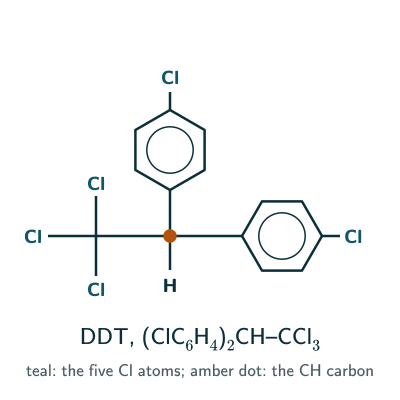
Uses and environmental effects
| Compound | Main uses (NCERT) | Main harm (NCERT) |
|---|---|---|
| CH2Cl2 | solvent, paint remover, aerosol propellant | central nervous system, skin, eyes |
| CHCl3 | solvent; making freon R-22 | nervous system, liver, kidneys; phosgene |
| CHI3 | old antiseptic | objectionable smell |
| CCl4 | making refrigerants and propellants (CFC feedstock); once a cleaning fluid | liver, nerves, heart; ozone layer |
| Freons | propellants, refrigeration, air conditioning | ozone layer |
| DDT | insecticide (malaria, typhus) | resistance, fish, builds up in fat |
Solved examples
Example 1: Phosgene from old chloroform
How much phosgene can at most form from 23.9 g of chloroform (119.4 g mol−1) left in light and air? (COCl2, 98.9 g mol−1.)
Answer: 23.9/119.4 = 0.200 mol CHCl3. From 2CHCl3 + O2 → 2COCl2 + 2HCl, one mole gives one mole of phosgene: 0.200 × 98.9 = 19.8 g (NCERT page 187; reasoned). This is why chloroform is stored in full, dark bottles.
Example 2: How much iodine is in iodoform?
Find the percentage of iodine by mass in iodoform, CHI3. (C = 12.0, H = 1.0, I = 126.9.)
Answer: M = 12.0 + 1.0 + 3 × 126.9 = 393.7 g mol−1; iodine: 380.7/393.7 × 100 = 96.7%. Nearly all of it is iodine, whose release explains the old antiseptic use (reasoned from NCERT page 187).
Example 3: Freon 12 by the Swarts reaction
Balance the Swarts reaction that turns CCl4 into freon 12 with SbF3, and find how many moles of SbF3 make 3.0 mol of CCl2F2.
Answer: 3CCl4 + 2SbF3 → 3CCl2F2 + 2SbCl3. Each CCl2F2 needs two F, and each SbF3 gives three, so 3.0 mol of freon 12 needs 2.0 mol of SbF3 (reasoned; NCERT names the Swarts reaction, page 188, and SbF3 among its fluorides, page 166).
Example 4: The chlorine in DDT
DDT is C14H9Cl5. What is its molar mass, and what fraction of it is chlorine? (C = 12.0, H = 1.0, Cl = 35.5.)
Answer: M = 14 × 12.0 + 9 × 1.0 + 5 × 35.5 = 168.0 + 9.0 + 177.5 = 354.5 g mol−1; chlorine 177.5/354.5 = 50.1%. A heavily chlorinated, stable molecule like this is not easily broken down, which is part of why it persists (reasoned from NCERT page 188).
Common mistakes to avoid
Common mistake
Storing chloroform in clear, half-filled bottles
Light and air turn it into phosgene; it is kept in closed, dark coloured bottles filled completely (NCERT page 187).
Common mistake
Calling iodoform itself the antiseptic
Its antiseptic action came from the free iodine it liberates, not from iodoform itself.
Common mistake
Calling freons toxic
Freons are non-toxic and unreactive near the ground; the harm is to the ozone layer, after they drift unchanged into the stratosphere.
Common mistake
Thinking DDT is broken down quickly
Animals do not metabolise it rapidly; it is stored in fatty tissue and builds up with steady intake.
Quick revision summary
- Polyhalogen compounds contain more than one halogen atom.
- CH2Cl2: solvent and paint remover; harms the nervous system, skin and eyes.
- CHCl3: solvent, makes R-22, once an anaesthetic; light and air turn it into phosgene, so it is stored in full, dark bottles.
- CHI3: old antiseptic, acting through free iodine; replaced because of its smell.
- CCl4: feedstock for refrigerants, propellants and other CFCs; once a cleaning fluid and fire extinguisher; liver and nerve damage; depletes the ozone layer.
- Freons (CFCs of methane and ethane): stable, non-toxic gases; freon 12 is CCl2F2, made by the Swarts reaction; they upset the ozone balance in the stratosphere.
- DDT: the first chlorinated organic insecticide; insects became resistant, it is toxic to fish and builds up in fat.
Formula sheet
- 2CHCl + O → 2COCl + 2HCl (light)
- Freon 12: CClF
- DDT: (ClCH)CH–CCl, CHCl
Questions students ask
Are chloroform and carbon tetrachloride still used today?
Chloroform and carbon tetrachloride are still made today, but mainly as raw materials for other chemicals: NCERT says chloroform’s major use now is making the refrigerant R-22 (page 187), and, beyond the NCERT text, R-22 is chlorodifluoromethane, CHClF2, made from chloroform and hydrogen fluoride with an antimony chloride catalyst and also used to make PTFE (Teflon) plastics (PubChem, Hazardous Substances Data Bank). Chloroform is also still used on a small scale as an extraction solvent. For carbon tetrachloride, the US EPA notes that in the United States consumer and fumigant uses have stopped and only industrial uses remain (via PubChem).
What replaced freons, and are the replacements safe for the ozone layer?
Beyond the NCERT text, freon 12 was replaced in refrigeration and air conditioning by the HFC R-134a, CH2FCF3, and CFCs in some uses by HCFCs such as R-22, CHClF2 (a freon in NCERT, page 187), which lasts about 12 years in air against 100 for freon 12 (US EPA; PubChem). HCFCs still contain chlorine and deplete ozone, though less (the EPA gives R-22 an ozone depletion potential of 0.055 against 1 for freon 12), and are being phased out under the Montreal Protocol. HFCs have no chlorine and spare the ozone layer but are potent greenhouse gases, which the Kigali Amendment of 2016 commits countries to cut by more than 80% over 30 years (US EPA).
What is the difference between DDT and BHC?
DDT and BHC differ in their rings: DDT, (ClC6H4)2CH–CCl3, keeps two aromatic benzene rings (NCERT page 188), while BHC, benzene hexachloride, C6H6Cl6, forms when three Cl2 molecules add to benzene in ultraviolet light, so its ring is no longer aromatic (addition to benzene; NCERT Class 11 Chemistry, Unit 9, page 324). Beyond the NCERT text, BHC is hexachlorocyclohexane, with one H and one Cl on each ring carbon, a mixture of stereoisomers whose γ isomer is the insecticide lindane (PubChem), so BHC, like DDT, is a chlorinated insecticide.
How is DDT made?
DDT is made, beyond the NCERT text, by condensing chlorobenzene with chloral, CCl3CHO, in the presence of sulphuric acid: two chlorobenzene rings join the CHO carbon, which becomes the CH of (ClC6H4)2CH–CCl3, and water is lost (PubChem, Hazardous Substances Data Bank). Each ring is attacked by electrophilic substitution, so the new bond goes mainly para to the chlorine, which is ortho and para directing (reasoned, NCERT page 184). Commercial DDT is about 77% p,p’-DDT, with about 15% of the o,p’ isomer (Wikipedia, “DDT”).
What is DDE, and how is it formed from DDT?
Beyond the NCERT text, DDE, dichlorodiphenyldichloroethylene, (ClC6H4)2C=CCl2, is a breakdown product of DDT with no use of its own (US Agency for Toxic Substances and Disease Registry). Its formula, C14H8Cl4, is DDT’s C14H9Cl5 less HCl (PubChem): the H of the central CH and a Cl of the CCl3 group next to it go, leaving a C=C bond, a β-elimination (reasoned from NCERT pages 179–180). DDE also persists, and it is blamed for the thin eggshells that cut the numbers of birds of prey (Wikipedia, “DDT”).
Are polyhalogen compounds in the JEE Main 2027 and NEET (UG) 2026 syllabuses?
Polyhalogen compounds are in both syllabuses, though not by that name: Unit 16, Organic Compounds Containing Halogens, of JEE Main 2027 ends “Uses, environmental effects of chloroform, iodoform, freons and DDT”, and that of NEET (UG) 2026 ends “Uses; Environmental effects of chloroform, iodoform freons, and DDT”. That names four of the six compounds of NCERT Section 6.8 (pages 187–188); dichloromethane and carbon tetrachloride are not named. Both syllabuses also list the preparation of iodoform among the organic compounds of Unit 20, Principles Related to Practical Chemistry.
Practice questions
Try each question first, then open the answer to check your working.
-
Q1. Why is chloroform stored in closed, dark coloured bottles filled to the top?
Show answerHide answer
In light, air slowly oxidises chloroform to phosgene, an extremely poisonous gas: 2CHCl3 + O2 → 2COCl2 + 2HCl. Dark glass keeps out light and filling the bottle keeps out air (NCERT page 187).
-
Q2. What are freons, and why do they harm the ozone layer even though they are unreactive?
Show answerHide answer
Chlorofluorocarbons of methane and ethane. Because they are so stable, they reach the stratosphere unchanged, where they start radical chain reactions that upset the ozone balance (NCERT page 188).
-
Q3. Give two reasons why the use of DDT became a problem.
Show answerHide answer
Any two of: many insects became resistant to it; it is highly toxic to fish; it is stable and fat-soluble, so animals store it in fatty tissue and it builds up over time (NCERT page 188).
-
Q4. Name the polyhalogen compound once used as a general anaesthetic, and one that was a household spot remover until the mid-1960s.
Show answerHide answer
Chloroform (CHCl3) was the anaesthetic; carbon tetrachloride (CCl4) was the spot remover (NCERT page 187).